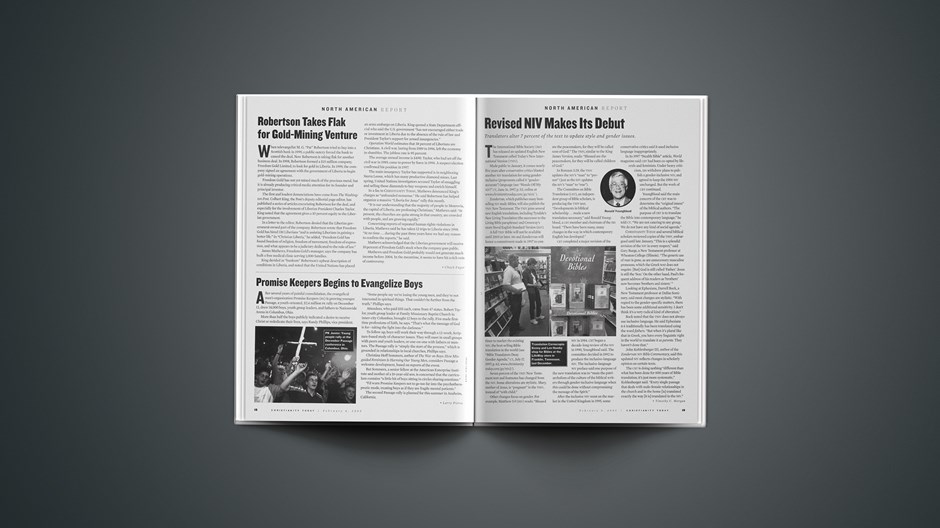
The International Bible Society (IBS) has released an updated English New Testament called Today's New International Version (TNIV).
Made public in January, it comes nearly five years after conservative critics blasted another NIV translation for using gender-inclusive (proponents called it "gender-accurate") language.
Zondervan, which publishes many best-selling NIV study Bibles, will also publish the TNIV New Testament. The TNIV joins several new English translations, including Tyndale's New Living Translation (the successor to the Living Bible paraphrase) and Crossway's more literal English Standard Version (ESV).
A full TNIV Bible will not be available until 2003 or later. IBS and Zondervan will honor a commitment made in 1997 to continue to market the existing NIV, the best-selling Bible translation in the world.
Seven percent of the TNIV New Testament text and footnotes has changed from the NIV. Some alterations are stylistic. Mary, mother of Jesus, is "pregnant" in the TNIV, instead of "with child."
Other changes focus on gender. For example, Matthew 5:9 (NIV) reads: "Blessed are the peacemakers, for they will be called sons of God." The TNIV, similar to the King James Version, reads: "Blessed are the peacemakers, for they will be called children of God."
In Romans 3:28, the TNIV updates the NIV's "man" to "person" (just as the ESV updates the RSV's "man" to "one").
The Committee on Bible Translation (CBT), an independent group of Bible scholars, is producing the TNIV text. "Developments in biblical scholarship … made a new translation necessary," said Ronald Youngblood, a CBT member and chairman of the IBS board. "There have been many, many changes in the way in which contemporary English has developed."
CBT completed a major revision of the NIV in 1984. CBT began a decade-long review of the NIV in 1990, Youngblood said. The committee decided in 1992 to produce the inclusive-language NIV. The inclusive-language NIV preface said one purpose of the new translation was to "mute the patriarchalism of the culture of the biblical writers through gender-inclusive language when this could be done without compromising the message of the Spirit."
After the inclusive NIV went on the market in the United Kingdom in 1995, some conservative critics said it used inclusive language inappropriately.
In its 1997 "Stealth Bible" article, World magazine said CBT had been co-opted by liberals and feminists. Under heavy criticism, IBS withdrew plans to publish a gender-inclusive NIV, and agreed to keep the 1984 NIV unchanged. But the work of CBT continued.
Youngblood said the main concern of the CBT was to determine the "original intent" of the biblical authors. "The purpose of CBT is to translate the Bible into contemporary language," he told CT. "We are not catering to any group. We do not have any kind of social agenda."
Christianity Today and several biblical scholars reviewed copies of the TNIV, embargoed until late January. "This is a splendid revision of the NIV in every respect," said Gary Burge, a New Testament professor at Wheaton College (Illinois). "The generic use of man is gone, as are unnecessary masculine pronouns, which the Greek text does not require. [But] God is still called 'Father.' Jesus is still the 'Son.' On the other hand, Paul's frequent address of his readers as 'brothers' now becomes 'brothers and sisters.'"
Looking at Ephesians, Darrell Bock, a New Testament professor at Dallas Seminary, said most changes are stylistic. "With regard to the gender-specific matters, there has been some additional sensitivity. I don't think it's a very radical kind of alteration."
Bock noted that the TNIV does not always use inclusive language. He said Ephesians 6:4 traditionally has been translated using the word fathers. "But when it's plural like that in Greek, you have every linguistic right in the world to translate it as parents. They haven't done that."
John Kohlenberger III, author of the Zondervan NIV Bible Commentary, said this updated NIV reflects changes in scholarly opinion on certain texts.
The CBT is doing nothing "different than what has been done for 600 years of Bible translation; it's just more systematic," Kohlenberger said. "Every single passage that deals with male-female relationships in the church and in the home [is] translated exactly the way [it is] translated in the NIV."
Previous Christianity Today articles on Bible translation include:
A Translation Fit For a KingIn the beginning, the King James Version was an attempt to thwart liberty. In the end, it promoted liberty. (Oct. 22, 2001)
The Reluctant RomansAt Douai in Flanders, Catholic scholars translated the Bible into English as an alternative to the Bible of "the heretics." (Oct. 22, 2001)
Old Wisdom for New TimesThe International Bible Society is doing "spiritual archaeology" and retro-publishing to reach seekers. (April 23, 2001)
And the Word Came with PicturesVisual Bible International (VBI), is producing a movie version of the Bible book for book, word for word. (March 1, 2001)
What Bible Version Did Jesus Read?What does the knowledge that Jesus used different versions of Scripture mean for us today? (April 26, 1999)
On the Shoulders of King JamesBarclay M. Newman has kept before him a question posed by the translators of the 1611 King James Version: "What can be more [important] than to deliver God's book unto God's people in a tongue which they understand?" (Oct. 27, 1997)
Confessions of a Bible TranslatorAs a stylist on a new translation of the Bible, Daniel worries over the effectiveness of the language into which the text is translated. (Oct. 27, 1997)
Have something to add about this? See something we missed? Share your feedback here.
Our digital archives are a work in progress. Let us know if corrections need to be made.

















 While we pray for peace, we need moral clarity about this war.
 We’ve got little information on Jesus’ appearance and personality. But that’s the way God designed it.españolFrançais
 The Grammy-winning artist was found dead at her home in Nashville at age 47.






