A harried team of TV executives, desperate to hold on to their market share, will consider almost anything. Pilot for a new series: Hero is a particle physicist turned Anglican priest. Fish out of water, you see—and remember, religion is hot. Science is sexy, too: Think Stephen Hawking without the wheelchair and squawk box. Rosy cheeks, a fringe of white hair, benevolent, quintessentially British.
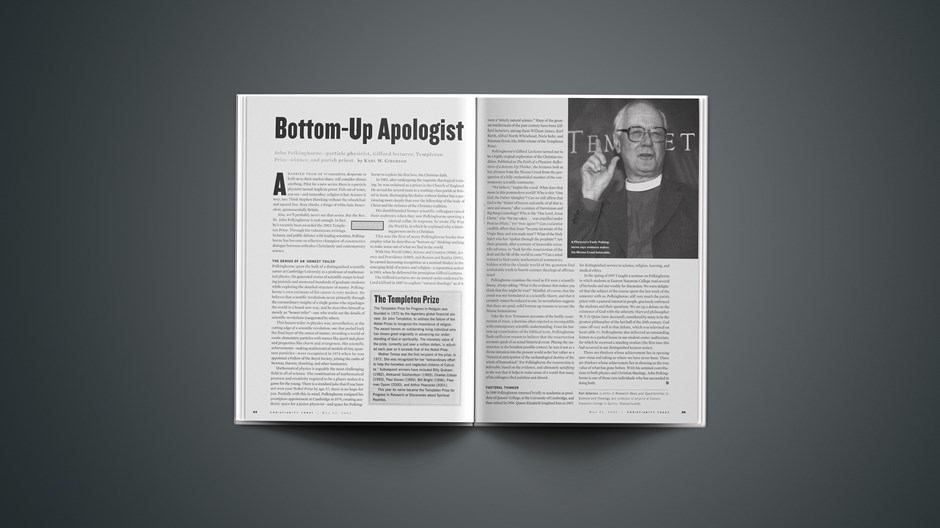
Alas, we'll probably never see that series. But the Rev. Dr. John Polkinghorne is real enough. In fact, he's recently been awarded the 2002 Templeton Prize. Through his voluminous writings, lectures, and public debates with leading scientists, Polkinghorne has become an effective champion of constructive dialogue between orthodox Christianity and contemporary science.
The Genius of an 'Honest Toiler'
Polkinghorne spent the bulk of a distinguished scientific career at Cambridge University as a professor of mathematical physics. He generated scores of scientific essays in leading journals and mentored hundreds of graduate students while exploring the detailed structure of matter. Polkinghorne's own estimate of his career is very modest. He believes that scientific revolutions occur primarily through the extraordinary insights of a single genius who repackages the world in a brand new way, and he describes himself as merely an "honest toiler"—one who works out the details of scientific revolutions inaugurated by others.
This honest toiler in physics was, nevertheless, at the cutting edge of a scientific revolution, one that peeled back the final layer of the onion of matter, revealing a world of exotic elementary particles with names like quark and gluon and properties like charm and strangeness. His scientific achievements—making mathematical models of tiny quantum particles—were recognized in 1974 when he was appointed a Fellow of the Royal Society, joining the ranks of Newton, Darwin, Hawking, and other luminaries.
Mathematical physics is arguably the most challenging field in all of science. The combination of mathematical prowess and creativity required to be a player makes it a game for the young. There is a standard joke that if you have not won your Nobel Prize by age 27, there is no hope for you. Partially with this in mind, Polkinghorne resigned his prestigious appointment at Cambridge in 1979, creating academic space for a junior physicist—and space for Polkinghorne to explore his first love, the Christian faith.
In 1982, after undergoing the requisite theological training, he was ordained as a priest in the Church of England. He served for several years in a working-class parish at Bristol in Kent, discharging his duties without fanfare but experiencing more deeply than ever the fellowship of the body of Christ and the richness of the Christian tradition.
His dumbfounded former scientific colleagues raised their eyebrows when they saw Polkinghorne sporting a clerical collar. In response, he wrote The Way the World Is, in which he explained why a thinking person can be a Christian.
This was the first of many Polkinghorne books that employ what he describes as "bottom-up" thinking: seeking to make sense out of what we find in the world.
With One World (1986), Science and Creation (1988), Science and Providence (1989), and Reason and Reality (1991), he earned increasing recognition as a seminal thinker in the emerging field of science and religion—a reputation sealed in 1993, when he delivered the prestigious Gifford Lectures.
The Gifford Lectures are an annual series endowed by Lord Gifford in 1887 to explore "natural theology" as if it were a "strictly natural science." Many of the greatest intellectuals of the past century have been Gifford lecturers, among them William James, Karl Barth, Alfred North Whitehead, Niels Bohr, and Freeman Dyson (the 2000 winner of the Templeton Prize).
Polkinghorne's Gifford Lectures turned out to be a highly original exploration of the Christian tradition. Published as The Faith of a Physicist: Reflections of a Bottom-Up Thinker, the lectures look at key phrases from the Nicene Creed from the perspective of a fully credentialed member of the contemporary scientific community.
"We believe," begins the creed. What does that mean in this postmodern world? Who is this "One God, the Father Almighty"? Can we still affirm that God is the "Maker of heaven and earth, of all that is, seen and unseen," after a century of Darwinism and Big Bang Cosmology? Who is the "One Lord, Jesus Christ," who "for our sakes … was crucified under Pontius Pilate," yet "rose again"? Can a scientist credibly affirm that Jesus "became incarnate of the Virgin Mary and was made man"? What of the Holy Spirit who has "spoken through the prophets"? Are there grounds, after a century of inexorable scientific advance, to "look for the resurrection of the dead and the life of the world to come"? Can a mind trained to find exotic mathematical symmetries hidden within the cloudy world of the quantum find unshakable truth in fourth-century theological affirmations?
Article continues below
Polkinghorne examines the creed as if it were a scientific theory, always asking, "What is the evidence that makes you think that this might be true?" Mindful, of course, that the creed was not formulated as a scientific theory, and that it certainly cannot be reduced to one, he nevertheless suggests that there are good, solid bottom-up reasons to accept the Nicene formulations.
Take the New Testament accounts of the bodily resurrection of Jesus, a doctrine often rejected as incompatible with contemporary scientific understanding. From his bottom-up examination of the biblical texts, Polkinghorne finds sufficient reason to believe that the resurrection accounts speak of an actual historical event. Placing the resurrection in the broadest possible context, he sees it not as a divine intrusion into the present world order but rather as a "historical anticipation of the eschatological destiny of the whole of humankind." For Polkinghorne the resurrection is believable, based on the evidence, and ultimately satisfying in the way that it helps to make sense of a world that many of his colleagues find pointless and absurd.
Pastoral Thinker
In 1989 Polkinghorne returned briefly to academia as president of Queens' College, at the University of Cambridge, and then retired in 1996. Queen Elizabeth knighted him in 1997, for distinguished service to science, religion, learning, and medical ethics.
In the spring of 1997 I taught a seminar on Polkinghorne in which students at Eastern Nazarene College read several of his books and met weekly for discussion. We were delighted that the subject of the course spent the last week of the semester with us. Polkinghorne, still very much the parish priest with a pastoral interest in people, graciously embraced the students and their questions. We set up a debate on the existence of God with the atheistic Harvard philosopher W. V. O. Quine (now deceased), considered by many to be the greatest philosopher of the last half of the 20th century. God came off very well in that debate, which was televised on local cable tv. Polkinghorne also delivered an outstanding lecture to a packed house in our student center auditorium, for which he received a standing ovation (the first time this had occurred in our distinguished lecturer series).
There are thinkers whose achievement lies in opening new vistas and taking us where we have never been. There are thinkers whose achievement lies in showing us the true value of what has gone before. With his seminal contributions to both physics and Christian theology, John Polkinghorne is one of those rare individuals who has succeeded in doing both.
Article continues below
Karl Giberson is editor of Research News and Opportunities in Science and Theology and professor of physics at Eastern Nazarene College in Quincy, Massachusetts.
The Templeton Prize
The Templeton Prize for Progress in Religion was founded in 1972 by the legendary global financial pioneer, Sir John Templeton, to address the failure of the Nobel Prizes to recognize the importance of religion. The award honors an outstanding living individual who has shown great originality in advancing our understanding of God or spirituality. The monetary value of the prize, currently just over a million dollars, is adjusted each year so it exceeds that of the Nobel Prize.
Mother Teresa was the first recipient of the prize, in 1972. She was recognized for her "extraordinary effort to help the homeless and neglected children of Calcutta." Subsequent winners have included Billy Graham (1982), Aleksandr Solzhenitsyn (1983), Charles Colson (1993), Paul Davies (1995), Bill Bright (1996), Freeman Dyson (2000), and Arthur Peacocke (2001).
This year its name became the Templeton Prize for Progress in Research or Discoveries about Spiritual Realities.
In May 1998, John Polkinghorne visited Eastern Nazarene College, where he was interviewed by professors Karl Giberson and Donald Yerxa and ENC's president, Kent Hill for Christianity Today sister publication Books & Culture.















 While we pray for peace, we need moral clarity about this war.
 We’ve got little information on Jesus’ appearance and personality. But that’s the way God designed it.españolFrançais
 Christian artists work at the intersection of music and climate change.






