Who Was Jesus?
A Jewish-Christian Dialogue
Paul Copan and Craig Evans, editors
Westminster John Knox, 205 pages, $24.95
Hidden Gospels:
How the Search for Jesus Lost Its Way
Philip Jenkins
Oxford University Press, 260 pages, $25
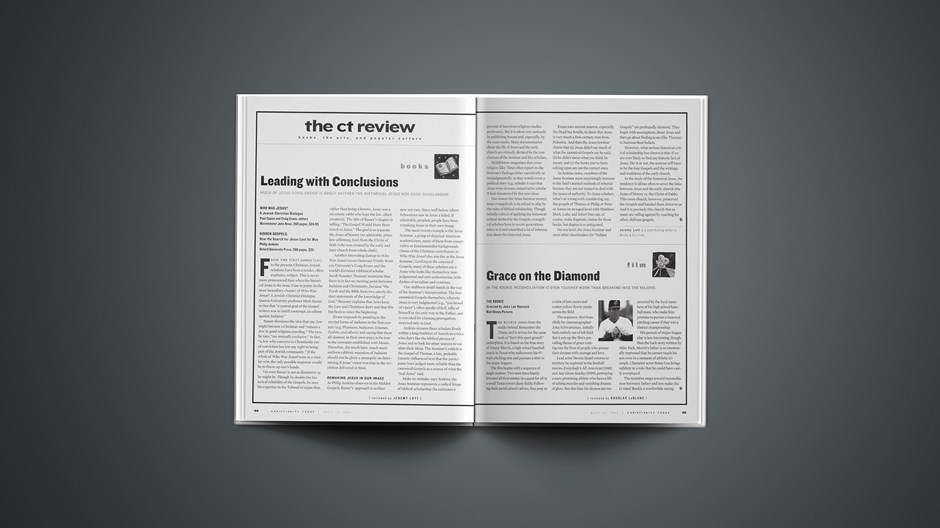
From the first century (A.D.) to the present, Christian-Jewish relations have been a tender, often explosive, subject. This is never more pronounced than when the historical Jesus is the issue. Case in point: In the most incendiary chapter of Who Was Jesus?: A Jewish-Christian Dialogue, Queens University professor Herb Basser writes that "a central goal of the Gospel writers was to instill contempt, an odium against Judaism."
Basser dismisses the idea that any Jew might become a Christian and "remain a Jew in good religious standing." The two, he says, "are mutually exclusive." In fact, "a Jew who converts to Christianity out of conviction has lost any right in being part of the Jewish community." If the whole of Who Was Jesus? were in a similar vein, the only possible response would be to throw up one's hands.
Yet even Basser is not as dismissive as he might be. Though he doubts the historical reliability of the Gospels, he uses his expertise in the Talmud to argue that, rather than being a heretic, Jesus was a messianic rabbi who kept the law, albeit creatively. The title of Basser's chapter is telling: "The Gospel Would Have Been Greek to Jesus." The goal is to separate the Jesus of history (an admirable, pious, law-affirming Jew) from the Christ of faith (who was created by the early and later church from whole cloth).
Another interesting dustup in Who Was Jesus? occurs between Trinity Western University's Craig Evans and the world's foremost rabbinical scholar, Jacob Neusner. Neusner maintains that there is in fact no meeting point between Judaism and Christianity, because "the Torah and the Bible form two utterly distinct statements of the knowledge of God." Neusner explains that Jews keep the Law and Christians don't and that this has been so since the beginning.
Evans responds by pointing to the myriad forms of Judaism in the first century (e.g. Pharisees, Saducees, Essenes, Zealots, and others) and saying that these all claimed, in their own ways, to be true to the covenant established with Moses. Therefore, the much later, much more uniform rabbinic mutation of Judaism should not be given a monopoly on determining if Jesus' vision was true to the revelation delivered at Sinai.
Remaking Jesus in Our Image
As Philip Jenkins observes in his Hidden Gospels, Basser's approach is neither new nor rare. Since well before Albert Schweitzer saw in Jesus a failed, if admirable, prophet, people have been remaking Jesus in their own image.
The most recent example is the Jesus Seminar, a group of skeptical American academicians, many of them from conservative or fundamentalist backgrounds. (Some of the Christian contributors to Who Was Jesus? also aim fire at the Jesus Seminar.) Looking at the canonical Gospels, many of these scholars see a Jesus who looks like themselves: nonjudgmental and anti-authoritarian, with dashes of socialism and cynicism.
One stubborn detail stands in the way of the Seminar's interpretation: The four canonical Gospels themselves, wherein Jesus is very judgmental (e.g., "you brood of vipers"), often speaks of hell, talks of himself as the only way to the Father, and is executed for claiming prerogatives reserved only to God.
Jenkins situates these scholars firmly within a long tradition of American critics who don't like the biblical picture of Jesus and so look for other sources to validate their ideas. The Seminar's vehicle is the Gospel of Thomas, a late, probably Gnostic-influenced text that the participants have judged more reliable than the canonical Gospels as a source of what the "real Jesus" said.
Make no mistake, says Jenkins, the Jesus Seminar represents a radical fringe of biblical scholarship (he estimates 6 percent of American religious studies professors). But it is taken very seriously by publishing houses and, especially, by the mass media. Many documentaries about the life of Jesus and the early church are virtually dictated by the conclusions of the Seminar and like scholars.
Middlebrow magazines that cover religion (like Time) often report on the Seminar's findings either uncritically or nonjudgmentally, as they would cover a political story (e.g., scholar A says that Jesus wore dresses; conservative scholar B feels threatened by this new idea).
One reason the Jesus Seminar annoys some evangelicals is its refusal to play by the rules of biblical scholarship. Though initially critical of applying the historical-critical method to the Gospels, evangelical scholars have in recent generations taken to it and unearthed a lot of information about the historical Jesus.
Evans uses ancient sources, especially the Dead Sea Scrolls, to show that Jesus is very much a first-century man from Palestine. And then the Jesus Seminar claims that (a) Jesus didn't say much of what the canonical Gospels say he said, (b) he didn't mean what you think he meant, and (c) the books you've been relying upon are not the correct ones.
Article continues below
As Jenkins notes, members of the Jesus Seminar seem surprisingly immune to the field's normal methods of rebuttal because they are not trained to deal with the issues of authority. To Jesus scholars, what's so wrong with considering, say, the gospels of Thomas or Philip or Peter or James on an equal level with Matthew, Mark, Luke, and John? One can, of course, make dogmatic claims for those books, but dogma is so antiquated.
On one level, the Jesus Seminar and most other cheerleaders for "hidden Gospels" are profoundly ahistoric. They begin with assumptions about Jesus and then go about finding texts (like Thomas) to buttress their beliefs.
However, what serious historical-critical scholarship has shown is this: If we are ever likely to find any historic fact of Jesus, like it or not, the sources will have to be the four Gospels and the writings and traditions of the early church.
In the study of the historical Jesus, the tendency is all too often to sever the links between Jesus and the early church (the Jesus of history vs. the Christ of Faith). This same church, however, preserved the Gospels and handed them down to us. And it is precisely this church that so many are railing against by reaching for other, dubious gospels.
Jeremy Lott is a contributing editor to Books & Culture.
Related previous Christianity Today articles include:
Who Killed Jesus?After centuries of censure, Jews have been relieved of general responsibility for the death of Jesus. Now who gets the blame? (August 24, 2000)
Reconstructing JesusThe rewards of N. T. Wright's historical recovery of Jesus are great—but he raises more questions than he answers. (August 27, 1998)
Doubting Thomas's Gospel |"Jesus said, 'Damn the Pharisees, for they are like a dog sleeping in the cattle manger, for it neither eats nor [lets] the cattle eat.' —Gospel of Thomas. (June 15, 1998)















 While we pray for peace, we need moral clarity about this war.
 A Christian reconciliation group in Israel and Palestine warned that war would come. Now the war threatens their relevance.العربيةFrançais
 Eastern Orthodox poet Scott Cairns reflects on his new collection, his journey of faith, and poetry’s capacity to apprehend inexhaustible realities.






