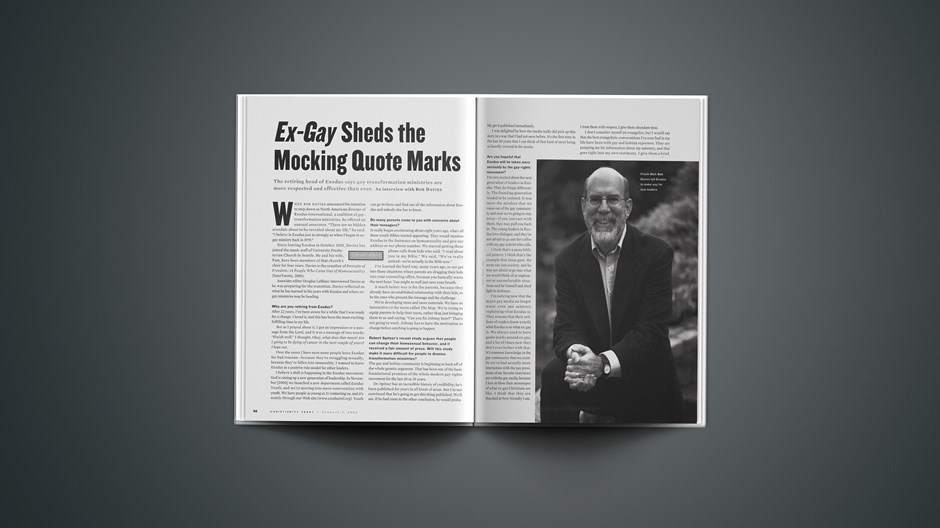
When Bob Davies announced his intention to step down as North American director of Exodus International, a coalition of gay-transformation ministries, he offered an unusual assurance. "There are no hidden scandals about to be revealed about my life," he said. "I believe in Exodus just as strongly as when I began in ex-gay ministry back in 1979."
Since leaving Exodus in October 2001, Davies has joined the music staff of University Presbyterian Church in Seattle. He and his wife, Pam, have been members of that church's choir for four years. Davies is the coauthor of Portraits of Freedom: 14 People Who Came Out of Homosexuality (InterVarsity, 2001).
Associate editor Douglas LeBlanc interviewed Davies as he was preparing for the transition. Davies reflected on what he has learned in his years with Exodus and where ex-gay ministries may be heading.
Why are you retiring from Exodus?
After 22 years, I've been aware for a while that I was ready for a change. I loved it, and this has been the most exciting, fulfilling time in my life.
But as I prayed about it, I got an impression or a message from the Lord, and it was a message of two words: "Finish well." I thought, Okay, what does that mean? Am I going to be dying of cancer in the next couple of years? I hope not.
Over the years I have seen some people leave Exodus for bad reasons—because they're struggling sexually, because they've fallen into immorality. I wanted to leave Exodus as a positive role model for other leaders.
I believe a shift is happening in the Exodus movement: God is raising up a new generation of leadership. In November [2000] we launched a new department called Exodus Youth, and we're moving into more intervention with youth. We have people as young as 11 contacting us, and it's mainly through our Web site (www.exodus.to). Youth can go in there and find out all the information about Exodus and nobody else has to know.
Do many parents come to you with concerns about their teenagers?
It really began accelerating about eight years ago, when all these youth Bibles started appearing. They would mention Exodus in the footnotes on homosexuality and give our address or our phone number. We started getting these phone calls from kids who said, "I read about you in my Bible." We said, "We've really arrived—we're actually in the Bible now."
I've learned the hard way, many years ago, to not get into those situations where parents are dragging their kids into your counseling office, because you basically waste the next hour. You might as well just save your breath.
A much better way is for the parents, because they already have an established relationship with their kids, to be the ones who present the message and the challenge.
We're developing more and more materials. We have an interactive cd for teens called The Map. We're trying to equip parents to help their teens, rather than just bringing them to us and saying, "Can you fix Johnny here?" That's not going to work. Johnny has to have the motivation to change before anything is going to happen.
Robert Spitzer's recent study argues that people can change their homosexual behavior, and it received a fair amount of press. Will this study make it more difficult for people to dismiss transformation ministries?
The gay and lesbian community is beginning to back off of the whole genetic argument. That has been one of the basic foundational premises of the whole modern gay-rights movement for the last 20 or 25 years.
Dr. Spitzer has an incredible history of credibility; he's been published for years in all kinds of areas. But I'm not convinced that he's going to get this thing published. We'll see. If he had come to the other conclusion, he would probably get it published immediately.
I was delighted by how the media really did pick up this story in a way that I had not seen before. It's the first time in the last 20 years that I can think of that kind of story being so heavily covered in the media.
Are you hopeful that Exodus will be taken more seriously by the gay-rights movement?
I'm very excited about the next generation of leaders in Exodus. They do things differently. The founding generation tended to be isolated. It was more the mindset that we came out of the gay community and now we're going to stay away—if you interact with them, they may pull you back in. The young leaders in Exodus love dialogue, and they're not afraid to go out for coffee with any gay activist who calls.
I think that's a more biblical pattern. I think that's the example that Jesus gave. He went out into society, and he was not afraid to go into what we would think of as unpleasant or uncomfortable situations and be himself and shed light in darkness.
I'm noticing now that the major gay media no longer waste even one sentence explaining what Exodus is. They assume that their millions of readers know exactly what Exodus is or what ex-gay is. We always used to have quote marks around ex-gay, and a lot of times now they don't even bother with that. It's common knowledge in the gay community that we exist. So we've had actually more interaction with the gay press. Some of my favorite interviews are with the gay media, because I love to blow their stereotypes of what ex-gay Christians are like. I think that they are shocked at how friendly I am. I treat them with respect, I give them abundant time.
Article continues below
I don't consider myself an evangelist, but I would say that the best evangelistic conversations I've ever had in my life have been with gay and lesbian reporters. They are pumping me for information about my ministry, and that goes right into my own testimony. I give them a brief, seeker-friendly perspective on my worldview. The bigger perspective is that God created me and he wants a personal relationship with me. He loves me. That's what motivates me to come out of homosexuality, because I want to live a life that's going to please him. And I just give them a little bit of the gospel.
I've had gay reporters say, "Nobody has ever told me this before. I have never had anyone explain it to me this clearly before." And that to me is a real victory.
A friend recently talked about a sociologist who does a pop quiz, asking ex-gays in an audience whether their arousal patterns or fantasy lives have changed. Apparently the answer is almost invariably no. Does this sound overly tidy?
I think sometimes we have overstated our defense. We know behind closed doors that change is possible, but change is rarely complete. I know many men who are totally transformed compared to 20 years ago, but that doesn't mean that they never have a thought or a memory or a temptation or a struggle. It means that the struggle has diminished significantly. That doesn't mean they haven't changed; it just means that for all of us, redemption is still incomplete. We're all still in process as believers. And we may never cross that finish line of total victory until we see Christ face to face. And that's true for any Christian.
Sometimes in Exodus we have been too silent about our ongoing struggles. As soon as we admit in the face of gay activists that we have any kind of residual struggles, they say, "Aha! See, you haven't changed, you're just a bunch of phonies and if you would really be honest with us, you'd admit that you're just the same person you always were but you're faking it."
I know many people in Exodus who are living very happy and fulfilled heterosexual married lives, or who are single. A lot of them are raising kids. They are living the abundant life that Christ promised them, and they could not be happier.
Article continues below
Exodus is getting older as a movement. Back in the early days we could say, "Yeah, I've been out of homosexuality for 18 months."
"Okay," critics would respond, "but you may fall off the wagon any day now."
But now I know people who have been out of this for 45 years. I don't think they're going to fall off the wagon tomorrow. I think they're probably going to be happily married until they die.
Do you think some of the most visible falls have resulted from the pressure of being a leader?
Definitely. Somewhere between 5 and 20 percent of ministries have been dissolved because the leader went back into active homosexuality. That's over our 25-year history. Quite a bit of that happened in the first five years of Exodus, when we were a young movement.
People were promoted far too quickly. We had people on national television shows, in books, and in magazine articles. Some of them had been believers for a very short time and they could not handle that pressure. They did not know the reality of spiritual warfare. And they just bombed.
But as we've matured, we've prohibited that from happening. Groups can't even get into Exodus as an official member until they've been in existence as a ministry for two years.
Some people still contact us and say, "I came out of homosexuality last month; I want to start a ministry." We say, "Great, but we're not going to promote you; we're not going to let anybody know you're there until you've been around awhile. You need to be grounded, you need to be trained, and you need to grow as a Christian."
Have evangelical churches grown in love for people who struggle with homosexuality?
They're getting better. I received a call from the senior pastor of a fairly sizable church. He is ex-gay, but nobody knows except his wife. He's been out of it for 20 years; he's been married for 18 and has two teenage daughters. He had never heard of Exodus before, until he read about us in his local newspaper. There are all kinds of these people out there. They are not about to tell anybody what God has redeemed them from.
That's a frustration to me, because they're some of the most solid stories of transformation that I've ever heard. But there's a perceived risk that if they are open about their Christian testimony—this is so ironic—they're afraid that they'll be out of a job, or they'll be stigmatized, or they'll lose important relationships in the church.
So I wish that all of those people would have the freedom to be open about their background. It would become such common knowledge in Christianity that people would take it for granted that people can get out of this. They would all know somebody, or two or three people. They would say, "Oh yeah, I used to be in that, but God took me out of that" and it would not be that big a deal. That's the day I pray for.
A ready-to-download Bible Study on this article is available at ChristianBibleStudies.com. These unique Bible studies use articles from current issues of Christianity Today to prompt thought-provoking discussions in adult Sunday school classes or small groups.
Last year, the director of the British ex-gay organization Courage renounced his earlier efforts, saying Exodus's mission doesn't work.
Earlier Christianity Today articles about compassion for homosexuals include:
Walking in the TruthWinning arguments at church conventions is not enough without compassion for homosexuals. (Sept. 4, 2000)
Building a BridgeA gay journalist and evangelical pastor correct their mutual misperceptions. (July 13, 2000)
The Jerry We Never KnewHe hangs out with liberal pundits and gay activists. Is this the same Jerry Falwell who founded the Moral Majority? (May 2, 2000)
Sex and SaintsA new vocabulary for an oversexualized culture. (Apr. 3, 2000)
Who Killed Matthew Shepard?Human nature being what it is, we can too easily cross the line between hating the sin and hating the sinner. (Dec. 7, 1998)
Revelation and Homosexual ExperienceCan it be said of us that we surprise others by the sympathy and compassion we extend toward homosexuals? (Nov. 11, 1996)
















 While we pray for peace, we need moral clarity about this war.
 As my doubts about his teachings grew, so did a secret fascination with Jesus.
 After lobbying from fellow Southern Baptists and Christians affected by the war, the House speaker moves a package forward.






