The vocabulary of academic freedom (or at least the vocabulary of its pious champions) is a sham and a cheat," postmodern icon Stanley Fish famously claims in his 1999 book, The Trouble With Principle. This is especially true, he says, in regards to religion. "As instances of a favored category—expression—religious utterances are cherished; as something you are asked to take seriously, they are feared and condemned."
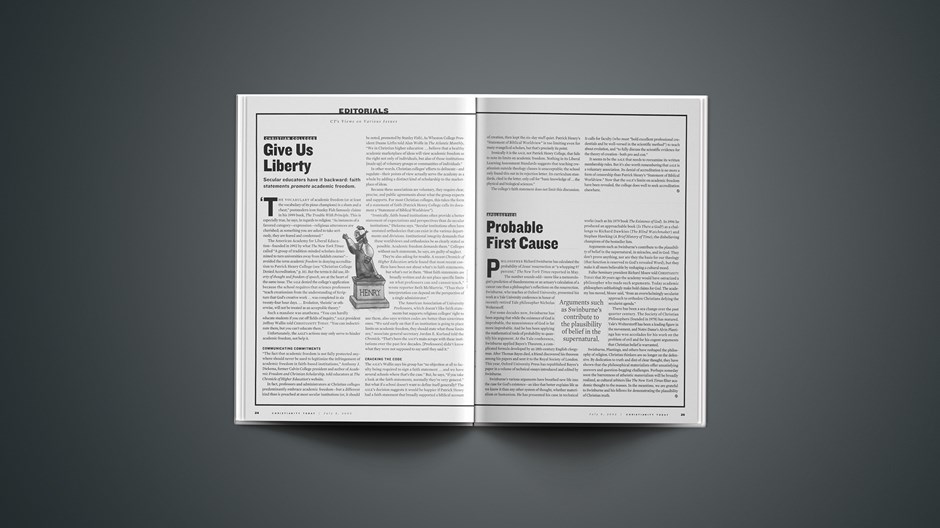
The American Academy for Liberal Education—founded in 1992 by what The New York Times called "A group of tradition-minded scholars determined to turn universities away from faddish courses"— avoided the term academic freedom in denying accreditation to Patrick Henry College (see "Christian College Denied Accreditation," p. 16). But the terms it did use, liberty of thought and freedom of speech, are at the heart of the same issue. The AALE denied the college's application because the school requires that science professors "teach creationism from the understanding of Scripture that God's creative wor … was completed in six twenty-four hour days . …Evolution, 'theistic' or otherwise, will not be treated as an acceptable theory."
Such a mandate was anathema. "You can hardly educate students if you cut off fields of inquiry," AALE president Jeffrey Wallin told Christianity Today. "You can indoctrinate them, but you can't educate them."
Unfortunately, the AALE's actions may only serve to hinder academic freedom, not help it.
Communicating Commitments
"The fact that academic freedom is not fully protected anywhere should never be used to legitimize the infringement of academic freedom in faith-based institutions," Anthony J. Diekema, former Calvin College president and author of Academic Freedom and Christian Scholarship, told educators at The Chronicle of Higher Education's website.
In fact, professors and administrators at Christian colleges predominantly embrace academic freedom—but a different kind than is preached at most secular institutions (or, it should be noted, promoted by Stanley Fish). As Wheaton College President Duane Litfin told Alan Wolfe in The Atlantic Monthly, "We in Christian higher education … believe that a healthy academic marketplace of ideas will view academic freedom as the right not only of individuals, but also of those institutions [made up] of voluntary groups or communities of individuals."
In other words, Christian colleges' efforts to delineate—and regulate—their points of view actually serve the academy as a whole by adding a distinct kind of scholarship to the marketplace of ideas.
Because these associations are voluntary, they require clear, precise, and public agreements about what the group expects and supports. For most Christian colleges, this takes the form of a statement of faith (Patrick Henry College calls its document a "Statement of Biblical Worldview").
"Ironically, faith-based institutions often provide a better statement of expectations and perspectives than do secular institutions," Diekema says. "Secular institutions often have unstated orthodoxies that can exist in the various departments and divisions. Institutional integrity demands that these worldviews and orthodoxies be as clearly stated as possible. Academic freedom demands them." Colleges without such statements, he says, are guilty of neglect.
They're also asking for trouble. A recent Chronicle of Higher Education article found that most recent conflicts have been not about what's in faith statements, but what's not in them. "Most faith statements are broadly written and do not place specific limits on what professors can and cannot teach," wrote reporter Beth McMurtrie. "Thus their interpretation can depend on the perspective of a single administrator."
The American Association of University Professors, which doesn't like faith statements but supports religious colleges' right to use them, also says written codes are better than unwritten ones. "We said early on that if an institution is going to place limits on academic freedom, they should state what those limits are," associate general secretary Jordan E. Kurland told the Chronicle. "That's been the AAUP's main scrape with these institutions over the past few decades. [Professors] didn't know what they were not supposed to say until they said it."
Cracking the Code
The AALE's Wallin says his group has "no objection at all to faculty being required to sign a faith statement … and we have several schools where that's the case." But, he says, "if you take a look at the faith statements, normally they're very general." But what if a school doesn't want to define itself generally? The AALE's decision suggests it would be happier if Patrick Henry had a faith statement that broadly supported a biblical account of creation, then kept the six-day stuff quiet. Patrick Henry's "Statement of Biblical Worldview" is too limiting even for many evangelical scholars, but that's precisely its point.
Ironically it is the AALE, not Patrick Henry College, that fails to note its limits on academic freedom. Nothing in its Liberal Learning Assessment Standards suggests that teaching creationism outside theology classes is unacceptable; the school only found this out in its rejection letter. Its curriculum standards, cited in the letter, only call for "basic knowledge of … the physical and biological sciences."
Article continues below
The college's faith statement does not limit this discussion. It calls for faculty (who must "hold excellent professional credentials and be well-versed in the scientific method") to teach about evolution, and "to fully discuss the scientific evidence for the theory of creation—both pro and con."
It seems to be the AALE that needs to reexamine its written membership rules. But it's also worth remembering that AALE is a voluntary association. Its denial of accreditation is no more a form of censorship than Patrick Henry's "Statement of Biblical Worldview." Now that the AALE's limits on academic freedom have been revealed, the college does well to seek accreditation elsewhere.















 While we pray for peace, we need moral clarity about this war.
 As my doubts about his teachings grew, so did a secret fascination with Jesus.
 Christians can disciple each other toward action, prayer, and hope.






