North American Christianity, like so much of U.S. culture, is caught up in a competitive marketplace. Seminaries supply many of the leaders and entrepreneurs in the religious marketplace, along with the competing theologies that are their stock in trade. Such seminary competition leads to the congregational, denominational, and theological "market share" of tomorrow.
In the past generation, evangelicalism has grown at the expense of the old mainline. But how did this theological competition play out on the ground—and specifically on seminary campuses?
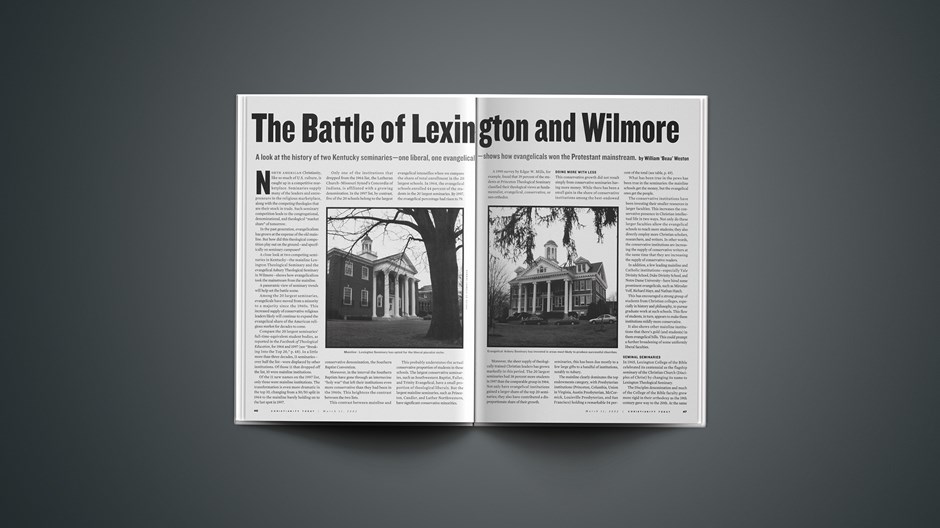
A close look at two competing seminaries in Kentucky—the mainline Lexington Theological Seminary and the evangelical Asbury Theological Seminary in Wilmore—shows how evangelicalism took the mainstream from the mainline.
A panoramic view of seminary trends will help set the battle scene.
Among the 20 largest seminaries, evangelicals have moved from a minority to a majority since the 1960s. This increased supply of conservative religious leaders likely will continue to expand the evangelical share of the American religious market for decades to come.
Compare the 20 largest seminaries' full-time-equivalent student bodies, as reported in the Factbook of Theological Education, for 1964 and 1997 (see "Breaking Into the Top 20," p. 48). In a little more than three decades, 11 seminaries—over half the list—were displaced by other institutions. Of those 11 that dropped off the list, 10 were mainline institutions.
Of the 11 new names on the 1997 list, only three were mainline institutions. The transformation is even more dramatic in the top 10, changing from a 50/50 split in 1964 to the mainline barely holding on to the last spot in 1997.
Only one of the institutions that dropped from the 1964 list, the Lutheran Church-Missouri Synod's Concordia of Indiana, is affiliated with a growing denomination. In the 1997 list, by contrast, five of the 20 schools belong to the largest conservative denomination, the Southern Baptist Convention.
Moreover, in the interval the Southern Baptists have gone through an internecine "holy war" that left their institutions even more conservative than they had been in the 1960s. This heightens the contrast between the two lists.
This contrast between mainline and evangelical intensifies when we compare the share of total enrollment in the 20 largest schools. In 1964, the evangelical schools enrolled 44 percent of the students in the 20 largest seminaries. By 1997, the evangelical percentage had risen to 79.
This probably understates the actual conservative proportion of students in these schools. The largest conservative seminaries, such as Southwestern Baptist, Fuller, and Trinity Evangelical, have a small proportion of theological liberals. But the largest mainline seminaries, such as Princeton, Candler, and Luther Northwestern, have significant conservative minorities.
A 1990 survey by Edgar W. Mills, for example, found that 39 percent of the students at Princeton Theological Seminary classified their theological views as fundamentalist, evangelical, conservative, or neo-orthodox.
Moreover, the sheer supply of theologically trained Christian leaders has grown markedly in this period. The 20 largest seminaries had 38 percent more students in 1997 than the comparable group in 1964. Not only have evangelical institutions gained a larger share of the top 20 seminaries; they also have contributed a disproportionate share of their growth.
Doing More with Less
This conservative growth did not result simply from conservative seminaries having more money. While there has been a small gain in the share of conservative institutions among the best-endowed seminaries, this has been due mostly to a few large gifts to a handful of institutions, notably to Asbury.
The mainline clearly dominates the top endowments category, with Presbyterian institutions (Princeton, Columbia, Union in Virginia, Austin Presbyterian, McCormick, Louisville Presbyterian, and San Francisco) holding a remarkable 54 percent of the total (see "Endowments to the Top 20," p. 49).
What has been true in the pews has been true in the seminaries: the mainline schools get the money, but the evangelical ones get the people.
The conservative institutions have been investing their smaller resources in larger faculties. This increases the conservative presence in Christian intellectual life in two ways. Not only do these larger faculties allow the evangelical schools to reach more students; they also directly employ more Christian scholars, researchers, and writers. In other words, the conservative institutions are increasing the supply of conservative writers at the same time that they are increasing the supply of conservative readers.
In addition, a few leading mainline and Catholic institutions—especially Yale Divinity School, Duke Divinity School, and Notre Dame University—have hired some prominent evangelicals, such as Miroslav Volf, Richard Hays, and Nathan Hatch.
This has encouraged a strong group of students from Christian colleges, especially in history and philosophy, to pursue graduate work at such schools. This flow of students, in turn, appears to make these institutions mildly more conservative.
Article continues below
It also shows other mainline institutions that there's gold (and students) in them evangelical hills. This could prompt a further broadening of some uniformly liberal faculties.
Seminal Seminaries
In 1965, Lexington College of the Bible celebrated its centennial as the flagship seminary of the Christian Church (Disciples of Christ) by changing its name to Lexington Theological Seminary.
The Disciples denomination and much of the College of the Bible faculty grew more rigid in their orthodoxy as the 19th century gave way to the 20th. At the same time, a competing group in the school wanted to upgrade the prestige and the academic credentials of the faculty. Some of the new faculty members were, in keeping with the general trend of the academy, religious liberals.
The inevitable conflict came to a head in 1917. The heterodox views of one of these new faculty members led more conservative Disciples to demand a trial. The liberals argued that a heresy trial was "un-Disciples" since the movement had been founded on a creed of having no creeds. Faced with these choices, the administration blinked, and there was no trial.
As a result, the liberals stayed, the conservatives left to create Cincinnati Bible College, and the seminary became increasingly academic, respectable, and liberal, in a genteel southern way. In 1965 the events of 1917 still lived in school lore as the turning point that made Lexington what it was meant to be.
The neo-orthodox theological consensus of the 1960s gave way to process theology, feminist theology, liberation theology, and finally to theological pluralism. In the late 1980s, an eloquent new dean, Michael Kinnamon, made a strong case for an activist ecumenical theology for the school and the denomination. In Kinnamon's subsequent bid for the highest elective office in the Disciples of Christ, he ran aground over opposition to his support for homosexual ordination and stepped down as dean in 1998.
Since then, the ruling sentiment of the seminary has turned toward the center under the leadership of chastened liberals.
Asbury Theological Seminary trekked through a similar theological gauntlet, but with a different result. Asbury had been created in 1929 to preserve the Wesleyan Holiness tradition, which had come on hard times in the increasingly liberal Methodist Church. As in Lexington, tension grew between hardening theological orthodoxy and developing academic respectability.
Article continues below
Things came to a head in 1957, when younger, more conservative faculty ousted an older teacher they found too heterodox on theodicy (vindication of God's goodness in the face of evil). This led to Asbury losing its accreditation.
The shock of that loss led to a movement in the opposite direction. While Asbury has never been liberal, it became more open to a broader range of religious expressions—but within a clearly conservative doctrinal standard. The seminary also formally acknowledged secular standards of academic freedom and eventually regained its accreditation.
Today, Asbury has an endowment five and a half times larger than Lexington's. Asbury has invested in a faculty that is four times larger than Lexington's. The real competition, though, is for students. In 1964, Asbury had twice as many students as Lexington. Since then, Asbury has grown steadily, while Lexington's student body has fluctuated dramatically. Today Asbury Theological Seminary has 11 times as many students as does Lexington Theological Seminary.
Differing Priorities
The way the two schools have allocated faculty reveals the different approaches they have taken to mission and competition. The two elements church-seekers say they most value are good preaching and good music. In the past generation, Lexington Seminary has eliminated its preaching (homiletics) and church music departments.
Growing churches also tend to emphasize what works now and are less driven by their denomination's history. Lexington has, in the face of financial constraints, maintained a strong history department.
Lexington has made a big investment in an ecumenical theology position. In theory, this was an excellent direction for a seminary of its kind to take: In the 1980s the seminary dropped the requirement that faculty be Protestant and added programs in Roman Catholic studies, a Jewish lectureship, and an Islamic center. Ecumenical theology seemed to be just the thing to revitalize its historic mission.
In practice, though, ecumenical theology has been too ecumenical to appeal to ordinary Disciples and too theological to appeal to ordinary laity of any stripe. And it has been too liberal and socially activist to appeal to the ordinary seekers drawn to independent Christian megachurches, which cut their ties to the Disciples a generation ago.
The attempt to make ecumenical theology the new identity of Lexington Seminary was so costly to the school's competitive position that it took something akin to a coup to redirect the seminary back toward the center.
Article continues below
Meanwhile, Asbury Seminary's faculty has more than doubled since 1965. Much of the growth came from the expansion of the core academic areas of Bible and theology.
Most growth, however, has come through the two new schools in evangelism and mission, on the one hand, and preaching and church leadership on the other. In other words, Asbury has made its signature investments in the very areas most likely to produce successful competitors at home and abroad.
Asbury has also pushed to produce pastors for the United Methodist Church. In the past, Asbury was content with an outsider role with the United Methodist Church, advocating traditional Wesleyan Holiness as Methodists grew increasingly liberal. The current president, Maxie Dunnam, by contrast, is an insider: formerly a successful United Methodist pastor, editor of The Upper Room devotional publication, and an active member of the Confessing Movement, which advocates renewal within the United Methodist Church. (Full disclosure: He also is a former senior editor of Christianity Today.)
United Methodist bishops used to distrust Asbury graduates as disloyal dissenters; now they favor them as reliable pastors who really want to be in the local church. The leading feeder schools used to be small conservative Wesleyan colleges; now Asbury gets more students from large state universities because it has produced a generation of Wesley Foundation directors at these universities.
Asbury has been criticized for leaving its Wesleyan Holiness roots. Some think that Asbury has moved too far into the evangelical mainstream, comparing itself to Fuller, Trinity Evangelical, Gordon-Conwell, and other more Reformed or Calvinist schools. Others think that Asbury has moved too far toward the Methodist mainstream, a sentiment that led some former Asbury faculty in the late 1960s to help create Wesley Biblical Seminary in Jackson, Mississippi.
Regarding the first accusation, Asbury officials point out that the seminary has invested heavily in becoming the world center for Wesleyan Holiness scholarship. As for the second criticism, Provost Robert Mullholand notes that "if we lose some to the left and some to the right, we must be doing something right."
The Surrounding Turf
Looking at the two seminaries' relation to the largest church in the region, the 5,000-plus-member Southland Christian Church, provides one final comparison. Southland descends from the same Restorationist root that produced the Disciples of Christ, and as recently as the early 1970s was counted in the same Christian Church. Lexington would be the natural seminary source for this suburban Lexington congregation.
Article continues below
Southland, however, had always been in the more traditional end of the Disciples of Christ, and had closer ties to Lexington Seminary's conservative rival, Cincinnati Bible College. Southland has become even more evangelical in recent years, and has experienced striking growth. At the same time, Southland's connections with Asbury have grown, despite roots in quite different traditions. The music minister and one of the counseling ministers are Asbury graduates, other staff members have taken courses at Asbury, and the senior minister, Mike Breaux, has taught in Asbury's programs for pastors.
Today, no member of the extensive Southland staff has a tie to Lexington Theological Seminary.
In truth, the battle of Lexington and Wilmore is not much of a battle at all. Lexington has opted for the liberal pluralist niche that used to lead the American religious establishment, but in the past generation has been in decline. Asbury has opted for the orthodox evangelical niche that is creating the new Protestant mainstream.
They compete for different sectors of the seminary population, with little overlap. More importantly, they supply new competitors to the American religious market. In this generation, the competition in the bluegrass—as in the nation—has decidedly gone the evangelical way.
William "Beau" Weston is author of Presbyterian Pluralism: Competition in a Protestant House, and teaches sociology at Centre College in Danville, Kentucky. The Louisville Institute provided the funds for his research.
Article continues below
Breaking Into the Top 20
In 33 years, the proportion of students enrolled in evangelical seminaries among the top 20 divinity schools grew from 44 to 79 percent.
Evangelical institutions shown in bold.
1964
Southwestern Baptist1,036 Southern Baptist860 Concordia (Missouri)672
Union (New York) 617 Southeastern Baptist555
Princeton 506
Yale 481
Candler (Emory) 470
Luther Northwestern 446 New Orleans Baptist442
Lutheran (Chicago) 392
Garrett-Evangelical 388
Drew University 365 Concordia (Indiana)354
Boston University 348
Andover Newton 336
Perkins (S. Methodist U.) 328
Colgate Rochester 323 Trinity Evangelical310
Lutheran (Philadelphia) 303
1997
Southwestern Baptist2,190 Fuller1,780 Trinity Evangelical974 Dallas898 Southern Baptist851 Southeastern Baptist762 Asbury748 New Orleans Baptist738
Princeton 630
Candler (Emory) 601 Reformed587
Luther Northwestern 576 Golden Gate Baptist556 Bethel484 Gordon-Conwell484 Concordia (Missouri)483
Duke University 483
Harvard University 470
Ontario 457 Ashland426
Endowments to the Top 20 (1997)
Mainline seminaries still draw greater funding than evangelical schools.
Princeton
Candler (Emory)
Columbia Asbury Fuller
Union (Virginia) Southern Baptist
Virginia (Episcopal)
Yale
Austin Presbyterian
McCormick
Christian
Louisville Presbyterian
Union (New York)
Brite (Texas Christian U.)
San Francisco
General (Episcopal)
Luther Northwestern
U. of the South (Episcopal)
Colgate Rochester
Christianity Today International's Seminary and Grad School Guide features schools, posts insightful advice columns and has allows viewers to search by region for semanaries.
Have something to add about this? See something we missed? Share your feedback here.
Our digital archives are a work in progress. Let us know if corrections need to be made.















 While we pray for peace, we need moral clarity about this war.
 A Christian reconciliation group in Israel and Palestine warned that war would come. Now the war threatens their relevance.españolالعربيةFrançais
 After lobbying from fellow Southern Baptists and Christians affected by the war, the House speaker moves a package forward.






