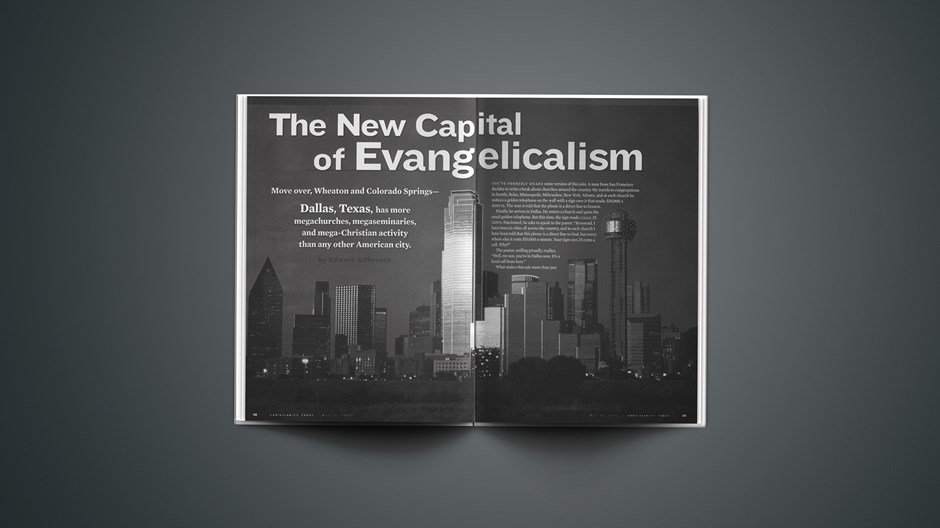
"Move over, Wheaton and Colorado Springs—Dallas, Texas, has more megachurches, megaseminaries, and mega-Christian activity than any other American city."
You've probably heard some version of this joke. A man from San Francisco decides to write a book about churches around the country. He travels to congregations in Seattle, Boise, Minneapolis, Milwaukee, New York, Atlanta, and at each church he notices a golden telephone on the wall with a sign over it that reads: $10,000 A MINUTE. The man is told that the phone is a direct line to heaven.
Finally, he arrives in Dallas. He enters a church and spots the usual golden telephone. But this time, the sign reads: CALLS: 25 CENTS. Fascinated, he asks to speak to the pastor. "Reverend, I have been in cities all across the country, and in each church I have been told that this phone is a direct line to God, but everywhere else it costs $10,000 a minute. Your sign says 25 cents a call. Why?"
The pastor, smiling proudly, replies, "Well, my son, you're in Dallas now. It's a local call from here."
What makes this tale more than just an amusing example of "Don't Mess with Texas" bravado is the nagging suspicion that, in Dallas, it could very well be true.
Judging from the unusually large number of churches, seminaries, and parachurch organizations here, one gets the impression that God has some special arrangement with the city—the kind Disney has with Orlando, or that movie stars have with Beverly Hills. The ubiquity of Christian institutions is astounding.
And these aren't your average-size churches, seminaries, and parachurch organizations either. In the great Texas tradition, they are big—really big—in both membership and clout.
For instance, travel downtown and you'll find First Baptist of Dallas, believed by some observers to be the nation's first modern megachurch. Under the leadership of the late W. A. Criswell, from 1944 to 1991 the church attracted prominent community leaders, implemented dozens of innovative programs, and eventually swelled to 28,000 members—the largest in the United States at the time. Though considerably smaller than in its heyday, today's First Baptist still claims 10,000 people on its rolls and 5,000 active members. And the church's facilities dominate an entire city block, not including the massive seven-level parking garage across the street.
Around the corner is the 4,000-member First United Methodist. A few blocks east there's Our Lady of Guadalupe Cathedral, which draws more than 11,000 Hispanic worshipers to its weekend Masses. Cruise northward and you'll find an assortment of large upper-middle-class congregations: Park Cities Baptist, Highland Park Presbyterian, Lovers Lane United Methodist, St. Michael and All Angels Episcopal, and several others. Most of the churches boast active memberships of 2,000 or more, and many of them are among the largest in their respective denominations. Go farther north to the wealthy suburb of Plano and you'll hit Prestonwood Baptist, a 20,000-member congregation that is one of the largest in the Southern Baptist Convention (SBC). Housed in a cavernous, ultramodern structure on a 140-acre campus, the church is led by Jack Graham, the man widely expected to be the SBC's next president.
On the southern edge of the city is a collection of mostly African American megachurches—including Tony Evans's Oak Cliff Bible Fellowship, E. K. Bailey's Concord Missionary Baptist, and the newest and biggest of them all, T. D. Jakes's Potter's House, which draws 23,000 each Sunday.
There are numerous other churches and religious bodies that stand out for one noteworthy characteristic or another: Covenant Church in nearby Carrollton is a 10,000-member charismatic congregation that is regularly lauded as the most racially diverse church in the Dallas area. Iglesia Evangélica Bethania (Bethany Evangelical Church) in Farmers Branch comprises 20 Latino nationalities and is one of the fastest-growing Hispanic congregations in the area. Temple Emanu-El in North Dallas is one of the largest synagogues in the nation. Then there's Cathedral of Hope, a 3,600-member congregation that, despite its decidedly evangelical flavor, bills itself as the world's largest gay church.
"There's a dramatic religious variety here. It's really unlike any other place in the country," says Darrell L. Bock, professor of spiritual development and culture at Dallas Theological Seminary (DTS). "You've got a microcosm of evangelicalism here in a lot of ways—the big megachurches, the average-size churches. But whereas most communities have one or two places like that, Dallas has tons."
Dallas's religious colleges and universities are almost as numerous as its churches. DTS is probably the most famous of the cluster of schools in the area. Renowned for its commitment to dispensational theology, the nondenominational DTS has trained countless thousands of students for ministry since its founding in 1924. Criswell College, organized in 1970 by First Baptist, has also prepared churchloads of fundamentalist preachers and missionaries. Dallas Baptist University, a 4,300-student school that serves both conservative and moderate factions of the SBC, is revered locally for its huge adult-degree program. Christ for the Nations Institute is a huge missionary school with a charismatic emphasis. In Fort Worth, 40 miles west of Dallas, there's Southwestern Baptist Theological Seminary, which is both the SBC's and the world's largest seminary.
Article continues below
And conservative evangelicals are not the only Christians taking up educational real estate. Southern Methodist University, which is home to the Perkins School of Theology (a bastion of moderate and liberal Christianity), is a prominent presence. The University of Dallas announces itself as "The Catholic University for Independent Thinkers." And Texas Christian University in Forth Worth is a 6,000-student school affiliated with the Christian Church (Disciples of Christ).
Add to this the scores of parachurch and broadcast ministries—in addition to Evans and Jakes, Chuck Swindoll, James Robison, and June Hunt also operate nationally known ministries out of Dallas—and you have a place that cranks out religion like Silicon Valley does microchips.
"There's a smorgasbord of religious options here," says Michael Williams, dean of the College of Humanities and Social Sciences at Dallas Baptist University. "I think people who are natives of this area don't recognize how different this is compared with other places in the U.S."
Dallas, it has been said, is located in "the buckle of the Bible belt." From its earliest days in the 1840s, when the first Anglo pioneers rolled into the region from places like the Carolinas, Tennessee, and Kentucky, the city has been defined by the Christian heritage of its residents.
'The Big D'
Texas as a whole has traditionally been dominated by at least four types of Christians—Methodists, Baptists, Catholics, and Churches of Christ. The names of the local hospitals, parks, and schools across the region bear witness to their enduring legacy. Still, in a state bursting with religious activity, Dallas sticks out.
Religious heritage accounts for some of Dallas's spiritual vibrancy, but the size and volume of religion here is also rooted in the ethos of the town. Consider this: According to some reports, Dallas has more churches per capita than any other city in the United States, but it also has more shopping malls.
Progress and expansion rule the day here. Along with their faith, Dallas's early settlers brought entrepreneurial passion and a knack for commerce—natural results of their adventurous "seize the frontier" mentality.
"It goes back to why Dallas exists as a city," says Carol Childress, information broker for Leadership Network, a Dallas-based church consulting organization. "There's no reason it should exist in and of itself. It's not near a major river. It's not a major port town. It wasn't on a major railroad line. But it was carved out of the prairie because of the vision and zeal of the people who settled it. They came and created a city where, by all logic of how great cities are established, there should not be one."
Article continues below
Today, Dallas is a bustling metropolis of 1.2 million. Throw in the Metroplex—the burgeoning northeast Texas region that encompasses Dallas, Fort Worth, Arlington, and more than 80 other surrounding communities—and that figure jumps to 5.2 million.
Those who have es of congested highways and jam-packed with both shiny glass office buildings and been to Dallas recently know that it is not an easy place to navigate. It is a sprawling medley of city and suburb connected by tentaclgeneric strip malls. In other words, it looks like every other big American city.
But for better or worse, Dallas—a.k.a. "The Big D"—has a reputation for doing things bigger, better, and more visibly than any other city. It can be seen in the architecture of houses, churches, and skyscrapers; in the wheeling and dealing of the pro sports teams; in the growth of Dallas/Fort Worth International Airport (the nation's third busiest); in the dominance of the region's technology sector (second in the U.S. only to Silicon Valley in its large concentration of high-tech firms); and, of course, in the pervasiveness of religious faith.
"I think of Dallas as a city of glitz and glitter, and nickels and noses," says Timothy George, dean of Beeson Divinity School in Birmingham and a leading voice in the SBC. "It has a cowboy-like spirit of what I would call rugged individualism and naïve optimism. For those reasons, none of which are particularly spiritual, I think it tends to be a magnet for a lot of evangelical ministries."
William Abraham, professor of Wesley studies at the Perkins School of Theology and one of a growing number of evangelicals at the school, remembers coming to Dallas in the mid-1980s. "When I first came here," says the native of Ireland, "I decided that everything had to be divided into two to get reality, because things were always talked about in larger-than-life terms. There is a cultural spirit here that says, 'We will dream bigger dreams than anyone else can dream, and if there's a problem we can fix it.' And you can see it in the churches, as well as in the larger culture. It's quite refreshing."
Article continues below
Abraham points out, for example, that mainline denominations like the United Methodist Church are on the decline in other parts of the country. But not in the Lone Star State. "Once the leadership in Texas realized the downward trend, they set about the process of expanding the church's evangelistic efforts, which are now bearing enormous fruit in Texas churches," he says. "The mainline is not supposed to have megachurches, but I go to Highland Park United Methodist, which has 12,000 members." He grins at the irony.
Dallas-area religion also benefits from the deep reservoirs of both old and new money coursing through the community's economic veins. Long before technology became a player, Dallas was renowned as a center of big banking and oil, and legendary capitalists like H. L. Hunt and Mary Kay Ash poured their wealth into local churches. Today, rich and powerful Dallasites like Norm Miller of Interstate Batteries and businessman Bob Buford, founder of the Leadership Network, are well known for their commitments to Christ. And several of the city's largest churches are in the midst of multimillion-dollar expansions. Indeed, many churches in Dallas appear to observe just two seasons: summer and building campaign.
"There's a great deal of wealth in this city, and that wealth tends to be centered in people who have religious commitments on one level or another," says Jim Dennison, senior pastor of Park Cities Baptist Church. "I don't know if there is a larger percentage of giving in Dallas than you'd find someplace else, but there is a great deal more resource from which that percentage is drawn."
In addition to the growth of existing churches, a number of itinerant ministers have found Dallas to be fertile soil for growing big churches from scratch. Just ask T. D. Jakes and Chuck Swindoll, two high-profile preachers who planted "instant" megachurches. "I think there's a demographic shift going on that explains some of the activity," says Dallas Baptist University's Michael Williams. "The proximity of the DFW Airport and a couple of major Interstate arteries make Dallas an important location in terms of commerce, and an outgrowth of that is the relocation of a lot of businesses—and people—to this area in the last 30 years. That's been a real benefit to the churches."
Finally, the presence of prominent seminaries like DTS and Southwestern, as well as nationally recognized churches like First Baptist of Dallas, have no doubt contributed to the qualitative and quantitative expansion of ministries and churches in the area. If part of the evangelical mission is multiplication, then Dallas Christianity has proven itself brilliantly efficient at doing the math.
Article continues below
A Baptist Battleground
You really can't talk about big Christianity in Dallas without looking at the crucial role of First Baptist and W. A. Criswell. During Criswell's 47 years as senior pastor, business leaders, politicians, and sports celebrities sat in pews alongside the everyday folk of the city to hear the preacher. They were attracted, observers say, by Criswell's fiery, old-time religion style and his passionate commitment to the Bible as the Word of God.
Criswell, who died in January at age 92, came to symbolize both the genius and folly of evangelicalism in Dallas, in the Southern Baptist Convention, and, ultimately, in the nation. His 17-year, verse-by-verse journey through the Bible brought him wide acclaim as a champion of expository preaching. But then there were his early outcries against Catholicism and racial integration (for which he later apologized) and the abrupt resignation of his successor Joel Gregory in 1992. (Gregory, only 20 months into his tenure, left First Baptist in a huff after Criswell refused to relinquish his hold on the church.)
But those incidents did not diminish Criswell's legend. He is remembered as a megachurch pioneer. He grew his Southern Baptist congregation to unprecedented numbers and strategically launched ministry after ministry to meet the needs of his congregants and the Dallas community. Under his direction, First Baptist started counseling programs, a Christian school, several mission churches, a 500-bed homeless shelter, an extensive prison ministry, a crisis pregnancy center, a radio station—and the list goes on.
"This church has had a tremendous impact on Christianity in the last century—a lot of megachurches probably took off from [Criswell's] model," says Mac Brunson, First Baptist's senior pastor since 1999. "Dr. Criswell knew that the way to build a church was through Sunday school, so he brought in a minister for each age group and each area of need. No one had really done that before him."
But he is also seen as the patriarch of the conservative movement that has taken over today's Southern Baptist Convention, says Barry Hankins, a professor of history and church-state studies at Baylor University in Waco.
Article continues below
"Criswell was a fundamentalist who was very concerned about liberalism creeping into the Southern Baptist Convention," says Hankins. "He inspired a new generation of Baptist conservatives, and consequently First Baptist has come to epitomize the conservative right wing of Southern Baptist life."
Today, the national battle raging between moderate and conservative Baptists is bloodiest in Texas, which is home to about 2.7 million Southern Baptists—nearly a fifth of all SBC members. And a number of key leaders from both sides of the chasm reside in Dallas. "There are a great deal of issues here, and they are nowhere near being resolved," says Jim Dennison, a moderate.
Brunson, a conservative, concurs: "It's rough in Texas among Baptists. It's mean and it's ugly and it's vindictive. In fact, I think the healthiest thing that could happen right now is for there just to be a separation and to be done with it. Let them do kingdom business their way, and we'll do kingdom business our way."
Brunson's remarks sound harsh, but he says them with humility. The reality is that Brunson and Dennison are actually great friends, despite their differing views on Baptist politics. They speak at each other's churches, do joint mission ventures, and meet often to discuss family and ministry issues. And the same is true for other Dallas clergy on opposite ends of the SBC conflict.
Says Dennison, "Within the state itself, and especially within Dallas, there have been wonderful personal relationships between Baptist clergy, despite our institutional conflicts. They know that I believe every word in the Bible is the Word of God. And I know that they love the Lord. We just agree to disagree about some issues."
Not surprisingly, denominational battles have played out in other large churches in Dallas. The most recent example was the 1991 church split at Highland Park Presbyterian (a PCUSA church) that begat Park Cities Presbyterian (now a PCA congregation). It was a devastating event at the time, but today leaders from the two congregations find ways to work together when they can.
This cordial spirit, in the midst of denominational hell-raising, seems to be the Dallas way.
'A Stealth Capital'
It is the best and worst of times in Dallas these days. At least that's the Dickensian perspective of several of the city's church leaders. They expressed excitement, for instance, about how churches are working together to prepare for Billy Graham's visit to the city in October.
But they also registered concerns about the pervasiveness of cultural Christianity and the town's lingering racial problems.
Article continues below
"We have such a strong mixture of conservatives and moderates and liberals all surviving in one city," says Sheron Patterson, senior pastor of St. Paul United Methodist Church in downtown Dallas. "It shows that we have a lot of tolerance and that there's room for different understandings of Christianity. But the fact that the races have not come together in a remarkable way through this Christianity shows that the problem of racial division still looms large."
"I think Dallas is the New Jerusalem," says pastor Mac Brunson with a hearty laugh. "I know this sounds prejudiced, but I believe we really know how to do church down here. We're giving more to missions. We've got some of the strongest biblical pulpits in the nation. I think Dallas's contribution is inestimable."
Jim Dennison, however, sees the glass as being more on the half-empty side: "There are reasons to be excited about what God's doing in Dallas, and there are reasons to be really frustrated about the spiritual climate here as well," he says.
What troubles Dennison is the surging category of Dallasites he calls "ignostics."
"In Dallas, if you're not a Jew, Muslim, Hindu, or Buddhist, you must be a Christian," he says. "Nearly everybody has a membership in a church someplace. They go on Easter and Christmas. They assume they are Christians because they're good people. They are ignorant—not agnostic as much as ignostic—as to what it is to really be a Christian. I think that's primarily because there is so much religiosity in this city."
Timothy George, who has observed Dallas from a distance, wonders whether the city's emphasis on size has contributed to this religiosity. "The phenomenon among Dallas Christians of expansion is positive in that it does enable the church to reach more people with the gospel, and you'd have to be a real cynic to be a naysayer against that," he says. "But when you're dealing with such bigness, you have to ask if it's really the gospel you're reaching people with, or is there a kind of subtle subversion of the gospel by the very phenomenon of success and bigness?"
Leadership Network's Carol Childress, a longtime Dallas resident, has tracked her city's cultural shifts. "As the city has grown and the population changed, Dallas has not been immune to the normal pressures of growth and changing cultural values that are common to cities around the country," she says. "We are a city full of churches, but are they alive and dynamic and filled with growing disciples?"
Article continues below
These, it seems, are questions commonly asked about many places in the U.S. where the church has a dominant presence. Which brings us to another question that sparked CT's fascination with Dallas: With all this religious activity going on, why don't we ever hear Dallas mentioned in the same breath as evangelical meccas like Wheaton or Colorado Springs?
One reason may be that Southern evangelicalism, with its ever-present fundamentalist stream, isn't really interested in being lumped into the loose and more theologically generic grouping of evangelicalism. Another reason may be that Texas, with its nearly 21 million residents, operates as a world unto itself.
In places like Wheaton and Colorado Springs, Christianity is perceived as an influential subculture; here it is the culture. Is it possible that something can get so big that it becomes concealed by its own ubiquity?
"I think Dallas is a stealth capital of evangelicalism," says DTS's Darrell Bock. "It represents a conglomeration of several movements. It is not as well known as Wheaton or Colorado Springs, but if you actually measure the influence of the leaders, churches, and institutions it has produced, it would certainly belong among those other towns."
Or maybe those other places are just smaller, more graspable versions of the big Christianity in the Big D. Maybe the rest of us are just trying to keep up.
Edward Gilbreath is an associate editor of Christianity Today.
A ready-to-download Bible Study on this article is available at ChristianBibleStudies.com. These unique Bible studies use articles from current issues of Christianity Today to prompt thought-provoking discussions in adult Sunday school classes or small groups.
Also appearing on our site today:
Big City, Big MinistryHow did a top-25 list of ministries become a cover story on Dallas?
Two Schools of ThoughtMany parents wonder what's best for their children—Christian or public education. Two Dallas schools suggest an answer. (May 18, 2001)
T. D. Jakes Feels Your PainThough critics question his theology, this fiery preacher packs arenas with a message of emotional healing. (Feb. 7, 2000)
Swindoll Starts Instant Megachurch"Preaching is my first love," Chuck Swindoll says as to why he leads the new Stonebriar Community Church in Frisco, a once-sleepy farm community north of Dallas. (April 26, 1999)
Have something to add about this? See something we missed? Share your feedback here.
Our digital archives are a work in progress. Let us know if corrections need to be made.















 While we pray for peace, we need moral clarity about this war.
 We’ve got little information on Jesus’ appearance and personality. But that’s the way God designed it.españolFrançais
 The Grammy-winning artist was found dead at her home in Nashville at age 47.






