Hardly a week goes by that people don't ask me, "Have you ever talked with Christopher Reeve? I saw him the other day on television and … " People are curious about where I stand regarding the paralyzed actor's hope for a cure through what he calls therapeutic cloning. After all, I'm disabled. Don't I want a cure? I would love to walk. But 35 years of quadriplegia since a diving accident in 1967 has honed my perspective. I look at the broader implications of medical research as a double-edged sword.
The Christopher Reeve Research Foundation aggressively promotes research using stem cells derived from human embryos that are clones or frozen discards from fertility clinics. But I want people to know that not all Americans with disabilities believe in using human embryos.
I have served on the National Council on Disability for two different administrations. I've led a national consortium of 80 disability organizations in my role as president of the Christian Council on Persons with Disabilities. I've interacted with thousands of disabled individuals who strongly believe that life is sacred even in this brave new world of biotech research, where humans and their genes may be cloned, copied, and altered. In the course of my ministry, I'm asked many probing questions about cloning and stem-cell research. Here are some of my responses, which contrast strongly with the views of Christopher Reeve.
You reject using embryonic stem cells for research, and champion the use of adult stem cells. Why?
Most Americans, out of a mixed sense of sympathy and awe, look at people in wheelchairs and think: Who would want to deny them a cure? No one better understands the desire for a cure than I do, as a quadriplegic who has lived in a wheelchair for decades. But even Christopher Reeve's chances for a cure are more realistic using adult stem-cell therapies.
For every study he may cite, I can point to scores of success stories using adult stem-cell therapies: At the Washington Medical Center in Seattle, physicians successfully treated 26 rapidly deteriorating multiple sclerosis patients with each patient's own bone marrow stem cells. Of the 26, 6 improved and 20 stabilized.
Here's another example. A Los Angeles neurosurgeon harvested stem cells from the brain of a Parkinson's patient. The doctor cultured the cells and a small percentage of those cells matured into dopamine-secreting neurons. He injected six million cultured cells back into his patient's brain. One year later, the patient's symptoms were down by 83 percent. It's a phenomenal success story, but few in the news media picked up on this breakthrough.
But in the long run, isn't embryonic stem-cell research more promising?
The question should not be which is more promising. Instead, what is right and good for our future? Researchers still make conflicting discoveries. Stanford University Medical Center said that stem cells taken from adult bone marrow do not have the ability to evolve as do those from human embryos. But the Stem Cell Institute at the University of Minnesota found another variety of bone-marrow stem cells that may develop into almost any type of cellular tissue in the body. This finding means a physician could use a patient's own cells in therapy, to lower the dangers of immune rejection or tumors. This practice promises to be more cost-effective, safer, and more ethical.
So why do we mostly hear about research that uses cloned embryonic stem cells?
The need to find innovative therapies that have a potential for profit fuels the biotech research engine. Cutting-edge therapies attract scarce research dollars. That means tough ethical questions take a back seat. The result is a flurry of reports about embryos holding the key to future cures. In reality, no researcher has tested a therapy using stem cells from a human embryo in a human patient. It's just too risky. Even testing in animals has been fraught with problems. Yes, we've all seen the video of the paralyzed mouse that moved its hind legs after stem-cell therapy. But that mouse developed tumors. Embryonic cells grow, grow, and grow. Their genetic blueprint requires it.
Stem-cell researchers haven't even developed what's called a "proof of concept" to take the experiment to the next step of using a human. It's too dangerous because of the massive tumors that keep developing.
Why not support both adult and embryonic stem-cell research?
Speaking recently at a Senate hearing, paraplegic James Kelly put it succinctly: "Huge obstacles stand in the way of cloned embryonic stem cells leading to cures for any condition. To overcome these obstacles, crucial funds, resources, and research careers will need to be diverted for many years to come. These obstacles include tumor formation, short and long-term genetic mutations, tissue rejection, prohibitive costs, and the need for eggs from literally tens of millions of women to treat a single major condition, such as stroke, heart disease, or diabetes. Every condition that cloned embryos someday may address is already being addressed more safely, effectively, and cheaply by adult stem cells."
Article continues below
In addition, research should not benefit James Kelly or me or any other person with a disability at the expense of other human life. My husband and I support spinal-cord-injury research, but not to the degree that the benefits of any potential cure outweigh serious moral questions, effects on society, and whether it is an affront to God.
Why do you want to make therapeutic cloning of human embryos illegal?
First, let's call it what it is: Research cloning. In research cloning, scientists clone human beings and destroy them for study and testing. There's no therapy, certainly not for the clone. This research is about scientists creating a class of humanity solely for experimentation, to extract cells from them. That's why it should be illegal. We must not give legal protection to anyone who would create human beings merely to exploit them.
Shouldn't we care more about living people than embryos?
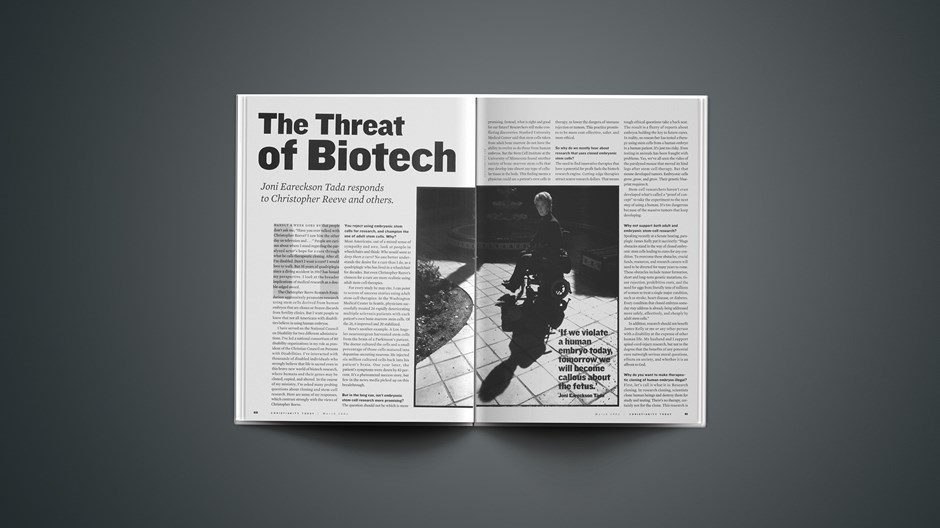
If we violate a human embryo today, tomorrow we will become callous about the fetus, then the infant, and then people with physical defects. A society that honors life will safeguard the rights of the disadvantaged, the weak, and the small.
But the weak are in mortal danger if a society allows scientists to create a class of human beings (as in cloning for research) in order to kill them and use their cellular tissue. A world in which the biotech industry sets the moral agenda is a threat to me as an adult and a quadriplegic.
Biotech advocates believe that a human embryo is just tissue, not a person. How can you convince them otherwise?
It doesn't matter whether you believe, as I do, that a soul dwells within a tiny human embryo. That embryo is not a goat, rat, or chicken embryo. It's human. Each of us began our journey on this planet as a living human embryo. We owe to embryonic human life the protection that any human life enjoys.
Why should your moral agenda interfere with the promise of new cures for the disabled through scientific research?
I find it shameful that some of my associates with disabilities use their physical impairment as a plea to promote research cloning. I'm offended that people employ words like "helpless victim" and "being trapped in a useless body" to sway the sympathies of legislators.
Rather, let's influence society with reasoned judgment, strength of character, and a commitment to improve our culture, not diminish it.
I would rather that credible bioethicists, not drug companies, set the moral agenda. All pursuit of medical advancements, all law and public policy, reflects somebody's morals. When it comes to hot competition for research dollars, we are wiser when we err on the side of caution. The fools who rush in to embryo research clumsily grapple with the essence of human genesis.
Article continues below
California already allows funding for embryonic stem-cell research. Isn't this fighting a losing battle?
A governor's signature on a bill doesn't mean the battle's over. The struggle with academic and corporate special interests is just beginning. God made us in his image. Embryo cloning for research is an attack on God's creative authority.
This research surfaces many other unresolved questions. What limitations are there on the morally abhorrent practice of filing a patent on human genes? Is there any protection for the privacy of an individual's genetic information? If human embryos have no legal protection, what would stop a researcher from manipulating the genes of a human embryo to enhance the intelligence or physical characteristics of a child?
Still, isn't technology our hope for the future in so many areas?
Technological knowledge is a double-edged sword. Technical advancements for good include the potential for evil abuses, whether it's splitting atoms or manipulating genes.
Scientific knowledge continues to grow rapidly. We need pioneers in ethics to keep pace with researchers, leading to prudent decision-making. After all, when we deal with the building blocks of human genesis, we are touching the apple of God's eye.
Joni Eareckson Tada is founder and president of Joni and Friends, a Christian ministry addressing the needs of people with disabilities. For more information, visit joniandfriends.org and stemcellresearch.org.
Undaunted | Bioethics challenges are huge. But so is God. (July 31, 2002)
The New Tyranny | Biotechnology threatens to turn humanity into raw material. (Oct. 5, 2001)
A 2000 Christianity Today editorial, "Thus Spoke Superman" also referenced Christopher Reeve's stance on bioethical research.
Article continues below
Christianity Today's Life Ethics archive and sister publication Books & Culture's Science Pages have more perspective on bioethics. For current news on stem-cell research and cloning, see Yahoo full coverage.
Previous Christianity Today coverage of bioethics includes:
Opinion Roundup: 'Only Cellular Life'? | Christians, leaders, and bioethics watchdogs react to the announcement that human embryos have been cloned. (November 29, 2001)

















 While we pray for peace, we need moral clarity about this war.
 As my doubts about his teachings grew, so did a secret fascination with Jesus.
 NIL deals in college athletics present new challenges—and opportunities—for colleges and students.






