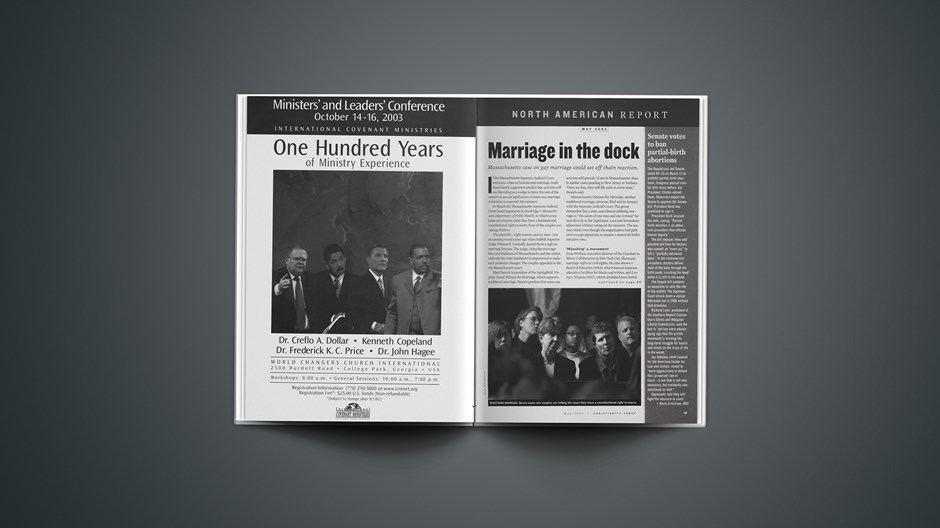
If the Massachusetts Supreme Judicial Court overturns a ban on homosexual marriage, traditional family supporters predict that activists will use the ruling as a wedge to force the rest of the country to accept legalization of same-sex marriage. A decision is expected this summer.
In March the Massachusetts Supreme Judicial Court heard arguments in Goodridge v. Massachusetts Department of Public Health, in which seven same-sex couples claim they have a fundamental, constitutional right to marry. Four of the couples are raising children.
The plaintiffs—eight women and six men—lost an opening round a year ago when Suffolk Superior Judge Thomas E. Connolly denied them a right to marriage licenses. The judge, citing the marriage laws and traditions of Massachusetts and the nation, said only the state legislature is empowered to make such profound changes. The couples appealed to the top Massachusetts court.
Matt Daniels is president of the Springfield, Virginia-based Alliance for Marriage, which supports traditional marriage. Daniels predicts that same-sex activists will prevail—if not in Massachusetts, then in similar cases pending in New Jersey or Indiana. "Once we lose, they will file suits in every state," Daniels said.
Massachusetts Citizens for Marriage, another traditional marriage advocate, filed suit in January with the Supreme Judicial Court. The group demanded that a state amendment defining marriage as "the union of one man and one woman" be sent directly to the legislature. Last year lawmakers adjourned without voting on the measure. The session ended even though the organization had gathered enough signatures to require a statewide ballot initiative vote.
'Hijacking' a movement
Evan Wolfson, executive director of the Freedom to Marry Collaborative in New York City, likens gay marriage rights to civil rights. He cites Brown v. Board of Education (1954), which banned separate education facilities for blacks and whites, and Loving v. Virginia (1967), which abolished laws forbidding interracial marriages.
"This case is about ending discrimination of people all over the country," Wolfson said. "The right to marry shouldn't be based on race, religion, or gender. It belongs to all of us."
Ethnic minorities, however, are troubled by such comparisons. "The civil rights struggle is not analogous to the gay and lesbian struggle," said Bishop George McKinney of the Church of God in Christ, one of the nation's largest predominantly African American denominations. In contrast to the Supreme Court's Dred Scott decision (1857), "There has never been a ruling that gays and lesbians are less than human," McKinney said. "[Activists] are trying to hijack a legitimate movement. It's a shallow, emotional approach that cheapens and scandalizes the meaning of marriage."
McKinney's is not a lone voice: A new Wirthlin opinion poll shows that 70 percent of Hispanics and African Americans are more likely to vote for a candidate who supports a federal amendment defining marriage as involving one man and one woman.
Polls still show that only a minority of Americans supports homosexual marriage, but the numbers are growing. Only 27 percent favored it in a 1996 Gallup poll. By last August it had risen to 46 percent.
The first step?
Wolfson contends that Massachusetts is just the first step. If homosexual marriage is legalized in one state, under the U.S. Constitution's Article 4 full faith and credit clause, Massachusetts couples who move to another state could demand legal recognition for their same-sex unions.
The attorneys general of Utah, Nebraska, and South Dakota have filed one of 15 amicus briefs in Goodridge, warning that one state's legislation of homosexual marriage could supplant the marriage laws of other states. Their brief highlights the experience of Vermont. The Vermont legislature, upon orders from the state supreme court in 2000, authorized civil unions between homosexuals and extended marriage benefits and protections to same-sex couples. But only 11 percent of the couples participating in civil unions in Vermont last year actually live in Vermont.
"As with any civil rights struggle, we will not stop until discrimination ends," Wolfson said. "Married couples should not have to get a marriage visa to cross state lines. There's no question gay marriage is inevitable."
Daniels said that because of Article 4 a pro-homosexual Goodridge verdict could invalidate the Defense of Marriage Act (DOMA), passed by Congress in 1996, as discriminatory. The only solution, Daniels says, is a constitutional amendment. Alliance for Marriage has been lining up support for a federal marriage amendment from organizations such as Focus on the Family and the Christian Legal Society. It has also received support from the Southern Baptist Convention and the Church of God in Christ.
Daniels believes state passage is within grasp. Thirty-six states, two shy of the three-fourths required to pass an amendment, already have passed state DOMA laws.
"Ultimately, homosexuals understand they cannot transform America the way they want," Daniels said, "as long as laws recognize the unique nature of marriage between a male and female."
The Defense of Marriage Act (DOMA) does two things: it provides that no State shall be required to give effect to a same-sex marriage law of another state, and it defines the words "marriage" and "spouse" for purposes of Federal law. It was passed in 1996.
In a 1996 Christianity Today column, Charles Colson said that "accepting same-sex relationships as the moral and legal equivalent of marriage will transform the very definition of marriage—with far-reaching repercussions."















 While we pray for peace, we need moral clarity about this war.
 We’ve got little information on Jesus’ appearance and personality. But that’s the way God designed it.españolFrançais
 We must always be people of the Word, but we’ll have to reimagine deep engagement with Scripture.






