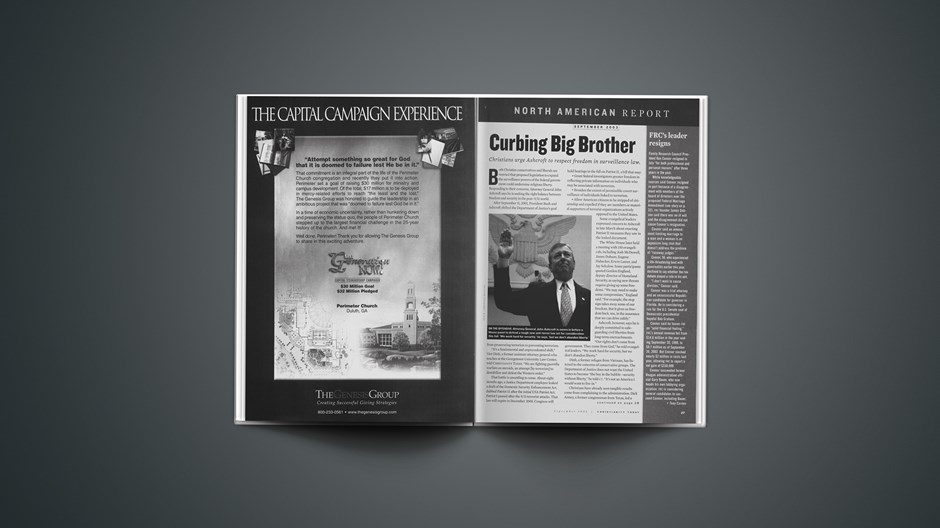
Both Christian conservatives and liberals are worried that proposed legislation to expand the surveillance powers of the federal government could undermine religious liberty. Responding to their concerns, Attorney General John Ashcroft says he is seeking the right balance between freedom and security in the post-9/11 world.
After September 11, 2001, President Bush and Ashcroft shifted the Department of Justice's goal from prosecuting terrorists to preventing terrorism.
"It's a fundamental and unprecedented shift," Viet Dinh, a former assistant attorney general who teaches at the Georgetown University Law Center, told Christianity Today. "We are fighting guerrilla warfare on steroids, an attempt [by terrorists] to destabilize and defeat the Western order."
That battle is unsettling to some. About eight months ago, a Justice Department employee leaked a draft of the Domestic Security Enhancement Act, dubbed Patriot II after the initial USA Patriot Act. Patriot I passed after the 9/11 terrorist attacks. That law will expire in December 2005. Congress will hold hearings in the fall on Patriot II, a bill that may:
Grant federal investigators greater freedom in collecting private information on individuals who may be associated with terrorism.
Broaden the extent of permissible covert surveillance of individuals linked to terrorism.
Allow American citizens to be stripped of citizenship and expelled if they are members or material supporters of terrorist organizations actively opposed to the United States.
Some evangelical leaders expressed concern to Ashcroft in late March about enacting Patriot II measures they saw in the leaked document.
The White House later held a meeting with 150 evangelicals, including Josh McDowell, James Dobson, Eugene Habecker, Erwin Lutzer, and Jay Sekulow. Some participants quoted Gordon England, deputy director of Homeland Security, as saying new threats require giving up some freedoms. "We may need to make some compromises," England said. "For example, the stop sign takes away some of our freedom. But it gives us freedom back, too, in the assurance that we can drive safely."
Ashcroft, however, says he is deeply committed to safeguarding civil liberties from long-term encroachments. "Our rights don't come from government. They come from God," he told evangelical leaders. "We work hard for security, but we don't abandon liberty."
Dinh, a former refugee from Vietnam, has listened to the concerns of conservative groups. The Department of Justice does not want the United States to become "the boy in the bubble—security without liberty," he told CT. "It's not an America I would want to live in."
Christians have already seen tangible results come from complaining to the administration. Dick Armey, a former congressman from Texas, led a fight to strengthen civil liberties in Patriot I.
Ashcroft and others in the Bush administration accepted an expiration date in the legislation. The administration also dropped a much-criticized citizen watch program.
Evangelicals have many allies on the issue. The liberal American Civil Liberties Union, a prominent critic of the anti-terror measures, says 141 communities in 26 states have passed resolutions in opposition. Protests have occurred in San Francisco and other cities.
In July, the House of Representatives, in a bipartisan move, voted against funding covert searches in criminal investigations. Patriot I allows them to take place.
Unintended consequences
Richard Cizik of the National Association of Evangelicals worries about Patriot II's unintended consequences for overseas missionaries: "What you sanction here will be used by others overseas against you." He said mission leaders worry that foreign governments will feel greater freedom to detain and deport American missions personnel without due process.
Lori Waters, executive director of Eagle Forum, said that without changes the legislation would be overly broad. Under the government's antiterrorist proposal, she said, "Every person regardless of religion is a terrorist suspect until it is proven that you're not." Waters is especially concerned about the Pentagon's Terrorist Information Awareness Plan—formerly code-named Carnivore—to sift data on every citizen to identify potentially dangerous people.
Recalling the misapplication of laws designed to combat organized crime, prolife activists told CT that prosecutors could create sweeping, abusive definitions of terrorist or terrorist network. "With a different administration," Waters said, "a few little tweaks with a word or comma could redefine prolife groups as domestic terrorists."
Attorneys at the conservative American Center for Law and Justice advise caution. Colby May, ACLJ senior counsel, said federal agents "should not put a question mark" over Christians involved in controversial but legal protests.
Ron Sider of Evangelicals for Social Action said that Ashcroft has legitimate security concerns but may be overlooking how power tends to corrupt. "We need a more Lincolnesque understanding of the tragedy of history from Ashcroft," Sider told CT. "Even good people abuse power."
Article continues below
Sources in the federal government told CT that after 9/11, federal officers started sweeping up every Middle Eastern person on their lists of former felons and those they deemed suspicious. One federal officer told CT that he was instructed, "Give us some names so we can bring them in." A high official in the Department of Defense's counter-terrorism effort told CT that he too was told, "Just give me some names."
According to reports by the U.S. inspector general—mandated by Patriot I—federal officials detained 762 immigrants in the year after 9/11. Authorities held many of them for months without charges or legal counsel. No one was charged with terrorism.
From December 16, 2002, to July 15, the inspector general's office received more than a thousand new complaints. But only 34 raised "credible Patriot Act violations on their face."
Observers say that Ashcroft has been helpful in implementing the inspector general's recommendations to discourage unwarranted detentions.
Preventing terrorism
Ashcroft says new legislation is needed because the current Patriot Act will expire and has loopholes that Patriot II will rectify. After 9/11, he said, law enforcement disrupted more than 100 terrorist plots, filed 228 terrorist-related criminal charges, convicted 113 people linked to terrorism, and dismantled 36 organizations that financially supported terrorism.
Administration officials say terrorists are on the defensive. A court document revealed that a terrorist cell member in Portland, Oregon, was recorded via wiretap complaining that the Patriot Act had disrupted his financial-support network. "Everybody's scared to give up money to help," he said, "because [of] that law that Bush wrote."
Since 9/11, the Bush administration has sought to strengthen security without weakening religious freedom and other civil rights. In his 2002 State of the Union address, Bush decried "the midnight knock of the secret police" and reiterated "the non-negotiable demands of human dignity: the rule of law, limits on the power of the state."
Americans have, since 9/11, shown "an astonishing faith" in technology to enhance the government's ability to fight terrorism, said David Lyon, a sociologist at Queens University, Ontario. He calls such faith misplaced and possibly dangerous.
Lyon, author of Surveillance After September 11 and Surveillance Society: Monitoring Everyday Life, said new technology allows government to monitor individuals in public places and create behavioral profiles based on their spending, travel, and purchases. "We are seeing the growth of cultures of suspicion, where not only law enforcement agencies, but ordinary people, are encouraged to distrust and spy on their neighbors," Lyon said.
Article continues below
Ashcroft said the government respects and is indeed fighting for freedom. "It is God's gift to humanity," he said. "It is the terrorists who assault this."
For now, most evangelical leaders are cautiously willing to give the embattled attorney general the benefit of the doubt. "The attorney general is responsive to our concerns," said Waters of Eagle Forum. "It looks like [Justice officials] have slowed down preparing Patriot II."
















 While we pray for peace, we need moral clarity about this war.
 As my doubts about his teachings grew, so did a secret fascination with Jesus.
 After lobbying from fellow Southern Baptists and Christians affected by the war, the House speaker moves a package forward.






