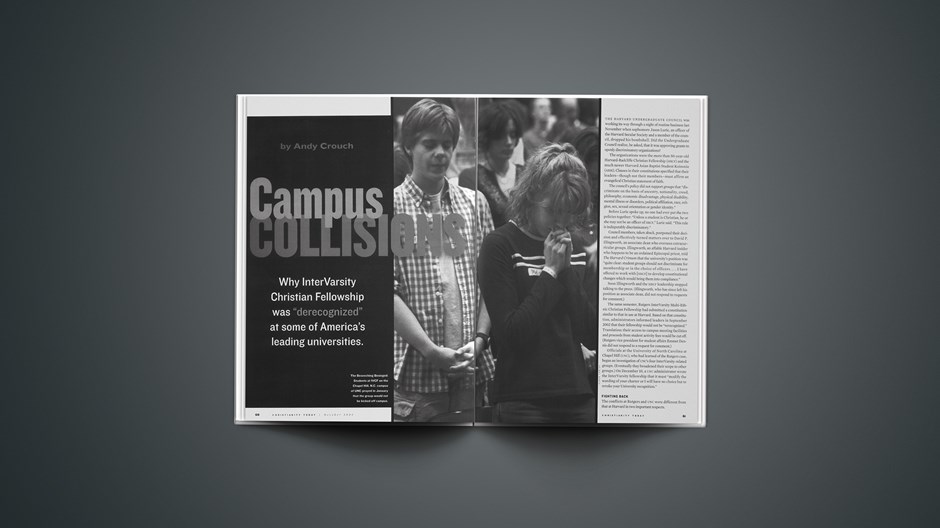
THE HARVARD UNDERGRADUATE COUNCIL was working its way through a night of routine business last November when sophomore Jason Lurie, an officer of the Harvard Secular Society and a member of the council, dropped his bombshell. Did the Undergraduate Council realize, he asked, that it was approving grants to openly discriminatory organizations?
The organizations were the more than 50-year-old Harvard-Radcliffe Christian Fellowship (HRCF) and the much newer Harvard Asian Baptist Student Koinonia (ABSK). Clauses in their constitutions specified that their leaders—though not their members—must affirm an evangelical Christian statement of faith.
The council's policy did not support groups that "discriminate on the basis of ancestry, nationality, creed, philosophy, economic disadvantage, physical disability, mental illness or disorders, political affiliation, race, religion, sex, sexual orientation or gender identity."
Before Lurie spoke up, no one had ever put the two policies together: "Unless a student is Christian, he or she may not be an officer of HRCF," Lurie said. "This rule is indisputably discriminatory."
Council members, taken aback, postponed their decision and effectively turned matters over to David P. Illingworth, an associate dean who oversees extracurricular groups. Illingworth, an affable Harvard insider who happens to be an ordained Episcopal priest, told The Harvard Crimson that the university's position was "quite clear: student groups should not discriminate for membership or in the choice of officers… . I have offered to work with [HRCF] to develop constitutional changes which would bring them into compliance."
Soon Illingworth and the HRCF leadership stopped talking to the press. (Illingworth, who has since left his position as associate dean, did not respond to requests for comment.)
The same semester, Rutgers InterVarsity Multi-Ethnic Christian Fellowship had submitted a constitution similar to that in use at Harvard. Based on that constitution, administrators informed leaders in September 2002 that their fellowship would not be "rerecognized." Translation: their access to campus meeting facilities and proceeds from student activity fees would be cut off. (Rutgers vice president for student affairs Emmet Dennis did not respond to a request for comment.)
Officials at the University of North Carolina at Chapel Hill (UNC), who had learned of the Rutgers case, began an investigation of UNC's four InterVarsity-related groups. (Eventually they broadened their scope to other groups.) On December 10, a UNC administrator wrote the InterVarsity fellowship that it must "modify the wording of your charter or I will have no choice but to revoke your University recognition."
The conflicts at Rutgers and UNC were different from that at Harvard in two important respects.
A private rather than public institution, Harvard expects its student groups to be independent of national organizations like IVCF (although since its founding, HRCF has been informally connected with IVCF). But at Rutgers and UNC, which are state universities, the student groups are full affiliates of InterVarsity's national organization. Hence the schools' policies must pass the same constitutional muster as all government entities.
As a result, whereas the dispute over HRCF's "discrimination" began publicly but soon went off the record, at Rutgers and UNC it was just the reverse. On December 28, after several months of fruitless private negotiations, IVCF president Alec Hill authorized a lawsuit against Rutgers.
"That was a difficult decision, because we have never been a litigious organization," Hill says. "But at each of the three times when the Apostle Paul calls on the civil powers in Acts, he uses his rights to ensure that the church is strengthened when he leaves. We were compelled to go this route not just for our sake, but for the sake of other ministries."
On December 30, the Foundation for Individual Rights in Education (FIRE), a Philadelphia-based civil liberties organization, issued an open letter putting pressure on UNC chancellor James Moeser to reverse his staff's decision. The Wall Street Journal, along with a host of others, picked up the story, including this ironic tautology from FIRE president Alan Charles Kors about the Rutgers case: "It is prohibited at this public university for a Christian organization to be Christian."
But to activists like Jason Lurie, the tautology ran the other direction. How could any group at an institution dedicated to non-discrimination so explicitly discriminate? As Lurie documented for the Undergraduate Council, many other large religious organizations at Harvard, from the Catholic Students Association to the Islamic Society, had no such restrictions in their constitutions. Why was it evangelical Christians alone who insisted on tests of belief for their leadership?
At the same time, activists like Lurie found it impossible to imagine that their passion for non-discrimination could be leading them into a form of discrimination that the First Amendment specifically singles out: interference with religion. They also admitted that nearly every organization had standards for their leaders, even if they weren't spelled out in their constitutions.
Article continues below
Why all the furor over a faith statement that many of the faithful didn't seem to need, and a pluralism that even the pluralists admitted was not truly enforceable? Discovering what is at stake in these conflicts requires two kinds of time travel—into the largely forgotten past (which has shaped both evangelicals and the secular universities where they study) and into the future.
IVCF's Vulnerability
The history behind the "doctrinal basis" in InterVarsity fellowships' constitutions is key.
At the turn of the 20th century, Darwinism, historical criticism, and modern optimism ushered in Western Christianity's most sweeping realignment since the Reformation. Christian student movements experienced sometimes gradual, sometimes wrenching changes as liberal modernism gained momentum.
The liberal Christians who gained control of organizations like England's Student Christian Movement (SCM) did not wish to repudiate Christianity altogether—instead, they sought to reinterpret it in forms more congenial to modern science and scholarship.
Disenfranchised from a movement that had been a source of major evangelistic and mission momentum only a few years earlier, more conservative students at schools like Cambridge and Oxford dissociated themselves from the SCM. When their "Inter-Varsity Fellowship" crossed the Atlantic, it brought along their concern for doctrinal specificity.
The "statement of faith" in InterVarsity constitutions is an inscribed memory of the instability of Christian institutions in the face of cultural pressure. What seems to Lurie to be an unnecessary imposition of dogmatic uniformity was to this earlier generation of evangelicals a minimum bulwark against the erosion of their faith.
The events of 2002-2003 had roots in more recent history as well. In April 2000, a student governing board at Tufts University in Medford, Massachusetts, "derecognized" InterVarsity's Tufts Christian Fellowship (TCF), effectively banning it from campus. The grounds were a complaint by TCF member Julie Catalano that she had been denied a leadership role in the organization because she was a lesbian.
IVCF area director Curtis Chang had to make a difficult decision—whether to counsel TCF students to attempt quiet diplomacy, or to take the case as public as possible. He chose publicity. TCF retained David French, a Harvard-trained lawyer who offered to take the case for free, and Chang's house near the Tufts campus became the center of a major public relations campaign. In October 2000, the student board effectively reinstated TCF, though it imposed one year's probation.
Article continues below
The Tufts case was not the first time that an InterVarsity chapter had been banned from campus because of its unwillingness to select actively homosexual leaders. At Grinnell College in Iowa, the InterVarsity group was banned in 1997 and only returned to campus in 2001. But the Tufts case was unique because of a combination of political intrigue (the meeting at which the fellowship was "derecognized" took place at 10 P.M., without prior notice), French's legal savvy, and Chang's determination to press tcf's case in the court of public opinion.
The media spotlight, like the courtroom, is an unfamiliar place for IVCF. The organization, with its Madison, Wisconsin, headquarters and British roots, is better known for producing thoughtful Christians than aggressive ones. Yet at Tufts, as at many schools since, IVCF faced public opposition that other evangelical groups have not. A spokesperson for Campus Crusade for Christ, which works with 44,000 students on U.S. campuses (compared with InterVarsity's 32,000), said that no Campus Crusade affiliates have had their constitutions rejected. Nor have other evangelical ministries attracted comparable public attention for their policies on homosexuality, though IVCF is not alone in expecting student leaders to affirm traditional Christian sexual morality.
Even as IVCF follows traditional sexual ethics, it is open to students who are struggling with their sexuality. IVCF made Catalano a women's Bible study leader even though she was questioning her sexual orientation. Only when she declared her opposition to IVCF's convictions was she denied a leadership position. "When you have an environment that is that open," French says, "it is inevitable that there will be conflicts over the basis of faith."
While IVCF's combination of conviction and openness has exposed it to criticism, that combination has its advantages. "I was a debater in high school," IVCF area director Laura Vellenga says, "and I find this stuff interesting." For David French, clients like Chang and Vellenga are an attorney's dream: "The InterVarsity folks don't apologize for their beliefs, but at the same time they present the spirit behind the belief.
Article continues below
"In some ways IVCF is one big sprawling university, with more meetings, more talking, more dialogue. That makes it uniquely qualified for this sort of cultural engagement."
A Modern Conundrum
Today's universities are a fruit of the modern liberal project—birthed in the 17th century when religion was, quite literally, a bloody mess. Early Enlightenment thinkers were horrified by the Thirty Years War, which pitted Catholic and Protestant armies against one another in an exhausting, miserable, and seemingly endless spiral of religious conflict.
The memory lingers: most Christians have heard or even said the phrase "beating people over the head with the Bible," with the specter of religious coercion it implies (though probably none have ever witnessed such an assault).
Consequently, the university approaches the problem of diversity with astonishing faith in the power of liberal values to resolve conflict. UNC administrators demonstrated this when they required every incoming student to read selections from the Qur'an in the fall of 2002. To many Americans this was a mystifying response to the religious violence of September 11, 2001. But it perfectly illustrated the enduring hope that reason and dialogue can overcome the danger of religious passion.
So it is no surprise, and no contradiction, that a university that required familiarity with the Qur'an also considered banning evangelical groups from campus. Other campus religious groups can readily affirm the liberal modern project's heart cry, "Can't we all just get along?" Jewish and Catholic student groups usually operate, sometimes uncomfortably, as broad alliances that encompass a variety of views, from orthodox to progressive.
Campus Muslim associations, often just as ecumenical as the Jewish and Catholic groups, benefit (for the moment) from the university's enthusiasm for diversity. Mainline Protestant groups tend to affirm the university's liberal and modern instincts.
In this context, many evangelical groups fit in by not codifying their doctrinal statements. Campus Crusade, for example, requires its staff to affirm an evangelical statement of faith, but has no such requirement—officially—of student leaders.
That often leaves InterVarsity fellowships, thanks to their constitutional memory of the struggle between modernists and fundamentalists, as the one inescapable reminder that we do not all agree.
Preliminary skirmishes
InterVarsity has won every challenge so far. UNC's chancellor reversed his staff's decision just one day after FIRE launched its publicity campaign, though some other UNC Christian organizations had yet to receive approval for their constitutions at press time; Rutgers settled out of court with its InterVarsity chapter on April 1, and later that month Harvard's Committee on College Life voted to allow HRCF to retain its statement of faith.
Article continues below
At Rutgers, Vellenga believes "the university is going to be very leery of doing anything like this in the future."
But others aren't so sure. "It would have been incredibly easy for those decisions to have gone the other way simply because we chose not to fight them as vigorously," says Chang.
French says such campus challenges to Christian organizations are inevitable because "they tap into the way our culture views religion in general: as a private matter, not something that could ever affect someone else.
"The Tufts case was gut-wrenching—painful for the InterVarsity students and for the complaining student, French says. "It is hard to keep the message of love intact. Yet situations like the Tufts case are invaluable educational moments if you're willing to bear the pain."
Hostile Future
There will almost certainly be more pain for InterVarsity to bear, pain that comes from being at the fulcrum of history. The campus challenges of 2002-2003 were not only a collision of histories; they were a collision of futures.
There is nothing so close to the university's heart as the dream of education as a liberating force. The liberation being most avidly sought in universities today is sexual—removing the shame from a wide variety of sexual orientations that are summed up in organizational names like "The Lesbian, Gay, Bisexual, Transgender and Questioning Alliance."
While the natural constituency of these organizations is a minority, they have the sympathy of a majority of students, themselves "straight," who also welcome relaxed sexual mores. At UNC, some members of the gay community, aware of InterVarsity's traditional views, were vocal in calling for the group's removal from campus.
The university's vision of the future means that InterVarsity's history of evangelical clarity is sure to be challenged again. IVCF's founders could not have imagined that sometime early in the 21st century, a student leader would be able to profess complete agreement with InterVarsity's statement of faith and also openly embrace homosexual practice.
This hasn't quite happened yet, even at Tufts in 2000 or in a similar incident at Iowa's Central College in 2003, but it is certain that it will. When it does, InterVarsity leaders will have to lead skeptical administrators and undergraduate councils through ethical complexities that are even now dividing Christianity as decisively as modernism did 100 years ago.
Article continues below
They are almost certain of a hostile audience, and their opponents will be activists mobilized by an issue that pierces to the very core of human identity. Jason Lurie had never heard of the Tufts case when he charged HRCF with being a discriminatory organization, but he blanches at the thought that Christian organizations might exclude practicing homosexuals from leadership: "That could really hurt people."
Lurie is right: religious and moral divisions do hurt. These cases go to the heart of the liberal project itself—the attempt to resolve ancient and intractable differences in a neutral public square. The very presence of religious particularity within a university community is a painful reminder of the limits, and perhaps the impossibility, of that project.
What will happen if universities themselves become increasingly dogmatic in defense of their secular faith? Such universities will be entirely capable of destroying the village of diversity in order to save it—driving out religion in the name of religious tolerance.
It falls to campus Christians themselves to show the university that there is another way, at once more peaceful and more painful. At Harvard, HRCF's cause was taken up by an unlikely ally: the Reverend Professor Peter J. Gomes, the university minister of plummy accent and penetrating intellect who made headlines, and alienated many evangelical friends, when he made public his homosexual orientation in 1991.
Gomes has advocated vigorously for the inclusion of active homosexuals in the Christian church. He has little reason to befriend groups like HRCF. And yet, behind the scenes and in the pages of The Crimson, Gomes defended HRCF's right to select its own leaders.
Would Gomes do the same if the issue were HRCF's right to reject homosexually active leaders? Yes, he says: "Religious communities have to come to their own decisions, as opposed to being coerced by the civil liberty establishment."
In any event, Gomes says, "I have much more in common with those people with whom I disagree on this particular point than I do with those people whose politics I agree with, but who are people of no faith at all."
Genuine Diversity
For InterVarsity, the controversies have created fresh opportunities to participate fully in the life of the university. "We're a missionary organization," says IVCF President Hill. "Whether it's goths or Greeks, we cross all sorts of boundaries."
Article continues below
At UNC in 2003, that meant InterVarsity staff joining in a debate, attended by 200 students, that also included a student life administrator, the university's acting counsel, and the head of the university's largest gay organization.
"Competing beliefs on a campus are going to cause conflict, but I don't necessarily see that as a negative thing," says InterVarsity UNC campus director Scott Vermillion. "At Carolina we have an absence of conflict. Everything is 'awareness'—be 'aware' of someone's issues so that you don't hurt them. But the gospel compels us to move forward in those areas. We do have conflict, but let's meet with each other, let's learn from each other."
Perhaps the real battle is not for the survival of evangelical groups on campus, nor even for a reformation of the modern liberal project to make it more genuinely hospitable to faith. The battle is for the heart of the gospel: the Christian claim that only the Cross can reconcile, and that all alternatives to the Cross—not least political alternatives—are ultimately idols.
Idols promise to solve problems, and the university would desperately like to solve the painful fractures in the human family. But it may be that human division cannot be solved, only suffered. Christians on campus who want to bear witness to that hard truth will need the same unlikely combination of confidence and humility, litigation and longsuffering, that Christianity's most famous evangelist exercised on his journey toward Rome.
Andy Crouch is a journalist and a CT columnist. He worked for InterVarsity at Harvard from 1991 to 2000.
InterVarsity Group on Probation | Tufts University says group violated school's nondiscrimination policy by excluding lesbian student from leadership (Nov. 27, 2000)

















 While we pray for peace, we need moral clarity about this war.
 A Christian reconciliation group in Israel and Palestine warned that war would come. Now the war threatens their relevance.العربيةFrançais
 Christian artists work at the intersection of music and climate change.






