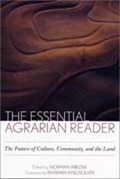
Take up a handful of soil and you will hold a miracle—the possibility of life, the product of death. Generations of plants and animals lie in a handful. Hundreds, even thousands of microorganisms live there, processing the nutrients necessary for plants and the animals that depend upon them. Soil is a grace upon which we are totally dependent yet of which we are rarely aware. For Norman Wirzba and the agrarian writers he's assembled in The Essential Agrarian Reader, soil is the standard by which we should begin to judge our culture, economy, and service to creation.
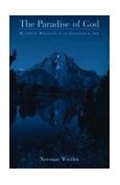
That we are dependent upon the soil and the created order that surrounds and lives off of it is an insight confirmed by both Scripture and ecology. In The Paradise of God, Wirzba explores both of these sources of knowledge, using them to understand our vocation as creatures and the possibilities of a "culture of creation." Wirzba moves with care and insight through key biblical passages from the creation of man to the garden city of the New Jerusalem. In his reading of Scripture he finds witness, not to a self-standing humanity placed in an alien landscape, but to a humanity formed from and tied up with the creation of which it is a part. The created order is then a moral order. It bares the curse that humanity brings upon it (Gen. 3:17) and awaits, with groaning, the new creation formed by Christ (Rom. 8:19-23).
We can't understand our own moral life without beginning to understand the networks of living and non-living things upon which we are dependent. This dependence is both basic and vast; as Wirzba says, "we are directly and symbiotically tied to the billions of organisms, past and present, that recycle energy and give us food and air … as much as 10 percent of our dry body weight is not us, but is instead a variety of organisms inhabiting us, organisms that facilitate life processes at work within and all around us." The understanding of these mutual dependencies, these processes within and around us, is the concern of ecology, a science that offers a revolution in self-understanding: "by helping us understand how we are implicated in the workings of creation," ecology "puts us in a better position to care and take responsibility for it."
Ed. by Norman Wirzba
Foreword by Barbara Kingsolver
Univ. Press of Kentucky
276 pp.; $27
This mutual fate of man and soil comes not only through shared dependence but also shared purpose. All of creation is aimed toward the glory of God, and it is only through the flourishing of each of its parts that creation can carry out this purpose. If one member of the choir of creation thwarts the praise of the others, then he must be called back to sing in harmony. Our culture has produced a choir of discordant soloists, and in doing so we have encouraged a "denial of creation," a denial of our own creatureliness.
Our dependence on the soil, a tradition affirmed by millennia of agriculture, has turned into agribusiness with its genetically engineered seeds, expensive fertilizers, and pesticides. Agribusiness, "rather than [submitting] to the grace of life … , [assaults] the earth with poisons, fertilizers, and heavy equipment so as to 'ensure' maximum crop yield." Farming is increasingly given over to a few large companies, making most people's cultural and personal link to the land only recreational. We live in what Wirzba calls an "abstract culture," a culture removed from its basic dependence upon grace and the soil. We are left to ask with Wirzba, "How will we care for what we do not know or appreciate?"
Wirzba finds his answer in agrarian culture. Agrarianism, as represented in The Essential Agrarian Reader and The Paradise of God, is nothing less than a call for cultural revolution and nothing more than the honest search for a good life. It is both critical and practical, based on careful work and discipline rather than lobbying and the rattling of talking heads. The Paradise of God exhibits this sensibility by ending what is essentially a book of theology and social criticism with practical suggestions on how to begin living out the ideas put forward in the book, suggestions such as becoming a gardener, supporting local economies, unplugging the media, and developing Sabbath rituals.
These are the habits and values that would flow from a culture and economy that recognized its dependence upon the grace of the land and soil as God's gifts. But our economy has not incorporated such an understanding of gifts. It has set a fixed value on what is invaluable. As Wendell Berry says in The Essential Agrarian Reader, "all economies begin to lie as soon as they assign a fixed value to land." The value of land is an immeasurable thing, "It is worth what food, clothing, shelter, and freedom are worth; it is worth what life is worth."
Agrarians seek to live in an economy of honest accounting. They ask us to consider the true costs of our industrial byproducts, of our mounting waste, of our culture abstracted from its dependencies. They say that we must begin to live according to limits and according to standards that are set by our dependencies rather than our desires. As Maurice Telleen writes, we must learn to say, "Enough is enough." Wendell Berry says that this agrarian standard "is local adaptation, which requires bringing local nature, local people, local economy, and local culture into a practical and enduring harmony."
Article continues below
The Essential Agrarian Reader is a guidebook for beginning to live with and think with this standard. The contributors include novelists and geneticists and economists, academics and sheep farmers. Through and through it is a book of hope, bypassing the political dichotomies of our age. It moves from novelist Barbara Kingsolver's beautiful foreword through essays on land-law reform, globalization, and grass. While Wirzba's The Paradise of God is a careful and sustained reflection on our place and responsibilities as creatures, The Essential Agrarian Reader is an exhilarating collection of ideas and possibilities. Its essays are full of wisdom that we would all do well to consider with the same care with which they are put forward. Agrarianism is a subject of concern to anyone who eats food, drinks water, and lives someplace. If you read The Essential Agrarian Reader or The Paradise of God, it will change the way you eat and shop and live.
Ragan Sutterfield teaches high school at Little Rock Christian Academy and is an apprentice sheep farmer.
A previous Books & Culture Corner, "Agrarians of the World, Unite!" discusses Wendell Berry's agrarian vision, and how Christians should respond to it.
Books & Culture Corner appears every Monday. Earlier editions of Books & Culture Corner and Book of the Week include:
The Year of the Fish | The 2003 baseball season concludes with a bang—and 2004 is just around the corner. (Oct. 27, 2003)
I Shop, Therefore I Am | Critics of "consumer culture" are all wet, Virginia Postrel says. The riot of choices available to us resonates with our deepest aesthetic instincts (Oct. 20, 2003)
Article continues below
Back to the Future | A sprawling new novel by the author of Snowcrash and Cryptonomicon goes to the 17th century to investigate the birth of the modern world. (You won't be surprised to learn that the Puritans are among the Bad Guys.) (Oct. 13, 2003)
Terrorists on Trial | How the nation responded to an earlier attack. (Sept. 29, 2003)
The Contemplative Christian | Eugene Peterson calls believers to a life lived with "wholeness, honesty, without contrivance"-against the grain of much that's currently driving the church in America. (Sept. 29, 2003)
Recalling California | Want to understand what's going on in the Golden State? Toss your newsmagazines and pick up Joan Didion's new book (Sept. 22, 2003)
The Ph.D. Octopus, 100 Years On | How Christians can make a difference in the upside-down world of graduate school (Sept. 15, 2003)
A New View of Worldview | Some critics want to retire the concept. Not so fast, says David Naugle (Aug. 18, 2003)
'A Golden Age' of Religious Tolerance? | The Ornament of the World analyzes how the intellectual elites of medieval Spain eschewed fundamentalism and showed surprising sensitivity in reconciling competing truths. (Aug. 11, 2003)
Looking for the 'I' | What happens to the self when the brain is injured or malformed? (Aug. 4, 2003)
The Terror of the Therapeutic | Margaret Atwood's new novel considers the price we may pay for looking to technology to remedy our ills, personal and social. (July 28, 2003)













 While we pray for peace, we need moral clarity about this war.
 As my doubts about his teachings grew, so did a secret fascination with Jesus.
 NIL deals in college athletics present new challenges—and opportunities—for colleges and students.