"Books & Culture's Books of the Week: Faith, Hope, and Charity in North Carolina"
New novels by Michael Morris—whose first novel, A Place Called Wiregrass, was a word-of-mouth hit—and Jan Karon, who continues her beloved Mitford saga
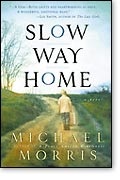
"If it hadn't been for Darrell, I don't know where I might have ended up," says Brandon Willard at the beginning of Michael Morris' new novel, Slow Way Home. This is irony. Brutal and vindictive, Darrell Foskey saves Brandon only by convincing the boy's mother, Sophie, to run off with him to Canada. Sophie leaves her eight-year-old son at the Raleigh bus station with the phone number of his grandparents and some characteristic parting words: "Don't give me that look. Just don't, okay. This is hard enough on me as it is."
Sophie boards the Greyhound, and nine buses later, Poppy and Nana Willard pull up to the curb. Their white Ford could be a white charger, for here at last are Brandon's cavalry, his real saviors. They sweep the boy away to their old farmhouse, where for the first time he learns what it means to be loved—not intermittently gushed over, not wounded to serve another person's pleasure, but really cared for.
Brandon misses his mother, but he dreads her return. Just when things seemed to have settled down, Sophie does reappear and says she wants her son back. She claims to have pulled her life together at a rehab clinic. "Learned I could either be pitiful or powerful," she declares, but it's obvious she'll continue to be both, at a high cost to Brandon. Faced with a court order to give their grandson back, the desperate Willards take him into hiding. They head down to the Florida Panhandle to live a new life under an assumed name.
Plenty of adventures follow on the Gulf: run-ins with the Klan, a fortuitous friendship with a lady preacher, even a dramatic baptism and visions of Jesus. Brandon finds friends in Florida who become as close as family. There's no rest in pseudonymity, however. Before long the law catches up to the Willards. A feud erupts, and state professionals swarm in to impose compassion on a world-weary boy.
Slow Way Home is a tribute to grandparents who step in where their adult children fail. It's also a criticism of the bungling foster care system—as if we needed another reminder about that (oh, for someone who can tell us how to fix it). As a work of fiction, its whole is greater than the sum of its parts. Morris is a clumsy stylist (awkward sentences would do well to be avoided by him), but he brings his people fully to life by a combination of humor and empathy. His love, in other words, covers a multitude of sins—and anyway, he does have a fine ear for conversation, particularly the conversation of children.
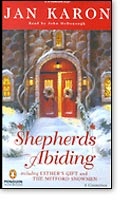
Jan Karon also has a good ear for conversation, and great empathy for her characters. Karon writes about "ordinary" North Carolinians who, to paraphrase Sophie Willard, are neither pitiful for powerful. Fans of her Mitford series will likely turn out in droves to buy Shepherds Abiding, the eighth Mitford book, timed both thematically and chronologically for this Christmas season.
Here Karon follows closely (and wisely) the formula of her other successful novels. She divides the greater story into many small scenes, skipping back and forth between characters as she drives each story toward its own conclusion. Father Tim works in secret to restore an old manger scene for his wife Cynthia's Christmas present; Hope Winchester falls in love and pursues her dream of running Happy Endings—the local bookstore—all on her own; Uncle Billy Watson frets about his wife's "Santy"—seeing how goggle-eyed she gets over Christmas (when she's so mean the rest of the year), he's bound and determined to get her just the right present. The effect of the episodic presentation is, yes, TV-like, and gives the novel the undeniable Mayberryishness that all the Mitford books possess. True, Mitford has no Barney Fife: readers who look for high social comedy, satire, or edgy writing will be disappointed. People who love Mitford for its own sake, however, will continue to love it, even devotionally.
Which brings me to a question: how can two books both be set in North Carolina, both portray "ordinary" lives, and even handle similar themes (faith, aging, reconciliation) yet be as different as Shepherds Abiding and Slow Way Home? The simplistic answer is that their writers differ in aims. Both writers aim to move us emotionally, but Jan Karon moves in order to soothe while Michael Morris moves in order to challenge.
Readers who love one kind of book may scorn the other, and certainly the super-popularity of Karon's work will raise arty eyebrows. It's good to remember, though, that we don't have to pronounce every book a success or failure right out of the gate. There have always been different kinds of novels: given a decent chance, the best of any genre will outlast the fame or obscurity of its author. The reader's first task is not to judge but to empathize, and both these book give plenty of opportunity for that.
Betty Carter is the author two novels. Her new book, Home Is Always the Place You Just Left: A Memoir of Restless Longing and Persistent Grace, is published by Paraclete Press.
The Year of the Fish | The 2003 baseball season concludes with a bang—and 2004 is just around the corner. (Oct. 27, 2003)
I Shop, Therefore I Am | Critics of "consumer culture" are all wet, Virginia Postrel says. The riot of choices available to us resonates with our deepest aesthetic instincts (Oct. 20, 2003)
Back to the Future | A sprawling new novel by the author of Snowcrash and Cryptonomicon goes to the 17th century to investigate the birth of the modern world. (You won't be surprised to learn that the Puritans are among the Bad Guys.) (Oct. 13, 2003)
Terrorists on Trial | How the nation responded to an earlier attack. (Sept. 29, 2003)
The Contemplative Christian | Eugene Peterson calls believers to a life lived with "wholeness, honesty, without contrivance"-against the grain of much that's currently driving the church in America. (Sept. 29, 2003)
Recalling California | Want to understand what's going on in the Golden State? Toss your newsmagazines and pick up Joan Didion's new book (Sept. 22, 2003)
The Ph.D. Octopus, 100 Years On | How Christians can make a difference in the upside-down world of graduate school (Sept. 15, 2003)
A New View of Worldview | Some critics want to retire the concept. Not so fast, says David Naugle (Aug. 18, 2003)
'A Golden Age' of Religious Tolerance? | The Ornament of the World analyzes how the intellectual elites of medieval Spain eschewed fundamentalism and showed surprising sensitivity in reconciling competing truths. (Aug. 11, 2003)
Article continues below
Looking for the 'I' | What happens to the self when the brain is injured or malformed? (Aug. 4, 2003)
The Terror of the Therapeutic | Margaret Atwood's new novel considers the price we may pay for looking to technology to remedy our ills, personal and social. (July 28, 2003)













 While we pray for peace, we need moral clarity about this war.
 We’ve got little information on Jesus’ appearance and personality. But that’s the way God designed it.españolFrançais
 Christians can disciple each other toward action, prayer, and hope.