Newspaper headlines today often expose divisions between science and faith. The most commonly covered issues range from sects claiming to have cloned babies to stem-cell research to local school boards fighting over evolution. While these particular arguments are relatively new, the tensions are anything but.
Larry Witham covered several evolution vs. creationism fights as a newspaper reporter with The Washington Times. To further look at what he couldn't in newspaper articles, Witham wrote Where Darwin Meets the Bible (Oxford University Press, 2002).
He's also written for Scientific American, Nature, and The Christian Century. His most recent book is By Design (Encounter Books, 2003).
How has the relationship between faith and science shifted over the years?
Natural theology was very strong through the 1700s and 1800s. Natural theology means you look at nature and then you logically conclude that a God must exist—because things look designed.
In the history of theology, thought had it the other way around. You believed in God because that was natural and then you looked for evidence of God. With the Enlightenment, there was a challenge to that idea. Natural theology came to the floor to say science could look and find design in the planetary systems, in the human being, and in how things adapt in nature.
Natural theology was finally debunked—as science tells the story—by Darwinism, which said all the things, all of design, actually, could have come into place by random mutation.
When was science in its strongest period?
Inarguably, the 1950s were the high point of confidence in science. The world wars put a lot of money into science so, in the '50s you have all the results. You find the genetic code. You put Sputnik up into the sky. There's the first experiment that says we can turn chemicals into living cells.
The famous Louis Leakey and Mary Leakey in 1959 found the skull of what became called Zinj, or the East Africa Man. Their enthusiasm was so great that they proclaimed, "We have finally found the human ancestor."
Also in 1959, you have the Darwin Centennial at the University of Chicago. They had 2,000 people from around the world and 100 key speakers. Even though scientists are skeptical, the mood was: Science is going to finally crack all the secrets of life.
That's where I open the book By Design. What I try to show in the book is that with every discovery, scientists are so confident that they've found the missing link or the secret of life, but then in ten years another scientist finds something that will totally contradict it.
Where does the relationship between faith and science go from there?
In the '70's, people began to question the very validity of science. It created atomic bombs. It created pollution. Scientists were coming off as sort of élite technocrats. That was a period when people began to think, "Maybe science has openings for other kinds of thinking, theological thinking, or artistic thinking."
This began a whole new debate about where you could shoehorn religion into the hard sciences. In England, Michael Polanyi, a world-famous chemist, argued that chemistry and physics do not explain the life of a cell. There's something more holistic happening there.
Arthur Koestler said scientists are not rational people who walk in a straight line to discovery. He called them "dreamwalkers." So we're opening up new views of the scientist.
What was the result from this new thought process?
With doubts about science in the '70's, theists with Ph.D.s—people who were in the closet, frankly—decided they had more freedom to talk about a creator. When we discover those laws we can say, "God did it this way or that way." Coming out of the '70s, more orthodox Christians are saying, "The God of the Bible can be talked about in science."
But there is another group who couldn't deal with a personal God. They also couldn't deal with this lifeless, cold, mechanistic universe of the Darwinian viewpoint. They harked back to Baruch Spinoza, the Jewish mathematician. He said that God is the laws. God is mathematics. If you find that harmony and that beauty in the order of the universe, that is God. Einstein said Spinoza was his kind of believer.
How did the Catholic Church become involved in the discussion?
John Paul II was a university professor, so he was well versed in debates over rationalism and faith. He came into office in 1978. The next year, he holds a 100th birthday party for Einstein. He told his science people at the Vatican Observatory, "The Roman Catholic Church has the oldest science academy in history." In recognition of that, he told them to start setting up conferences to bring in major scientists. They looked for common ideas and common research methods. They celebrated Newton's birthday.
Because of the imprimatur of the Catholic Church, the religious interest in science gathered major momentum. What was lacking was enough money to do it.
In the same year the John Paul II becomes Pope, the cover of Fortune magazine carries its first picture of John Templeton, who literally managed billions of dollars of people's Wall Street investments. He was a Presbyterian layman who, in the '60s, could retire because of his wealth.
Article continues below
He had all these friends—unbelieving big high rollers—who looked down on religion. So he thought, "I'm going to use some of my money to upgrade religion in modernity." You do that by facing religion off with science. By the '90s he was putting $50 million a year into conferences and funding courses at universities.
Scientists who were theists now started coming out of the woodwork. That continued into the '90s when it became socially controversial. The atheists in science began to fire back.
In this battle between theists and Spinozan pantheists, how can science answer questions of faith?
The argument is that if you think God exists, scientific evidence provides a universe that looks like a God exists. Fifty years ago it was doubtful. The universe was chaotic, meaningless, and nothing was connected. It was random, except maybe the laws.
Science is looking for values or morality. Where do you get it? You can't get it out of a gene. You can't get it out of a biological system. Perhaps you need something more transcendent. Not all scientists are saying this, but they are recognizing that you need that. There's the role of belief.
American psychologist William James, probably to the day he died, struggled with doubt over whether God existed. He cut apart brains, he did studies, and he read all the philosophical works. He looked at all these religious people in the world and said, "It helps them with their life so much there must be something there."
In today's design debate, he would say: "If the scientific evidence helps you think that God exists and it helps your life, then use those arguments." Pragmatic. Use them. It's the American way. It's not an argument for absolute truth, but it's sure a good argument for belief.
Kevin Leman Talks About Sex, Baby | The author of The Birth Order Book looks at the private lives of Christian couples in Sheet Music: Uncovering the Secrets of Sexual Intimacy in Marriage. (August 12, 2003)
Why God is like Jazz | Donald Miller, author of Blue Like Jazz, talks about why Christians need writers who honestly deal with their faults and why penguin sex is an apt metaphor for believing in Christ. (August 5, 2003)
Article continues below
A Gerontologist Gets Older | David Petty, author of Aging Gracefully, has long taught about the process of aging. Now, he is personally learning that one of the most important aspects is the spiritual side. (July 29, 2003)
Paul Elie on 'the Holy Ghost School' | The author of The Life You Save May Be Your Own talks about the personal journeys of Flannery O'Connor, Thomas Merton, Dorothy Day, and Walker Percy and what we learn from them today (June 3, 2003)
Why We Are Drawn to The Matrix | Chris Seay, coauthor of The Gospel Reloaded, says the first movie was about finding belief and the second looks at walking that path. (May 27, 2003)
Dick Staub was host of a eponymous daily radio show on Seattle's KGNW and is the author of Too Christian, Too Pagan and The Culturally Savvy Christian. He currently runs The Kindlings, an effort to rekindle the creative, intellectual, and spiritual legacy of Christians in culture. His interviews appeared weekly on our site from 2002 to 2004.













 While we pray for peace, we need moral clarity about this war.
 We’ve got little information on Jesus’ appearance and personality. But that’s the way God designed it.españolFrançais
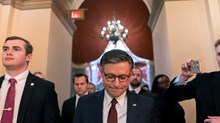 After lobbying from fellow Southern Baptists and Christians affected by the war, the House speaker moves a package forward.





