Newspapers aren't sure what the Episcopalians did yesterday Journalists must have been confused during yesterday's Episcopalian House of Bishops vote on same-sex union liturgies yesterday in Minneapolis. A sample of the newspaper headlines this morning:
Confused? Hopefully, Douglas LeBlanc's dispatch from the convention today can explain what really happened.
Christian station turns to 1960's rock and roll Old Bob Larson must be turning over in his grave (not that he's dead). Springfield, Ohio, Christian radio station WULM, run by Urban Light Ministries is going "less talk, more rock." More specifically, it's dropping its news, sports, and weather format in favor of "the sounds of Motown and the Rock of the '60s." This probably makes it the only Christian radio station in the country to make the Rolling Stones and the Beatles the cornerstone of its broadcasting.
However, reports The Springfield News-Sun, the station will bar suggestive material. Among the 43 of the 1,100 songs banned in the WULM library: "Let's Spend the Night Together" and "The Ballad of John and Yoko."
"In keeping with providing family-safe programs and in working toward presenting a positive viewpoint toward Christianity, we felt like it was for the good that certain songs were not played," station general manager Robert Pitsch told the paper.
The station will also air "short Christian vignettes … to inspire thoughts of hope, faith, and concern for character," the paper says.
Integrity Music slumps While WULM's format change may set some Nashville commentators talking about what makes something "Christian," Christian music company Integrity Media took a major hit this week on the stock market after reporting a second-quarter loss of $696,000, or 12 cents a share. Monday, the stock price dropped 18 percent, to a a two-year low of $4.30.
"The company blamed the weak economy, a flood of product returns and a lack of new releases for its poor showing," notes SmartMoney.com. But president and CEO Michael Coleman also " blamed his company's flagging sales on the illegal downloading of music from the Internet (though he didn't quantify the impact to the top line)," writes SmartMoney.com's Lawrence Carrel.
Daniel Smith, an analyst at Austin-based hedge fund Teton Capital, agrees. "I think the main thing is the piracy," he said.
Really? Weblog earlier reported that the Gospel Music Association has blamed piracy, at least in part, for its 10 percent drop in sales, but the examples given by the GMA suggested that pirates were more prone to stealing crossover acts like Evanescence and Stacie Oricco than core Christian acts—especially praise tunes. Are pirates really hitting KaZaA for the latest Darlene Zschech recording of "Shout to the Lord"?
Given Weblog's online setup—and the fact that Weblog isn't too keen on potentially making Christianity Today International party to the Recording Industry Association of America's anti-piracy Inquisition—Weblog has no idea how many Integrity titles are available on file-sharing networks like KaZaA. Does anyone else know? How popular are praise tunes?
More articles:
Gay marriage:
On gay marriage, ask 'Why?' rather than 'Why not?' | Society has long understood the broader principle that its successful continuance is best placed in the hands of heterosexual couples in a monogamous marriage (Dennis Byrne, Chicago Tribune)
The constitutional defense | If the Supreme Court is going to continue to perform as a standing constitutional convention, then it becomes a conservative warrant to employ constitutional defenses (William F. Buckley Jr.)
Oz PM rules out support for gay marriages | Prime Minister John Howard has aligned himself with the Vatican and US President George W Bush in ruling out gay marriages, saying they do nothing to support "survival of the species" (The Sydney Morning Herald)
Priests' messages mixed | No directive from Cardinal Turcotte. Some tackle issue of same-sex unions from pulpit, but others decide to keep silent (The Gazette, Montreal)
We need a real debate over gay marriage | Rather, a handful of provincial courts—in Ontario, B.C., and Quebec—have taken liberal positions, and our government is responding by following the path of least resistance (Editorial, The National Post, Canada)
Group to tackle gay marriage after break | The Senate will investigate whether new laws should be passed to strengthen the federal definition of marriage as a man-woman union when it returns from its summer recess, a Republican said Friday (Associated Press)
Article continues below
'Reject gay rights move' | An archbishop has called on members of Scottish Parliament to vote against giving homosexual partners the same legal rights as married couples (BBC, audio)
Oppose rights Bill, says Archbishop | The Archbishop of Glasgow called on politicians yesterday to vote against a move to give homosexual couples the same rights as heterosexual married couples (The Daily Telegraph, London)
Uniting Church fears split over decision | Evangelicals in the Uniting Church of Australia are trying to force the church's assembly to reconsider last month's decision to allow gay ministers (The Age, Melbourne)
Also: Naracoorte minister to fight gay decision | Naracoorte Uniting Church minister Brian Zeitz says he is staying on to help fight a decision by the church's national assembly to allow the ordination of practising homosexuals (Australian Broadcasting Corp.)
Don't marry church, state | Several Colorado political leaders, including Gov. Bill Owens, were right to eschew a Vatican directive for Catholic lawmakers to actively oppose same-sex marriages (Editorial, The Denver Post)
The Catholic Church and Canada's gay marriage laws:
The Vatican defiant | Criticism was the order of the day on European op-ed pages after the Holy See urged Catholic lawmakers to oppose legalizing gay marriages (Deutsche Welle, Germany)
Turning the clock back | The Catholic Church must learn respect (Editorial, The Guardian, London)
Expect a Catholic exodus | Catholics, who for historical reasons have largely voted Democrat, will abandon the party in droves (just as social liberals have been, and are, abandoning the Church). (Hugo Gordon, National Post, Canada)
Sexual ethics:
Rainbow warriors | The gay-rights movement has seized the nation's attention and agenda. Can it hold them? (The Boston Globe)
Godly gays seek brotherly love | Political and religious leaders are struggling to reconcile society's growing liberalism towards homosexuality with the still-strong opposition by social conservatives to gay priests and same-sex marriages (The Economist)
Step by step, nontraditional families gain greater legal recognition and rights | Ruling by ruling, vote by vote, in courtrooms and boardrooms and town halls nationwide, the makers of day-to-day policies are extending greater legal recognition and support to other forms of family — same-sex couples, unmarried heterosexual couples, single parents (Associated Press)
Faith in politics:
Mwenje, a Born-Again Christian | Embakasi MP David Mwenje is now a born-again Christian and has apologized for all the violence that has ever been associated with him. (The East African Standard, Nairobi)
Who are you calling evil? | It is not just because they're politicians that many find the idea of Bush and Blair in private prayer creepy or frightening. It is because they have power and we don't want a holy war (Janet Dubé, The Guardian, London)
New tolerance for faith in politics | America has apparently moved beyond that era when religion was strictly a private affair (The Christian Science Monitor)
Priest suspension lifted | Thorkild Grosbøll, who denied existence of God, apologized (The Copenhagen Post)
Disbelieving preacher may not be all bad | Disavowing belief in God — who theoretically is your boss — generally is not considered wise (Jim Ketchum, The Times Herald, Port Huron, Mich.)
Fate of Ventura landmark at a crossroads | The City Council is to decide tonight whether to sell the land under the 91-year-old cross, which some argue has no place on public property (Los Angeles Times)
Ventura to auction off hilltop cross | The City Council acts to avoid a lawsuit. The high bidder would own the historic 24-foot structure and an acre around it in Grant Park (Los Angeles Times)
Chipping away at church-state separation | The Supreme Court is badly out of balance. It is controlled by what used to be considered fringe views. Its most liberal justices are really moderates, and even yesterday's conservatives are lesser moderates on this court (Myron Beckenstein, The Baltimore Sun)
Manatee board to weigh court views on prayer | Members of the Manatee County School Board say they never meant to offend anyone by saying the Lord's Prayer at the start of their meetings (Sarasota Herald-Tribune, Fla.)
Parking lot policy stuns Dallas minister | The leader of the Dallas Ministerial Association said Friday that local churches would have helped if they had known Polk County was requiring some ex-cons to sleep on the ground in a downtown parking lot (The Oregonian)
Pastor puts money where sermon is | A Baptist minister went "fishing for white folk" in Shreveport on Sunday morning, offering $5 per hour to Caucasians willing to cross the color line and attend his predominantly black church (The Times-Picayune, New Orleans)
Earlier: Church draws national attention | Paying white people to diversify congregation attracts media spotlight (The Shreveport Times, La.)
A great retelling of the greatest story ever told | The Passion is the most beautiful, profound, accurate, disturbing, realistic and bloody depiction of this well-known story that has ever been filmed (Cal Thomas)
'Passion' shaping up as Gibson's lethal weapon | Watching Mel Gibson cleverly build interest in his unreleased film on Christ's execution is like watching an unwholesomely willful child playing with matches (Tim Rutten, Los Angeles Times)
Controversial film | Michael Medved chats on The Passion (The Washington Post)
Judicial appointment battles:
Democrats rebuff bias accusations | Democrats condemned accusation as "a smear" and charged that the White House bears responsibility for nominating divisive judicial candidates. (Newsday)
Playing the religion card | Even senators who support the administration's nominees should be speaking out against the dangerous charges of religious bias being made on their behalf (Editorial, The New York Times)
Using religion as a litmus | It was the Democratic Senate opposition—and not the Committee for Justice's ad campaign—that injected religion into the Pryor debate (C. Boyden Gray, The Washington Post)
The 'religious litmus test' | The effect — intentional or not — of the Democrats' religious litmus test means the automatic disqualification of any judicial nominee who believes in the teachings of his church (Editorial, The Washington Times)
Attack on judges | Congress, it is saying, need not respect the courts' judgments on the meaning of the Constitution and need not remedy those illegalities the courts identify (Editorial, The Washington Post)
Catholics need not apply? | The GOP crosses a line in the fight over the Pryor nomination (Byron York, National Review Online)












 While we pray for peace, we need moral clarity about this war.
 As my doubts about his teachings grew, so did a secret fascination with Jesus.
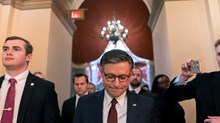 After lobbying from fellow Southern Baptists and Christians affected by the war, the House speaker moves a package forward.





