News stories easily cover the scandalous, the outrageous, and the embarrassing, and when it comes to covering the Anglican Communion's current crisis, many stories center on lawsuits, church divisions, and the power play between bishops and alliances. Fortunately, the exceptional news story exists.
This week, The Guardian, offers an outsider's (author Rachel Cooke is agnostic) look (with admirable sympathy) at the power play between evangelical Anglican churches and the liberal, more "traditional" wings of the church. Cooke attends two services, one at St Mark's, in Dalston, Hackney, a liberal parish where "only nine people are in church tonight, and all but two of us have come alone. As we sing 'Come Ye Faithful, Raise the Anthem', our voices are tiny in all the air; when we share the Peace, our heels click-clack loudly as we find one another in the half-light. I sit in my long, lonely pew, and I think: if this were a restaurant, the proprietor would have hung a 'closed' sign on the door years ago."
On the other hand, at St Thomas's Church, which has the largest congregation in the north of England, "between 800 and 1,000 people—the vast majority under the age of 35—pile into this, a former engineering warehouse in the heart of the inner city … The Philadelphia Campus, as it is known, cost St Thomas's £1.75m—a sum raised entirely by its members—yet still the premises are too small, and a new 'worship centre' is soon to be built on site."
"There are two trends at play inside the Church of England. While the congregations of many traditional places of worship are static or in decline, those at evangelical churches are growing faster than Russian vine on a south-facing wall." Cooke explains that part of the evangelical's success is due to contemporary services, outreach programs, and marketing, but she doesn't stop there. The evangelicals, she says, "are reaching out to a post-millennium population that, according to almost every recent survey, feels itself to be spiritually and morally disenfranchised. Their message? That the Scriptures are the word of God and, as such, should be interpreted in literal rather than pragmatic fashion. This way salvation lies."
Cooke seems nearly drawn into the church herself. She is surprised that the evangelicals she meets are not so judgmental as she expected. "They are often far more tolerant than their critics, sometimes soaringly so." She finds the same kind of acceptance throughout the Anglican church. "In all of these places, I find a similar kind of faith: restrained yet flexible, pragmatic yet purposeful. I start to feel embarrassed by my own prejudices - the preconceived ideas born of my own bolshie brand of agnosticism."
While the liberal wing follows its course, its leaders worry about the influence of the evangelicals, which are increasingly providing the money and the members to the church. " 'By 2010, some 29 per cent of Anglican churches will regard themselves as evangelical,' says Peter Brierley, the director of Christian Research. 'Given the relative size of their congregations, this will represent nearly 50 per cent of the church-going population.' " In England, evangelical's giving amounts to 40 percent of the church's income. "It is clear that the evangelicals can no longer be dismissed, as they often are by senior liberals, as a vociferous minority—a bunch of fringe fundamentalists—whose influence is out of all proportion to their numbers. If they wanted to, they could bankrupt the Church."
However the current crisis plays out (and Cooke notes the Anglican Communion has survived many upheavals), Cooke prays the evangelicals do not fully break with the church. "The very best thing about the Church, whether you choose to make use of it or not, is that it values the few as much as the many. I felt this, powerfully, on the night I showed my Godless face at St Mark's," Cooke says. It is the evangelicals who lend strength and vitality to the larger church, and make it possible for her to attend the 10 member St. Mark's where talking to Canon Lucy Winkett she found "sheer goodness" that stuck with her.












 While we pray for peace, we need moral clarity about this war.
 As my doubts about his teachings grew, so did a secret fascination with Jesus.
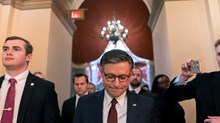 After lobbying from fellow Southern Baptists and Christians affected by the war, the House speaker moves a package forward.





