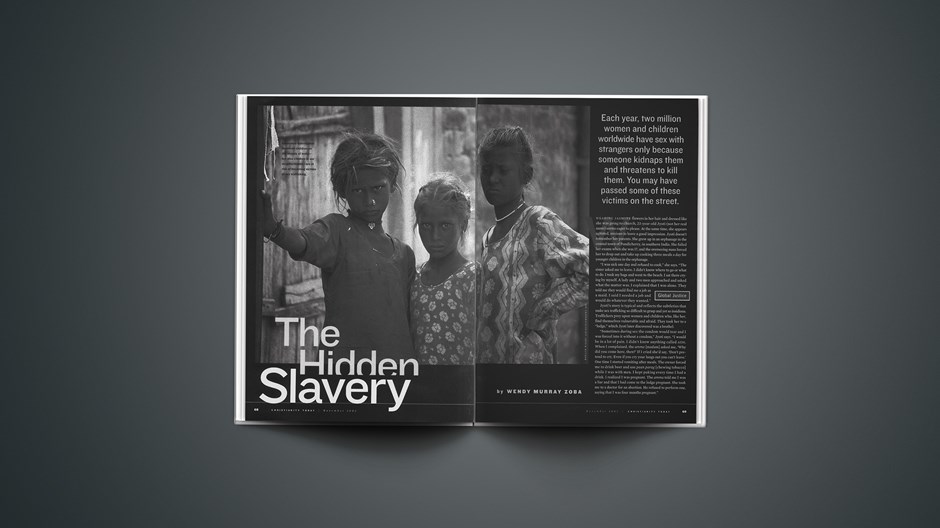
"Each year, two million women and children worldwide have sex with strangers only because someone kidnaps them and threatens to kill them. You may have passed some of these victims on the street"
WEARING JASMINE flowers in her hair and dressed like she was going to church, 23-year-old Jyoti (not her real name) seems eager to please. At the same time, she appears agitated, anxious to leave a good impression. Jyoti doesn't remember her parents. She grew up in an orphanage in the coastal town of Pondicherry, in southern India. She failed her exams when she was 17, and the overseeing nuns forced her to drop out and take up cooking three meals a day for younger children in the orphanage.
"I was sick one day and refused to cook," she says. "The sister asked me to leave. I didn't know where to go or what to do. I took my bags and went to the beach. I sat there crying by myself. A lady and two men approached and asked what the matter was. I explained that I was alone. They told me they would find me a job as a maid. I said I needed a job and would do whatever they wanted."
Jyoti's story is typical and reflects the subtleties that make sex trafficking so difficult to grasp and yet so insidious. Traffickers prey upon women and children who, like her, find themselves vulnerable and afraid. They took her to a "lodge," which Jyoti later discovered was a brothel.
"Sometimes during sex the condom would tear and I was forced into it without a condom," Jyoti says. "I would be in a lot of pain. I didn't know anything called AIDS. When I complained, the ammas [madam] asked me, 'Why did you come here, then?' If I cried she'd say, 'Don't pretend to cry. Even if you cry your lungs out you can't leave.' One time I started vomiting after meals. The owner forced me to drink beer and use paan parag [chewing tobacco] while I was with men. I kept puking every time I had a drink. I realized I was pregnant. The amma told me I was a liar and that I had come to the lodge pregnant. She took me to a doctor for an abortion. He refused to perform one, saying that I was four months pregnant."
Any hour, day or night, Jyoti would be summoned when a "guest" would arrive. The amma would say, "Get ready and come down to meet him." She would then find herself behind a closed door, delivered to her tormenter, tricked, helpless, and alone. How does one measure that? How does one report it? What is the recourse for trust betrayed? What is the measure of a lost sense of self? Of perceptions of love? Of hope in God? Are these betrayals crimes?
They were crimes, but she was generally unable to report them. She was isolated in a world that had stolen her will and reduced her to flesh. She felt like an animal and was so treated. Her countenance had changed from naive hopefulness to drug-sotted lethargic despair. In most cases, women like her are incapable of self-rescue.
Sex trafficking is buying and selling human beings (usually women and children)—and recruiting, transporting, transferring, and harboring them—for sexual exploitation. It is illegal in most countries and violates the Universal Declaration of Human Rights (1948), which asserts that "everyone has the right to life, liberty, and security of person," and that "no one shall be held in slavery or servitude [or] … be submitted to torture." It is a vastly misunderstood crime, because many people tend to perceive prostitutes as willing participants in a "trade." And some gatekeepers of public morality—such as corrupt local police—often fail to defend, let alone rescue, the victimized women and children. Trafficked people are thus twice discarded.
Researchers estimate that two million people are enslaved by the international sex market (as opposed to the general slave labor market). Numbers in the U.S. domestic sex market reach the hundreds of thousands. "There are more slaves alive today than all the people stolen from Africa," notes Kevin Bales in his book Disposable People (Univ. of California Press, 2000).
Forces of modernization have accelerated the resurgence of this "new slavery," as Bales calls it. The dramatic increase in world population, tripling since 1945 (from about 2 to 6 billion), has overwhelmed some developing countries. Rampant unemployment and underemployment give rise to masses of desperate people, producing what Bales calls "a glut of potential slaves."
"Sending" countries supply women and children. Trafficking flourishes, notably, in regions with the greatest population growth: Southeast Asia, the Indian subcontinent, Africa and the Arab world. Rapid social and economic change has meant that poverty has worsened for the underclass while the gap between rich and poor has widened. Women and children in economically desperate situations easily fall prey to tricks of traffickers.
They are then moved to "transit" countries—Mexico and Canada, for example, where they can more easily slip illegally into "receiving" countries like the United States, though Mexico and Canada do their own share of sending and receiving respectively.
The U.S., Germany, and Italy are the top three destination countries, with the Netherlands and Japan close behind. According to one report by the U.N. Office on Drugs and Crime (May 2003), receiving countries are typically developed nations.
Article continues below
An estimated 45,000 to 50,000 foreign women and children cross the U.S. borders each year as fodder for sex trafficking. A layer down, intrastate domestic trafficking networks trade 300,000 to a million each year, according to the Center for Missing and Exploited Children. (The fluid and secretive nature of the trade makes it hard to pin down more specific numbers, CMEC explains.) Domestically or internationally, the script is the same: desperate women are lured with false promises. In the U.S., for example, they are promised work as an au pair or a secretary, a waitress or a maid. But when they arrive at their destinations, the jobs aren't there. They end up in massage parlors, escort services, and dance clubs. They are told they must pay the expenses incurred in finding a job: transportation, rent, food. But in order to earn their keep, the women and children are forced to sell their bodies—at least "temporarily," they are told. But their so-called expenses outpace their income, and victims find it almost impossible to buy themselves out of their captors' clutches (see "Finding the 'Real God,' " below).
Minnesota Nice
Take the case of Heidi, 41, who endured ten years of sex slavery. She grew up in church and was a virgin when she graduated from high school. In college, she experimented with alcohol and became estranged from her strict churchgoing parents. Feeling like a failure, she latched on to a seemingly helpful man who approached her with promises. He said he'd be her "daddy."
"He took time enough to be my boyfriend, then sent me out on the Midwest circuit," she says. This meant she was carted around for weekly stints in strip clubs, forced to live out of rank hotels in small towns all over the Midwest. Her "daddy" and a few of his friends had beaten and raped her a few times, and forced her to take addictive drugs. At the strip club, when she refused raunchy requests, they pelted her with empty shotgun shells. On another occasion a man attacked her while she was on a stage.
"Who's going to protect you?" she asks. "You're in a dark room full of gaping men," which includes police officers, clergy, judges, and politicians. "Who are you going to tell?" she says. At the same time, Heidi's pimp was telling her, "If you leave me, I'll kill you."
She hails from Minnesota, an abundant source for supplying young blondes to the U.S. sex trade. "A blue-eyed blonde girl gets a premium price," she says, "as do church girls." "Minnesota nice," as she calls it, is a vulnerability pimps seize upon. "It's a Scandinavian trait to be polite to people," Heidi says. "Traffickers stalk malls looking for young girls to approach with a compliment or an offer to buy a Coke." Midwestern girls' tendency to be "nice" allows the foot in the door, she says.
Article continues below
In a February 2002 report titled "The Commercial Sexual Exploitation of Children in the U.S., Canada, and Mexico," Richard J. Estes and Neil Alan Weiner of the University of Pennsylvania documented that the sex industry's prime targets are children or youth older than 12. They are often recruited by peers, whom adults "play a very active role in managing" (with incentives like money and drugs). Hundreds of thousands of children are at risk for commercial sexual exploitation and trafficking, the report said.
"Church girls go for very high prices," Heidi says. "Innocence can get a lot of money. The 'tricks' [customers] want fresh-faced young girls."
The New Abolitionists
Sex trafficking is a sophisticated network that pays off sweetly. In The Inner Voice of Love, Henri Nouwen describes a "deep abyss" in every human heart. It is impossible to fill, he says, because the needs are inexhaustible. "You have to work around it so that gradually the abyss closes."
It is similarly impossible to fill the abyss that is sex trafficking. The drives that fuel it—both greed and sexual desire—are insatiable. Still, local champions have arisen. In concert, from various fronts and on differing levels here and abroad, they are working around the abyss. Four mentioned here represent only a few frontline activists among countless others.
The Salvation Army's sprightly but fierce Lisa Thompson, sharply bedecked in the Army's signature blue and brass, leads the church's Initiative Against Sexual Trafficking, which works with over 30 ministries, social agencies, denominational groups, and mission organizations that attack the problem. Thompson and IAST members write letters to legislators and religious authorities, speak in churches, at conferences, and universities, and generally try to create trouble for those who feed or abet this scourge.
The so-called good old boy mentality is a formidable opponent, she says. It reduces the sex trade to a "boys will be boys" proposition, which breeds complacency and a lack of political will. Thompson is determined to change that.
"The historical approach has been to penalize the women as wanton creatures who love sex and want easy money," she says. "But prostitution is not about the women. It is buying and selling human flesh that enables men to have their stable of women for sex without consequences. If you're serious about stopping sex trafficking, then you've got to be serious about the sex industry in general and all its disgusting and multifarious forms. Lack of political will in communities blinds them to what is going on in the 'gentlemen's club' on the corner. It is a blight on communities and the breeding ground for other criminal activity. It is time for law enforcement, prosecutors, and churches to spend time and resources to combat it."
Article continues below
Many U.S. laws need to be changed. In some states, it's merely a misdemeanor to pimp, a slap on the wrist for people who are essentially traffickers. The most powerful element in the demand-supply-distribution network, pimps are too often back on the streets after paying a fine or spending a night or two behind bars.
Thompson also says she hopes to fight bad laws before they're instituted. Among them is a proposal in Nevada to tax the proceeds from prostitution. "This would be a disaster," she says. "Once the lawmakers see prostitution as a solution to their budget problems, we'll have prostitution all over the place."
Self-described feminist Donna Hughes, a professor of women's studies at the University of Rhode Island, combats complacency in the academy. Through articles in academic journals, television appearances, and op-eds she rallies Christians and women's groups to unite in this moral battle.
What motivates her to fight, Hughes says, is the global movement to legalize prostitution, to "clean it up." Prostitution, so goes this line of thought, "empowers" the women who "choose" the vocation. Prostitution is already legal in the Netherlands, Germany, and Australia, and many other nations are considering whether to follow suit. Advocates argue that even prostitutes can possess dignity, but Hughes counters that dignity cannot arise from an industry that misuses and molests women.
She believes that "cleaning up" prostitution and removing legal constraints actually propels the sex trafficking industry. The Netherlands is a case in point. The sex industry there is a billion-dollar business that accounts for 5 percent of the economy, an increase of 25 percent in 10 years. Women in the industry come from 32 different countries, signaling a "predatory dependence on foreign women to meet the demand for flesh in Dutch brothels," to quote from a letter to Pope John Paul II, which Hughes signed. The government has a vested interest "in maintaining the transnational flow of women and children for commercial sexual exploitation" because the financial stakes are so high.
Article continues below
Hughes commends the State Department's Laura Lederer for breaking new ground in foreign aid policies. Some government aid agencies, in an attempt to "minimize harm" to those active in the sex trade, have unwittingly acquiesced to the trend of normalizing this behavior. Lederer, a senior adviser on trafficking in The Office of Global Affairs at the U.S. Department of State, has waged this "epic battle" (her words) at the highest levels of government for over ten years. She describes one telling incident from a conference on child trafficking at the Columbia School of Public Health in New York. "A wonderful group of doctors, nurses, public health officials and NGOs presented their work from all around the world. One NGO gave a slide presentation that showed a small building behind a medical clinic. It turned out that children—6, 7, and 8 years old—were coming [for treatment] because they were involved in what the NGO called 'sex work.' The slide presentation highlighted [workers] teaching young women and children how to use condoms and how to say in English, Japanese, and German, 'Please use a condom when you penetrate me.' What started out as a way to keep young women and children from getting and spreading AIDS had become part of the sex industry. Nobody was saying, 'This is illegal everywhere around the world, and we need to intervene.' They were making it possible for men to have access to younger and younger children."
Lederer quickly adds that USAID (the United States Agency for International Development) would deny funding to such programs. She says grants are dispersed in seven-figure checks to "big Beltway organizations." The subsequent subgrants and subcontracts are difficult for USAID to track. Lederer does not impugn the general work of NGOs. She salutes NGO workers who, often at personal risk, are rescuing women and children from the world's saddest places. Nevertheless, her researchers turned up conclusive evidence that the slide presentation represented "one of many" such examples.
Here's the good news: Lederer has seen more progress in the last three years than in the past twenty. She says the Trafficking Victims' Protection Act, which became law in October 2000, "gives organizations and law enforcement tools to go after traffickers." It raises the stakes for trafficking. Previously the matter was addressed under transportation laws and carried a five-year maximum sentence for violators, most of whom ended up serving three months, if convicted at all. The new law ratchets up the maximum sentence to 20 years and targets not just pimps but the entire sex trafficking network: recruiters, buyers, sellers, harborers, guards, and transporters of women and children. They can and will be charged, prosecuted, and convicted under this new law, she says: "It sends a strong message to traffickers. The law is the model for all other laws around the world."
Article continues below
President Bush issued a National Security Presidential Directive (NSPD) in February that called prostitution inherently harmful and degrading to women and stressed the importance of identifying, protecting, and assisting victims exploited by traffickers. It was the first NSPD ever issued on trafficking. The NSPD, in turn, prompted USAID administrator Andrew S. Natsios to announce the agency's intention to fund only those NGOs that will "monitor and combat this horrendous attack on the fundamental rights of vulnerable populations." In other words, USAID has moved from a position of "minimizing harm" to one of "report and rescue." Exactly how aid workers on the ground are to go about the "reporting and rescuing," Lederer says, is messy and still being worked out.
"People object that they aren't able to discern who is being trafficked and fear that monitoring it will put people in danger," she says. She concedes that aid workers are not police officers. At the same time, they are not powerless. "Anybody who encounters a six- or seven-year-old in a brothel can be assured that child is trafficked. They need to report to embassies, making it clear they've seen something illegal."
Hidden in Plain Sight
Thompson, Hughes, and Lederer are working at the grassroots, academic, and national levels. Al Erickson, in the meantime, works in the church. A quiet, simple pastor in the Evangelical Lutheran Church in America, he has learned dearly what the sex trade can do to a family.
In the late 1980s, a person whom he only describes as his "loved one" faced a hard time in college and found solace in the company of a polished young man she met at a Christian gathering. She eventually followed him to California—"which was a dumb thing to do, but people do dumb things," Erickson says—and ended up drugged and forced into prostitution at the point of semi-automatic weapons. "You're caught in a terrorizing world," he says. "If you don't understand this issue, you're probably buying the lie that prostitution is a choice and so think, 'My kid would never make that choice.' It is violent and ugly and needs to be exposed for what it really is."
Article continues below
Erickson is founder and director of Adults Saving Kids, a church-based ministry to help families protect their children. Erickson's denomination has issued "A Message on Commercial Sexual Exploitation", which explains sexual exploitation and what churches can do to combat it. The statement is a model other churches and denominations are following.
Erickson is troubled by the reticence he senses among Christians to face this issue honestly and boldly. It is due in large part to the lack of knowledge about how sexual exploitation works and what is at stake. Heidi, who knows Erickson and his work, concurs: "In every church there are husbands addicted to pornography, a child who may be being seduced, or a woman who was once trapped in prostitution. But they can't talk about it in church. So they keep it inside as a dark secret."
Donna Hughes says the sex trade "is hiding in plain sight, in massage parlors you pass in shopping centers, in escort services advertised in your Yellow Pages." She and Heidi and Thompson and Lederer and Erickson would join in chorus encouraging citizens to act: Write letters to local papers; pressure town councils to outlaw such places.
One citizen group Heidi knew of hovered near the parking lot of an adult club and photographed license plates on parked cars. With the help of local police, they tracked the owners and sent letters saying, "Your car was seen on this property."
Healing Comes
Jyoti tested positive for HIV and gave birth. Her baby, also HIV-positive, was taken from her. A Christian NGO (which asked not to be named) took her into its care home, where she began making teddy-bear key chains and paper flowers.
"It is very difficult for those engaged in prostitution to change their behavior overnight," says Jyoti's counselor, Tabitha Malini. In an odd and heartbreaking twist, some women don't want to be rescued. They become conditioned to the degradation. "When a woman remains in an abusive relationship with a partner who batters her, or even when she defends his actions, concerned people recognize the complexity of her compliance," says a report issued by the Coalition Against Trafficking in Women International titled "10 Reasons for Not Legalizing Prostitution" (March 2003). "Like battered women, women in prostitution often deny their abuse if provided with no meaningful alternatives."
Article continues below
"We've been working with Jyoti for the past three months," says Malini. When asked about her aspirations, Jyoti said she'd like to complete the tenth grade, work in a respectable job, and overcome her unhealthy sexual appetite for men. She wants to be a "good person."
Heidi has overcome her unhealthy sexual appetite for men and she is now completing a master's degree in psychology. She wants to counsel victimized women, and encourage them that they can recover "through therapy, twelve-step programs, and faith."
She recalls as a young girl of 20 being trapped in a second-rate hotel room because church women outside were holding signs that read WHORE. But she was a church girl at heart.
She remembers flipping through channels looking for religious programs. "I remember crying, being high and beat up, but feeling too dirty to go to church. Christians need to understand that [the prostitute] is not the enemy. She's a victim. She could be your daughter."
Wendy Murray Zoba is a senior writer for CT. Freelance writer Susan George reported from India.
Organize a group of people who can provide practical help for victims or potential victims.
Support Christian organizations that fight sex trafficking.
Report suspected abuse to the Trafficking in Persons and Worker Exploitation Task Force at the U.S. Department of Justice (888.428.7581) and to the fbi field office nearest you (find it at www.fbi.gov/contact/fo/fo.htm).
Refer suspected victims to counselors recommended by the Initiative Against Sexual Trafficking (703.519.5896) or by Shared Hope International (www.sharedhope.org).
Write a congregational letter to your congressional representatives asking them to make a priority of combating sex trafficking.















 While we pray for peace, we need moral clarity about this war.
 As my doubts about his teachings grew, so did a secret fascination with Jesus.
 When I married into a Jewish family, antisemitism hit home. Now, the holy day reminds me of our future hope.






