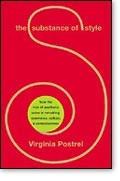
I can't decide if it's a paradox, an irony, or evidence that Virginia Postrel's publisher hates her. In her new book, The Substance of Style, Postrel preaches the importance of aesthetics—the "look and feel" of things—in selling products. She also argues that an author's attractiveness can be a major asset in book sales—see the back cover of works by Michael Lewis. So what did HarperCollins do? It slapped an ugly red-and-green cover on the dust jacket and went with a small black-and-white mug shot of this very photogenic author.
That was unfortunate, because, through a process Postrel calls the "aesthetic ratchet effect," such a cover is … not likely to help book sales. Though it would not have looked out of place in the '70s and '80s, we have lately come to demand more of our goods and services. It's no longer enough that products function properly, we want them to look cool too, to reflect well on the buyers—that is, us.
So, on the one hand, there is a massive amount of money to be made from satisfying customer demand for better-looking things (e.g., designer toasters or the new VW bug). On the other, this creates something like an aesthetic arms race, where products have to look better in order not to be left behind. I fear the look of this book may confine most of the copies to the industry equivalent of the dustbin of history, the remainder bins.
That would be a shame. Though the new tome isn't up to the level of her previous one, The Future and Its Enemies, Postrel does a good job of showing just how much the U.S., in particular, changed during the '90s. Judging by nearly every indicator, there was an explosion of options in every sphere of life. In dress, in transportation, in housing, in cosmetics, even in toiletries, customers demanded more and got it. As a result, a whole aesthetics industry sprang up: Martha Stewart showed us what a good thing a little home decor could be; dozens of fashion and design magazines hit newsstands; companies such as General Electric started whole aesthetic divisions to get a well-pedicured leg up on the competition.
Of course, The Substance of Style does more than report on a phenomenon, it also attempts to understand why this happened, give us a picture of the future, and re-frame the way we think about the look and feel of things. Here the results are mixed. Postrel persuasively demonstrates that baby boomers and the credit cards they wielded with abandon laid the ground for the explosion of choices. Boomers created a larger market for goods by virtue of their demographic heft; credit cards turned a series of essentially local markets into one national one.
As for why the explosion occurred when it did, she is less than fully convincing. In order to rebut some critics of consumer culture, she only briefly nods at the keeping-up-with-the-Joneses aspect of aesthetic improvement, and says that the only alternative to the aesthetic ratchet effect would be to impose controls, in the form of regulation or taxation—Very Bad Things, but also very much straw men.
Postrel is on much stronger ground when she is showing how our aesthetic sense is fundamental to human nature. She spends a good deal of time undercutting psychologist Abraham Maslow's famed hierarchy of needs. The late professor had structured basic human necessities as a pyramid—e.g., once basic food and shelter were secured, people would see to their health needs, then their belonging needs, etc. Aesthetic delights, according to Maslow, were a luxury, to be satisfied only after the other foundations were firmly in place. Postrel argues that this is bunk. Before recorded history, our ancestors were carving bones and painting caves, going beyond the strictly utilitarian to make things look and feel more pleasant to their senses. Tolkien (not Postrel) would say we are sub-creators, made in our Creator's image. And clearly God is the supreme connoisseur of Style, the cosmos emerging from his studio in all its superb extravagance.
Jeremy Lott is assistant managing editor of The American Spectator.
Books & Culture Corner appears every Monday. Earlier editions of Books & Culture Corner and Book of the Week include:
Back to the Future | A sprawling new novel by the author of Snowcrash and Cryptonomicon goes to the 17th century to investigate the birth of the modern world. (You won't be surprised to learn that the Puritans are among the Bad Guys.) (Oct. 13, 2003)
Terrorists on Trial | How the nation responded to an earlier attack. (Sept. 29, 2003)
The Contemplative Christian | Eugene Peterson calls believers to a life lived with "wholeness, honesty, without contrivance"-against the grain of much that's currently driving the church in America. (Sept. 29, 2003)
Article continues below
Recalling California | Want to understand what's going on in the Golden State? Toss your newsmagazines and pick up Joan Didion's new book (Sept. 22, 2003)
The Ph.D. Octopus, 100 Years On | How Christians can make a difference in the upside-down world of graduate school (Sept. 15, 2003)
A New View of Worldview | Some critics want to retire the concept. Not so fast, says David Naugle (Aug. 18, 2003)
'A Golden Age' of Religious Tolerance? | The Ornament of the World analyzes how the intellectual elites of medieval Spain eschewed fundamentalism and showed surprising sensitivity in reconciling competing truths. (Aug. 11, 2003)
Looking for the 'I' | What happens to the self when the brain is injured or malformed? (Aug. 4, 2003)
The Terror of the Therapeutic | Margaret Atwood's new novel considers the price we may pay for looking to technology to remedy our ills, personal and social. (July 28, 2003)













 While we pray for peace, we need moral clarity about this war.
 A Christian reconciliation group in Israel and Palestine warned that war would come. Now the war threatens their relevance.españolالعربيةFrançais
 After lobbying from fellow Southern Baptists and Christians affected by the war, the House speaker moves a package forward.





