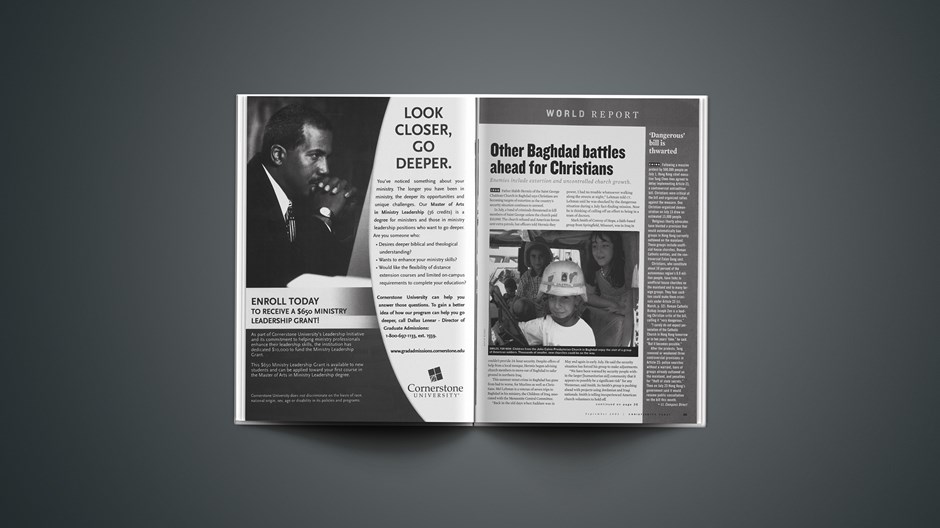
Father Habib Hermiz of the Saint George Chaldean Church in Baghdad says Christians are becoming targets of extortion as the country's security situation continues to unravel.
In July, a band of criminals threatened to kill members of Saint George unless the church paid $10,000. The church refused and American forces sent extra patrols, but officers told Hermiz they couldn't provide 24-hour security. Despite offers of help from a local mosque, Hermiz began advising church members to move out of Baghdad to safer ground in northern Iraq.
This summer street crime in Baghdad has gone from bad to worse, for Muslims as well as Christians. Mel Lehman is a veteran of seven trips to Baghdad in his ministry, the Children of Iraq, associated with the Mennonite Central Committee.
"Back in the old days when Saddam was in power, I had no trouble whatsoever walking along the streets at night," Lehman told CT. Lehman said he was shocked by the dangerous situation during a July fact-finding mission. Now he is thinking of calling off an effort to bring in a team of doctors.
Mark Smith of Convoy of Hope, a faith-based group from Springfield, Missouri, was in Iraq in May and again in early July. He said the security situation has forced his group to make adjustments.
"We have been warned by security people within the larger [humanitarian aid] community that it appears to possibly be a significant risk" for any Westerner, said Smith. So Smith's group is pushing ahead with projects using Jordanian and Iraqi nationals. Smith is telling inexperienced American church volunteers to hold off.
"At this point we're just saying, 'It's not the time to come yet.' And we're not sure when that time will be," Smith said.
Leadership in transition
Christians enjoyed relative freedom under the violent and cruel regime of Saddam Hussein (CT, Nov. 18, 2002, p. 34). Baghdad's churches are distinguished and well-kept buildings in the heart of the city. They operated for decades with no special security or restrictions on who came or went.
Some members of the minority Christian community publicly identified with Saddam's brutal reign. "Many Christians were members of the Baath Party," Hermiz said, including Tariq Aziz, the foreign minister familiar to many Westerners.
Ikram Mehanni, a senior pastor of the John Calvin Presbyterian Church, said many people, including his own daughter, signed up solely for the economic and social benefits. Then there were those who were "born into the party," he said. "They can never be changed. Even if they ask for forgiveness, deep down they will stay a Baath member."
"None, so far" have spoken to him of repentance, Hermiz said. "Maybe alone, with themselves, they have done it. We need repentance."
Mehanni said Iraqis are casting out religious officials linked to Saddam's regime. He said all of the Muslim clerics he knew in Baghdad who held power during that period have been removed.
Among those recently ousted is one of Iraq's most prominent church leaders. Georges Hormis Sada, 63, former chairman of the Assembly of Evangelical Presbyterian Churches-Iraq and a former air vice marshal in Saddam's air force, was dismissed from leadership, although he remains a member of the John Calvin Presbyterian Church (also known as National Presbyterian Church).
Mehanni and several church members said Sada, who was also church president, was dismissed because he went abroad for eight months, and thus missed three consecutive meetings of the church council, a violation of church bylaws. Sada has relatives in the United Kingdom. Church leaders declined to elaborate on the reasons for Sada's dismissal. Sada was unavailable for comment.
Sada maintains a good reputation outside Iraq. In June, Coventry Cathedral in England named Sada one of two winners of its 2003 Coventry International Prize for Peace and Reconciliation.
A cathedral spokeswoman said in a press release, "In the first Gulf War [Sada] had responsibility for prisoners of war but was eventually thrown into prison by Saddam Hussein for refusing to kill them. He is also working fervently for the rebuilding of a democratic Iraq."
Sada is scheduled to receive the prize in Coventry on November 14.
Independent spirit
Baghdad's Christian leaders are also worried about the growth of new independent churches, potentially aggravating relations with Muslims.
Saddam forbade group meetings in private homes—a ban that applied to grassroots church meetings. The regime also prohibited building two churches of the same denomination in any one neighborhood.
Mehanni said thousands of new, small churches may open in Iraq, and "many people in America might be happy about that." But he worries that the Christian community will lose clout as it diffuses into the countryside. There are only a relative handful of official churches in the country.
"I believe it's better to support existing churches, and make them an umbrella" for Christian work, said Mazim Yousif, a John Calvin church council member. Yousif said competing for members "is like stealing other people's sheep."
Article continues below
Some Americans who have visited Baghdad in recent months have attended the grassroots church services that worry Christians such as Mehanni. Held in private apartments packed with joyous people, they are organized by Iraqi Christians who want something different from the established church order.
The word is spreading in ways unimaginable under Saddam. Amid the vast, decadent opulence of one of the dictator's presidential palaces, U.S. Army Chaplain Ron Prosise preached in front of a huge mural showing missiles roaring into the air and under a domed ceiling about 40 feet high.
Prosise also discussed his faith over lunch with an Iraqi Muslim who works in the Ministry of Education. He hopes many such low-key conversations will lead Muslims there to convert to Christ.
"It wasn't a planned thing," Prosise said. "We were talking about God and life and beliefs. We both really enjoyed that opportunity to exchange ideas."
Arab to Arab
Convoy of Hope's Smith, however, acknowledges that Iraqis will have to shoulder much of the evangelistic burden.
"Now, you may hear certain groups say, 'We've had some victories here, some victories there.' But in the long run, I think it's got to be Arab to Arab," Smith said.
A group of Egyptian Christians visiting Iraq on a medical relief mission said they're very hopeful about the future. One of them, Maher Fouad of the Arab World Evangelical Ministers Association, said he sees a spiritual awakening throughout the Middle East.
"I can tell you yes, for sure, the coming days will be better spiritually," Fouad said. "We are expecting a kind of spiritual revival in the coming days. There is a big spiritual vacuum in the hearts of people all over. People are looking for God.
"When people know about Jesus, they come," Fouad said. "I think for Iraq, the churches begin to awake, and move ahead."
Hermiz pointed out that Christians in Iraq have weathered many storms over the years—and will continue to do so.
"Don't worry about the Christians in Iraq," he said. "We've been here 1,800 years."
CT Classic: Weeping over Baghdad | Desert Storm cost Iraq thousands of lives. At its conclusion, a Christianity Today editorial called for the church to deal with the living souls that remained. (March 21, 2003)















 While we pray for peace, we need moral clarity about this war.
 As my doubts about his teachings grew, so did a secret fascination with Jesus.
 NIL deals in college athletics present new challenges—and opportunities—for colleges and students.






