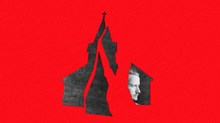
Presbyterian Leader Suspended After Admitting Sexual Misconduct as Seminary Head
"Gay bishop costs Anglicans dialogue with Muslims, Canadian pastors say vote today could ban Bible, and other stories from online sources around the world"
A month later, the Presbytery of Transylvania, which overseas Presbyterian Church (U.S.A.) congregations in eastern Kentucky, launched an investigation into allegations of sexual misconduct. Yesterday, Mulder admitted the misconduct, and was suspended from his ordained office for 14 months by the presbytery.
"In the final years of my presidency I yielded to personal temptation by inappropriately engaging in sexual conduct with adult women outside my marriage vows, my pastoral vows, and contrary to Scripture," Mulder wrote in a letter to the seminary's faculty and student body. "I ask now your forgiveness for these sins, and for the harm they have caused the Seminary."
In his letter, Mulder also noted that he is being treated for medical depression and alcohol abuse.
The Louisville Courier-Journal notes that "sexual misconduct" has a specific meaning in the PCUSA: it's "a misuse of authority and power that breaches Christian ethical principles by misusing a trust relation to gain advantage over another for personal pleasure in an abusive, exploitative, and unjust manner." But the paper says it's unknown if Mulder sexually abused his authority with seminary employees or students.
"That is not the issue, who they are," Dorothy Ridings, chairwoman of the seminary's board of trustees, told the paper. "The issue is that it happened." She did, say, however, that Mulder's actions were not criminal, and that the board knew about the misconduct when Mulder resigned, but wanted the presbytery to investigate before taking any action.
"If you go back and look at that [news] release [when Mulder's resignation was announced], everything was honest," she said. "It doesn't say everything, though." Ridings told The Presbyterian Outlook that the board's knowledge of the misconduct was "absolutely" a factor in Mulder's resignation.
Only three years ago Donald McCullough was forced to resign as president of San Francisco Seminary, another PCUSA school, for sexual abuse, which the denomination defines separately from sexual misconduct. (He was restored to active ministry in November 2001.)
This is a very sad development, not just for a denomination, but for a man who has had tremendous influence on it. Mulder, author of Vital Signs: The Promise of Mainstream Protestantism and works on Woodrow Wilson, was highly influential in bringing the PCUSA's headquarters to Louisville, septupled the seminary's endowment, and doubled its faculty.
Muslims castigate Anglicans African Primates of the Anglican Communion said that the church's interaction with Muslims would get much harder with the Episcopal Church USA's confirmation of a homosexual bishop. They were right. Late last week, top Islamic scholars from Egypt withdrew from a meeting with Archbishop of Canterbury Rowan Williams and other top Anglicans in protest.
"The Muslims can't understand why Christians are ignoring the revelations given to us," Bishop of Rochester Michael Nazir-Ali told The Daily Telegraph. "This is very serious in the present international situation."
Meanwhile, The East African of Kenya reports that "the divisions within the Worldwide Anglican Community are not as clear cut as they appeared to be at the beginning of the ongoing debate on gay clergy." But is it true? The paper notes comments from South African archbishop Winston Njongonkulu Ndungane and his predecessor, Desmond Tutu, who both said that gay bishops were not a big deal. But orthodox Anglicans weren't all that surprised by these comments, and South Africa often sides with more liberal churches in Europe and North America rather than its counterparts in Africa, Asia, and Latin America. Make no mistake: the Anglican Communion really is divided, and the Primates' meeting in October is going to be a serious one.
More on the impending Anglican breakup:
Church gay row reignites | Senior evangelicals are expected to call for the Church of America and Canada to be suspended from the Anglican Communion for allowing a gay man to become a bishop (Sky News, U.K.)
Anglicans face schism over gay row | Conservative US bishops prepare to take on liberal British wing in bitter struggle for Church's soul (The Observer, London)
Trinity associate priest resigns | Cites conservative, 'schismatic' direction local church is going (Columbus Ledger-Enquirer, Oh.)
More articles
Homosexuality and Canada:
Marriage divides the House | The deep divisions within the Liberal government on plans to legalize gay marriage were laid bare Tuesday in the House of Commons when the Grits barely survived an Alliance motion to preserve the traditional definition of marriage (The Globe and Mail, Toronto)
Earlier: Alliance motion on marriage a trap: PM | Warns of threat to the equality rights of gays, lesbians, calls on Liberals to defeat resolution today (Toronto Star)
Religious groups fear Bible may become illegal | Bill C-250 would include sexual orientation into Canada's hate propaganda law that already bans inciting hatred against an "identifiable" group defined by color, race, religion or ethnic origin (Calgary Sun)
For filmmakers, pastor's story was personal | Dawn Mikkelson and Jamie A. Lee chronicle a lesbian ELCA minister in the documentary This Obedience (Pioneer Press, St. Paul, Minn.)
$250,000 chokes Liberia for Jesus | Barely two months following the presentation of the checks, executives and other officials of the LFJ have declined to disclose the name of the local bank in which the check is being deposited (The News, Monrovia, Liberia)
Mercy Ministries changes girls' lives | Residential program treats girls who have suffered from sexual abuse, addiction to drugs or a myriad of other problems (The Tennessean)
An unlikely Eden | Equipped with a hi-tech bus and DIY skills, an army of evangelical Christian youth workers has taken its brand of social healing to the housing estates of Manchester. But their efforts to breathe new life into rundown areas are proving controversial (BBC)
Pastors:
The pastor's champions | John Paul Hankins has inspired for decades, and now, as he's forced to retire, his congregation has been moved to 'acts of disobedience' in its effort to sway the bishop (Newsday, Long Island, N.Y.)
Revival leader starting Southlake church | Steve Hill, best known for his five-year revival at a church in Pensacola, Fla., is leaving the road (Ft. Worth Star-Telegram)
Article continues below
The prophet of profit sows the seeds of wealth | Encouraged to "sow seeds" of prosperity, followers attending E. Bernard Jordan's services in Manhattan and, since July, at the church's new retreat in the Sullivan County hamlet of Woodbourne, donate or pledge sums of as much as $10,000—contributions that they expect to bring them greater wealth (The Record, Middletown, N.Y.)
Churchgoers want meters to honor the Sabbath, too | The city's Transportation Department extended the amount of time available in the parking meters, from one to two hours, in the vicinity of two Brooklyn churches (The New York Times)
Education:
Churches call for Christianity to be part of national syllabus | The Church of England, the Methodist Church and the Free Churches have written to Charles Clarke, the Education Secretary, calling for an end to the current system of allowing local councils to determine what religion is taught in schools (The Daily Telegraph, London)
Baylor regents throw embattled Sloan strong support | But in acknowledgement of recent turmoil, controversy and scandal, they also appointed committees to examine issues that have divided the campus, alienated alumni and donors, and caused a schism among veteran faculty and newer hires (Waco Tribune-Herald)
Can Baylor balance Christian mission, on-court success? | While emphasizing that no one is immune from potential problems, officials at Brigham Young and Notre Dame—two renowned universities with religious ties—say it's absolutely possible (Associated Press)
Speakers focus on evolution | Although not exactly the Scopes "monkey trial," scores of sometimes-unruly critics and proponents of modern evolutionary theory squared off Wednesday before the Texas State Board of Education (Ft. Worth Star-Telegram)
Senate resumes consideration of abortion ban bill | After a nearly three-month delay, the U.S. Senate this week is expected to formally begin final negotiations on a bill to ban a procedure that opponents call "partial birth" abortion (Reuters)
Article continues below
Womb 'smile' fires abortion row | Images published for the first time yesterday suggesting unborn babies smile, blink and cry months before they leave the womb have renewed calls for abortion to be outlawed (The Age, Melbourne, Australia)
California cases impact raging fetal rights debate | A national debate raging over fetal rights has been influenced by two central California tragedies, more than three decades apart (The Modesto Bee)
State high court turns away appeal by abortion doctor | The Arizona Supreme Court has turned away an appeal filed on behalf of an abortion doctor whose manslaughter conviction prompted the Legislature to regulate abortion providers (Associated Press)
Russia turns spotlight on abortion | Russia could be on the point of a significant change in direction on morality and sexual issues, as a major debate looms over the rights of women and unborn children (BBC, video)
Johnny Cash:
Family pastor sings praises of Johnny Cash | Courtney Wilson shared many of the big moments in the lives of Johnny Cash and his family, both happy and sad (The News Examiner, Gallatin, Tenn.)
Tangled up in Bob | Leading Dylanologist Christopher Ricks concludes his obsessive pursuit of an elusive quarry in Dylan's Visions of Sin (The Observer, London)
Christian singer promoting music as instrument of faith | When faith and show business mingle, the message gets fuzzy. What's so refreshing about singer Natalie Grant is her honesty about the issue. (David Crumm, Detroit Free Press)
Bono has talk with Bush over AIDS funds | "He's very passionate about these problems and I believe him," Bono said after their White House meeting. "I just can't agree with the numbers." (Associated Press)
Earlier: Bono's American Prayer | The world's biggest rock star tours the heartland, talking more openly about his faith as he recruits Christians in the fight against AIDS in Africa (Christianity Today, Feb. 21, 2003)
Garner Ted Armstrong dies at 73 | He was one of the most successful, but also the most controversial, of American television evangelists (The Daily Telegraph, London)
Earlier: From the Fringe to the Fold | How the Worldwide Church of God discovered the plain truth of the gospel (Christianity Today, July 15, 1996)
Earlier: Splinter Groups Dismiss Leaders | Church of God, International, revokes the ministerial credentials of Garner Ted Armstrong (Christianity Today, Mar. 2, 1998)













 While we pray for peace, we need moral clarity about this war.
 A Christian reconciliation group in Israel and Palestine warned that war would come. Now the war threatens their relevance.العربيةFrançais
 But experts say it can offer opportunities for leaders and congregations to grow.





