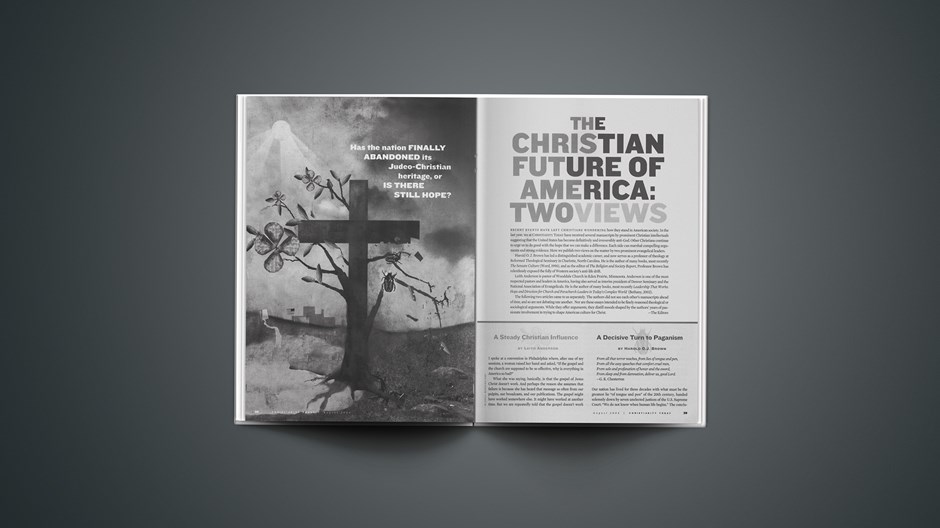
Recent events have left Christians wondering how they stand in American society. In the last year, we at Christianity Today have received several manuscripts by prominent Christian intellectuals suggesting that the United States has become definitively and irreversibly anti-God. Other Christians continue to urge us to do good with the hope that we can make a difference. Each side can marshal compelling arguments and strong evidence. Today and tomorrow we will publish two views on the matter by two prominent evangelical leaders.
Harold O. J. Brown has led a distinguished academic career, and now serves as a professor of theology at Reformed Theological Seminary in Charlotte, North Carolina. He is the author of many books, most recently The Sensate Culture (Word, 1996), and as the editor of The Religion and Society Report, Professor Brown has relentlessly exposed the folly of Western society's anti-life drift.
Leith Anderson is pastor of Wooddale Church in Eden Prairie, Minnesota. Anderson is one of the most respected pastors and leaders in America, having also served as interim president of Denver Seminary and the National Association of Evangelicals. He is the author of many books, most recently Leadership That Works: Hope and Direction for Church and Parachurch Leaders in Today's Complex World (Bethany, 2002).
These two articles came to us separately. The authors did not see each other's manuscripts ahead of time, and so are not debating one another. Nor are these essays intended to be finely reasoned theological or sociological arguments. While they offer arguments, they distill moods shaped by the authors' years of passionate involvement in trying to shape American culture for Christ. —The Editors
I spoke at a convention in Philadelphia where, after one of my sessions, a woman raised her hand and asked, "If the gospel and the church are supposed to be so effective, why is everything in America so bad?"
What she was saying, basically, is that the gospel of Jesus Christ doesn't work. And perhaps the reason she assumes that failure is because she has heard that message so often from our pulpits, our broadcasts, and our publications. The gospel might have worked somewhere else. It might have worked at another time. But we are repeatedly told that the gospel doesn't work anymore; we have had ample opportunity in America for the gospel to have significant impact, but what we often hear is that things are getting far worse.
So how bad are things in the United States? Indeed, we live in difficult times. Not one of us needs to look very far to see the effects of sin. We have corporate corruption, pornography, abortions, divorces, anemic churches, 5 million couples living together who are not married, clergy immorality, drug abuse, and more.
But that really isn't anything new, is it? In the history of America, the roots of deism and secularism go back a long way. Books like Undaunted Courage, about the Lewis and Clark expedition, and Theodore Rex, the biography of Theodore Roosevelt, remind us of the appalling immorality, drug abuse, and business and political corruption that permeated generations 100 and 200 years ago.
So things have been bad, and continue to be bad, in lots of ways. But what kind of influence are Christians having on our country today?
The Difference We Make
One hundred and fifty years ago, slavery became illegal in America when abolitionist Christians put their lives on the line for human freedom. One hundred years ago in America, opium, laudanum (an opium-based painkiller), and morphine use was so pervasive that it produced an unprecedented number of addicts. One hundred years ago, the Sears and Roebuck catalog sold heroine and syringes through the mail. Fifty years ago theological liberalism dominated the religious landscape of America, and born-again Christians were clearly on the margins of society.
Today, those who publicly state that they are born-again Christians include the President of the United States, the attorney general, the national security adviser, governors of many states, members of Congress, senators, CEOs of our largest corporations, university professors, bestselling authors like John Grisham, country music stars like Randy Travis-on and on the list goes.
New York City had a reputation a generation ago for being one of the dirtiest and most unsafe cities in the world. Today it has one of the lowest crime rates, per capita, in the country. More than three-quarters of Americans describe themselves as Christians. Churches where the Bible is taught and holiness is lived are multiplying and flourishing. The largest and most effective churches in America, almost without exception, have a serious commitment to the truth of the Bible and the authority of Jesus Christ.
There are fewer R-rated films produced now than there were 10 years ago. And one of the most successful R-rated films is The Passion of the Christ. The bestselling books in America, and around the world, in recent years have included The Prayer of Jabez, Left Behind, and The Purpose-Driven Life.
Article continues below
I remember well when pornography magazines were sold in 7-Eleven and other convenience stores. I don't recommend that you go and look for them, but you would have difficulty finding those publications readily available in those stores today.
The New York Times editorialized recently that evangelical Christians in America are shaping U.S. foreign policy toward righteousness.
And on it goes. Christians are living holy lives that are having an enormous impact within our society.
Some Christian leaders say that Christianity in America is, in fact, 3,000 miles wide and one inch deep. As someone who travels a great deal in this country and interacts across the nation on a weekly basis with Christians, I simply say, that's not my experience.
One way to test that theory is to take out the sharp knife of tragedy and cut deep to see what's under an inch of American Christianity. I remember the day of tragedy at Columbine High School. My wife, Charleen, and I walked the perimeter of the fence and saw the thousands upon thousands of notes and little shrines that were established. We spent hours reading them, and almost all of them acknowledged a loyalty to God and a love for Jesus Christ.
I was commuting to a job in Washington D.C. when the sniper tragedies were taking lives at random around the metropolitan area. And I watched carefully on television when people who were absolutely shaken by the tragic deaths of family members stated that their only hope and confidence was in Jesus Christ and that Jesus Christ had given them strength, stability, and peace in the midst of their difficulties.
September 11, 2001, produced more testimonies to Jesus Christ than anything that I can remember in recent times.
On September 29 of last year, there was a shooting in a Hennepin County Courthouse in the Twin Cities in Minnesota. A severely wounded attorney lay bleeding on the floor of the courthouse hallway. The Minneapolis Star Tribune in a front-page story told about the woman who knelt down in front of this man. She pressed her navy blue suit jacket so hard against the wound on his neck that her arm shook. "Jesus, please save this man," she prayed over and over. "Jesus, don't let this man die."
We often hear cynical Christians condemn the impotence of American Christianity, but listen to a real cynic: Justin Webb, the bbc correspondent in Washington, D.C. He spoke about his postings in Belgium, London, and then the United States.
Article continues below
My wife and I do not believe in God. In our first posting in Brussels among the nominally Catholic Belgians, unbelief was not a problem. Our house in London was right next to a church. We talked to the tiny congregation about the weather, about the need to prune the rosebushes and mend the fence, but we never talked about God. How different it is here on this side of the Atlantic.
I'm not talking about the Bible Belt-or about the loopy folk who live in log cabins in Idaho and Oregon and worry that the government is poisoning their water. I'm talking about Mr. and Mrs. Average in Normal Town, U.S.A. Mr. and Mrs. Average share an uncomplicated faith with its roots in the Puritanism of [their] forbears. According to that faith there is such a thing as heaven-86 percent of Americans, we are told by the pollsters, believe in heaven.
But much more striking for me and much more pertinent to current world events is that 76 percent, or three out of four people you meet on any American street, believe in hell and the existence of Satan. They believe the devil is out to get you, that evil is a force in the world-a force to be engaged in battle. Much of the battle takes place in the form of prayer. Americans will talk of praying as if it were the most normal, rational thing to do. The jolly plump woman who delivers our mail in the Washington suburbs has a son who is ill-the doctors are doing their best, she says, but she's praying hard and that's what will do the trick.
And so I'll tell you, I'm awed. I'm impressed and awed by Christians in America who in facing unexpected tragedies turn to God.
Growing Wheat
Jesus' parable of the wheat and the weeds in Matthew 13 is fitting for us who live in the best of times and the worst of times. Servants asked the master whether they should tear out the weeds that had unexpectedly grown up alongside the wheat. The master replied no: "Because while you are pulling the weeds you may root up the wheat with them. Let both grow together until the harvest. At that time I will tell the harvesters, first collect the weeds and tie them into bundles to be burned and then gather the wheat and bring it into my barn."
Let there be no doubt, wheat and weeds are growing side by side in America. But Jesus tells his followers not to worry about pulling up the weeds-he will take care of that later. Instead he tells his followers to grow the wheat.
A ready-to-download Bible Study on this article is available at ChristianBibleStudies.com. These unique Bible studies use articles from current issues of Christianity Today to prompt thought-provoking discussions in adult Sunday school classes or small groups.
Have something to add about this? See something we missed? Share your feedback here.
Our digital archives are a work in progress. Let us know if corrections need to be made.

















 While we pray for peace, we need moral clarity about this war.
 As my doubts about his teachings grew, so did a secret fascination with Jesus.
 The Grammy-winning artist was found dead at her home in Nashville at age 47.






