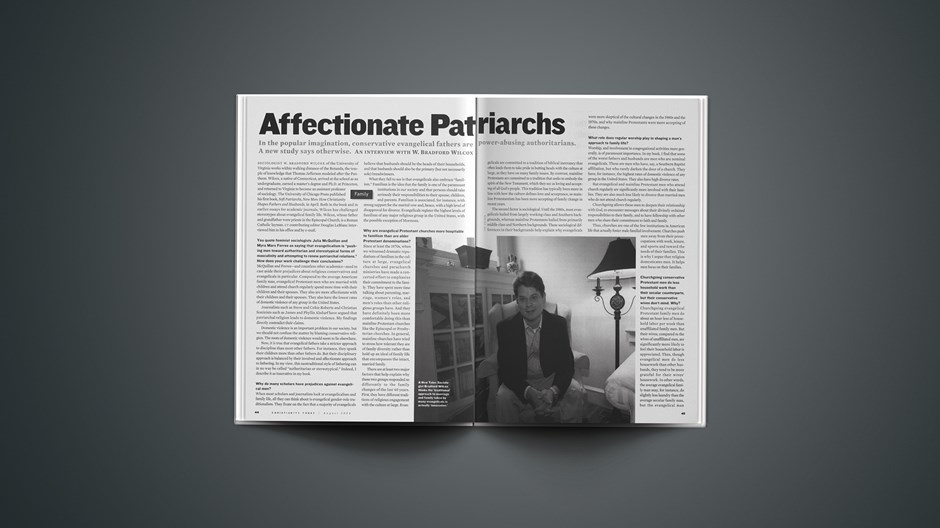
Sociologist W. Bradford Wilcox of the University of Virginia works within walking distance of the Rotunda, the temple of knowledge that Thomas Jefferson modeled after the Pantheon. Wilcox, a native of Connecticut, arrived at the school as an undergraduate, earned a master's degree and Ph.D. at Princeton, and returned to Virginia to become an assistant professor of sociology. The University of Chicago Press published his first book, Soft Patriarchs, New Men: How Christianity Shapes Fathers and Husbands, in April. Both in the book and in earlier essays for academic journals, Wilcox has challenged stereotypes about evangelical family life. Wilcox, whose father and grandfather were priests in the Episcopal Church, is a Roman Catholic layman. CT contributing editor Douglas LeBlanc interviewed him in his office and by e-mail.
You quote feminist sociologists Julia McQuillan and Myra Marx Ferree as saying that evangelicalism is "pushing men toward authoritarian and stereotypical forms of masculinity and attempting to renew patriarchal relations." How does your work challenge their conclusions?
McQuillan and Ferree—and countless other academics—need to cast aside their prejudices about religious conservatives and evangelicals in particular. Compared to the average American family man, evangelical Protestant men who are married with children and attend church regularly spend more time with their children and their spouses. They also are more affectionate with their children and their spouses. They also have the lowest rates of domestic violence of any group in the United States.
'Churches are one of the few institutions in American life that actually foster male familial involvement.' —W. Bradford Wilcox
Journalists such as Steve and Cokie Roberts and Christian feminists such as James and Phyllis Alsdurf have argued that patriarchal religion leads to domestic violence. My findings directly contradict their claims.
Domestic violence is an important problem in our society, but we should not confuse the matter by blaming conservative religion. The roots of domestic violence would seem to lie elsewhere.
Now, it is true that evangelical fathers take a stricter approach to discipline than most other fathers. For instance, they spank their children more than other fathers do. But their disciplinary approach is balanced by their involved and affectionate approach to fathering. In my view, this neotraditional style of fathering can in no way be called "authoritarian or stereotypical." Indeed, I describe it as innovative in my book.
Why do many scholars have prejudices against evangelical men?
When most scholars and journalists look at evangelicalism and family life, all they can think about is evangelical gender-role traditionalism. They fixate on the fact that a majority of evangelicals believe that husbands should be the heads of their households, and that husbands should also be the primary (but not necessarily sole) breadwinners.
What they fail to see is that evangelicals also embrace "familism." Familism is the idea that the family is one of the paramount institutions in our society and that persons should take seriously their responsibilities to their spouse, children, and parents. Familism is associated, for instance, with strong support for the marital vow and, hence, with a high level of disapproval for divorce. Evangelicals register the highest levels of familism of any major religious group in the United States, with the possible exception of Mormons.
Why are evangelical Protestant churches more hospitable to familism than are older Protestant denominations?
Since at least the 1970s, when we witnessed dramatic repudiations of familism in the culture at large, evangelical churches and parachurch ministries have made a concerted effort to emphasize their commitment to the family. They have spent more time talking about parenting, marriage, women's roles, and men's roles than other religious groups have. And they have definitely been more comfortable doing this than mainline Protestant churches like the Episcopal or Presbyterian churches. In general, mainline churches have tried to stress how tolerant they are of family diversity rather than hold up an ideal of family life that encompasses the intact, married family.
There are at least two major factors that help explain why these two groups responded so differently to the family changes of the last 40 years. First, they have different traditions of religious engagement with the culture at large. Evangelicals are committed to a tradition of biblical inerrancy that often leads them to take pride in butting heads with the culture at large, as they have on many family issues. By contrast, mainline Protestants are committed to a tradition that seeks to embody the spirit of the New Testament, which they see as loving and accepting of all God's people. This tradition has typically been more in line with how the culture defines love and acceptance, so mainline Protestantism has been more accepting of family change in recent years.
Article continues below
The second factor is sociological. Until the 1980s, most evangelicals hailed from largely working class and Southern backgrounds, whereas mainline Protestants hailed from primarily middle class and Northern backgrounds. These sociological differences in their backgrounds help explain why evangelicals were more skeptical of the cultural changes in the 1960s and the 1970s, and why mainline Protestants were more accepting of these changes.
What role does regular worship play in shaping a man's approach to family life?
Worship, and involvement in congregational activities more generally, is of paramount importance. In my book, I find that some of the worst fathers and husbands are men who are nominal evangelicals. These are men who have, say, a Southern Baptist affiliation, but who rarely darken the door of a church. They have, for instance, the highest rates of domestic violence of any group in the United States. They also have high divorce rates.
But evangelical and mainline Protestant men who attend church regularly are significantly more involved with their families. They are also much less likely to divorce than married men who do not attend church regularly.
Churchgoing allows these men to deepen their relationship with God, to encounter messages about their divinely ordained responsibilities to their family, and to have fellowship with other men who share their commitment to faith and family.
Thus, churches are one of the few institutions in American life that actually foster male familial involvement. Churches push men away from their preoccupations with work, leisure, and sports and toward the needs of their families. This is why I argue that religion domesticates men. It helps men focus on their families.
Churchgoing conservative Protestant men do less household work than their secular counterparts, but their conservative wives don't mind. Why?
Churchgoing evangelical Protestant family men do about an hour less of household labor per week than unaffiliated family men. But their wives, compared to the wives of unaffiliated men, are significantly more likely to feel their household labor is appreciated. Thus, though evangelical men do less housework than other husbands, they tend to be more grateful for their wives' housework. In other words, the average evangelical family man may, for instance, do slightly less laundry than the average secular family man, but the evangelical man appears to be more likely to thank his wife for the laundry she does.
Article continues below
Do you feel hopeful about the immediate future of the family, at least among churchgoing Christians?
I am hopeful. The family is under a great deal of stress today but, paradoxically, I think many Christians are getting smarter about family life even as the culture at large is less family-centered than it used to be. The attention that evangelical churches are devoting to fostering male familial involvement is one indication that churches can move in innovative directions that strengthen the family. I also see homeschooling as an encouraging development, insofar as it affords parents greater influence over their children's religious and moral education.
But my hope is tempered by three realities: high divorce rates among Christians, falling birthrates among Christians, and an insularity one finds among some Christian families.
Although churchgoing Christians of all denominations are about 30 percent less likely to divorce than unchurched Americans, the divorce rate among churchgoers is still high from a historical perspective. If they really wish to witness the truth about marriage to the larger society, churches need to do more to make sure their members honor the covenant of marriage. Among other things, this means mentoring engaged and newly married couples, disciplining those who break their marital vows, and closing the door to remarriage after divorce in most cases. This will be hard. But no one ever said Christianity was supposed to be easy.
Since the 1960s, birthrates have been falling among Christians. Too many Christians now think marriage is primarily about the emotional union between the spouses. This is wrong. Marriage is supposed to be a fruitful spiritual, emotional, and physical union between spouses that enlarges the kingdom of God in large part through the bearing and rearing of children. Married Christians should recall the first commandment God gave to his people: "Be fruitful and multiply." Christians ought to recognize that children are a gift from God and act accordingly.
Although the focus that evangelical institutions have devoted to the family since the 1970s is largely on target, I think evangelical institutions and families need to be careful not to let their focus on family life be too insular. The family needs our attention and our devotion, but the family cannot be the only or even the ultimate object of our devotion.
Christians need to see their families as domestic churches where worship, discipleship, charity, and an evangelical spirit are cultivated. Christian parents need to teach their children to worship at home, to see the family as an outpost for evangelism, and to bind up the wounds of a broken world. I think charity is particularly important in this regard. Christian families need to look for opportunities to serve the poor, feed the hungry, comfort the sick and the elderly, and so on.
Article continues below
A decade ago, I met a young woman whose family consistently opened their home to unwed mothers. This young woman was one of the most faithful and kind women I have ever met. She saw charity in action in her home and was inspired to embrace the gospel in ways that far surpassed most of her Christian peers. Christian families—my own included—need to remember that we can only "save" the family by losing ourselves in service to God and neighbor.
Earlier Christianity Today articles on gender roles include:
Headship with a Heart | How biblical patriarchy actually prevents abuse. (Feb. 10, 2003)
Nuptial Agreements | Two models of marriage claim biblical warrant and vie for evangelicals' allegiance. Advocates of both claim good results. But do we have to choose? (March 15, 2003)
Adam and Eve in the 21st Century | When it comes to gender roles, CT readers oscillate between complementarian and egalitarian ideas. (March 15, 2003)
CT Classic: Adam and Eve in America | In 1990, readers first revealed what they thought it means to be created male and female. (March 15, 2003)
Can We Talk? | We may never resolve all our differences about women in leadership, but we can help each other toward better understanding. (March 15, 2003)
A Different Kind of Women's Lib | A dispatch from the Council for Biblical Manhood and Womanhood conference. (October 12, 2001)
The Next Christian Men's Movement | Just because Promise Keepers no longer fills stadiums doesn't mean men's ministry is dead. Far from it. (Sept. 15, 2000)
Article continues below
What Has Gender Got to Do with It? | Wesleyan-Holiness churches were led by women long before the rise of the modern women's movement. (Sept. 12, 2000)
A Woman's Place | Women reaching women is key to the future of missions. (Aug. 4, 2000)
Integrating Mars and Venus | Gender-based ministries may be effective, but are they biblical? (July 12, 1999)
















 While we pray for peace, we need moral clarity about this war.
 We’ve got little information on Jesus’ appearance and personality. But that’s the way God designed it.españolFrançais
 Leader explains why the movement is seeing its biggest membership bump in 30 years and its mission for the years ahead.






