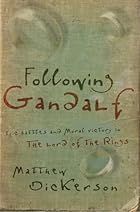
Following Gandalf: Epic Battles and Moral Victory in The Lord of the Rings
Author
Matthew T. Dickerson
Publisher
Brazos Press
Release Date
October 1, 2003
Pages
240
Price
16.89
Given the number of books already published on Tolkien (the last three years have been boom times), one might wonder whether Matthew Dickerson's Following Gandalf is a necessary addition to the field. After all, others have already produced fine treatments of the religious and literary background of Tolkien's work. Just how many studies of Tolkien did we really need?
Answer: at least one more. Following Gandalf is a timely and relevant exploration of how military conflict illustrates the profound inner conflict of moral responsibility. Its basic argument is that Tolkien's restraint in describing battles exalts heroism, not violence; and that heroism is an image of the universal human need to strive for moral victory, which is made possible by real freedom.
Tolkien was reluctant to discuss moral theological matters in his fiction, and had a "cordial disdain" for allegory and heavy-handed literary treatments of religion. He even went over his manuscripts before publishing them in order to remove explicit religion from Middle Earth. His reason for doing so? Not, as we might expect, to expunge religion and morality from Middle Earth, but to give them pride of ubiquitous place. In a letter written in 1953, Tolkien wrote that
The Lord of the Rings is of course a fundamentally religious and Catholic work … . That is why I have not put in, or have cut out, practically all references to anything like "religion," to cults or practices, in the imaginary world. For the religious element is absorbed into the story and the symbolism.
A casual observer of Peter Jackson's recent films might be excused for missing the religious element and for surmising that Tolkien's world is one where the dominant forces are occult magic, intrigue, and military might. After all, battlefields and battles of will account for a goodly portion of Jackson's visually lush films. Harrumph to mere lions and tigers and bears! None holds a candle to Jackson's oliphaunts, cave trolls, and Uruk-Hai. His battles are breathtaking and emotionally compelling, keeping even those of us who know how they end on the edges of our seats. But how important were those battles to Tolkien? A graduate student at my university recently offered me a Heideggerian (and slightly Marxist) reading, suggesting that The Lord of the Rings is about the overcoming of metaphysics and of technology. It seems undeniable that Tolkien hankers for the pastoral Shire, where growing things are preferred over machines. But are all those battles about setting Dasein free from the oppression of technological enframing?
Dickerson makes explicit what Tolkien plainly understood to be the real meaning of violent conflict in The Lord of the Rings. Tolkien's use of violence is wholly but subtly subordinated to the task of pointing up the issue of moral conflict in human life; and that moral conflict beckons us to glance in a transcendent direction, "beyond the walls of this world." We have no choice about whether we will have conflict; we are determined, as it were, to choose to act morally. Dickerson refers to this as "the doom of choice." Paradoxically, it is the fate of humankind to be free to make moral decisions. Though Tolkien didn't often say so, and though he never made it explicit in his fiction, his work is profoundly Christian both in its origin and its outlook.
Thankfully, rather than clodhopping where Tolkien tiptoed, Dickerson honors Tolkien's reason for religious reticence by letting the stories speak for themselves. Dickerson doesn't attempt to "rescue" Tolkien from pagan, dialectical-materialist, or other appropriations. In the opening chapters, Dickerson does take on Bertrand Russell, Ruth Benedict, and their determinist and moral relativist disciples, but always with a view to show how Tolkien's stories about heroic moral choices provide a more interesting and more compelling account of human existence. Dickerson gently draws the themes of freedom, creativity, and moral responsibility out of Tolkien's work. To be free, creative, and responsible is to be made in the image of God, to be capable of what Tolkien called "sub-creation." Tolkien saw his writing as both an instance of that sub-creation and a sort of delicate literary apology for it.
Along the way, Dickerson takes a few polite but earnest jabs at Jackson while evincing honest admiration for the films. Dickerson has been teaching Tolkien for 15 years, and is no latecomer to the fray, merely hoping to capitalize on the films. Rather, he makes it plain that he is writing at an opportune time in order to make sure that the majesty of Tolkien's achievement is not overwhelmed by the visual spectacle of the films. Jackson plainly misunderstands the nature of power, equating it with force, to the neglect of spiritual and moral power. This is especially true in the character of Faramir. Faramir is one of the most pious of characters in Tolkien's work, resisting the lure of the Ring before he even knows it is near him, and praying regularly with his men (a rarity in Middle Earth!). Jackson's films show the tortured relationship between Faramir and his father Denethor, but precious little of the moral character that sustains Faramir in this conflict. Similarly, Jackson gets wisdom wrong, and so his portrayal of the characters that Tolkien plainly sets aside as wise is skewed: Elrond comes off as petty and Galadriel as mildly sinister.
Article continues below
Perhaps the chief criticism that one could level at Dickerson is that he knows too much: he repeatedly and suggestively opens up new vistas into Tolkien's work but then moves on in order to continue to pursue the main theme; and the references to names and places in Tolkien's stories can be a bit dizzying at times, despite Dickerson's helpful reminders of how each fits into the whole story. The effect of this is to remind the reader just how rich Tolkien's writings are, and how much is left to be explored in them. A chapter devoted to the cosmogony that opens The Silmarillion would have been nice, rather than the scattered references to it in other chapters; and several times Dickerson begins to touch on but never fully develops themes of prayer or (implicitly) of Tolkien's affinities to and minor divergences from Thomist metaphysics. For instance, Dickerson suggests (without descending into philosophical jargon) how Tolkien uses the angelic Gandalf and human creativity to improve on Aquinas' realist metaphysics and to answer Ockham's nominalism, though this is not explored in detail.
But Dickerson's mastery of Tolkien's oeuvre is complete. Written in a style that is both accessible to the general reader and inviting to academics, his book is a good introduction to the religious and moral themes in Tolkien's lesser-known writings, beginning with Dickerson's real love, The Silmarillion, and including Tolkien's writing on writing itself in "Leaf by Niggle," "On Fairy-Stories," and Tolkien's early writings on language and Beowulf. Of particular interest is the explanation of Tolkien's doctrine of "eucatastrophe," the happy turn of events that marks a good fairy-story. It is just such a turn that we hope for in our world, and this is suggestive of the real gravity of moral choice.
David L. O'Hara is a doctoral student in Philosophy at Penn State University.
Hobbits Aren't Fence-Sitters | The authors of Tolkien's Ordinary Virtues and J. R. R. Tolkien's Sanctifying Myth discuss why Tolkien hated modernity and thinking about evil—and whether he was right to do so. (Dec. 20, 2002)
Does The Lord of the Rings Teach Salvation By Works? | The authors of Tolkien's Ordinary Virtues and J. R. R. Tolkien's Sanctifying Myth talk about whether Tolkien was too ignorant of evil and other subjects. (Dec. 19, 2002)
Why The Lord of the Rings Is Dangerous | The authors of Tolkien's Ordinary Virtues and J. R. R. Tolkien's Sanctifying Myth talk about the Christian life in Faerie. (Dec. 18, 2002)
Urban Eden | In City: Urbanism and Its End, a new history of New Haven, Connecticut, the city (in its late 19th-century form) is an ambiguous heaven-and the suburbs that relentlessly followed are hell. Which leaves us where, exactly? (Dec. 01, 2003)
Faith, Hope, and Charity in North Carolina | New novels by Michael Morris—whose first novel, A Place Called Wiregrass, was a word-of-mouth hit— and Jan Karon, who continues her beloved Mitford saga. (Nov. 17, 2003)
The Year of the Fish | The 2003 baseball season concludes with a bang—and 2004 is just around the corner. (Oct. 27, 2003)
I Shop, Therefore I Am | Critics of "consumer culture" are all wet, Virginia Postrel says. The riot of choices available to us resonates with our deepest aesthetic instincts (Oct. 20, 2003)
Back to the Future | A sprawling new novel by the author of Snowcrash and Cryptonomicon goes to the 17th century to investigate the birth of the modern world. (You won't be surprised to learn that the Puritans are among the Bad Guys.) (Oct. 13, 2003)
Terrorists on Trial | How the nation responded to an earlier attack. (Sept. 29, 2003)
The Contemplative Christian | Eugene Peterson calls believers to a life lived with "wholeness, honesty, without contrivance"-against the grain of much that's currently driving the church in America. (Sept. 29, 2003)
Recalling California | Want to understand what's going on in the Golden State? Toss your newsmagazines and pick up Joan Didion's new book (Sept. 22, 2003)
The Ph.D. Octopus, 100 Years On | How Christians can make a difference in the upside-down world of graduate school (Sept. 15, 2003)













 While we pray for peace, we need moral clarity about this war.
 A Christian reconciliation group in Israel and Palestine warned that war would come. Now the war threatens their relevance.españolالعربيةFrançaisрусскийУкраїнська
 NIL deals in college athletics present new challenges—and opportunities—for colleges and students.





