China cancels China National Orchestra concert over Christian fears
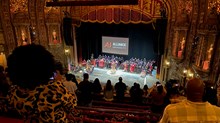
China's Ministry of Culture ordered the chorus of the China National Orchestra to withdraw from a Saturday concert, reportedly because it included Christian-themed material, according to the Associated Press.
Conductor Su Wenxing, whose Hebei Orchestra was to perform "Easter Chorus" and other works with the China National Orchestra, said the Chinese government refused to give any official information about the cancellation. Both Su and the Chinese-born Canadian composer of "Easter Chorus," Huang An Lun, are Christians.
If fear of Christianity really was the reason for the demand—and what else could it be?—it's another piece of evidence that the Chinese government is becoming increasingly antagonistic toward Christianity (though, of course, other recent evidence is much more troubling). In 2002, China Daily, a state-run newspaper, touted Su's conducting of Handel's "Messiah" and other religious works. "Many great composers such as Bach and Handel were loyal Christians," he was quoted as saying. "Since I became a Christian, I have had a new understanding of them and interpret them much better."
Su told the AP that he wanted the Hebei Orchestra to play the concert anyway, outside Beijing's Zhongshan Concert Hall. There's no word on how that went.
Supreme Court rejects fired officer's case
Benjamin Endres, a Baptist who was fired by the Indiana State Police for refusing to work full-time at a casino, has been denied a hearing by the U.S. Supreme Court. That means that the decision from the 7th U.S. Circuit Court of Appeals stands, and that Endres stays fired.
The Associated Press suggests that the Supreme Court justices rejected the case out of religion fatigue. Columnist James J. Kilpatrick says it's because the case deals with "fuzzy-wuzzy questions, heavily reliant on particular facts."
Still, it would have been nice to have the justices weigh in on the degree to which state agencies must accommodate the faith of their employees. Under the 7th Circuit's decision (which affects Indiana, Illinois, and Wisconsin), the answer is that they really don't have to be accommodated at all. "Baptists oppose liquor as well as gambling, Roman Catholics oppose abortion, Jews and Muslims oppose the consumption of pork," Judge Frank Easterbrook wrote.
If Endres is right, all of these faiths, and more, must be accommodated by assigning believers to duties compatible with their principles. Does the act require the State Police to assign Unitarians to guard the abortion clinic, Catholics to prevent thefts from liquor stores, and Baptists to investigate claims that supermarkets mis-weigh bacon and shellfish? Must prostitutes be left exposed to slavery or murder at the hands of pimps because protecting them from crime would encourage them to ply their trade and thus offend almost every religious faith?
That decision is surprisingly at odds with the facts of the case. Endres didn't oppose working as a law enforcement officer in a casino. If crime happened there, he was happy to dispatch his duties to serve and protect. What he opposed to was a full-time stationing at the casino, a job that he believed would both suggest his support of gambling and benefit the casino. He simply asked for a different appointment, and the Indiana State Police apparently didn't even consider alternatives. That's still not a problem, Easterbrook said. Police and fire departments, he said, must insist that employees "leave their religious and other views behind so that they may serve all without favor on religious grounds."
The three dissenters in that case said that opinion may sound nice in this day and age, but it's illegal.
"Time and time again, we profess that, in interpreting a statute, we begin with the plain wording of the statute. Unless there is an ambiguity, we apply the explicit command of Congress," Kenneth F. Ripple wrote. "No one suggests that Congress has left any doubt as to what it expects in this situation. Unfortunately, however, our current decisional behavior does not follow the course of our rhetoric. In future cases, judges, attorneys and litigants will have to accept the reality that they must observe not what we say, but what we do."
While the U.S. Supreme Court won't sort out the issues, the executive branch did weigh in, filing a brief supporting Endres.
More articles
Jeffrey John:
- On his first day, dean says Church should bless gays | Cleric's call over homosexual couples sparks outrage from conservative Christians (Jonathan Petre, The Telegraph, London)
- Time to bless same-sex unions, says gay cleric | Jeffrey John says Church and State should offer couples a covenant of faithfulness (The Times, London)
- Gay canon welcomed as dean of St Albans | After prayer, bishop feels appointment is 'right and good' (The Guardian, London)
- Evangelical veto | There is no logic to the appointment of Dr Jeffrey John as Dean of St Albans. That does not make it any less welcome (Editorial, The Guardian, London)
The Passion:
- 'Passion'-bashing minimal | Fears that The Passion of the Christ would inflame passions worldwide turned out to be overblown (Variety)
- 'Passion' still tops as foreign market slows | Passion chalked up an estimated $14.6 million from about 52 markets to raise its international gross to an estimated $177.1 million (Reuters)
- Pirated 'Passion' copies swamp Peru | They cost about 95 cents (Associated Press)
- Passion comes to India on May 7 | No cuts made (UNI, India)
- How to gag on 'The Passion' | Nine fun-filled ways Mel Gibson's brutal snuff film makes a mockery of true belief. Clip n' save! (Mark Morford, SF Gate)
The Bible:
- The Bible's baffling one-liners | The church is divided over single verses (Bob Cuttino, Carolina Morning News, Bluffton, S.C.)
- The Internet shall make Bible free | Michael P. Johnson's World English Bible (WEB) is an online, open-source Bible without a copyright (The Salt Lake Tribune)
Books:
- A phenomenon's finale | The last novel in the Left Behind series, Christian fiction that has made publishing history, is on store shelves. But that may not be the end of the story (St. Petersburg Times, Fla.)
- 'Rapture' rebuts end-time 'Left Behind' theology | Barbara R. Rossing's "The Rapture Exposed" convincingly debunks the methodology of "end times" philosophy and shows why all this is more than just a theological spat in our war-torn world (The Journal Gazettte, Ft. Wayne, Ind.)
- Rethinking the Rapture | Not all scholars are swept away by Left Behind's end-times scenario (The Kansas City Star)
- Searching for purpose, a day at a time | There's something different about Rick Warren's book -- a work stunning for both its popularity and power (Ken Garfield, The Charlotte Observer, N.C.)
- A breakdown | Huntington professor simplifies Christianity for 'idiots' (The Journal Gazette, Ft. Wayne, Ind.)
- Vicar's black magic works £3.5m deal | Graham Taylor has signed a £3.5m publishing deal for his next six novels (The Guardian, London)
History:
- Investigation of Holy Grail intrigues, then just peters out, on History Channel | "Investigating History" has a tendency to pick up lines of thought, drop them and then repeat them in a fashion reminiscent of cross-country trips with a garrulous relative (Kay McFadden, The Seattle Times)
- A museum tells the story of Christianity in Korea | Christianity was believed to have been introduced to Korea around the late 18th century through Roman Catholic missionaries, until now. A local museum finds the religion reached the peninsula much earlier, between the 7th and 8th centuries during the reign of the Unified Silla Kingdom (The Chosun Ilbo, Seoul)
- Holy turf wars | Whenever I visit history-haunted Istanbul, my first stop is the cathedral of St. Sophia. The greatest monument of Christianity's first millenium is now a museum run by the Turkish government. It never occurred to me to demand it back (Ralph Peters, New York Post)
Media:
- Christian radio veteran heeds call from WMBI | Wayne Pederson, a prominent and once-controversial figure in Christian broadcasting nationwide, is taking over the Chicago radio flagship of Moody Bible Institute (Chicago Sun-Times)
- Ruling affirms sale of KOCE | A judge approves a college district's choice of a pro-PBS group's bid. A religious network, with a rival bid, says it will appeal (Los Angeles Times)
- Also: Judge okays KOCE sale to local foundation | Spurned Christian TV bidder vows to appeal the decision to allow $28-million deal that keeps public programming (Daily Pilot, Newport Beach, Ca.)
Music:
- Byzantine chant, rich challenge to its Gregorian counterpart | The choir of tenors and basses provided consistently robust and visceral sounds which filled the Cathedral Church of St. John the Divine on Saturday (The New York Times)
- Charlie Peacock finds his voice—again | New CD and book out from Christian musician (The Grand Rapids Press)
- With a Christian beat | The Seakers' religious message has a '60s influence (The Press-Enterprise, Riverside, Ca.)
- Gospel group inspires through song | Its 76 years attest to commitment to faith, fellowship (The Courier-Journal, Louisville, Ky.)
PBS on evangelicals:
- America's evangelicals | Part one: Evangelicals and identity (Religion & Ethics Newsweekly)
- America's evangelicals: Survey analysis | It's impossible to measure religious experience, but it is possible to ask people about their beliefs and practices, and we did that in our national survey (Religion & Ethics Newsweekly)
U.K. TV'sMy Foetus:
- Review: Abortion documentary is hard-hitting | The end result is often shocking and harrowing. But it is a valuable program to watch (BBC)
- Pushing the TV boundaries | Channel 4's programme containing footage of a woman undergoing an abortion, My Foetus, has sparked complaints ahead of its broadcast on Tuesday (BBC)
- Storm expected over abortion film | A controversial new documentary showing a woman having an abortion is to be shown on Channel 4 on Tuesday night (BBC)
- Abortion film 'can spark debate' | A British filmmaker of what may be the first pictures of an abortion ever shown on television has defended her documentary (ITV)
- Controversial abortion film to be screened | A filmmaker behind what is being billed as the first pictures of an abortion ever shown on television has defended her documentary as a powerful stimulus to moral debate (Reuters)
- Moral maze of abortion | By the time doctors told June Jones her baby was going to be born without arms, it was too late to have an abortion (The Evening Chronicle, Newcastle, England)
More on abortion & life ethics:
- Attorneys argue over brain-damaged woman | The attorney for a man seeking to end his severely brain-damaged wife's life argued Monday that Gov. Jeb Bush shouldn't be allowed to gather new evidence in the case because the judge has the information he needs to decide if the law keeping her alive is unconstitutional (Associated Press)
- Illegal abortion clinics victimize Indian women | Illegal abortion clinics thrive in India - often with disastrous consequences for women - almost 33 years after the Medical Termination of Pregnancy Act came into being (IANS, India)
- One vote revives abortion bill | State Rep. Mike Turner needs one vote. One vote, or the proposed amendment to rule out abortion as a right in the Tennessee Constitution, would be dead (The City Paper, Nashville)
- Too much sex 'causes sterility' | While countless clinical studies around the world show that an active sex life contributes to the average person's well-being and health, one prominent Chinese doctor is warning it can lead to sterility (AFP)
- Also: Doctor: Sex harmful to middle schoolers | Sex among middle school students may be contributing to growing sterility problems among young women in Guangzhou, capital of Guangdong Province, says a prominent local doctor (Xinhua, China)
Marriage:
- Get me to the church on time? Not with new ministries | Many clergy are ordained in a mainstream church, but perform marriage ministry independently of a parish or church, sometimes with premarital counseling (The New York Times)
- Insurance a wedding obstacle | Disabled woman would lose benefits (The Atlanta Journal-Constitution)
- The shameful silence of the churches | Why won't our church leaders speak up in favour of marriage (Bettina Arndt, The Age, Melbourne, Australia)
- State of matrimony | The current debate over same-sex marriage has spurred an examination of all marriages (Rocky Mountain News)
Gay marriage:
- Foes of gay marriage try long shot | Bill seeks to remove four of SJC's justices (The Boston Globe)
- Also: Removal of pro-gay marriage judges sought (Associated Press)
- Derry to stage first gay wedding | Couple to exchange vows ext year (The Belfast Telegraph, Northern Ireland)
Homosexuality & religion:
- Svend theft taints bill: Christians | Canadian Christian groups are demanding a controversial bill to ban verbal gay-bashing be scrapped because it was drafted by an "admitted thief" (Canadian Press)
- Angry congregations seek split from regional United Methodist Conference | The controversy over an active lesbian minister in Ellensburg threatens to boil over to the entire United Methodist Church in America (KIMA, Yakima, Wa.)
- Sexuality controversies again on tap at Methodist conference | A stew is likely brewing again for United Methodists as their delegates prepare for a policy-making gathering held every four years (The Decatur Daily, Ala.)
- Sexuality study hot ELCA assembly topic | A year before the national Evangelical Lutheran Church in America tackles whether to ordain noncelibate gays and lesbians and bless same-sex unions, the topic may be addressed by Lesbian pastor installed | A mission hires a minister the church once removed from its ordained roster (The Press-Enterprise, Riverside, Ca.)
- Presbyterians watch minister's case for constitutional impact | Presbyterian Church (USA) members and other church observers around the country are closely watching the next phase in the case of a Cincinnati minister convicted of violating church law by performing same-sex marriages (Associated Press)
- Church avoidance tied to gay tolerance | Canadians are more accepting of homosexuality because they spend less time in church than Americans, says well-known Canadian sociologist Reg Bibby (CanWest News Service)
- Homosexuality: It's not a sin | The Christian education of a Baptist minister (Chris Ayers, The Charlotte Observer, N.C.)
- Singing the gospel of Transcendence | Nation's first all-transgender gospel choir raises its voices to praise God and lift their own feelings of self-love and dignity (San Francisco Chronicle)
- Give no attention to fanatic | A gay-hating minister has no ties to compassionate Christianity (Editorial, The Statesman Journal, Salem, Ore.)
- one area synod (The Forum, Fargo, N.D.)
- The pseudoscience of sexual orientation change therapy | An "old" problem with relevance today (Editorial, British Medical Journal)
- Church opens doors to gays | Plymouth Congregational Church may offer same-sex unions (Lawrence Journal-World, Kan.)
African churches refuse U.S. funds:
- Anglican bishops back gay ban | Bishops from mainstream Kenya churches yesterday supported the ban by African bishops on congregations accepting funds from wealthy American churches, in protest at the ordination of a homosexual bishop (The Nation, Nairobi, Kenya)
- Africa's answer to the 'homosexual problem' | Africa's Anglican archbishops have vowed not to receive donations from western churches which support the ordination of gay priests(Mail & Guardian, South Africa)
Nigeria ban on televised miracles:
- Senate probes clampdown on miracle pastors | Tele-evangelists affected by the National Broadcasting Commission's directive banning miracles that cannot be verified on television may still have the opportunity of getting their programmes back on air if the investigations due to be instituted into the matter by the Senate end in their favour (Vanguard, Lagos, Nigeria)
- Religious broadcasts: PFN cautions NBC | Pentecostal Fellowship of Nigeria (PFN) has cautioned the Nigerian Broadcasting Commission (NBC) against imposing a blanket ban on the broadcast of religious activities (This Day, Lagos, Nigeria)
- Miracles on TV: Will the axe fall? | The Nigerian Broadcasting Commission's threat to ban the advertisement and showing of miracles on television channels in the country has elicited mixed reactions from the public (This Day, Lagos, Nigeria)
Church life:
- Check excessive noise by churches | A passionate appeal has been made to the Environmental Protection Agency to seriously consider extending its control and checks on excessive noise making to the churches as well (GNA, Ghana)
- Altitude blamed for cleric's heart attack | Colorado's altitude is being blamed, in part, for a heart attack suffered Sunday night by a visiting head of a branch of Russian Orthodoxy (Rocky Mountain News)
- Global Church hindered by local rules | Though mainly well regarded, it has had issues with Riverside County and a tribe (The Press-Enterprise, Riverside, Ca.)
- Demographic trends will alter face of faith in U.S. | Nation will be older and more Hispanic by 2050 (A. James Rudin, Religion News Service)
- Commission to vote on controversial church | In a report to Vista's seven-member Planning Commission, city officials state that a large church complex in north Vista should be built despite the impact it would have on the surrounding neighborhood (North County Times, San Diego, Ca.)
- Churches get a little brighter | Bright Sunday worship extends holy season (Toledo Blade, Oh.)
- 2 dead in church van crash | Another tragedy resulting from a blown tire (KCRA, Kansas City)
- Keeping the faith | Casual churches attracting young worshippers (Ft. Worth Star-Telegram, Tex.)
- Brave new church | 'Emerging' movement attracts young people with movies and all things digital (Religion News Service)
- Keeping the flock together | Presbyterian moderator in constant motion to maintain church unity (Houston Chronicle)
- Drought puts Anglican parish future on the line | The church is the latest casualty of drought in the far south-east of New South Wales (Australian Broadcasting Corp.)
- St. Paul's Episcopal attempting purchase of Jerry's restaurant | After 20 years of slinging hash browns and coffee, one of Fayetteville's longest-running homestyle restaurants may soon come to an end (Northwest Arkansas Times, Fayetteville)
- Church restoration in progress | West Virginia's oldest Episcopal church will be restored, if only in "baby steps" (The Journal, Martinsburg, WV)
- A window pain | Priest says stained-glass windows will remain, others prepare for legal battle (The Times, Munster, Ind.)
- Church takes fight over land to court | Aurora rejects request to rezone west side parcel (Chicago Tribune)
Pastor auctions funeral service services:
- Pastor offers funeral service as part of Rotary Radio Auction | Of the hundreds of selections at this Saturday's Rotary Radio Auction, the Rev. Jim Keyser's contribution definitely stands out (The Grand Island Independent, Neb.)
- Also: Pastor auctions off eulogies (Associated Press)
Catholicism:
- One man's crusade | The Domino's Pizza founder launched Ave Maria to promote conservative Catholic teaching (The Orlando Sentinel)
- Conference explores roles, frustrations of women in Catholic church | Saying they are struggling to reconcile their faith in Catholicism with their concern for women's issues, more than 500 people gathered yesterday at Boston College to examine the role of women in the church following the clergy sexual abuse crisis (The Boston Globe)
- Bishops back rights for asylum-seekers | Roman Catholic bishops in Britain called last night for more rights for asylum-seekers to seek welfare support (The Times, London)
- Desperate sins of Catholic flesh | Growing up in a small Taranaki town, I have a vivid memory of one of the first times I heard the silent speech mark (Linda Burgess, The Dominion Post, New Zealand)
- What can Protestants learn from the Virgin Mary? | How many Protestants are willing to give her even the slightest honor that is hers? (Tom Schaefer, Wichita Eagle, Kan.)
- Shrine to saint draws faithful to S. Phoenix | Francisco Vasquez's center of spirituality has proven its timelessness and survived despite the fast growth in what is now called the Baseline Road corridor (The Arizona Republic)
Religious freedom:
- Jewish inmate sues over religious meals | Jewish inmate said in a lawsuit filed yesterday that Virginia discriminates against female prisoners by limiting special religious diets to its maximum-security prison for women, while providing such meals in all men's prisons (The Washington Times)
- Vietnamese media report deaths, injuries in Central Highlands a week after protests | Two ethnic minority Christians died while dozens of demonstrators and police were injured during violent mass protests in Vietnam's Central Highlands a week ago, state-controlled media reported Sunday (Associated Press)
- Police launch ID raids in Poso in search of gunmen | Police further tightened security in Poso regency, Central Sulawesi on Monday by checking the identity cards of residents in an effort to prevent more attacks by gunmen in the religiously divided town (The Jakarta Post, Indonesia)
Religious relations:
- Essay contest designed to improve religious relations | Boston philanthropist is teaming up with the Baltimore-based Institute for Christian and Jewish Studies to launch a $100,000 essay contest that's designed to improve Christian-Jewish relations in the wake of Mel Gibson's film called "The Passion of The Christ" (The Boston Globe)
- Two faiths find some similarities | Yesterday, in the middle of Bradley Chapel at Grace Episcopal Church, Mostafa Gami, a Muslim, bent, kneeled and touched his forehead to the ground while he praised God's glory aloud in Arabic (The Journal News, Rochester, N.Y.)
- At last, an imam at Eton | Muslim Etonians are just as likely to have spiritual concerns as Jewish or Catholic ones, and it is pleasing to think that they will now have their own pastoral figure at hand (Editorial, The Telegraph, London)
Muslim call to prayer:
- Old and new Hamtramck clash in debate over Muslim call to prayer | Long known for pierogi and polka, this bustling city is now debating whether to add an amplified Arabic chant to the list of local sights and sounds (Associated Press)
- Call to tolerance | Hamtramck should not silence part of Muslims' faith (Editorial, Detroit Free Press)
Christians in India:
- Not this time Mr Dutt, say Christian voters | Many Christians in the Mumbai North-West constituency will vote for the Sena this time. Many simply won't vote (Express, India)
- Hindu militants gun for Christians ahead of elections | Every election is awaited with fear by Christians in rural central India, but the community says the current campaign for national polls has been particularly brutal as right-wing Hindus step up harassment (The Daily Times, Pakistan)
- Christians pray for safe conduct of elections | Around 700,000 people participated in the 72-hour-long prayers by the Jesus Calls Prayer Church in Chennai (ANI, India)
Crime:
- Ohio bishop sentenced for groping woman (Associated Press)
- Episcopal diocese presents theft case against priest | Officials want accused defrocked (Lexington Herald-Leader, Ky.)
- Episcopal priest to face tribunal | Clergyman accused of stealing funds (The Herald-Leader, Lexington, Ky.)
- Religious trial to find what happened to church money | A religious trial underway Monday is looking into allegations that an Episcopal priest took $30,000 of church money (WKYT, Lexington, Ky.)
- Former St. James' priest, 47, pleads guilty | Government says Mark Cole took $128K from Oneonta Episcopal church (The Daily Star, Oneonta, N.Y.)
- 2 teens sentenced in cross-burning at pastor's home | For a brief time yesterday, the courtroom at the Denney Juvenile Justice Center became an impromptu classroom. The subject: the history of hate crimes against blacks in the United States. The pupils: two Arlington teens who burned a cross outside the home of an African-American pastor (The Seattle Times)
- Arlington teens apologize, get 30-day sentences for cross burning | Pastor and his wife offer forgiveness to 16-year-old cousins, who express remorse (Seattle Post-Intelligencer)
- Bishop jailed for grabbing woman | Antiochian Orthodox prelate for area serves term in Michigan jail (The Toledo Blade, Oh.)
- Angry letters to God prompt call to police | St. Paul police were called to Como Park Lutheran Church last week to collect the most recent, an angry 17-page missive someone left in the lobby. An officer concluded in a preliminary report: "No specific threat to anyone but God" (Pioneer Press, St. Paul, Minn.)
- Capital landlord settles sexual harassment suit | Former minister and evangelist who was accused of evicting female tenants who rejected his advances agrees to pay $100,000 (The Sacramento Bee)
- Church role questioned | Testimony in the civil case against the Northern Texas/Northern Louisiana Synod resumed on Monday with most of the day's testimony focusing on presiding Bishop Kevin Kanouse (Marshall News Messenger, Tex.)
Church shooting/kidnapping:
- Mystery on fatal shot | Only Monroeville officer, kidnapping suspect fired weapons (Pittsburgh Post-Gazette)
- Boyfriend scared woman's family | Yesterday, family and friends were trying to make sense of the tragic events that brought a life full of promise to a premature end (Pittsburgh Post-Gazette)
- Court orders couldn't keep woman safe | A piece of paper can't stop a bullet (Pittsburgh Tribune-Review)
Abuse:
- Former priest accused of abuse files suit | N.O. archbishop sued for defamation (The Times-Picayune, New Orleans)
- Also: Retired New Orleans priest files suit against Archbishop | Claims he was wrongfully accused of clergy sex abuse (WGNO, New Orleans)
- Charges against clergy elusive | Facing a virtual graveyard of failed clergy abuse prosecutions nationwide, the county's top prosecutor was unusually expansive recently as he announced plans for a grand jury probe into ex-Bishop Thomas L. Dupre (The Republican, Greenfield, Ma.)
- Pastor controversy goes to the public | Parishioners are holding discussions about Msgr. John Alesandro's leadership and his knowledge of diocese's priest sex abuse scandal (Newsday)
- Lawyer: Priest tricked men into ritual | A molestation charge against a priest has brought forth allegations of a bizarre bondage ritual performed on men two decades ago in the basement of a small-town church (Associated Press)
- Louisville priest convicted of molesting 2 boys in 1974 | Victims told jury abuse followed drug, alcohol use (The Courier-Journal, Louisville, Ky.)
- Spokane Diocese settles a molestation case | The Catholic Diocese of Spokane will pay $30,000 to settle a claim by a person who contended he was molested decades ago by a priest in Walla Walla (KXLY, Spokane)
- Clergy must report sex abuse under new law | Exceptions made for private conversations (Milwaukee Journal-Sentinel)
Missions & ministry:
- Hospital minister tends diverse flock | Spiritual guidance is sometimes lost in that search for top-flight care, since many patients' ministers can't make the trip to Portland (Portland Press Herald, Maine)
- An old-time revival | 3-day event in El Cajon brings rousing message to a cross section of congregations and creeds (San Diego Union-Tribune, Ca.)
- Crusade to take gospel into state prisons begins | Beginning today for the next week, 10 of the state's lockups for young offenders will open their doors to a group of evangelical Christians, who intend to spread God's message of love and hope to budding criminals by, basically, putting on a show (South Florida Sun-Sentinel)
- Kansans gearing up for Graham crusade in K.C. | Christians in Wichita plan to travel to Kansas City, Mo., in June for what could be the final Billy Graham crusade in this region. The Heart of America Billy Graham Crusade is scheduled for June 17-20 at Arrowhead Stadium (The Wichita Eagle, Kan.)
- Church looks to expand west, and perhaps south | Almost 20,000 worshipers filled Sound Advice Amphitheatre last weekend to hear Tom Mullins, senior pastor at Christ Fellowship church of Palm Beach Gardens, proclaim the Resurrection of Jesus (Palm Beach Post)
- Boy evangelist touches crowd | Alejandro Arias is only 16 and well on his way to building a worldwide congregation (The Miami Herald)
- Constant Center plays host to regional revival | Top-selling Christian author Joyce Meyer kicked off Hope for Hampton Roads, a weeklong evangelical revival, on Monday with a little advice: No pain, no gain (The Virginian-Pilot)
Religion & politics:
- Conservatives try to exploit Catholic Democrats' views | Conservatives argue that some Democrats cannot have it both ways, presenting themselves as faithful Catholics while voting for abortion (The New York Times)
- With God on his side … | By invoking a higher power, Bush sidesteps pesky constitutional issues (Robert Scheer, Los Angeles Times)
- Their beliefs are bonkers, but they are at the heart of power | US Christian fundamentalists are driving Bush's Middle East policy (George Monbiot, The Guardian)
- Bush tapestry of policy woven with prayer draws concerns | At a recent news conference and in a new book by Bob Woodward, President Bush conveys a sense that when it comes to foreign policy, he's on a mission from God (Knight Ridder)
- Religious activists set to run for Conservatives | Three high-profile religious activists have decided to try their hands at partisan politics by throwing their hats into the ring for the Conservative Party (The Globe and Mail, Toronto)
- GOP criticizes group's push to impeach judge | House Republican leaders say key lawmakers are being strong-armed by a prominent conservative group to agree to advance the impeachment of a judge before they've heard the case against him (The Denver Post)
- Christian right mulls primary | Conservatives struggle to agree on GOP candidate for the U.S. Senate (The State, Columbia, S.C.)
- Warner alters measures on feticide, gay marriage | Virginia Gov. Mark R. Warner on Friday amended bills passed by the General Assembly that would make killing a fetus a felony and deny gay couples the legal benefits of marriage (The Washington Post)
- Update: Lawmakers to vote on Warner's amendments to bills | The measures most likely to spark debate relate to same-sex civil unions and fetal homicide. Mr. Warner has proposed amendments to those bills that have been criticized by the bills' sponsors and by conservative groups (The Washington Times)
- Cypriots who back UN plan face damnation, says bishop | Barely a week before Greek and Turkish Cypriots vote for or against reunification of this divided island, a leading Orthodox bishop has threatened Greek voters with damnation if they support the United Nations plan (The Independent, London)
- Chiluba didn't make Zambia a Christian nation—Mumba | Chiluba Didn't Make Zambia a Christian Nation—Mumba (The Post of Zambia)
- Earlier: One African Nation Under God | Zambia is missionary David Livingstone's greatest legacy. But this Christian nation isn't always heaven on earth (Christianity Today, Feb. 5, 2002)
Focus on the Family:
- Dobson emphatically endorses pro-family Republican in Penn. Senate primary | Three-term congressman Toomey challenging 'moderate' incumbent Specter (Agape Press)
- Valuable anchor in a cultural storm | Focus on the Family doesn't deserve to be a whipping boy (Rob Asghar, The Charlotte Observer, N.C.)
- Christians vs. homosexuals part II | I heard no hateful speech from Dobson. What I did hear was concern for a society on a slippery slope to self-destruction (Bruce Russell, The Oregonian)
Education:
- Voucher foes right for wrong reason | Keep state out of church schools (Steve Wehrheim, Lexington Herald-Leader, Ky.)
- Teen goes to court over gossip discipline | Arizona 16-year-old suspended from school for talking about rival — who says it wasn't just talk, but threatening (Associated Press)
- Bible, evolution at odds | You can't have it both ways (Brian Hemen, American News, Aberdeen, S.D.)
War & terrorism:
- Brethren pastor struggles with pacifism of his faith | War-veteran dad bequeathed pride in the military (South Bend Tribune, Ind.)
- Missionary family tells about attack | Family with local ties ambushed in Guatemala (The Kansas City Star)
- Back with his flock | Two years ago, the Rev. John Herrmann left the pulpit of Faith Lutheran Church in Fair Oaks to serve in the Middle East as a chaplain in the Reserve. Sunday, he came home (The Sacramento Bee, Ca.)
Sin taxes:
- Sin taxes: Political genius or unstable way to fund schools? | In a special session that starts Tuesday, lawmakers will debate Perry's plan to eliminate the share-the-wealth system known as Robin Hood, which redistributes property tax revenue from wealthy school districts to poorer districts (Associated Press)
- Some religious leaders upset with Perry's video gaming plan | Suzii Paynter has no problem with "sin taxes," but she and some other Texas religious leaders are upset over one aspect of Perry's plan: his call for video lottery terminals at state race tracks and Indian casinos (Associated Press)
Spirituality:
- Jesus 2004 | He's the most talked-about man in the country. His influence is at a peak. His power is unquestioned. But what--whom--do we mean when we say Jesus? ( A handy guidebook based on conversations with those who know him well ) (Tom Junod, Esquire)
- Poll tracks religious Web use | Nearly two-thirds of American adults with Internet access have used it for spiritual or faith-related reasons, according to a study released this past week by the Pew Internet and American Life project (Religion News Service)
- Honing spirituality via ancient practice | Spiritual direction is an ancient Christian tradition, though today it is practiced by people of all faiths, and there are two Jewish training programs in the United States (The Miami Herald)
- In church, faith is hope | Proverbs and Job comfort congregants (The Cincinnati Enquirer)
- Followers debate faith's fade | Falling birthrate and refusal to accept converts point to the extinction of Zoroastrianism, an ancient religion that influenced monotheism (The Baltimore Sun)
- Ministries to share day of spirituality | With the Kateri Northwest Ministry, the Helena Diocese Native American Outreach Ministry has planned a time of sharing in prayer, spiritual development, and mutual awareness of Indian spirituality (Helena Independent Record, Mont.)
Other articles of interest:
- Pikeville hospital drops 'Methodist' from its name | A Kentucky hospital has dropped the word Methodist from its name as part of a settlement that ended a lengthy legal battle with the nation's second-largest Protestant denomination (Associated Press)
- 'Orthodox bulldozer' | Artists whose works deal with religious themes are reviled by the Russian Orthodox Church, while the vandals who destroy their works are hailed as martyrs (ARTnews)
- Ex-staffers sue Salvation Army over religious bias | The Salvation Army is being sued by several former top employees in its New York office for discriminating against non-Christians in the office. It stacks up as a potential test case for President Bush's Faith-Based Initiative (All Things Considered, NPR)
Copyright © 2004 Christianity Today. Click for reprint information.
Related Elsewhere:
Suggest links and stories by sending e-mail to weblog@christianitytoday.com
Check out Books & Culture's weblog, Content & Context.
See our past Weblog updates:
April 19
April 16 | 15 | 14 | 13 | 12
April 8 | 7 | 5
April 2 | 1 | March 31 | 30 | 29
March 26 | 25b | 25a | 24 | 23 | 22
March 19 | 18 | 17 | 16 | 15
March 12 | 11 | 10 | 9 | 8
and more, back to November 1999







Support Our Work
Subscribe to CT for less than $4.25/month