It is with some skepticism that I pick up contemporary fantasy novels. C. S. Lewis and Tolkien are so well known and loved that it is impossible not to wonder if a new writer will stand the comparison. L. B. Graham is not exempt from the comparison.
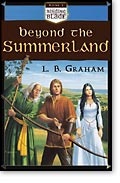
In fact, you will sense Tolkien immediately when you open Graham's Beyond the Summerland, the first installment in a projected multivolume series. It begins with language: the first name in the prologue, Andunin, recalls the River Anduin. Many of the mortal names in Graham's book have Elvish or Dwarfish resonance: Elyas, Wylla, Andira, Evrim, Ulmindos, Corindel. (Graham has kindly provided a glossary, and you'll need it.)
The parallels to Tolkien's world continue. In The Silmarillion, Eru, or Ilvutar, the Holy One, made the immortal Ainur first. The strongest of these, Melkor, to whom had been given the greatest measure of power and glory, lusted for more and sowed discord, from which began the wars of the ages.
Graham has given us Allfather, who made the Twelve, the immortal Titans, the greatest of whom is Malek. Malek rebels, seeking to rule the world of Kirthanin alone, and plunges that world into strife.
The mortals of Kirthanin are divided into four regions corresponding to the cardinal directions. Even those—Nolthanin, Suthanin, Enthanin and Werthanin—sound Tolkienish, as do the names of cities: Dal Harat, for one.
Graham's Black Wolves bring to mind the Wargs. Graham invents creatures called Malekim and Grendolai that correspond roughly to Orcs and Balrogs. A terrifying water beast similar to the one in The Fellowship of the Ring makes a brief appearance. A graybeard prophet of Gandalf's ilk has a major role. Great Bear bring to mind Beorn; dragons fight (although here on the side of good, unlike Smaug); and birds aid the prophets' ability to see far away, as the Eagles helped Gandalf.
A mountain, Agia Muldonai, is linked to the past and future, as is Tolkien's Mt. Doom. Swords that are forged to battle evil are given names, as Tolkien's characters named theirs; and a land called Sulare, or the Summerland, reminds the reader of Elrond's Rivendell.
This is not the nit-picking of a Tolkien scholar, because I am not one. It's difficult—impossible to all but the stupendously gifted—to invent a convincingly original new world, let alone another language. But the question cannot be avoided: has L. B. Graham (and why L.B. when there's already C.S. and J.R.R.?) merely transposed Tolkien into another key, or is there enough to mark Graham as an original talent?
Talented he is. John Gardner wrote that the fictional narrative should function as a vivid and continuous dream, and by that standard Graham succeeds: he effortlessly suspends his reader's disbelief. Graham is a gifted storyteller, and his fiction is not marred by obvious flaws, though occasionally he nods. (Beyond the Summerland is set in the age of dragons, swords, and bows, but the speech of some characters is anachronistically modern: they say "Yeah," and "I can't handle it," or "I can't take it." Younger characters exhibit this most, but Graham provides no reason why their immaturity is defined by 21st-century diction.)
Powerful storytelling is no small accomplishment, and this alone lifts Graham head and shoulders above most of his competition. The cottage industry of writers capitalizing on Tolkien's masterpiece is populated by cynical hacks and hopeful amateurs. (A recent example is Eragon, the New York Times bestseller for young readers, written by a 19-year-old.) Graham's story has depth: substantial people with real problems and emotions, a tale of more than just dragons and wars. Graham himself has lived a little—as head of a Christian school in St. Louis and as a man with a family. In an interview, Graham says that "the real issue is balancing any creative pursuit that can absorb you with family. Family has to be first. Being a husband and a father is vastly more important than work or writing." That's worth quite a few points in my book.
Graham's story concerns the coming of age of a young man, Joraiem Andira, who discovers he's a prophet and is one of a group who fights Malek's forces of evil. As in Tolkien's tales, several historical threads run through the narrative. The past is explained in a somewhat slow-moving prologue that gathers sense in light of the whole book.
I have until now sidestepped the question of the value of fantasy. Is it merely escapism? Should it have a place on the bookshelves of Christians called to nourish and rule the earth, that very tangible substance under our feet? How can a book about fantastical characters from a far-away age be relevant to our labor in Christ's kingdom?
Graham, who studied at Oxford for a time, says his story began when
a footnote in an anthology of poems by W.B. Yeats and an image from the book of Isaiah collided in my imagination. … The story began with the image from Isaiah, the image of swords and spears being remade into pruning hooks and plowshares. It occurred to me as a fan of fantasy, a genre full of young warriors defining themselves with their battle prowess and yet often using that same skill to achieve peace, that the restoration both they and I hoped for might involve more internal identity crisis than I had thought. Would a hero still be a hero if the essential tool of his heroism was melted down in the end and turned into a set of steak knives or horseshoes? … And in that restoration,[sic] lies the final struggle, to let go of the sword that has defined you, and to take up the plow you have fought for.
Article continues below
The Bible itself should give pause to anyone who thinks that only representational realism is legitimate. Ezekiel and other prophets had visions of things we don't see every day. Our Lord Himself is revealed from the very beginning as serpent-slayer, the hero in an epic struggle to destroy the works of the devil. We catch a glimpse of the battles of principalities and powers. Or we recognize, when we've been protected from disaster, that angels are about and our world is filled with more than what we see. With Job, we confess that we only grasp at the fringes of His ways. In this light, fantasy is "not … for whimsy-lovers," as Donald Barr, one of Tolkien's earlier reviewers, so aptly wrote.
One benefit of fantasy is that it can be potently anti-egalitarian, with its hierarchical ranks of otherworldly beings, mortals, and creatures. It fleshes out the order of Psalm 8: God, angels, mankind, the animals. In this way fantasy can serve as a corrective for our culture's insistence on leveling every distinction of rank and office. Fantasy like Graham's can also remind Christians of the daily battles we face against the flesh and that old serpent: we are called to be warriors in Christ's service. Douglas Wilson has written:
The serpent of Genesis is the dragon of Revelation (Rev. 20:2), and we are called to rejoice that a dragon has been slain. In contrast, we have reduced the gospel to four basic steps toward personal happiness, and we are much farther from the truth than our fathers were when they told their glorious stories. This is another way of saying that dragon-lore is truer than therapy-speak. (Future Men, Canon Press, 2001).
L. B. Graham's tale is not as seamless as Tolkien's or his characters as flawlessly rendered. But buy the book; it's eminently enjoyable, and you'll be supporting a brother. (P&R Publishing should be commended for venturing out of their theology and self-help.) Those of us who are intrigued to see how Graham will answer his own question—about a world of warriors populating the peace they fought for—are already looking forward to the next volume in the series.
Article continues below
Newlyn Allison is a writer living in Santa Fe, New Mexico.
More Christianity Today articles on J.R.R. Tolkien are available from our Lord of the Ringsspecial section, and our sister publication, Christian History & Biography, recently devoted an issue to the mythmaker.
Books & Culture Corner appears every Tuesday. Earlier editions of Books & Culture Corner and Book of the Week include:
'Be Happy!' | How the ancient Olympics differed from the modern spectacle. (Aug. 10, 2004)
We've Got Books | The first installment of our new midyear book report. (Aug. 10, 2004)
Rediscovering 'Husbandry' | What Colonial farmers have to teach us about living with the land. (Aug. 03, 2004)
The Naked City | The story of the 1977 blackout in New York-the occasion of widespread looting and destruction-has some surprisingly timely lessons for America in 2004. (April 19, 2004)












 While we pray for peace, we need moral clarity about this war.
 A Christian reconciliation group in Israel and Palestine warned that war would come. Now the war threatens their relevance.españolالعربيةFrançais
 After lobbying from fellow Southern Baptists and Christians affected by the war, the House speaker moves a package forward.





