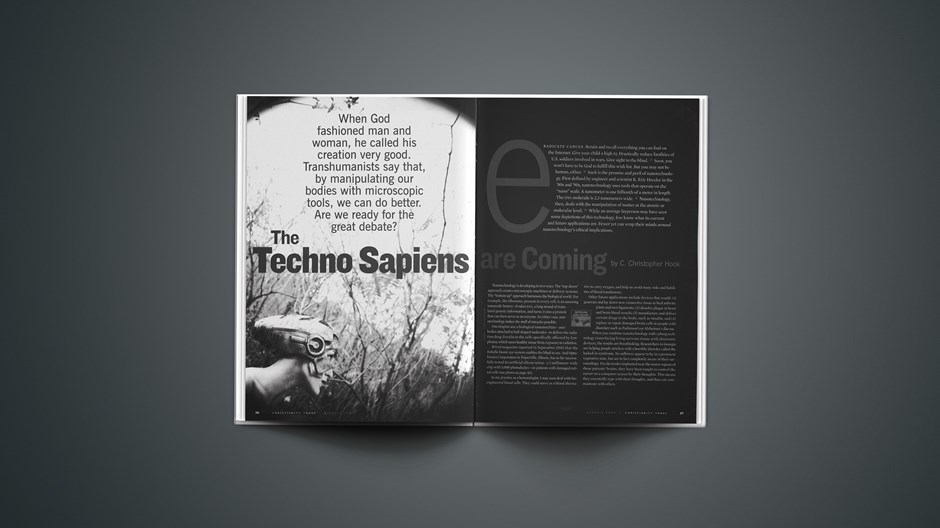
When God fashioned man and woman, he called his creation very good. Transhumanists say that, by manipulating our bodies with microscopic tools, we can do better. Are we ready for the great debate?
Eradicate cancer. Retain and recall everything you can find on the Internet. Give your child a high IQ. Drastically reduce fatalities of U.S. soldiers involved in wars. Give sight to the blind. * Soon, you won't have to be God to fulfill this wish list. But you may not be human, either. * Such is the promise and peril of nanotechnology. First defined by engineer and scientist K. Eric Drexler in the '80s and '90s, nanotechnology uses tools that operate on the "nano" scale. A nanometer is one billionth of a meter in length. The DNA molecule is 2.3 nanometers wide. * Nanotechnology, then, deals with the manipulation of matter at the atomic or molecular level. * While an average layperson may have seen some depictions of this technology, few know what its current and future applications are. Fewer yet can wrap their minds around nanotechnology's ethical implications.
Nanotechnology is developing in two ways. The "top-down" approach creates microscopic machines or delivery systems. The "bottom up" approach harnesses the biological world. For example, the ribosome, present in every cell, is an amazing nanoscale factory—it takes RNA, a long strand of translated genetic information, and turns it into a protein that can then serve as an enzyme. In either case, nanotechnology makes the stuff of miracles possible.
Oncologists use a biological nanomachine—antibodies attached to ball-shaped molecules—to deliver the radiation drug Zevalin to the cells specifically affected by lymphoma, which saves healthy tissue from exposure to radiation.
Wired magazine reported in September 2002 that the Dobelle bionic eye system enables the blind to see. And Optobionics Corporation in Naperville, Illinois, has so far successfully tested its artificial silicon retina—a 2 millimeter-wide chip with 5,000 photodiodes—on patients with damaged retinal cells.
In my practice as a hematologist, I may soon deal with bioengineered blood cells. They could serve as a blood alternative to carry oxygen, and help us avoid many risks and liabilities of blood transfusions.
Other future applications include devices that would: (1) generate and lay down new connective tissue to heal arthritic joints and torn ligaments; (2) dissolve plaque in heart and brain blood vessels; (3) manufacture and deliver certain drugs in the body, such as insulin; and (4) replace or repair damaged brain cells in people with disorders such as Parkinson's or Alzheimer's disease.
When you combine nanotechnology with cyborg technology (interfacing living nervous tissue with electronic devices), the results are breathtaking. Researchers in Georgia are helping people stricken with a horrible disorder called the locked-in syndrome. Its sufferers appear to be in a persistent vegetative state, but are in fact completely aware of their surroundings. Via electrodes implanted near the motor regions of these patients' brains, they have been taught to control the cursor on a computer screen by their thoughts. This means they essentially type with their thoughts, and thus can communicate with others.
It's not hard to imagine that such tools will move beyond therapy into augmentation, or enhancement, of "normal" individuals—or what is more objectively called "bioengineering."
Direct neural interfacing with computer systems would be attractive to people who need to have access to lots of information. Centers such as MIT, Stanford, and the University of Toronto have programs in developing "wearable computers," devices that seamlessly become part of our day-to-day apparel, yet allow 24/7 connection to the Internet and other computer databases. The interface uses optical projectors in specially engineered glasses, and a small handheld module. Hitachi and Charmed Technologies are already marketing such devices. We're very close to taking the ultimate step toward "seamless" interfacing by direct brain implants.
Astronomer and physicist Robert Jastrow, for example, envisions this in his 1983 book The Enchanted Loom: "A bold scientist will be able to tap the contents of his mind and transfer them into the metallic lattices of a computer… . It can be said that this scientist has entered the computer and now dwells in it. At last the human brain, ensconced in a computer, has been liberated from the weakness of the mortal flesh… . It is in control of its own destiny … housed in indestructible lattices of silicone, and no longer constrained in its span of years … such a life could live forever." Well, at least as long as one can supply the needed batteries or power.
Many scholars are anticipating cyborg and nanotech enhancements as means of forestalling aging, or even pursuing immortality. The possibilities belong mostly in the realm of science fiction right now, but they seem less and less improbable as the years go by.
Join the Dinosaurs!
The ethical implications of nanotechnology are great, but even more troubling is the philosophy of some of its proponents, who subscribe to transhumanism. This is the belief that someday we will re-engineer our natures to such an extent that a posthuman species, or several new species, will be created that are "superior" to homo sapiens.
Article continues below
That we are biological creatures is simply our current status, transhumanists believe, but it is not necessary for defining who we are or who we should be. Bart Kosko, a professor of electrical engineering at the University of Southern California, puts it more bluntly in his book Heaven in a Chip (2002): "Biology is not destiny. It was never more than tendency. It was just nature's first quick and dirty way to compute with meat. Chips are destiny."
British roboticist Kevin Warwick put it this way: "I was born human. But this was an accident of fate—a condition merely of time and place." This sounds startingly reminiscent of what nihilist Frederick Nietzsche wrote in Thus Spake Zarathustra: "I teach you the overman. Man is something to be overcome."
Transhumanism is in some ways a new incarnation of gnosticism. It sees the body as simply the first prosthesis we all learn to manipulate. As Christians, we have long rejected the gnostic claims that the human body is evil. Embodiment is fundamental to our identity, designed by God, and sanctified by the Incarnation and bodily resurrection of our Lord. Unlike gnostics, transhumanists reject the notion of the soul and substitute for it the idea of an information pattern.
Katherine Hayles, a professor of English at the University of California, Los Angeles, says in How We Became Posthuman (1999) that "in the posthuman, there are no essential differences, or absolute demarcations, between bodily existence and computer simulation, cybernetic mechanism and biological organism, robot technology and human goals." She concludes her book with a warning: "Humans can either go gently into that good night, joining the dinosaurs as a species that once ruled the earth but is now obsolete, or hang on for a while longer by becoming machines themselves. In either case … the age of the human is drawing to a close."
Are these ideas the musings of a small band of harmless techno geeks? Unfortunately not. Two summers ago, the National Science Foundation, the National Science and Technology Council, and the Department of Commerce published the proceedings of a December 2001 conference on "Converging Technologies for Improving Human Performance." This seminal document is a manifesto for government sponsorship of nanotechnology, biotechnology, information technology, and cognitive science/cybernetics to enhance human beings.
Article continues below
The report sporadically acknowledges that there may be ethical and social concerns with implementing these goals and technologies, yet nowhere does it specifically articulate them. It assumes that ethicists, when involved at all, will simply provide pragmatic justification for the plan, rather than actually raising substantive questions about the underlying philosophy behind the program. On December 2, 2003, President Bush signed into law the 21st Century Nanotechnology Research and Development Act. The bill, as nano news site reported, gives nanotech "a permanent home in the federal government" and assigns nearly $3.7 billion over four years for nano research and development programs.
My hope is that those involved in this research will heed the wisdom of the report of The President's Council on Bioethics released last October, which examines the ethical and social meanings of using biotechnologies for purposes "beyond therapy." It is a statement appropriately skeptical of transhumanist and scientific utopianism. "In wanting to become more than we are, and in sometimes acting as if we were already superhuman or divine, we risk despising what we are and neglecting what we have," the Council admonishes. "In wanting to improve our bodies and our minds using new tools to enhance their performance, we risk making our bodies and minds little different from our tools, in the process also compromising the distinctly human character of our agency and activity. In seeking by these means to be better than we are or to like ourselves better than we do, we risk 'turning into someone else,' confounding the identity we have acquired through natural gift cultivated by genuinely lived experiences, alone and with others. In seeking brighter outlooks, reliable contentment, and dependable feelings of self-esteem in ways that bypass their usual natural sources, we risk flattening our souls, lowering our aspirations, and weakening our loves and attachments." (Read the entire report).
We're All Enhanced
But is there really anything wrong with enhancing our attributes? Each of us engages in various forms of augmentation. We go to school. We train to improve our endurance and agility. We take vitamins. We use corrective lenses, false teeth, and hearing aids.
True. But none of these items and activities seeks to transcend our species' normal capabilities. They are accepted because they merely optimize performance within the natural constraints of homo sapiens.
Article continues below
How about calculators and computers? They augment our ability to obtain, store, retrieve, and process vast amounts of information, more than our brains ever could. But having access to technologies that are separate from ourselves and that we can turn off is quite different from permanent implants, or structural or genetic modifications that can potentially be passed on to subsequent generations.
There are several key questions that our churches and theologians will have to address. Is it appropriate for members of the Body of Christ to engage in alterations that go beyond therapy and are irreversible? Is it just to do so in a world already deeply marked by inequities? What does it mean that our Lord healed and restored in his ministry—never enhanced? Is it significant that the gifts of the Holy Spirit—wisdom, love, patience, kindness—cannot be manufactured by technology? How would the transformation from homo sapiens to techno sapiens affect our identity as bearers of the image of God? If Christians should conclude that such enhancements are not appropriate for them to receive, should they oppose their use by others?
If we do, we can expect severe rejection. Embryonic stem-cell research and cloning exploit other helpless human beings, so they become an ethical problem to many more people. But enhancement technologies may seem unquestionably beneficent since they are used only by those who chose to use them. You cannot deprive people of their right to "better" themselves, especially if it affects only them, right?
The military feels a moral imperative to do whatever is necessary to make sure that each soldier comes home alive and well. If it takes genetic, cybernetic, or nanotechnological modifications to do that, so be it. After all, how could we deny our soldiers the greatest chance of survival?
Market forces will likely push people to undergo enhancements to be competitive in the marketplace. It's already happening. Those with faulty vision cannot be a Navy Seal—unless they undergo irreversible and still risky LASIK eye surgery. It's only a matter of time before members of the armed forces will be required to undergo other forms of augmentation.
Many things are being sold to the public in the name of compassion—but at what price? A quick look at the history of technology shows that for almost every technological "fix," myriad other problems arise. Nuclear power is but one example.
The human lifespan may be expanded, but at what cost to social structures? What will be the effect on employment and retirement? If we alter our bodies with stronger components, what is the cost to our humanity? Although we may not understand the value of our weaknesses, Paul says, even our imperfections give us opportunities (2 Cor. 12:9, Phil. 4:11).
Article continues below
Nano-engineered cybernetic implants may provide us access to vast amounts of information, but will they lead to increased wisdom or knowledge of the Lord?
Cyber connections in the brain are going to be two-way means of communication. This means that the last bastion of privacy—our minds—may no longer be secure. Will such implanted mechanisms force us to be exposed to unwanted images and ideas? We can't even control spam in our current computer networks. Imagine computer viruses that could be engineered to injure brain cells through cybernetic implants!
Remember Sin
Transhumanist philosophy claims that technology can correct the fundamental problems of humankind. As Christians, we know that our elemental problems arise from the corruption of the human heart (Mark 7:2123).
Sin is real, observable, and unexplained by empirical tools. All technological innovations will not only fail to produce true happiness but also will be corrupted intrinsically by sin. Tools offered to produce liberation will also be used to further tyranny. It has always been so.
But Christians must not become techno-dystopians, suspicious of all new technologies. While technology is not our salvation, neither is it intrinsically evil. Technology has enhanced our ability to show compassion and to spread the gospel. Christians need to be techno-realists, recognizing the potential goods of innovation, but realistically anticipating and restricting its potential harms. This requires a correct understanding of human nature and of God's ultimate plans for our species that only the gospel can provide. Christians must boldly engage in the discussion of these issues, both among themselves and in the public square.
Government policies to deal with the ethical and social consequences of bioengineering do not now exist. But this isn't stopping the researchers or the government. As of the end of October, Congress was estimating that the government would have to spend about $4 billion for nano research over the next four years.
Woody Allen once quipped, "More than at any time in history, mankind faces a crossroads. One path leads to despair and utter hopelessness, the other to total extinction. Let us pray that we have the wisdom to choose correctly."
Article continues below
It is my prayer that the body of Christ, inspired by the Holy Spirit and the gospel's perfect vision for human flourishing, can help us avoid either path. Instead, I pray that we will be able to guide our surrounding culture to a truly human future.
C. Christopher Hook is a hematologist, director of bioethics education for the Mayo Graduate School of Medicine, and chairman of the Mayo Clinical Ethics Council. Hook's comments are solely his own and do not necessarily represent the views of the Mayo Clinic.
Recommended Reading
Bio Engagement: Making a Christian Difference Through Bioethics Today (Eerdmans, 2002) edited by Nigel M. de S. Cameron, Scott E. Daniels, and Barbara J. White
Cutting-Edge Bioethics: A Christian Exploration of Technologies and Trends (Eerdmans, 2002) edited by John F. Kilner, C. Christopher Hook, Diann B. Uustal
Enough: Staying Human in an Engineered Age (Times Books, 2003) by Bill McKibben
Habits of the High Tech Heart: Living Virtuously in the Information Age (Baker, 2002) by Quentin J. Schultze
In Our Image: Artificial Intelligence and the Human Spirit (Fortress, 2002) by Noreen L. Herzfeld
Our Posthuman Future: Consequences of the Biotechnology Revolution (Farrar, Straus, and Giraux, 2002) by Francis Fukuyama
TechGnosis: Myth, Magic, and Mysticism in the Age of Information (Three Rivers, 1999) by Erik Davis
Why Things Bite Back: Technology and the Revenge of Unintended Consequences (Knopf, 1996) by Edward Tenner
NanoEthics on the Web
www.betterhumans.com "Connecting people to the future so that they can create it, we explore and advocate the use of science and technology for furthering human progress."















 While we pray for peace, we need moral clarity about this war.
 A Christian reconciliation group in Israel and Palestine warned that war would come. Now the war threatens their relevance.العربيةFrançais
 We must always be people of the Word, but we’ll have to reimagine deep engagement with Scripture.






