When Aaron Barg was three months old, a hernia left him in almost constant pain. Finding a surgeon who could repair the hernia was easy, say his parents, Steve and Susan Barg. But finding an anesthesiologist was almost impossible.
With a rare genetic disorder called Trisomy 13, Aaron was born with a weakened heart and lungs and an undeveloped brain, and he was deaf and legally blind. Doctors told the Bargs that Aaron would most likely die within a year. If he survived beyond that time frame, his life would have little quality—he'd never speak, walk, or feed himself.
For most anesthesiologists, the risk was too high. They felt any operation could kill Aaron.
Getting the medical community to regard Aaron as a person worth saving was a challenge. Susan Barg remembers that doctors didn't refer to him by name, but only "baby Barg." Though doctors commonly refer to even healthy babies this way, she found it symbolic of their attitude toward Aaron.
"He has a name," she would insist. "Please use it."
During a medical visit, Barg asked an anesthesiologist if he would like to hold Aaron. He did so for a full hour, and only then did he agree to assist in an operation. Since then, the anesthesiologist has helped in several more operations for Aaron.
"He holds Aaron, and he becomes a human being," Barg says. "Not a statistic, not a piece of medical research on a piece of paper—but a human being with a name who responds to touch and cuddling and love."
Now 13, Aaron is a handsome boy with blond hair and a face that lights up when someone he knows comes by. Bend down by his wheelchair and he'll pull your face close to his, stare deeply into your eyes, and stroke your face. Though he can't speak, his eyes and hands tell you that he knows you are there. And he has far exceeded all expectations—he can move his wheelchair, feed himself, and even communicate using five hand signals.
To Be or Not To Be
Aaron's experience raises hard questions about personhood. There is no scientific agreement over when human life begins, much less when that life attains personhood—or moral standing, personal stature, or a soul.
But the question of personhood, with its incumbent legal and moral implications, is at the nub of all bioethics debates. Do our capabilities make us persons? If that's the case, then some, like bioethics professor Peter Singer of Princeton University, would argue that Aaron is not a person.
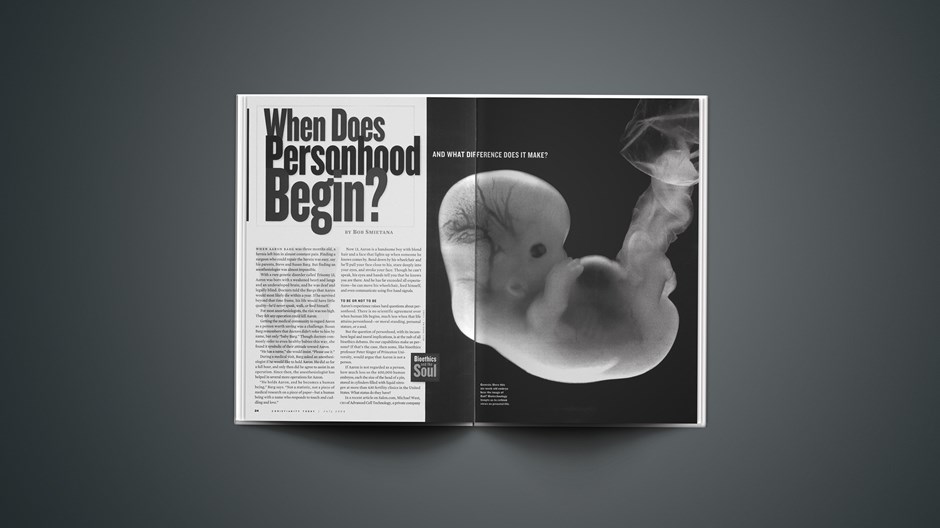
If Aaron is not regarded as a person, how much less so the 400,000 human embryos, each the size of the head of a pin, stored in cylinders filled with liquid nitrogen at more than 430 fertility clinics in the United States. What status do they have?
In a recent article on Salon.com, Michael West, ceo of Advanced Cell Technology, a private company working on stem cells, described an embryo as neither human life nor a person, "just an ordinary group of cells."
"It's not a developing human being," West told Salon.com. "There are no body cells of any kind. … There are not even any cells that have begun to become any body cells of any kind."
Few in the evangelical orbit would agree with such a statement, but a limited range of belief about personhood does exist among Christians.
Most evangelicals would agree that personhood begins at conception, says John Kilner, director of The Center for Bioethics and Human Dignity. At least in theory, that is.
"If you asked about personhood," Kilner says, "people will say, in theory, they support full personhood at conception—few people would deny that." In practice, though, Kilner says many Christians also would "make some exceptions for abortion in the case of genetic deficiencies, or for the use of stem cells. And this is from people whom you'd expect to hold pro-life positions."
To make that distinction, he says, is to bestow personhood at a later stage in development.
One complicating factor for conferring personhood at conception is that a large number of fertilized eggs do not implant, says Hessel Bouma III, professor of biology at Calvin College and chairman of the bioethics commission of the American Scientific Affiliation. Estimates of the number of fertilized eggs that fail to implant run as high as 70 percent.
Conservative Christians have been reluctant to face this fact, Bouma says.
"It's something we've only become aware of in the last 30 years—the majority of fertilized eggs fail to develop," he says. "If we consider the fertilized egg as a person, then take all of the other causes of death and multiply them by three—that's the number of so-called persons who are dying before developing."
Bouma says that personhood should be conferred during the second trimester of pregnancy. Before that point, he says, too many things can go wrong. But most evangelicals, such as Robert D. Orr, director of ethics at the University of Vermont College of Medicine, tie personhood closer to conception.
Uterine Hypocrisy
At one time Orr considered personhood to begin at implantation of the fertilized egg in the uterus. But threats posed by advances in biotechnology have made him reconsider.
Article continues below
"I think it's important to hold the line for moral standing to start at conception," Orr says. "If you move the line away from conception, it just opens up the door to so many technological advances."
Orr first became involved in bioethics following the Roe v. Wade decision in the 1970s. He eventually gave up his medical practice in Vermont, where he'd practiced for 20 years, and enrolled in the University of Chicago to study bioethics.
He has studied personhood as it relates to both the beginning and end of life. Vermont has been targeted by the Hemlock Society as the second state (after Oregon) where a "death with dignity" bill, which he opposes, could be introduced.
Orr and his colleague, C. Christopher Hook of the Mayo Clinic, have written an essay in the Yale Journal of Health Policy, Law, and Ethics entitled "Stem-Cell Research: Magical Promise vs. Moral Peril." They argue for recognizing a unique human individual at the earliest stages of life.
In the abortion debate, they write, it is ironic that "many argue that it is not a human until it is 'out of the uterus,' and in the stem-cell debate many argue that it is not a human until it is 'in the uterus.' These arguments based on the individual's location are feeble attempts to deny the basic fact understood and accepted by scientists for many generations: humanhood begins with the union of 23 chromosomes from the ovum with 23 chromosomes from the sperm."
Most Christian ethicists that Christianity Today interviewed hold that personhood begins at conception. Like Kilner, though, many of them note that the practices of evangelicals don't always reflect that view.
For example, during the in vitro fertilization (IVF) process, embryos are frozen, rated for their quality, discarded if they hold genetic defects, or thawed and dumped in the trash if they are no longer needed. None of these practices would be acceptable in the case of fully developed persons. But most are accepted by evangelicals undergoing IVF treatments.
The scale of IVF and other assisted reproductive technologies (ART) is also a concern. In 2001, the last year for which statistics are available, the Centers for Disease Control reported there were 107,587 ART attempts (known as cycles) resulting in 40,687 babies. That total is up from 64,724 cycles and 20,659 babies in 1996.
With an average cost of $12,400 per cycle, infertility treatment has become a billion-dollar industry. And there's enormous potential for growth. The Association for Reproductive Medicine reports that only 5 percent of the estimated 2.1 million infertile couples have used IVF. To capitalize on this potential, a number of clinics have begun offering "100 percent money-back guarantees" and financing for patients who sign up for ART discount packages.
Article continues below
Concerned about the cost of IVF, the alarming number of excess embryos in fertility clinic freezers, and a tendency to view children as commodities, ethicists have begun calling for limits on ART. A United Methodist bioethics panel recommended to that church's General Assembly in early May that couples forgo the use of IVF—or at least severely limit the number of embryos produced.
A member of the committee, Amy Laura Hall, adamantly opposes IVF. An ordained Methodist minister and assistant professor of theological ethics at Duke Divinity School, Hall anguishes in her opposition. She has several friends who resorted to IVF; she adores their children.
She tells of a close friend who was "very much pro-life" before facing infertility. As a result of her IVF treatment, the friend began to rethink her positions on the beginning of life.
"It became really clear, as we were looking at the embryo under the microscope, that life must not begin at conception," she told Hall after completing her IVF process.
Hall believes that the rationalistic and impersonal practices of IVF—watching the sperm and egg join under a microscope, rating and discarding lower-quality embryos, and freezing those left over—undermine respect for life and the concept that life begins at conception.
"We think that abortion is something that bad women do … or something that irresponsible teenagers do. On the other hand, IVF is something that good, respectable Christian couples do to grow their families," she says. "They are willing to go to great expense, to scrimp and to save, for the procedures that will give them children. Is it possible that what's going on with IVF is very subtly evil?"
IVF undermines the value of human life and paves the way for using embryos as raw material for biotechnology, Hall argues. In coming years, she believes, evangelicals will face a test of resolve on the question of prenatal life.
"For years, evangelical leaders have been very clear on the question of life and personhood beginning at conception," Hall says. "Now that we have found a use for embryos, with the possibility of healing ourselves and healing our children, we are tempted to rethink our position on prenatal life." She points to an irony of the evangelical pro-life commitment: "Now that we are being called to bear the sacrifice of a witness to life, we are tempted not to sacrifice."
Article continues below
Despite the concerns of Hall and other members of the United Methodist bioethics committee, their recommendations about forgoing IVF—and any reference to the embryo as "a form of human life"—were eliminated from the bioethics resolution passed at the latest General Conference.
The Conference passed an additional committee recommendation that excess embryos be used for stem-cell research. Hall co-wrote a dissent from that position.
"We must repent for our actions in creating these embryos," she says, "and then allow them to thaw with a sense of grief and loss. To make use of them allows us to avoid the realization that something indeed has been lost."
Confused and Dangerous
Hook, who teaches ethics at the Mayo Clinic, is also concerned about the practices of IVF. But he believes those practices should be reformed, rather than halted.
One alternative is to limit the number of fertilized eggs to only the number that a couple will implant.
Stunningly, technology also can be harnessed for a lesser-known alternative. Clinics can freeze fertilized eggs at the pronuclear stage—before the sperm and egg DNA are fused.
"If we cryo-preserve at that point," Hook says, "we don't have as much worry about the loss of life."
This technique further muddies the issue of when human life and personhood begin. In any case, Hook says, such reforms mean Christian couples have to be specific about their beliefs when talking with doctors.
The medical community's concept of personhood varies sharply from the most prevalent Christian views. Bob Scheidt, chair of the Christian Medical Association ethics commission, says the medical profession uses four characteristics to define personhood.
All four are related to the function of the neocortex of the brain: rationality, self-awareness, communication/relationship with others, and happiness. Scheidt believes that these functions fall short of a true definition of personhood.
Some of them, like self-awareness and rationality, disappear when a person is under anesthesia, for example. Does that make a patient under anesthesia any less of a person?
Like many ethicists, Scheidt is concerned that personhood is used more often than not to exclude, rather than include people.
Article continues below
"When we didn't want to treat blacks as equal," he says, "we defined them as not persons or as three-fifths of a person in the early American Constitution. We define a fetus as a non-person, and then we can do whatever we wish with it. Most recently [personhood has] been used in arguments about people in persistent vegetative states."
Scheidt believes that the issue of ensoulment is less important than that of the image of God.
"We are bearers of an alien dignity," he says. "We bear the image of God—we are more than phenomena of the earth."
Gilbert Meilaender, professor of Christian ethics at Valparaiso University, says we must restore the notion that a person is something more than a set of capacities.
Instead, he argues that all human life has value because God cares for it regardless of capacities.
For example, he says, while a Scriptural passage like Psalm 139:13-16 ("You knit me together in my mother's womb …") may not be a "proof text" for personhood at conception, it does show that "God's care and his hand are on those who have no capacities."
Because we are of equal dignity, according to Meilaender, we are not at each other's disposal.
Any attempt to separate personhood from human being undermines this essential human dignity. Ironically, he says, U.S. society has limited the idea of personhood in order to narrow its moral responsibility. "The class of human beings," he notes, "has come to be much larger than the class of persons."
Christian theology can offer a corrective to that limited view of personhood, Meilaender believes. By articulating the value of all human beings, he says, "We will be able to show the way in which the language of personhood is confused and dangerous."
Allen Verhey, who chairs the department of religion at Hope College in Holland, Michigan, offers a theological perspective that agrees on the dangers of mere humanistic criteria for personhood.
Verhey sees a parallel between the parable of the Good Samaritan and the debate over personhood. The questions "Who is a person?" and "Who is a neighbor?" both have the same goal—"to find out where our moral duties end," he says.
"Jesus doesn't give a set of criteria to define who is a neighbor," Verhey says. "In the same way, I don't think we can give a set of criteria to define who a person is."
Twin Approaches
At the President's Council on Bioethics, William Hurlbut of Stanford University approaches the issue of individual status from a biological perspective.
Article continues below
He never discusses the soul, and only rarely does he bring up personhood.
Instead, he asks: "When does the embryo become one of us? When does it become an individual with moral standing?"
Hurlbut, who focuses on the ethics of biotechnology, argues that biology can show when an embryo is worthy of full moral status.
"It's undeniable that you have biological continuity in the unfolding of a life," he says. "Fertilization initiates the most complex chemical reaction in the known universe—once initiated, you have a transformation from a zygote (fertilized egg) to an organism with an integrated, self-directed, self-assembling trajectory of a life."
Ethicists often refer to the human embryo as a "potential human being." Hurlbut balks at this characterization, objecting to potential being confused with mere possibility. Rather, he says a human embryo has "potential as potency."
"It's a living entity," he says. "The embryo is a self-assembling individual that is on organizational continuity with the later fetal stage, the baby at the breast, the teenager—all the way to natural death, you have a continuous, unbroken continuity of being."
The real drive behind the argument over personhood, at least for human embryos, says Hurlbut, is that they have become a potential resource for biotechnology.
"If there was no use for the embryo," he argues, "people would be more willing to grant it full moral standing from the beginning."
Beyond conception, the next scientific threshold for moral standing comes at 14 days. That's when the primitive streak, a precursor of the spinal column, appears in an embryo. Before then, Hurlbut says, embryos have been seen as "inchoate compost cells" or simply raw material for the developing life.
But new research into mammalian embryology, he says, shows "there is already development in the individual embryo at its earliest stages."
Fourteen days is also when "twinning" can no longer occur; that is, until that point the embryo could split and become identical twins. Consequently, many argue that until this point the embryo is not an individual person. But Hurlbut says the potential for twinning has no bearing on the embryo's humanity.
"The moral standing doesn't change with twinning," he says. "You had one human life, and now you've got two human lives." Twinning occurs when the embryo "is disrupted and heals itself," he says. (This process happens 10 times more often in IVF labs than in ordinary development in the womb, he says.)
This purely biological view is a kind of twin to the theological view espoused by evangelicals such as Susan Haack, a Wisconsin OB-GYN and member of the ethics commission of the Christian Medical Association. She says that, biblically, she cannot separate human life from personhood.
Article continues below
Based on one part each of theology, ethics, and biology, she traces personhood back to those first stages of life. After conception, she says, "you have the same being all the way to birth and beyond."
Her theology echoes Roman Catholic teaching.
"From the moment of conception," the 1987 encyclical Donum Vitae says, "the life of every human being is to be respected in an absolute way because man is the only creature on earth that God has 'wished for himself' and the spiritual soul of each man is 'immediately created' by God; his whole being bears the image of the Creator."
Susan Barg learned this truth firsthand from her son Aaron. After he was born, her gynecologist told her that he would have counseled her to have an abortion had he known beforehand about Aaron's Trisomy 13.
Barg says she would have found a way to follow her doctor's advice and justify ending Aaron's life. Now she can't imagine making that decision.
"Having Aaron here has helped me understand that God doesn't make mistakes," Susan says. "Aaron has a mission on this earth to fulfill, and a purpose—just like you and I have."
Bob Smietana is features editor of The Covenant Companion, the monthly magazine of the Evangelical Covenant Church, and a freelance religion writer based in Chicago.
Opinion Roundup: 'Only Cellular Life'? | Christians, leaders, and bioethics watchdogs react to the announcement that human embryos have been cloned. (Nov. 29, 2001)
Times Fifty | Can a clone be an individual? A short story. (Oct. 02, 2001)















 While we pray for peace, we need moral clarity about this war.
 A Christian reconciliation group in Israel and Palestine warned that war would come. Now the war threatens their relevance.العربيةFrançais
 The Grammy-winning artist was found dead at her home in Nashville at age 47.






