In Dan Brown's best-selling novel The Da Vinci Code, villain Leigh Teabing explains to cryptologist Sophie Neveu that at the Council of Nicea (A.D. 325) "many aspects of Christianity were debated and voted upon," including the divinity of Jesus. "Until that moment," he says, "Jesus was viewed by His followers as a mortal prophet. … a great and powerful man, but a man nonetheless."
Neveu is shocked: "Not the Son of God?"
Teabing explains: "Jesus' establishment as 'the Son of God' was officially proposed and voted on by the Council of Nicea."
"Hold on. You're saying that Jesus' divinity was the result of a vote?"
"A relatively close one at that," Teabing says.
A little later, Teabing adds this speech: "Because Constantine upgraded Jesus' status almost four centuries after Jesus' death, thousands of documents already existed chronicling His life as a mortal man. To rewrite the history books, Constantine knew he would need a bold stroke…Constantine commissioned and financed a new Bible, which omitted those gospels that spoke of Christ's human traits and embellished those gospels that made Him godlike. The earlier gospels were outlawed, gathered up, and burned."
Unfortunately, this passage of fiction has raised questions for many readers because it appears to be an accurate historical summary embedded in an otherwise fictitious account. It is anything but that.
The novel expresses in popular form what some scholars have been arguing or implying for years. Twenty years ago, Elaine Pagels wrote The Gnostic Gospels, a book that introduced the larger public to the other "Christian" writings that arose in the early centuries of the church. Regarding the books of the New Testament, Pagels asked, "Who made that selection, and for what reasons? Why were these other writings excluded and banned as 'heresy'?"
For Pagels this wasn't a rhetorical question, but one designed to get readers to question the very authority of the New Testament.
Other books—like The Gospel of Mary of Magdala: Jesus and the First Woman Apostle (2003) and The Orthodox Corruption of Scripture: The Effect of Early Christological Controversies on the Text of the New Testament (1997)—have been similarly skeptical.
The issue of canon—what books constitute the final authority for Christians—is no small matter. If the critics are correct, then Christianity must indeed be radically reinterpreted, just as they suggest. If they are wrong, traditional Christians have their work cut out for them, because many seekers remain skeptical of claims to biblical authority.
Let us examine whether revisionist authors' claims stand up to the historical test.
'Heresy' In the Beginning
Pagels is a history of religions professor at Princeton University. Her book explores a number of ancient texts that teach Gnosticism—the collective name for many greatly varying sects that believed that matter is essentially evil and spirit good, and that God is infinitely divorced from the world.
Where Judaism and Christianity emphasize the role of faith and works in salvation, and salvation of both body and spirit, gnostics taught that the soul's salvation depended on the individual possessing quasi-intuitive knowledge (gnosis) of the mysteries of the universe and of magic formulas.
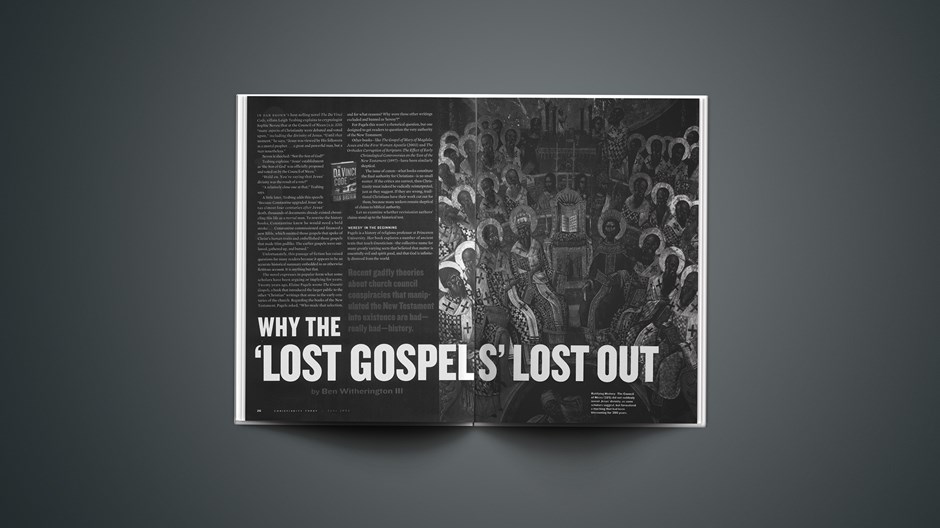
Pagels admits that the gnostic texts were rejected by the orthodox, but she claims that it wasn't until the period of great councils (325 and after) that "orthodoxy" was defined as opposed to "heresy." Thus fourth-century religious politics decided "orthodoxy." As one character in The Da Vinci Code puts it, "Anyone who chose the forbidden gospels over Constantine's version was deemed a heretic. The word heretic derives from that moment in history."
But was there really no such thing as "orthodoxy" before the fourth century? Is it really the case that Gnosticism was harshly suppressed without being given a fair trial?
First, there is no strong evidence to suggest that gnostic Christians vied with the orthodox from the beginning. Even what is probably the earliest gnostic document, the Gospel of Thomas, seems to have come from a period after the New Testament books were already recognized as authoritative and widely circulated.
The Gospel of Thomas, in fact, draws on most of these documents, adding some new ideas about Jesus and about the faith. All other major gnostic texts—like the Gospel of Truth, the Gospel of Philip, the Gospel of the Hebrews, the Gospel of Mary, and so on—are clearly written in the second and third centuries.
Church Fathers Irenaeus and Tertullian addressed Gnosticism in the second century in works titled Against Heresies and The Prescription Against Heretics. And the Muratorian Canon (a list of New Testament writings from late second century) says this: "There is current also an epistle to the Laodiceans, and another to the Alexandrians, both forged in Paul's name to further the heresy of Marcion, and several others which cannot be received into the catholic Church. For it is not fitting that gall be mixed with honey." In other words, it is historically false to say that the councils of the fourth and fifth centuries invented or first defined "heresy."
Article continues below
Revisionist historians like Pagels also argue that there was no core belief system, later called "orthodoxy," in the first century. This is a strange claim, because anyone who has read the letters of John, for example, knows that discussions about orthodoxy and heresy were heating up in the New Testament period. Paul's letters, too, show distinctions being made between truth and error. By the time we get to the Pastoral Epistles (1 and 2 Timothy, and Titus), there is a strong sense of what is and is not sound doctrine, particularly in terms of salvation and the person of Jesus Christ.
Furthermore, the early church viewed the Old Testament as both authoritative and inspired, as 2 Timothy 3:16 shows. This is an important point in regard to Gnosticism. The earliest churches had already recognized the Hebrew Scriptures as canon, a set of authoritative and divinely inspired texts. Notice how much of the Old Testament is quoted in the New Testament books—all written to edify churches across the ancient world. Gnosticism fundamentally rejected Jewish theology about the goodness of creation, and especially the idea that all the nations could be blessed through Abraham and his faith. When the church accepted the Hebrew Scriptures, it implicitly rejected Gnosticism before it had a chance to get started. Thus we are already at a watershed moment in the development of early Christianity, one that could not allow Gnosticism to ever be regarded as a legitimate development of the Christian faith.
New Testament scholar Pheme Perkins points out how rarely the Gnostic literature refers to the Old Testament: "Gnostic exegetes were only interested in elaborating their mythic and theological speculations concerning the origins of the universe, not in appropriating a received canonical tradition. … [By contrast] the Christian Bible originates in a hermeneutical framing of Jewish scriptures, so that they retain their canonical authority and yet serve as witnesses to the Christ-centered experience of salvation."
Article continues below
She puts her finger on one of the main reasons gnostic texts could never have been included in the canon—they largely rejected the Scriptures the earliest Christians affirmed, the Hebrew Bible.
The formation of authoritative apostolic texts, moreover, was already occurring in the New Testament period. We see this in 2 Peter 3:16, which says of Paul: "He writes this same way in all his letters, speaking in them of these matters. His letters contain some things that are hard to understand, which ignorant and unstable people distort, as they do the other Scriptures … " Even if this text was written in the earliest years of the second century (as some New Testament scholars think), it makes plain that there was already a collection of Paul's letters that were considered authoritative and on a par with "Scriptures."
In other words, by the New Testament period, there was already a core of documents and ideas by which Christians could evaluate other documents. The New Testament documents already manifest a concept of "orthodoxy," or at least criteria by which truth and error could be distinguished. Among the second-century lists of authoritative Scriptures, never are gnostic texts listed—not even by the unorthodox Marcion in about 140. There was never a time when a wide selection of books, including gnostic ones, were widely deemed acceptable.
A good example of this is Serapion of Antioch (a bishop from 190 to 211), who let some of his flock read the Gospel of Peter in church—until he read the book himself. He concluded that it had a heretical Christology, teachings about Jesus that did not conform to other ancient apostolic documents. Or compare the Apocalypse of Peter with the canonical gospel portraits of Jesus' Passion. The gnostic text depicts Jesus as glad and laughing on the cross, a radiant being of gnostic light (81:10-11).
Pagels's suggestions to the contrary, gnostic texts were never seriously entertained by many Christians as legitimate representations of the faith.
E Pluribus Unum
Another revisionist historian is Harvard professor Karen King, author of The Gospel of Mary of Magdala: Jesus and the First Woman Apostle (2003). In this book, she is right in affirming that the earliest Christians grappled with a number of issues. She denies, however, that there was a core set of beliefs shared by most followers of Jesus.
Article continues below
For example, listen to why she thinks the Nag Hammadi codices (third- to fifth- century gnostic manuscripts from Egypt) are so crucial to a revision of the history of early Christianity: "These writings are of inestimable importance in drawing aside the curtain of later perspectives behind which Christian beginnings lie, and exposing the vitality and diversity of early Christian life and reflection. They demonstrate that reading the story of Christian origins backwards through the lenses of canon and creed has given us an account of the formation of only one kind of Christianity, and even that only partially. The fuller picture lets us see more clearly how the later Christianity of the New Testament and the Nicene Creed arose out of many different possibilities through experimentation, compromise and very often, conflict."
The fourth- and fifth- century councils and creeds aside, the essential question is, What do the earliest documents about the rise of Christianity say?
As any good historian knows, the documents closest to the source of the rise of the movement are likely to reveal most about the origins of a religious group. Documents by eyewitnesses or those in contact with eyewitnesses are our primary sources. These documents happen to be the New Testament itself, plus a few other first century works like the Didache and 1 Clement.
King's argument—that the earliest churches held a wide spectrum of beliefs—is an argument entirely from silence. We have no evidence of Marcionites or gnostics running around in first-century churches. This is not surprising, since the Jewish presence in those churches was still considerable and the New Testament documents, with the possible exception of Luke-Acts, were written by Jews.
King urges us to "accept that the norm of early Christianity was theological diversity, not consensus." King also seems to completely ignore the existence of core beliefs about Jesus, his life and death, and his resurrection that united the earliest churches. What Paul says in 1 Corinthians 15:1-3 has good claims to being true. This was the tradition that Paul and other apostles were passing down everywhere about Jesus and his death and resurrection.
She ignores masterful studies, like that of J.D.G. Dunn on The Unity and Diversity of the New Testament, which show that theological diversity was hardly the "norm" of the early church. To the contrary, the early church battle cry was akin to "E pluribus unum." Hear the way it is put in Ephesians—"There is one body and one Spirit—just as you were called to one hope when you were called—one Lord, one faith, one baptism, one God and Father of all" (Eph. 4:4-6).
Article continues below
Note the Trinitarian flow and flavor of this text, speaking of our relationship with Spirit, Lord, and Father. It was not the later councils that imposed on the church the notion of the divinity of Christ or a Trinitarian way of thinking about God. The raw, initial articulation of this thinking had already emerged in the New Testament. Unity around this set of core beliefs made Christians stand out from other religious groups in the first century, in the eyes of both Jews and pagans.
But wait a minute, say the critics. We don't have the original New Testament documents. All we have are copies of copies. What if there were orthodox monks who deliberately changed the text while copying it, shaping it according to their own theology, so that our New Testament is a far cry from the originals?
The Non-Problem of Copies
Though we have close to 5,000 original-language manuscripts containing text from part or all of what we now call the New Testament, no two copies are exactly alike. The question for many, then, becomes whether there was some sort of conspiracy to change the originals to make them conform to the orthodoxy taught in the fourth- and fifth- century churches.
As noted earlier, this question has taken popular form in The Da Vinci Code, where "thousands of documents" supposedly chronicled Christ's life as "a mortal man." Constantine supposedly destroyed these gospels and "embellished" the four Gospels to make Christ appear more "godlike." Is there any truth to this?
Bart Ehrman is a specialist in New Testament text criticism—the study of partial and whole manuscripts to reconstruct original texts. In his Orthodox Corruption of Scripture (1997), Ehrman meticulously explores what he calls the orthodox corruptions of Scripture. This enables him to document how, in response to various heresies (including Gnosticism), some scribes added or subtracted from the text to highlight the true humanity or true divinity of Christ. I emphasize highlight, because Ehrman does not suggest, as The Da Vinci Code does, that new ideas were simply imported into the text. For example, sometimes the word Christ is added to the name Jesus to emphasize his exalted status even from birth. It is not as though a foreign idea is sneaking into the text. The vast majority of these enhancements are not to be found in our modern translations (niv, nrsv, the New Living) because text critics have demonstrated they were not part of the originals.
Article continues below
The most important observation to be made is that none of the "corruptions" or corrections was carried out in a systematic way. We have no evidence of a systematic conspiracy by the orthodox church to doctor the text of the New Testament, particularly the Gospels, in order to prop up a new Christology. Yes, certain overzealous individuals, Ehrman shows, were even prepared to create forgeries to support their own view of orthodoxy. But well before the canonization of the New Testament, many Christians had the established apostolic testimony to evaluate the authority—or not—of the various copies floating about.
In fact, on the whole, Christian scribes were notably conservative in how they handled their copies. Worried that a verse might be misunderstood, sometimes they would seek to clarify that which could be overlooked, distorted, or misconstrued. Sometimes they would find alternate readings in the margins of the manuscripts they were copying from, and they would include both readings lest they leave out the correct one. These scribes had a profound sense that they were copying the sacred Scriptures, and they did not want to leave anything out that the originally inspired author had included.
If Ehrman had left his discussion at that point, there might not be any objection to his argument. But he goes on to plow the same furrow as Pagels and King; he too writes revisionist history, arguing for a wide array of beliefs at the church's beginning. The struggle over an emerging orthodoxy, in his view, was not solidified until the fourth century.
How much more solid Ehrman's book would be if it had come to grips with works by Martin Hengel that deal with both early Judaism and early Christianity. There could hardly be a scholar better grounded in primary source texts, both orthodox and heterodox.
From the outset of his The Four Gospels and the One Gospel of Jesus Christ (2000), Hengel stresses that "primitive Christianity has no knowledge of the abrupt distinction between theology and history: The truth lies between a 'historicism' which is hostile to theology, and a 'dogmatism' which is hostile to history."
Article continues below
Hengel shows that the titles on the canonical Gospels—"according to Matthew," and so on—likely were already in place by at least 125. This would mean they circulated together, because the titles imply a distinction between, for example, Luke's rendering and Mark's. Indeed, the collection of four Gospels together may have been one of the first such collections to circulate in one codex or book.
Harry Gamble, in Books and Readers in the Early Church (Yale, 1995), shows at length that Christians in the second century quickly took to the codex (book form) rather than individual papyrus scrolls to more easily circulate multiple documents at once. He demonstrated that Paul's letters also circulated in a collected form early in the second century. This is not just because these documents were popular. It is also because they were seen as representative apostolic texts that faithfully presented the earliest and most authentic evidence and interpretation of Christianity and its founder.
It is no accident that, in about 180, Irenaeus, bishop of Lyons, could already speak clearly and definitively about the fourfold Gospel, specifically citing those of Matthew, Mark, Luke, and John. He does so as he is opposing things he deems heretical. Thus, already in the second century, he has a strong sense of what amounts to orthodoxy when it comes to the story of Jesus.
Even before Irenaeus, from the middle of the second century, we have the witness of Justin Martyr, the great opponent of Marcion and his aberrations. In his Dialogue with Trypho (160), he calls the canonical Gospels "the reminiscences" of the apostles and says they were read and used in worship in his day. Nothing comparable is said about any other gospels, not even the Gospel of Thomas.
We can say without hesitation that various books that were to become part of the New Testament were already seen and used as authoritative and acceptable in the second century in various parts of the church, both Eastern and Western—and that their listing as authoritative in the early fourth century was without serious debate.
In the end, the gnostic gospels and other gnostic documents were never even considered for inclusion in the Christian canon. Other, non-gnostic books that did not make it into the canon were debated rather heavily—namely, the Shepherd of Hermas, 1 Clement, the letters of Ignatius, and, most surprisingly, the Wisdom of Solomon. It is noteworthy that not a single document written after about 120 was ever considered for inclusion in the canon, not least because such documents were not written by people in direct touch with the apostolic tradition, much less with the apostles themselves.
Article continues below
Hence, contrary to Pagels and others, the case was never that the gnostic documents were excluded or deleted. Rather, they were never serious contenders for inclusion in the canon, either in the Eastern or the Western church. As the canon list of Athanasius in 367 demonstrates, even in the home region of the Nag Hammadi texts none of those texts was ever included in a canon. None ever appeared in any authoritative list, and it is perhaps also suggestive that when the Nag Hammadi texts were found, they were found without one single canonical book included with them. This should tell us something about how they were separated from and viewed differently from canonical books.
The New Gnostic Faith
Some 20 years after she wrote The Gnostic Gospels, Elaine Pagels penned the beautifully written Beyond Belief. In a particularly candid and confessional part of the book, Pagels talks about how she had been alienated from Christian faith while in high school: She was part of an evangelical church when a Jewish friend died, and her fellow Christians told her that since the friend was not born again, she was going to hell.
Though this turned her off from the church, she maintained a lively interest in New Testament studies and the early church. While doing doctoral work at Harvard, she had an epiphany. She was reading the Gospel of Thomas when she came across this saying of Jesus: "If you bring forth what is within you, what you bring forth will save you."
She comments: "The strength of this saying is that it does not tell us what to believe but challenges us to discover what lies hidden within ourselves; and with a shock of recognition, I realized that this perspective seemed to me self evidently true."
Her comparison of the Gospel of Thomas and the Gospel of John reveals how far down this road she has traveled. In John, there is an "I-and-Thou" relationship, a vine and branches relationship, that involves an integral connection between the divine and human without identification of the "I" with the "Thou." But in Thomas, it is a matter of "I am Thou." The self is deified and is seen as the finish line of faith.
Here we find the appeal to personal impressions or experience as the final authority. The believer is not asked to believe specific things that come from without (by revelation), nor to submit to any authority but the self. Instead, we are to be the measure of ourselves and to find our own truths within us.
Article continues below
In this book, we see Pagels's story of suffering and feeling betrayed, and her long spiritual journey to a reconfigured form of Christianity—reconfigured as self-actualization. And it is evident that the gnostic texts have helped lead her in that direction.
Pagels is not a disinterested scholar when she writes about Gnosticism. Her spiritual journey entices her to look at the gnostic texts in a particular way, and to postulate an early and widespread authority for them—and then to suggest that the process of New Testament canonization was arbitrary. Orthodox scholars are similarly tempted in their own direction. I know I am. So we are wise to recognize this potential bias in evaluating any argument. But in the end, we still have to make arguments based on history, not on silence.
I don't know the personal story of the other scholars who argue for a vital and early Gnosticism in the church. It really doesn't matter. They might want to argue that Gnosticism should have won the day, or that the church today should resurrect Gnosticism as a valid Christian expression. But their attempt to show that the process of forming the New Testament was somehow arbitrary and manipulative is a failure, and it seems to be driven by something other than historical scholarship.
Ben Witherington III is professor of New Testament at Asbury Theological Seminary and author of many books, most recently Paul's Letter to the Romans: A Socio-Rhetorical Commentary (with Darlene Hyatt: Eerdmans, 2004) and The Gospel Code: Novel Claims About Jesus, Mary Magdalene, and Da Vinci (InterVarsity, 2004), from which this article is adapted.
Reconstructing Jesus | The rewards of N. T. Wright's historical recovery of Jesus are great—but he raises more questions than he answers. (Apr. 27, 1998)
Grave Matters | Take away the Resurrection and the center of Christianity collapses. (Apr. 6, 1998)
Who Killed Jesus? | After centuries of censure, Jews have been relieved of general responsibility for the death of Jesus. Now who gets the blame? (Apr. 9, 1990)
Our sister publication, Christian History, compiled a special section on the Da Vinci Code.
Have something to add about this? See something we missed? Share your feedback here.
Our digital archives are a work in progress. Let us know if corrections need to be made.















 While we pray for peace, we need moral clarity about this war.
 We’ve got little information on Jesus’ appearance and personality. But that’s the way God designed it.españolFrançais
 After lobbying from fellow Southern Baptists and Christians affected by the war, the House speaker moves a package forward.






