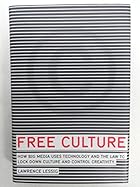
Free Culture: How Big Media Uses Technology and the Law to Lock Down Culture and Control Creativity
Author
Lawrence Lessig
Publisher
Penguin Press HC, The
Release Date
March 30, 2004
Pages
368
Price
14.76
Christian music publishers hoped they were different. As song swapping grew exponentially in the late 1990s, the Christian labels stayed silent on the issue, thinking that Christian teens would behave differently from their non-Christian peers. Christian teens don't head home from youth groups and Campus Crusade meetings to burn copies of Third Day's newest album for each other, right? There's that whole "thou shalt not steal" commandment to think about. The labels continued to post growing sales figures even as secular labels complained loudly about the damage being done by online trading. Christian music racked up $920 million in sales and moved almost 50 million units in 2001, but by 2003, with sales down by almost 5 percent, the labels began to wonder if song swapping had to be addressed.
The Christian Music Trade Association commissioned a study from the Barna Group to get some hard numbers, and the results were shocking. In an April 25, 2004 press release headed, "CHRISTIAN TEENS TAKE THE MORAL HIGH GROUND ON MUSIC PIRACY … NOT!", the CMTA announced that being a born-again, actively church-attending Christian made absolutely no difference in one's behavior in this area. None. Neither did race, gender, or socioeconomic status. 80 percent of all teens, Christian and otherwise, had shared copyrighted music in the last six months, including almost half of those who believed that it was wrong to do so.
Lawrence Lessig's new book Free Culture takes the problems faced by the music industry as its starting point in talking about the battles over copyright that are raging across the country. Lessig, a Stanford law professor and one of the leading voices on digital technology issues, has no time for true pirates who deprive media companies and artists of deserved income, but he also has serious questions about current policies that turn 80 percent of American teens into criminals.
Free Culture argues that without a better balance between the interests of rights-holders and the interests of the public, we as a culture are losing our own ability to create new culture. Copyright owners exert control as they never have before in history over the use and distribution of their products, even being able to limit 'fair use' rights explicitly granted to consumers under copyright law.
In the first hundred years of America's history, copyright was extended only one time, in 1831, from a maximum of 28 years to 42 years. In the next 50 years, it was extended once more as the maximum was raised to 56 years in 1909. But from 1962 to 2002, copyright has been extended eleven times, and all eleven times have extended the right of existing copyrights. Most recently, under heavy lobbying from Disney (as Mickey Mouse was about to come out of copyright), the 1998 Sonny Bono Copyright Term Extension Act gave all copyright holders an extra 20 years of protection.
But how does copyright affect the ways that artists create new culture? Lessig answers that longer copyright terms prevent material from entering the "public domain," our repository of free-to-use culture from the past. Throughout the book, Lessig points out that copyright was never meant to be perpetual. The Constitution enshrines this principle of limited time, granting Congress the power "to promote the progress of science and useful arts, by securing for limited times to authors and inventors the exclusive right to their respective writings and discoveries." In the not-so-distant past, the public domain was always "just over the hill." The average length of copyright was around 30 years, which meant that anything more than a generation and a half old could be freely used, remade, or transformed in any way. Now, though, thanks to the extensions of copyright granted to Mickey Mouse (created in 1928), only material from before the Great Depression can be assumed to be in the public domain.
To show that this loss of the public domain has real consequences, Lessig turns to his favorite example, that of Walt Disney himself. Mickey's first successful cartoon, Steamboat Willie, was not created in a vacuum—it was a direct parody of Buster Keaton's recent silent film Steamboat Bill, Jr., which was itself based on the popular ballad "Steamboat Bill." Disney was free to draw on very recent cultural products and to transform them in his own creative way in something new, and not just with Mickey Mouse. Most of the great Disney cartoons have drawn from other people's source material (such as the Brothers Grimm), including Snow White, Pinocchio, Dumbo, Bambi, Cinderella, Alice in Wonderland, Robin Hood, Peter Pan, and so on. The irony here is clear: Disney built a media empire on the back of public domain material but now fights tooth and nail to prevent any of its own content from flowing back into that same shared space.
At its heart, copyright has always been about preventing the spread of unauthorized copies of a work. Now that digital copies of any work can be instantly shared, proliferating across the network like rabbits, the power of copyright has grown enormously in scope. As only one example of the power of copyright in the digital age, Lessig points out that a teenager who downloads two copyrighted songs to his computer faces stiffer maximum penalties ($150,000 per song) than does a surgeon who accidentally amputates the wrong leg of his patient ($250,000). Free Culture's central claim is that the control exerted by major media companies ought to be scaled back to a more sensible level, one that leaves more room for transformative works (such as Disney's) and creates a healthy public domain. "The internet," writes Lessig, "should at least force us to rethink the conditions under which the law of copyright automatically applies, because it is less clear that the current reach of copyright was never contemplated, much less chosen, by the legislators who enacted copyright law."
Article continues below
Loaded with fascinating examples, Free Culture is a thought-provoking read, though at times it slows under the weight of repetition. It's a book designed to make you angry at the status quo, and on that level it works superbly well, but those hoping that Lessig will come down squarely on the side of the millions of file-swapping Christian teenagers will be disappointed. File-swapping, like the VCR, has all sorts of non-infringing uses, but if record companies don't grant permission to share their music, Lessig is no Abbie Hoffman. He will argue, though, that labels cannot hang onto their copyrights forever; Christian teens will just have to wait for middle age before downloading that Steven Curtis Chapman disc for free.
Nathan Anderson lives and writes in Wheaton, Illinois.
The Naked City | The story of the 1977 blackout in New York-the occasion of widespread looting and destruction-has some surprisingly timely lessons for America in 2004. (April 19, 2004)
History Repeats Itself, Sort of | How the fate of Eugene McCarthy's insurgency against LBJ sheds light on the 2004 presidential campaign. (Feb. 16, 2004)
The Worst President Ever? | Former Nixon aide John Dean attempts to rehabilitate the reputation of Warren G. Harding. (Feb. 09, 2004)
Wholly, Wholly, Wholly | Calvinists and conga drums in Grand Rapids: a report from the seventeenth annual Calvin Symposium on Worship and the Arts. (Feb. 02, 2004)
The Doom of Choice | Fate, free will, and moral responsibility in Tolkien. (Feb. 02, 2004)
A Rose Among Thorns | A new novel by the author of Father Elijah illumines the spiritual consequences of our simplest decisions. (Jan. 26, 2004)
Baptized in Fire | A new book on Martin Luther King, Jr., emphasizes his spiritual transformation. (Jan. 19, 2004)













 While we pray for peace, we need moral clarity about this war.
 As my doubts about his teachings grew, so did a secret fascination with Jesus.
 Leader explains why the movement is seeing its biggest membership bump in 30 years and its mission for the years ahead.





