Plus: Nigeria violence spreads despite state of emergency, more on the Communion conundrum, closing Catholic churches, and other stories from online sources around the world.
Justices to say whether murderer's conversion should have been emphasized in jury sentencing instructions In 1981, William Payton went to a California home where he'd previously rented a room, begging for a place to stay. The woman there let him sleep on the couch. A few hours later, while she was still sleeping, Payton stabbed her 12 times, then raped her as she lay dying. Then he attacked the woman's housemate, stabbing her 40 times, and her 10-year-old son, stabbing him 23 times. Both of these victims, however, survived.
In other words, Payton's crimes are pretty heinous. And a jury found him guilty on all counts.
But God is gracious to the greatest of sinners. In prison, Payton converted to Christianity, and became zealous in his faith. He even led several prison Bible studies.
At Payton's sentencing hearing, eight witnesses told of Payton's conversion, faith, and his changed character. But the prosecutor in the case told the jury to disregard the conversion as a "mitigating" factor—it didn't count. The jury agreed, and sentenced Payton to death. Last October, the 9th U.S. Circuit Court of Appeals said the prosecutor's comment was a mistake—and one big enough to overturn the sentence (as well as the California Supreme Court's 1992 affirmation of Payton's death penalty).
"We have determined that there is a reasonable likelihood that the jury accepted the prosecutor's erroneous statement of the law rather than the defense counsel's and that it therefore failed to consider the only evidence offered in mitigation of the death penalty," Judge Richard Paez wrote for the 6-5 majority.
The dissenters in the case not only questioned the wisdom of overturning the sentence, but also wondered about the "mitigating factors" in Payton's conversion itself
"Abstract legal discussions are important to the development of the law, but so is the ability to look at the impact of those abstract decisions in the context of the real world," wrote Judge Richard Tallman. "Any legal errors were harmless in relation to the acts committed by the man who stood before the jury and asked it to mitigate his sentence based solely on his change of heart after he was caught."
Now the U.S. Supreme Court will take up the case, which prosecutors say could have a significant effect on a number of other death penalty cases.
Nigeria villagers running scared despite state of emergency | Women and children carrying head-loads of personal belongings streamed out of Bakin Ciyawa - a little village of mud huts and a few cement buildings with corrugated iron roofing in central Nigeria's Plateau State - just ahead of dusk, fearful of another militia attack (IRIN, UN)
Plateau killings spread - Alli wants foreign help | Fighting has spread in the killing fields of Plateau State, where President Olusegun Obasanjo Tuesday last week declared a State of Emergency, with reports of killings in Pandam, Namu, Saminaka and Barkin Ciyawa in Quanpan Local Government Area of the state last weekend (P.M. News, Nigeria)
CAN arranges parley with Obasanjo, Pam | Christian Association of Nigeria (CAN) yesterday said it had arranged a meeting between President Olusegun Obasanjo and its Plateau leader, Reverend Yakubu Pam to help resolve their differences, even as it called on its members to continue to exhibit patience and understanding in the face of attacks (Vanguard, Nigeria)
One week of emergency rule in Plateau | With the crisis in Plateau not showing signs of easing off, the following weeks could determine whether this policy was sound, because increasingly respected public personalities have come out against it; furthermore, it seems what happens in Plateau might well end up defining the Obasanjo Presidency and the survival of democracy (Paul Odili, Vanguard, Nigeria)
Subverting God in the service of God | What happened in Kano was predictable and only another in an endless series of religious rioting. It will surely happen again (Harry Nwana, Vanguard, Nigeria)
Cash payments offered for militia guns in troubled Plateau state | The newly appointed administrator of Plateau State, Retired General Chris Alli, has offered cash payments for the return of weapons in the hands of rival Muslim and Christian militia groups that have killed hundreds of people in an upsurge of sectarian violence in recent weeks (IRIN, UN)
Work towards peace, unity, Anglican Church tells Nigerians | Concerned about the violence across the country, the Diocese of Lagos, (Church of Nigeria), Anglican Communion has called on politicians to work vigorously towards the enthronement of peace and unity in the country (Daily Times, Nigeria)
CAN, traditionalist rift in Ido/Osi council settled | An age long feud between the Christian Association of Nigeria (CAN) and the traditionalists in the Ilogbo Community in the Ido/Osi Local Government Area of Ekiti State has come to an end as the warring factions have settled their rift (Daily Times, Nigeria)
Article continues below
Refugees flee violence in central Nigeria | Violence in central Nigeria between Christians and Muslims has caused tens of thousands of people to flee the area. President Olusegon Obasanjo declared a state of emergency last week in the state of Plateau. Death toll estimates from attacks in May have ranged from 67 to as many as 600 killed (All Things Considered, NPR)
Public morality:
Seismic moral shift | There are now no boundaries in America. Any rule is potentially viewed as oppressive and any law — whether legal or moral — is up for debate, negotiation and overturning if it impedes a single individual from fulfilling his or her desire (Cal Thomas, The Washington Times)
Archbishop attacks pursuit of short-term goals | The Archbishop of Canterbury has criticised Britain's "portfolio culture", in which personal integrity is being sacrificed to short-term goals (The Times, London)
Challenging the West's moral virtue | Western values have been found wanting. Stand by for the rise of China and India (Martin Jacques, The Age, Melbourne, Australia)
Church life:
Is the sign for commuters a message from above? | On the shaky ride in from the suburbs, one of the last things riders on most Long Island Rail Road lines see before plunging into a tunnel under the East River is a message from New York Presbyterian Church (The New York Times)
Log on for salvation | If people won't come to church, the church will have to come to them—or, at least, to their computers (Newsweek)
Why Kirk's tradition gags talented Moderators | The temporary nature of the Church of Scotland's Moderators' tenure has been a weakness, and never more so than in the modern era (Magnus Linklater, Scotland on Sunday)
Kirk shames middle class 'skinflints' | Senior Church of Scotland leaders have criticized wealthy, middle-class parishioners who they accuse of keeping their hands in their pockets when the collection plate comes round on a Sunday (The Times, London, sub. req'd.)
Article continues below
Kirk on course for 100 new ministers | There has been a sharp increase in the number of people approaching the Church of Scotland wanting to become ministers, the General Assembly heard (The Scotsman)
Unitarian church shrinking:
The end is nigh for Unitarians, minister warns | The Unitarian movement, a dissenting church that grew out of the Reformation and denies the divinity of Jesus Christ, has fewer than 6,000 members in Britain; half of whom are aged over 65 (The Times, London, sub. req'd.)
Denial of the Holy Trinity led to ban | The earliest Unitarian movements were founded in the 16th century in Transylvania and Poland. In parts of Eastern Europe, where it flourished, it was known as Socinianism, after the anti-Trinitarian theologian Fausto Sozzini (The Times, London, sub. req'd.)
Missions & ministry:
The high tech nun | Sister Patsy Harney fights the digital divide to bring the poor up to speed A lot of basic elements of growing up are now entwined in digital media, says a national researcher on kids and computers (San Francisco Chronicle)
Hoping faith will stop crime | Lawtey is the latest experiment in a growing religion-in-prison movement pushed by Christian luminaries such as former Watergate cover-up figure Charles Colson that has gained a foothold in at least five states (Newsday)
Man on a mission rips phone books | When Ed Charon rolls into town, telephone books ought to make themselves scarce. By the time he leaves, inevitably there's a pulpy trail of torn yellow pages and, he hopes, a few hearts steered toward Christianity (Billings Gazette, Mont.)
With this ring … | … more teens are pledging chastity until marriage (The Morning Call, Allentown, Pa., alt site)
Popular faith:
Prophets and politics | I'd sooner not call myself religious, because we on the left have allowed the right to hijack the notion of faith (Kwame Kwei-Armah, The Guardian, London)
A proper regard for faith on the field | A soccer player has demanded her religion be respected by the Women's Premier League (Editorial, The Age, Melbourne, Australia)
The do-it-yourself doctrine | It's a heresy nowadays to accuse someone of heresy. (Charlotte Allen, Los Angeles Times)
A better bowl of cherries | Just as you are allowed to sit down without being able to define a chair, so, I'd have thought, you should be able to worship without being able to define religion (Christopher Howse, The Telegraph, London)
Article continues below
Seeking common ground | Christians, Muslims, Jews told spirituality, not religion, is key (San Francisco Chronicle)
Iliff president retiring after four years | The president of Denver's Iliff School of Theology announced his retirement Monday after a four-year tenure marked by enrollment and fundraising gains as well as bitter struggles over the Methodist seminary's direction (The Denver Post)
Higher education should reach for God | There's nothing more important in life than the pursuit of truth about and service to God. Yet, even though many universities and colleges were founded by Christian denominations, fewer and fewer today systematically provide for the soul (Raymond J. Keating, Newsday)
Proposal urges exodus from public schools | Choosing between public education or private Christian-based instruction could get more complicated for Southern Baptist parents if their denomination's annual meeting in June endorses a proposed wholesale exodus from "godless" public schools (The Virginian-Pilot, Hampton Roads, Va.)
Vote sought on public school 'exodus' | T.C. Pinckney explains why he is petitioning the Southern Baptist Convention to urge Christian parents to remove their children from public schools (Education Week)
Religion hasn't been 'kicked out' of schools | In fact, over past decade it has kicked back in — so let's stop unfairly demonizing public school (Charles Haynes, First Amendment Center)
'I'm more like a thing than a human being' | John Close should have died in the bay window of his flat, watching the sun set. Instead, crippled by motor neurone disease, he had to travel to Zurich so a doctor could help end his life (Lesley Close, The Guardian, London)
Warner signs bills on feticide | Gov. Mark Warner signed two identical bills that would make murdering a fetus a crime (The Washington Times)
Pupils given morning after pill | Pupils at high schools across Worcestershire are to be offered the morning after pill (BBC)
Article continues below
Abortion:
Pro-abortion group in fresh legal bid | Pro-abortion campaigners have launched a renewed bid to make pregnancy terminations more widely available in Northern Ireland where abortion laws are among the most restrictive in Europe (Reuters)
Appeal over abortion guidelines | An appeal has begun in the High Court in Belfast against a decision not to issue guidelines on the practice of abortion (BBC, video1, video2)
Midwife admits illegal abortions | A senior Northern Ireland midwife has admitted taking part in illegal abortions and believes most terminations now carried out in the province are "criminal acts" (The Sunday Times, London, sub. req'd.)
Animal rights:
Bush speechwriter emerges as animal welfare advocate | Although animal welfare is usually thought of as a liberal cause, Matthew Scully argues that it ought to be a central issue for religious conservatives (The Washington Post)
Earlier: Creature Discomforts | A conservative Christian makes the case for animal mercy in Dominion (Christianity Today, July 31, 2003)
Politics and Communion:
Chaput joins political debate | Denver Roman Catholic Archbishop Charles Chaput on Tuesday joined a national debate about Communion and the ballot box, writing that denying anyone the Eucharist is a "very grave matter" that should be used only in "extraordinary cases of public scandal" (The Denver Post)
Eucharist debate extends to Denver | Archbishop Charles Chaput on Tuesday said the media turmoil over "denying Catholic politicians Communion" is filled with ignorance about the church and the real meaning of the Eucharist (The Gazette, Colorado Springs)
Archbishop Chaput speaks to his flock | Denver prelate's message on Communion focuses on spiritual issues and the conscience of Catholics, doesn't give political orders to the faithful (Editorial, The Denver Post)
Religious leaders rightly defend basic tenets | The need of bishops, rabbis, and imams to state their religions' boundaries trumps their instinct for compassion. They shouldn't bend to public pressure (Gerald L. Zelizer, USA Today)
Churches can decide their own standards | This is not about the separation of church and state. It is a question of the standards of each (Joseph P. Owens, The Express-Times, Bethlehem, Pa.)
Article continues below
Religion & politics:
Separation anxiety | John Kerry's religion problem—and the Catholic Democrat who can help him solve it (Scott Stossel, The Boston Globe)
Lawyer seeks justice's ouster, disqualification | Mobile lawyer Jim Zeigler said Tuesday he will file an ethics complaint today against Justice Jean Brown for running what he says are false and misleading campaign commercials about her vote to remove a Ten Commandments monument from the state judicial building (The Birmingham News, Ala.)
All Methodists don't think alike | U.S. Sen. Hillary Rodham Clinton and President Bush are both United Methodists whose lives have been touched significantly by their church (Leo Sandon, The Tallahassee Democrat, Fla.)
Bishops and the ethnic vote | So Canada's Roman Catholic bishops are getting involved in the election and have outlined 13 key issues they are asking Catholics to consider when deciding how to vote (Andrew Cardozo, The Globe and Mail, Toronto)
Hate-spewing Christians are Satan's helpers | As the former mayor, police commissioners and fire chief of New York City testified last week before the Sept. 11 commission, a band of protesters held up signs that bore such slogans as "God Hates America" and "Thank God for 9/11" (Charita Goshay, The Canton Repository, Oh.)
Cross-bearing | County seal flap illustrates political correctness gone wild (Editorial, Los Angeles Daily News)
Evangelicals not all for Bush | New polling shows that Evangelical Christians are not uniformly conservative on every issue. About one third of them are described as moderate, theologically conservative on sexual morality but socially progressive on political issues such as poverty and the environment (William McKenzie, Morning Edition, NPR)
Alabama Christian Coalition chief is now Catholic | John Giles found himself in awe of church's history and ritual, particularly its use of sight, sound, smell, taste and touch in each service (Associated Press)
Evangelicals give U.S. foreign policy an activist tinge | Led in part by the irrepressible Michael Horowitz, a Jewish neoconservative at the Hudson Institute think tank, evangelicals are embracing international causes with the same moral fervor they have long brought to domestic matters (Associated Press)
Pastor elected mayor on anti-porn platform:
Anti-porn pastor elected mayor of small town | Six months ago Jim Norwood and other church members came up with a plan: take pictures of customers' cars parked outside strip joints and adult bookstores and mail them the photos, along with an invitation to visit the church (Associated Press)
Article continues below
Also: No surprise here: New mayor has big plans for Kennedale | The fast-growing, 6,100-population community as of Monday will be operating with the quirky but also charismatic and highly intelligent 56-year-old Jim Norwood at the helm (O.K. Carter, Ft. Worth Star-Telegram)
Down the sewer to Abu Ghraib | Our military is addressing the abuses that occurred in a prison far away and holding accountable those who are responsible — but what are the rest of us doing to restore civility and decency here at home? (Rebecca Hagelin, Los Angeles Times)
Liberia's Catholic Church calls for war crimes tribunal | In a statement Wednesday on the prevailing situation in Liberia, the Catholic Archdiocese said while it does not oppose any setting up of a Truth and Reconciliation Commission or any other transitional justice systems, it believes that the war crimes tribunal is an additional mechanism to correct the wrongs (The News, Monrovia, Liberia)
God & the EU:
God's place in charter is dividing Europeans | As the Europeans haggle over the final wording of their first constitution, they are bedeviled by a three-letter word: God (The New York Times)
Whose edifice is this? | Spain peels back the layers of its identity (The Christian Science Monitor)
Religious freedom:
JUI to resist changes in blasphemy laws | The Jamiat Ulema-i-Islam, whose amir Maulana Fazlur Rehman has been appointed opposition leader in the National Assembly, declared on Tuesday that the party would not allow the government to make any change to the blasphemy laws or the Hudood Ordinance (Dawn, Pakistan)
Beijing expected to have two more churches | This Chinese capital of Beijing is expected to have two new churches by the end of the year, said Zhang Shuxian, director of the Beijing Municipal Administration for Religious Affairs on Wednesday (Xinhuanet, official China news source)
Organization fights University's policy | The women's Christian cooperative house at Purdue has been exempted from following the University's non-discrimination policy (The Purdue Exponent, Ind.)
Gay marriage:
'Army' fights gay nuptials | Some of the country's most powerful evangelical leaders exhorted conservative Christians to fight for traditional marriage during a nationally broadcast rally Sunday night at New Life Church in Colorado Springs (The Gazette, Colorado Springs)
Article continues below
Provincetown reveals plan today on order limiting marriage | Provincetown's board of selectman declined to comment last night after a meeting about whether the town would comply with Attorney General Thomas F. Reilly's order that officials there stop marrying same-sex couples from out of state (The Boston Globe)
Maryland, Virginia reject gay unions in other states | Maryland and Virginia will not recognize the "marriages" of area same-sex couples who are joining other homosexuals in flocking to Massachusetts to exchange vows, but D.C. officials are still deciding the issue (The Washington Times)
Mass. towns halt licensing of some gay marriages | Three of four Massachusetts towns issuing marriage licenses to out-of-state gay couples stopped doing so on Tuesday after the state's attorney general ordered them to end the practice (Reuters)
Lesbian moms a growing U.S. phenomenon | According to the Family Pride Coalition, a national advocacy group for gay and lesbian families, some 9 million children in America have at least one gay parent and one in five lesbian coupled households include a child under 18 (Reuters)
California Supreme Court considers gay marriage licenses | Some of the seven justices hinted that Mayor Gavin Newsom of San Francisco had overstepped his authority in directing the county clerk to issue the licenses (The New York Times)
Justices wary of S.F. gay unions | At a state high court hearing, several say the city should have pursued a legal challenge before allowing same-sex couples to marry (Los Angeles Times)
John A. Huffman dies at 92 | Massachusetts pastor was founding member of the National Association of Evangelicals and was the founding editor of the organization's publication, United Evangelical Action Magazine (Chicago Tribune)
In Christian book battle, 'Davids' say they're fending off 'Goliaths' | As Christian books rise in popularity, a national trend for Wal-Mart, Target, Barnes & Noble and other large chain stores to carry popular Christian titles doesn't have many local Christian booksellers worried (The News-Enterprise, Hardin County, Ky.)
'Offensive' cross is covered up | A crucifix at a crematorium has been covered up in case it offends mourners of other religions (Evening Standard, London)
Books:
God inspires healthy lifestyle | The "Body For God" program, started by church pastor Ed Young, is a Biblically-based way church members, and others, can live a more healthy and spiritual lifestyle (WNEM, Dallas)
Dead Theologians Society brings Catholic faith to life | With Gregorian chants playing in the background and a fragrant pipe tobacco smoldering like incense in a bowl, the Dead Theologians Society of La Crosse gathers each week in a limestone basement chapel to read by candlelight the writings of the early church fathers or ponder the lives of saints (La Crosse Tribune, Wis.)
The 'Buffy' papers | Here is a list of some other topics that will be discussed at the academic conference on Buffy (The Tennessean, Nashville)
Article continues below
Catholicism:
New bishop to make values his top priority | The Rev. Francis Xavier DiLorenzo was installed yesterday as the 12th bishop of the Roman Catholic Diocese of Richmond, vowing to make traditional values of the church his top priority (The Washington Times)
English bishops soften Vatican's moral line | The Catholic Church in England and Wales will today soften the harsh moralistic language of the Vatican in setting out its most comprehensive moral guidelines for many years to the faithful on how they should live their lives (The Guardian, London)
Religious orders meet the public | Traditionally private religious communities of monks and nuns are opening their doors for a series of monthly 'encounter-days' (BBC)
The ethics of happiness | The fundamentals of Catholic teaching are still rooted in the most basic human desires (Cormac Murphy-O'Connor, The Guardian, London)
Boston church announces parish closures | Roman Catholics at dozens of churches around Massachusetts had to cope with similar feelings of disappointment, sadness and anger as the Boston Archdiocese announced Tuesday it would close 65 of its 357 parishes (Associated Press)
Boston archdiocese to close 70 parishes | Boston's Roman Catholic Archdiocese will soon close 70 of its 357 parishes in the face of dwindling finances and declining Mass attendance exacerbated by the sexual abuse crisis that began here two years ago (The Washington Post)
Also: Catholic dioceses struggle financially | Some examples of financial problems faced by U.S. Roman Catholic dioceses in recent years (Associated Press)
In cuts, archdiocese is seen as sharing burden | Rich and poor parishes alike are being closed by Boston's Roman Catholic Archdiocese, according to a Boston Globe analysis of the decisions announced yesterday. Still, the heaviest cuts are in minority and immigrant communities (The Boston Globe)
Article continues below
'Light of faith will burn … brighter in renewal' | Excerpts from yesterday's statement by Archbishop Sean P. O'Malley on the closing of parishes in the Archdiocese of Boston (The Boston Globe)
Disappearing parishes | Parish life is a lattice of faith, study, family, and friendship supporting individuals and neighborhoods. Parish closures rip apart that support and should be held to a minimum (Editorial, The Boston Globe)
Eulogy for 60 churches: Priest shortage compels closures | Archbishop Sean P. O'Malley unveiled a sweeping reorganization of the Archdiocese of Boston yesterday and attributed the dramatic move to a persistent priest shortage - a problem likely to lead to future closings unless a solution is found (Boston Herald)
Church closings painful, necessary | O'Malley has set the archdiocese on a course of healing, financially and spiritually. Accepting these church closings is one of the higher mountains he will ask Boston-area Catholics to climb (Editorial, Boston Herald)
Conservative group amplifies voice of Protestant orthodoxy | The Institute on Religion and Democracy, a small organization based in Washington, has helped incubate traditionalist insurrections against the liberal politics of the denomination's leaders (The New York Times)
A muted response to AIDS | The growing epidemic is the nation's No. 1 killer, but many of the sick are shunned and left to rely on prayer and untested remedies (Los Angeles Times)
Concern over 'lack of Christians' at Kirk's Israeli hotel and retreat | The Church of Scotland's troubled hotel and retreat in Israel was plunged into fresh controversy last night, after one of the Kirk's senior ministers in Jerusalem accused officials running the project of not employing Christians in senior positions (The Scotsman)
Judge orders auction to end Bible dispute | Ruling in the case of a brother and sister who have been locked in a four-year fight over who owns their mother's 125-year-old family Bible, a Lake County probate judge hit upon a way for each to come away with their share (Associated Press)
Article continues below
Mich. priest arrested in online sex sting | A Roman Catholic priest was arrested in an Internet sex sting after allegedly arranging to meet someone he thought was a 14-year-old girl (Associated Press)
Heavens above, the planets may affect us | Scientists have always dismissed astrology as a load of old bunk. Now, a British astronomer has said that there might be something in it after all. Could the planets really control our fates? (The Age, Melbourne, Australia)
Launched in 1999, Christianity Today’s Weblog was not just one of the first religion-oriented weblogs, but one of the first published by a media organization. (Hence its rather bland title.) Mostly compiled by then-online editor Ted Olsen, Weblog rounded up religion news and opinion pieces from publications around the world. As Christianity Today’s website grew, it launched other blogs. Olsen took on management responsibilities, and the Weblog feature as such was mothballed. But CT’s efforts to round up important news and opinion from around the web continues, especially on our Gleanings feature.
Ted Olsen is Christianity Today's executive editor. He wrote the magazine's Weblog—a collection of news and opinion articles from mainstream news sources around the world—from 1999 to 2006. In 2004, the magazine launched Weblog in Print, which looks for unexpected connections and trends in articles appearing in the mainstream press. The column was later renamed "Tidings" and ran until 2007.














 While we pray for peace, we need moral clarity about this war.
 As my doubts about his teachings grew, so did a secret fascination with Jesus.
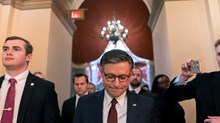 After lobbying from fellow Southern Baptists and Christians affected by the war, the House speaker moves a package forward.





