One spring sunday morning, I was on my way to visit Mars Hill Bible Church, one of the largest and youngest churches in the country, with 10,000 meeting weekly for worship in a converted mall outside Grand Rapids, Michigan. As I took the freeway exit, unsure of the exact directions, I noticed a bumper sticker on the car in front of me. "Love wins," it said, in distressed white type on a black background. In the rear window was a decal with an intricate pattern—half Art Deco, half Goth tattoo—that incorporated a cross and a fish.
Neither the bumper sticker nor the tattoo-decal alone would have induced me to set aside my hastily scribbled directions and simply follow the car straight to the Mars Hill parking lot. But I knew I'd found my mark when I saw the passenger lower the sun visor, look into the makeup mirror, and meticulously adjust his hair.
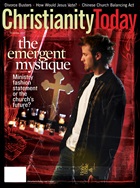
Gentlemen, start your hair dryers—not since the Jesus Movement of the early 1970s has a Christian phenomenon been so closely entangled with the self-conscious cutting edge of U.S. culture. Frequently urban, disproportionately young, overwhelmingly white, and very new—few have been in existence for more than five years—a growing number of churches are joining the ranks of the "emerging church."
Like all labels, this one conceals as much as it reveals. But the phrase "emerging church" captures several important features of a new generation of churches. They are works in progress, often startlingly improvisational in their approach to everything from worship to leadership to preaching to prayer. Like their own members, they live in the half-future tense of the young, oriented toward their promise rather than their past. But if their own focus is on what they are "emerging" toward, perhaps most surprising are the places they are emerging from.
Weak Is the New Strong
Mars Hill's teaching pastor, Rob Bell, hair tousled and reddish brown, hops on stage in the center of what must have been the mall's anchor store. The huge space has been redecorated in utilitarian gray; a wooden cross reaches from floor to ceiling. Communion elements—the broken crackers and grape juice that are standard issue at Bible churches of every generation—are set at its base.
Bell is almost certainly the only pastor to have begun a megachurch-planting career with a sermon series from the book of Leviticus. Today Bell's text—the story of Jesus rebuking Peter for drawing his sword in the Garden of Gethsemane—is more conventional. Bell has the comic timing, the charisma, and the confidence you'd expect from someone who speaks to thousands every week. And he has a gift for the preacher's memorable phrase. "Swords appear strong," Bell says, "but they're actually quite weak. Jesus appears weak, but he's actually quite strong." Inviting his congregation to embrace weakness, referring to Paul's words about his own infirmity in , Bell takes up a refrain: "Weak is the new strong."
It's a pithy way of describing Jesus' upside-down kingdom, and it's a striking way of introducing a Communion service at the foot of a large cross. But "Weak is the new strong" is also an allusion to fashion-industry dictates like "Gray is the new black." Bell is both echoing and subverting a fashion-driven culture of cool. You could say that he puts the hip in discipleship.
Clearly cultural relevance was part of the reason for planting a church whose worship team requires a bass player who can play "in the style of Jimmy Eat World and Coldplay." No generation has ever been more alert to such nuances than the media-fed children of the 1980s and '90s, who can sense uncoolness at a thousand paces. As Rob Bell's wife, Kristen, tells CT in a joint interview after the service, "It's a cultural jump for our friends to come to church. It's a cultural jump for us, and we grew up in the church."
But it quickly becomes clear that these Wheaton College sweethearts have more on their minds than just cultural adaptation. "This is not just the same old message with new methods," Rob says. "We're rediscovering Christianity as an Eastern religion, as a way of life. Legal metaphors for faith don't deliver a way of life. We grew up in churches where people knew the nine verses why we don't speak in tongues, but had never experienced the overwhelming presence of God."
In fact, as the Bells describe it, after launching Mars Hill in 1999, they found themselves increasingly uncomfortable with church. "Life in the church had become so small," Kristen says. "It had worked for me for a long time. Then it stopped working." The Bells started questioning their assumptions about the Bible itself—"discovering the Bible as a human product," as Rob puts it, rather than the product of divine fiat. "The Bible is still in the center for us," Rob says, "but it's a different kind of center. We want to embrace mystery, rather than conquer it."
"I grew up thinking that we've figured out the Bible," Kristen says, "that we knew what it means. Now I have no idea what most of it means. And yet I feel like life is big again—like life used to be black and white, and now it's in color."
Article continues below
The more I talk with the Bells, the more aware I am that they are telling me a conversion narrative—not a story of salvation in the strict sense, but of having been delivered from a small life into a big life. The Bells, who flourished at evangelical institutions from Wheaton to Fuller Theological Seminary to Grand Rapids's Calvary Church before starting Mars Hill, were by their own account happy and successful young evangelicals. Yet that very world, as the Bells tell it, became constricting—in Kristen's phrase, "black and white."
An earlier generation of evangelicals, forged in battles with 20th-century liberalism, prided themselves on avoiding theological shades of gray, but their children see black, white, and gray as all equally unlifelike. They are looking for a faith that is colorful enough for their culturally savvy friends, deep enough for mystery, big enough for their own doubts. To get there, they are willing to abandon some long-defended battle lines.
"Weak is the new strong," it turns out, is not just Rob Bell's knowing reference to the world of fashion, nor just his clever reframing of Paul's message of Christlike life. It's a roadmap for a new way of doing church, even a big church.
And how did the Bells find their way out of the black-and-white world where they had been so successful and so dissatisfied? "Our lifeboat," Kristen says, "was A New Kind of Christian."
A Story of Two Friends
Brian McLaren is not particularly young—he was born in 1956—and he doesn't have cool hair, if only because he has very little hair at all. With his blue-jeans-and-Birkenstocks dress code and a middle-age paunch, he looks like a suburban, nondenominational pastor who came of age playing the guitar for youth ministry meetings in the 1970s.
Which is exactly what he is. Yet he is also the de facto spiritual leader for the emerging church, thanks to his indefatigable speaking and writing schedule that produced, among his many books, 2001's A New Kind of Christian.
A New Kind of Christian became influential not just because of its content but also its form. McLaren cast the book as a story of two friends, a disillusioned evangelical pastor named Dan Poole and an enigmatic high school science teacher nicknamed Neo. On the brink of despair with his own ministry, Dan is led by Neo—who turns out to be a lapsed pastor himself—through a series of set pieces that introduce the initially skeptical Dan to a "postmodern" approach to Christianity.
Article continues below
The modern period of history, as Neo tells it, is coming to an end. We are entering "postmodernity," an as-yet ill-defined borderland in which central modern values like objectivity, analysis, and control will become less compelling. They are superseded by postmodern values like mystery and wonder. The controversial implication is that forms of Christianity that have thrived in modernity—including Dan's evangelicalism—are unlikely to survive the transition.
McLaren managed to connect abstruse concepts of intellectual and social history to a visceral sense of disillusionment among evangelical pastors. Dan's dissatisfaction with ministry, in McLaren's telling, was not primarily a faith problem, a psychological problem, or a sociological problem. It was a philosophical problem—the result of a way of thinking that was no longer adequate. Pastors who would have had a hard time seeing the relevance of postmodernism could suddenly envision it as the key to finding, as the book's jacket put it, "spiritual renewal for those who thought they had given up on church."
The book generated an outpouring of intensely personal response. To this day McLaren continues to receive grateful e-mails from readers. The book also confirmed the intuitions of many who sensed that major changes were under way in the culture. By offering a fundamentally hopeful, rather than despairing or defensive, reading of those changes, McLaren staked out an attractive position for young people like Rob and Kristen Bell.
But A New Kind of Christian has also attracted plenty of critics. The most persistent question they raise is whether "modern" and "postmodern" can be divided so cleanly. Wheaton College philosopher Mark Talbot points out that skepticism about values like objectivity, analysis, and control was already present in Enlightenment figures like David Hume. Meanwhile, Talbot says, "the great irony is that by giving us these sharp categories of 'modern' and 'postmodern' ways of thinking, McLaren is doing the very sort of categorization he describes, and implicitly condemns, as modern."
The point Talbot and others make is not just a matter of quibbling over definitions. If a self-avowed postmodern Christian can't differentiate himself from the moderns he is critiquing, perhaps the divide between modernity and postmodernity is less like the San Andreas Fault and more like a crack in the sidewalk. And if there is no massive change under way in the culture, why make a case for a massive change in the church?
Article continues below
Envisioning a Postmodern Church
The real significance of A New Kind of Christian, though, may be not its answers but its openness to questions that are clearly widespread.
Even now McLaren resists calling Emergent, the emerging church network that he and several other church planters and pastors lead, a "movement," with that word's connotations of a clear leadership and agenda.
"Right now Emergent is a conversation, not a movement," he says. "We don't have a program. We don't have a model. I think we must begin as a conversation, then grow as a friendship, and see if a movement comes of it."
Yet recently McLaren has started to sketch the outlines of his vision of a postmodern church. He sketches a big circle labeled "self," a smaller circle next to it labeled "church," and a tiny circle off to the side labeled "world."
"This has been evangelicalism's model," he says. "Fundamentally it's about getting yourself 'saved'—in old-style evangelicalism—or improving your life in the new style. Either way, the Christian life is really about you and your needs. Once your needs are met, then we think about how you can serve the church. And then, if there's anything left over, we ask how the church might serve the world."
He starts drawing again. "But what if it went the other way? This big circle is the world—the world God loved so much that he sent his Son. Inside that circle is another one, the church, God's people chosen to demonstrate his love to the world. And inside that is a small circle, which is your self. It's not about the church meeting your needs, it's about you joining the mission of God's people to meet the world's needs."
With his circle diagrams, McLaren is popularizing the work of the late British missionary Lesslie Newbigin, who returned from a lifetime in India to spend his last years reflecting on the need for a new theology of mission. "According to Newbigin, the greatest heresy in monotheism is a misunderstanding of the doctrine of election," McLaren says. "Election is not about who gets to go to heaven; election is about who God chooses to be part of his crisis-response team to bring healing to the world."
McLaren doesn't just want to turn the doctrine of election upside down (or, as Newbigin argued, right side up)—he has questions about other cherished words in the evangelical vocabulary.
"I don't think we've got the gospel right yet. What does it mean to be 'saved'? When I read the Bible, I don't see it meaning, 'I'm going to heaven after I die.' Before modern evangelicalism nobody accepted Jesus Christ as their personal Savior, or walked down an aisle, or said the sinner's prayer."
Article continues below
It's not that McLaren is interested in joining the liberal side of modern Protestantism. "I don't think the liberals have it right. But I don't think we have it right either. None of us has arrived at orthodoxy."
Comments like these make many evangelicals nervous. It doesn't help that postmodernism, in the popular imagination, often amounts to pure skepticism about getting anything "right" at all. How can a worldview built on critiquing—or in the postmodern argot, deconstructing—concepts like orthodoxy and salvation be faithful to the gospel? What makes the emerging church's dissatisfaction with traditional Christianity any different from that of liberal Protestantism, which embraced the culture's values only to wither as the culture changed a generation later?
Yet there are real differences between emerging-church leaders like McLaren and those who led the charge for liberal Christianity. Liberalism flourished in a time of Christian cultural dominance, and was championed by leaders eager to keep pace with modern culture. McLaren and his companions tend to be children of notably conservative churches—in McLaren's case, the Plymouth Brethren—who have never enjoyed, nor aspired to, cultural power. They are also evangelists who care passionately about reaching the unchurched.
McLaren describes his dissatisfaction when he first became a pastor: "My gifts were in evangelism, but I was spending all my time with Christians. Then I encountered Rick Warren and his conviction that the church could be evangelistic. We decided to take 10 months to regroup. Then we reconstituted the church with about 80 Christians—and in a year or so, another hundred previously unchurched people joined us."
If critics overlook the evangelistic energy of the emerging church, they also often lump together two very different kinds of postmodern thought. The most notorious postmodern thinkers have been the "deconstructionists"—French intellectuals like Jacques Derrida and Michel Foucault who seek to show that the cherished ideals of Western society (and Christian faith) are fatally compromised by internal contradictions.
But another stream, less well-known outside universities and seminaries, has taken dissatisfaction with modernity in a more constructive direction. It is these thinkers—the late philosopher Michael Polanyi and Notre Dame professor Alasdair MacIntyre, along with theologians like Newbigin—who are gaining the attention of the emerging church's more theologically inclined leaders.
Article continues below
From Newbigin, McLaren has drawn the idea of the church as "missional"—oriented toward the needs of the world rather than oriented towards its own preservation. From Polanyi and MacIntyre, he concludes that the emerging church must be "monastic"—centered on training disciples who practice, rather than just believe, the faith.
He cites Dallas Willard and Richard Foster, with their emphasis on spiritual disciplines, as key mentors for the emerging church. None of these thinkers has any inclination to throw out the baby of truth with the bathwater of modernity.
Indeed, these constructive postmodernists have been read and appreciated in many evangelical seminaries for years—but their ideas have been more often appreciated than applied. McLaren's innovation was to ask what it would mean to actually live out their ideas in a local church. Like Rob and Kristen Bell, he is passionate about the Good News. He just wonders if there is more to that Good News than evangelicals have yet imagined.
Cultural Collision
At the Emergent Convention in Nashville in April, it becomes clear that McLaren's insistence that "Emergent is not a movement" is not false modesty.
In the cavernous hall of the Nashville Convention Center, jerky loops of handheld video—an urban streetscape, an artist at work, a cross-country ski trail—play continuously on three separate screens throughout each general session. On one side of the room, the ancient and currently fashionable tradition of a prayer labyrinth has been revived, with the addition of bicycles.
At the opening session, Youth Specialties president Mark Oestreicher (hair: two-tone wavy locks) urges attendees to come and go at will, cheerfully undermining the credibility of the proceedings: "A lot of what conference speakers say is not really true—they take 20 years of reality and turn it into 90 minutes of unreality."
Thus prepared, the 800 conference-goers do indeed wander in and out through the videos, poetry, worship music, and plenary speakers, chatting on their cell phones in aimless motion. Like so much of American mass media culture, the overall effect is undeniably cool, but also seemingly designed to aggravate—if not generate—attention deficit disorder.
At the Emergent Convention, emerging theology and emerging culture don't so much coexist as collide, thanks to the somewhat uneasy partnership between Emergent and Youth Specialties. During one particularly experimental worship session, featuring a well-known British dj (hair: spiked) whose pulsating techno music (complete lyrics: "It's just you and God") builds to a climax that would have played well in pagan Corinth, I find Brian McLaren outside the convention hall.
Article continues below
"I hate it," he says ruefully of the worship music. Another Emergent leader tells a seminar, "The general sessions are a betrayal of everything Emergent stands for."
The truth is that the convention makes it difficult to tell what Emergent does stand for. Even the invited guests seem bewildered. Plenary speaker Robert Webber, whose book The Younger Evangelicals celebrates the emerging church, is clearly taken aback by what he sees: "They claim to be rejecting the last 30 years of evangelicalism—and they're repeating the last 30 years of evangelicalism."
Twentysomething writer Lauren Winner, dismayed by the video loops playing incessantly behind her during her address, tells me, "I feel so alienated from my generation."
Hair Today, Gone Tomorrow?
Any movement—or conversation—that can inspire such ambivalence, even among its friends, has an uncertain future. Nor is it easy to quantify the emerging church's present.
McLaren guesses that "only a few dozen" churches across the country are fully committed to the theological journey he sketched in A New Kind of Christian. Even Rob Bell did not start that journey until after founding Mars Hill Bible Church. The number of churches whose pastors have cool hair is, of course, much larger—but hardly qualifies as a single movement any more than the number of churches whose pastors wear ties. For the moment, as the Emergent Convention demonstrates, the confusion of style and substance makes for strange bedfellows.
Meanwhile, McLaren's fellow travelers—whether they are dozens or, as Emergent book sales would suggest, tens of thousands—are not the only Christians responding to the challenges of postmodern culture. Manhattan's Redeemer Presbyterian Church attracts several thousand culturally savvy young people with unapologetically Reformed preaching and worship, and churches inspired by Redeemer are thriving in several cities on both coasts.
Catholic journalist Colleen Carroll Campbell has documented the rise of "the new faithful," a growing group of young Americans, often drawn from the same locations and vocations as the emerging church, who are embracing orthodoxy without McLaren's qualifiers.
Article continues below
Implicitly responding to Emergent's disaffection with modern evangelicalism, in March the National Association of Evangelicals attracted more than 200 "young evangelicals" to the inaugural meeting of a network led by Carolyn Haggard, the niece of NAE president Ted Haggard. The 23-year-old Wellesley College graduate says, "The Bible has been relevant for 2,000 years, and popular culture isn't really going to change that. Saying that we're cooler than the generation before, we're more savvy, and we're obviously more intellectual than the generation before—that's not something we'd be at all interested in promoting."
So Emergent has no lock on the next generation. In this respect it may prove no different from the previous Christian movement characterized by male hair, the Jesus Movement. It coexisted, often uneasily, with more cautious expressions of church, was animated by a combination of beautiful ideals and foolish ideas, and ultimately merged into an evangelical mainstream that had adapted to its presence.
But the Jesus Movement, largely composed of converts, was generally unconcerned with theology. Emergent, whose leaders are evangelicalism's own sons and daughters, may yet contribute something more profound than one more fleeting form of cultural relevance.
At least that's what Rob Bell hopes. "People don't get it," he told me. "They think it's about style. But the real question is: What is the gospel?"
That question, of course, is not new. It was asked by, among others, a devout young German monk named Martin Luther who found church increasingly dissatisfying. His answer, rooted in Scripture, changed the direction of Christian history at a moment of epochal cultural change.
Is it possible that a compelling new answer could emerge from McLaren's "conversation"? If so, Bell may have a head start, with props to the apostle Paul.
"Weak is the new strong." The emerging church, and evangelicalism, could do a lot worse.
Andy Crouch is a columnist for CT and a coauthor of Emergent's The Church in Emerging Culture (Zondervan, 2003).
The Virtue of Unoriginality | The old kind of Christian is the best hope for church renewal. (April 04, 2002)
The Postmodern Moment | Are Christians prepared for ministry after modernism's failure? (June 18, 2002)
Article continues below
A Story Darwin Might Love | Brian McLaren's evolutionary interpretation of the faith promises more than it delivers, but what it delivers is good enough. (April 14, 2003)
A Newer Kind of Christian | Brian McLaren's sequel to A New Kind of Christian touches other tenets of faith. (March 26, 2003)
Andy Crouch's columns for Christianity Today are available online.
Our sister publication, Leadership journal, recently ran a profile of Rob Bell's preaching.
To start your own postmodern conversation or find out more about Emergent, you can become a friend of Emergent Village, Emergent's non-movement.
However, much of the emerging church conversation is done on the Internet. While there are too many to sites and weblogs to list, here are a few:
Next-wave—updated monthly, this site has articles and a weblog by its publisher, Charlie Wear, a grandfather who has a skateboarding ministry.
The Ooze—has articles, news, blogs, and plenty of links "to create environments where church leaders (traditional teachers/theologians as well as emerging storytellers/artists) can converse about and collaborate on resources and experiences."
EmergingChurch.info—has articles and blogs, and calls itself a "touching place for the emerging church."
Vintage Faith—has articles, music and book discussions, and is part of Vintage Church in Santa Cruz, California.
Books & Culture articles about emergent and A New Kind of Christian include:
Let's Get Personal | Yes, the church needs to get past modernity's impersonal techniques. But adding the prefix post doesn't solve anything
Post-Evangelicalism | Last in a series of responses to Brian McLaren's book, A New Kind of Christian.
Leadership journal has also run a number of articles on emergent and postmodern thought:
My Emergent Guilt | How did I get here, dancing off-beat, and out of touch?
Has the Emergent Church Emerged? | When newspapers pick up on a religion story, there's a good chance it's old hat to insiders. So now that the Denver Post and the Press-Enterprise of inland Southern California have written stories on emergent churches, are they really still emerging?


















 While we pray for peace, we need moral clarity about this war.
 We’ve got little information on Jesus’ appearance and personality. But that’s the way God designed it.españolFrançais
 The Grammy-winning artist was found dead at her home in Nashville at age 47.






