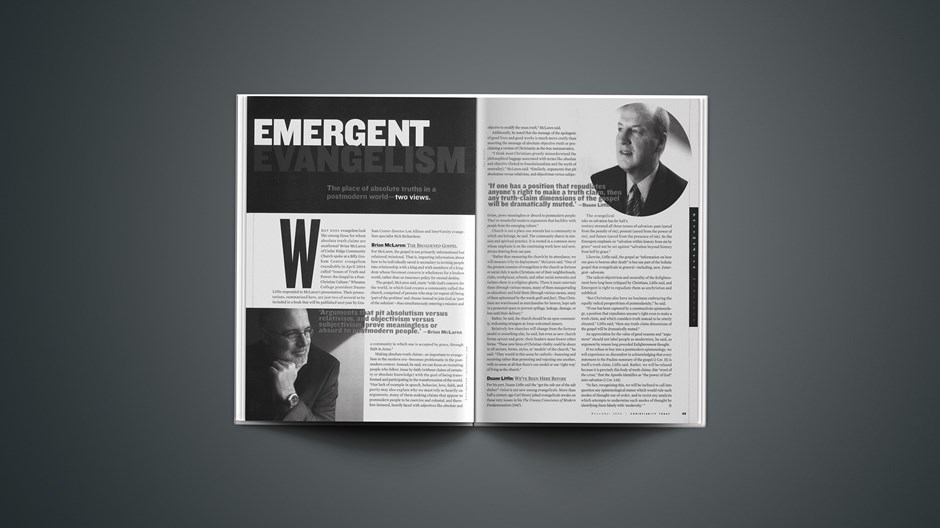
What does evangelism look like among those for whom absolute truth claims are anathema? Brian McLaren of Cedar Ridge Community Church spoke at a Billy Graham Center evangelism roundtable in April 2004 called "Issues of Truth and Power: the Gospel in a Post-Christian Culture." Wheaton College president Duane Litfin responded to McLaren's presentation. Their presentations, summarized here, are just two of several to be included in a book that will be published next year by Graham Center director Lon Allison and InterVarsity evangelism specialist Rick Richardson.
Brian McLaren: The Broadened Gospel
For McLaren, the gospel is not primarily informational but relational/missional. That is, imparting information about how to be individually saved is secondary to inviting people into relationship with a king and with members of a kingdom whose foremost concern is wholeness for a broken world, rather than an insurance policy for eternal destiny.
The gospel, McLaren said, starts "with God's concern for the world, in which God creates a community called the church, comprised of persons who stop (or repent of) being 'part of the problem' and choose instead to join God as 'part of the solution'—thus simultaneously entering a mission and a community in which one is accepted by grace, through faith in Jesus."
Making absolute truth claims—so important to evangelism in the modern era—becomes problematic in the postmodern context. Instead, he said, we can focus on recruiting people who follow Jesus by faith (without claims of certainty or absolute knowledge) with the goal of being transformed and participating in the transformation of the world. "Our lack of example in speech, behavior, love, faith, and purity may also explain why we must rely so heavily on arguments, many of them making claims that appear to postmodern people to be coercive and colonial, and therefore immoral, heavily laced with adjectives like absolute and objective to modify the noun truth," McLaren said.
Additionally, he noted that the message of the apologetic of good lives and good works is much more costly than asserting the message of absolute objective truth or proclaiming a version of Christianity as the true metanarrative.
"I think most Christians grossly misunderstand the philosophical baggage associated with terms like absolute and objective (linked to foundationalism and the myth of neutrality)," McLaren said. "Similarly, arguments that pit absolutism versus relativism, and objectivism versus subjectivism, prove meaningless or absurd to postmodern people: They're wonderful modern arguments that backfire with people from the emerging culture."
Church is not a place one attends but a community to which one belongs, he said. The community shares in mission and spiritual practice. It is rooted in a common story whose emphasis is on the continuing work here and now, always drawing from our past.
"Rather than measuring the church by its attendance, we will measure it by its deployment," McLaren said. "One of the greatest enemies of evangelism is the church as fortress or social club; it sucks Christians out of their neighborhoods, clubs, workplaces, schools, and other social networks and isolates them in a religious ghetto. There it must entertain them (through various means, many of them masquerading as education) and hold them (through various means, many of them epitomized by the words guilt and fear). Thus Christians are warehoused as merchandise for heaven, kept safe in a protected space to prevent spillage, leakage, damage, or loss until their delivery."
Rather, he said, the church should be an open community, welcoming strangers as Jesus welcomed sinners.
Relatively few churches will change from the fortress model to something else, he said, but even as new church forms sprout and grow, their leaders must honor other forms. "These new hives of Christian vitality could be abuzz in all sectors, forms, styles, or 'models' of the church," he said. "They would in this sense be catholic—honoring and receiving rather than protesting and rejecting one another, with no sense at all that there's one model or one 'right way' of living as the church."
Duane Litfin: We've Been Here Before
For his part, Duane Litfin said the "get the salt out of the salt shaker" vision is not new among evangelicals. More than half a century ago Carl Henry jolted evangelicals awake on these very issues in his The Uneasy Conscience of Modern Fundamentalism (1947).
The evangelical take on salvation has for half a century stressed all three tenses of salvation: past (saved from the penalty of sin), present (saved from the power of sin), and future (saved from the presence of sin). So the Emergent emphasis on "salvation within history from sin by grace" need not be set against "salvation beyond history from hell by grace."
Likewise, Litfin said, the gospel as "information on how one goes to heaven after death" is but one part of the holistic gospel that evangelicals in general—including, now, Emergent—advocate.
Article continues below
The radical objectivism and neutrality of the Enlightenment have long been critiqued by Christians, Litfin said, and Emergent is right to repudiate them as unchristian and unbiblical.
"But Christians also have no business embracing the equally radical perspectivism of postmodernity," he said.
"If one has been captured by a constructivist epistemology, a position that repudiates anyone's right even to make a truth claim, and which considers truth instead to be utterly situated," Litfin said, "then any truth-claim dimensions of the gospel will be dramatically muted."
An appreciation for the value of good reasons and "argument" should not label people as modernists, he said, as argument by reason long preceded Enlightenment thought.
If we refuse to buy into a postmodern epistemology, we will experience no discomfort in acknowledging that every statement in the Pauline summary of the gospel (1 Cor. 15) is itself a truth claim, Litfin said. Rather, we will be relaxed because it is precisely this body of truth claims, this "word of the cross," that the Apostle identifies as "the power of God" unto salvation (1 Cor. 1:18).
"In fact, recognizing this, we will be inclined to call into question any epistemological stance which would rule such modes of thought out of order, and to resist any analysis which attempts to undermine such modes of thought by identifying them falsely with 'modernity.' "
The Virtue of Unoriginality | The old kind of Christian is the best hope for church renewal. (April 04, 2002)
The Postmodern Moment | Are Christians prepared for ministry after modernism's failure? (June 18, 2002)
Article continues below
A Story Darwin Might Love | Brian McLaren's evolutionary interpretation of the faith promises more than it delivers, but what it delivers is good enough. (April 14, 2003)
A Newer Kind of Christian | Brian McLaren's sequel to A New Kind of Christian touches other tenets of faith. (March 26, 2003)
Our sister publication, Leadership journal, recently ran a profile of Rob Bell's preaching.
To start your own postmodern conversation or find out more about Emergent, you can become a friend of Emergent Village, Emergent's non-movement.
However, much of the emerging church conversation is done on the Internet. While there are too many to sites and weblogs to list, here are a few:
Next-wave—updated monthly, this site has articles and a weblog by its publisher, Charlie Wear, a grandfather who has a skateboarding ministry.
The Ooze—has articles, news, blogs, and plenty of links "to create environments where church leaders (traditional teachers/theologians as well as emerging storytellers/artists) can converse about and collaborate on resources and experiences."
EmergingChurch.info—has articles and blogs, and calls itself a "touching place for the emerging church."
Vintage Faith—has articles, music and book discussions, and is part of Vintage Church in Santa Cruz, California.
Books & Culture articles about emergent and A New Kind of Christian include:
Let's Get Personal | Yes, the church needs to get past modernity's impersonal techniques. But adding the prefix post doesn't solve anything
Post-Evangelicalism | Last in a series of responses to Brian McLaren's book, A New Kind of Christian.
Leadership journal has also run a number of articles on emergent and postmodern thought:
My Emergent Guilt | How did I get here, dancing off-beat, and out of touch?
Has the Emergent Church Emerged? | When newspapers pick up on a religion story, there's a good chance it's old hat to insiders. So now that the Denver Post and the Press-Enterprise of inland Southern California have written stories on emergent churches, are they really still emerging?















 While we pray for peace, we need moral clarity about this war.
 A Christian reconciliation group in Israel and Palestine warned that war would come. Now the war threatens their relevance.العربيةFrançais
 The Grammy-winning artist was found dead at her home in Nashville at age 47.






