At the beginning of a Seattle screening of The Polar Express, when the locomotive of the title arrived in cacophonous glory, it frightened a girl—probably four years old—near the front of the theatre. She launched from her seat and fled up the aisle, her flustered mother following along. That dazzling train must have been quite a shock for the little tyke, who was probably accustomed to watching cartoons on the family television.
But when she reached the back door, she could not bring herself to exit. She just wanted to keep her distance until she was sure the train wouldn't run her down. After the characters in the film settled in for their North Pole voyage, while dancing attendants served them hot chocolate, she escaped her mother's patient embrace and edged back down the aisle. She stopped right next to me and stood there for most of the movie, oblivious to the fact that she had become part of the spectacle for the rest of us. Her expression reminded me of the boy in Close Encounters of the Third Kind when he sees UFO lights in the front yard—hypnotized, enthralled, and delighted.
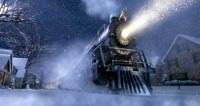
No ordinary train, the Polar Express is a journey from doubt to belief
Based on an exquisite storybook by Chris Van Allsburg, The Polar Express comes to us from Robert Zemeckis. Zemeckis has transported us to other times (Back to the Future); to exotic and remote destinations (Cast Away); and through groundbreaking advances in animation technology (Who Framed Roger Rabbit?). In this film, he takes us to all three: a simpler time, a far-off and frozen place, and an animated exhibition that glows like a forest of illuminated Christmas trees and roars like … well … like a passing train.
Zemeckis inventively converts the simple storybook into a full-length feature without excessive plotting. The film feels more like a tour than a tale. It's as if we're peering into a world that is going on all the time somewhere else. We're introduced to a young boy just as the first frost of adolescent skepticism settles on his heart. On Christmas Eve, he bah-humbugs himself to bed after his World Book Encyclopedia informs him that the North Pole is "devoid of life." "He used to stay up all night waiting for Santa. Those days are over," sighs Mom. "The end of the magic," agrees Dad.
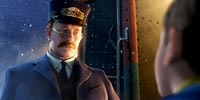
The Conductor (Tom Hanks) invites the boy to get on board
Just in time, and to the boy's amazement, a train arrives in front of his house, and he's invited aboard. Inside, he settles in with other young passengers—an array of similarly wide-eyed children—for a round-trip North Pole voyage. Along the way, they'll find their virtues and their faith tested in preparation for an encounter with Saint Nick himself.
Teenagers and jaded grownups might scoff at Express's old-fashioned sentimentality. But small children, and others who can surrender to such simple whimsy without becoming sarcastic, are likely to find themselves spellbound. We haven't seen a film so perfectly pitched for the very young (and the very young at heart) in years. Recalling classic holiday specials like Rudolph the Red-Nosed Reindeer and Santa Claus Is Coming to Town, The Polar Express is utterly sincere in its storytelling, without a hint of irony or cynicism. (The only painful pop culture reference comes at the end, when we glimpse a singer who resembles a famously flamboyant rock star.)
Hero Girl (Nona Gaye) is caught up in the wonder of it all
The highlight is the train itself. Like a massive seething beast, it barrels through obstacles and plummets down panic-inducing spans of track, dizzying viewers like those old Cinerama-style amusement park rides once did. Along the way, we see several memorable sights, like an airborne train ticket doing its impression of the feather from Forrest Gump (also directed by Zemeckis) and a herd of caribou startled by the beacon of the oncoming train. When the train tracks disappear beneath the surface of a frozen lake, even adult viewers will instinctively reach for seatbelts. It's all too easy to forget we're watching animation.
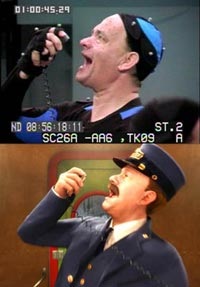
The New York Times' Dave Kehr calls Express—a film in which "there is no film"—a "turning point" in moviemaking, when really this is just one step further along the trail blazed by Sky Captain and the World of Tomorrow earlier this year. Tom Hanks follows in the footsteps of The Lord of the Rings' Andy Serkis, decorated with hundreds of sensors that translate movements and expressions into code, so that he can reappear in this digital wonderland. There, animators alter his appearance so he can appear as a variety of characters, from a father to a train conductor to a wise hobo that resembles Tom Waits. Ever the consummate professional, Hanks shows restraint where others would have hammed it up. But I'm hesitant to praise him too highly—how can I know how extensively his "performance" was digitally altered to suit the director's vision?
Giving the director and his animators so much control over actors, scenery, and action can crush a film's vitality, ridding it of the spontaneity of performances, the elements, and light. These artists' achievement is remarkable, but they're not as successful with the animated children as they are with landscapes. Where Serkis's Gollum was able to communicate cleverness, emotion, and even soul, the children on this train remain eerily distant and mechanical.
Article continues below
Other aspects also feel frustratingly routine. The soundtrack is forgettable; its opening theme is cloned from Edward Scissorhands. The inclusion of big holiday showtune, sung by a young doubter who looks like a cross between Haley Joel Osment and Malcolm in the Middle's Dewey, is an unfortunate stumble. Zemeckis and his co-screenwriter William Broyles, Jr. milk the narrative for typical "Christmas spirit" platitudes until we weary of the word "believe."
Tom Hanks doing 'performance capture' in the studio, and the final product
In a few poignant moments, the story reminds us that there is a deeper meaning to Christmas than an army of elves can explain. Santa holds up a jingle bell and says, "This bell is a wonderful symbol of the spirit of Christmas. As am I." But the implication is that the "spirit of Christmas" equals human kindness.
And Zemeckis' tale undercuts the symbolic potential of the Express itself. It's hard not to think of the myriad gospel songs that tell us, "You don't need no ticket, you just get on board." Zemeckis steers the train clear of this interpretation, though, insisting on the generic spirituality that diluted his adaptation of Contact. He likes the word "faith," so long as he doesn't have to decide who to place faith in. "One thing about trains," a character assures us. "It doesn't matter where they're going. What matters is deciding to get on." That's a strange principle to assert in an election year. It does matter which train we climb aboard, which dream we adhere to, and what we choose to believe in.
Having said that, I cannot deny that there's enough imagination in The Polar Express to merit a recommendation. As the elves of the North Pole led the young visitors to the threshold of Santa's home, that little four-year-old in the aisle responded to Saint Nick's magnetism. As if answering an altar call, she broke free of her mother's grasp and hurried down toward the front of the theatre to reclaim her seat. I hope that this pattern plays out through the rest of her life, as she comes to consider a more amazing spectacle—the true meaning of Christmas.
Talk About It
Discussion starters
Is there any value in the popular mythology of Christmas-Santa, the North Pole, elves, and presents? Where do these stories come from? Who was Saint Nicholas?
Talk about the differences between the four children-the boy, the girl who befriends him, the know-it-all, and the doubter-in personality, wisdom, and weakness.
Article continues below
Do you trust the different figures who offer the boy instruction along the way-the conductor, the hobo, and Santa? What are they trying to teach him? What does the boy learn from his experience?
Why do adults like the boy's parents feel sad when children lose their ability to believe in Santa Claus? What does it tell us about a child when they believe in the Santa myth?
The Family Corner
For parents to consider
The film is rated G. Small children might get a bit nervous at the sight of the rumbling train, especially when it hurtles down steep inclines or careens across a frozen lake.
Based on an exquisite storybook by Chris Van Allsburg, The Polar Express comes to us from Robert Zemeckis, who has transported us to other times (Back to the Future); exotic destinations (CastAway); and through groundbreaking advances in animation technology (Who Framed Roger Rabbit). In this film, he takes us to all three: a simpler time, a far-off and frozen place, and an animated exhibition that glows like a forest of illuminated Christmas trees and roars like a passing train.
The Polar Express is a fantastic feat of animation and a delightful film. It's well worth seeing, especially if you have very young children. But it's important to talk with children after seeing the movie and lead them a little further along the path of what all of this Christmas mythology represents.
"Believe." "Have faith." "The spirit of Christmas." These are phrases that get tossed around far too often in Christmas movies. Most end up implying that belief is about Santa and reindeer, that faith is about trusting that there will be presents under the tree, and that the spirit of Christmas is a warm and gooey feeling of happiness akin to a sugar high. Good storytellers avoid paraphrasing the lessons of their own stories, and the vague and over-used "lessons" like those in The Polar Express lead only to shallow sentimentality.
For all of its pleasures, The Polar Express falls victim to the Curse of the Flimsy Christmas Movie. While some stories of Saint Nicholas remind us of God's extravagant grace through the gift of his son, this one offers only clichés and slogans about human kindness. My full review is at Christianity Today Movies.
Michael Elliott (Movie Parables) calls it a "must-see holiday experience. Both the story and the telling of it have a timeless feel that will be sure to delight generations of families in the many years to come."
Article continues below
But Steven D. Greydanus (Decent Films) is not so enamored. "The Polar Express manages to achieve a remarkable degree of fidelity not only to the simple structure of its picture-book source material, but also to its look and spirit. But is this trip really necessary? As depicted here, Santa's North Pole is neither a magical fairyland nor a picturesque, snowbound toymaker village, but a quaint European-style city with dark, deserted cobblestone streets and—I am not making this up—canned Christmas muzak. Alas, even at the North Pole, where everyone celebrates Christmas, only 'inoffensive' secular tunes are permitted … 'The real meaning of Christmas is in your heart,' Santa says. Whatever that means."
David DiCerto (Catholic News Service) is impressed, calling it "a beautifully told fairy tale whose heartwarming sentiment is as welcome as a mug of steaming hot chocolate on a cold winter's day. Tinged with menace, the film's storybook images are, at once, both beautiful and haunting, evoking, by turns, Norman Rockwellesque nostalgia and the impressionistic otherworldliness of a childhood dream."
Bob Smithouser (Plugged In) says, "As thoroughly secular Christmas stories go, The Polar Express has a tender heart and enough visual tricks to wow even adults. At times, this film's synthetic imagery is amazing. [It] also takes the depiction of people to another level, though it wasn't a warm, intimate enough level to make me fall in love with the characters. I felt like I was watching a technical marvel with lots of bells and whistles, but a pseudo-soul." He also testifies that small children might be shaken by this "sweet story" that's been transformed into "an often scary thrill ride."
Annabelle Robertson (Crosswalk) has an altogether different take: "There is something very sick about this movie, and it isn't the fact that Tom Hanks plays nearly every role, as annoying as that is.It also isn't the fact that a Christmas movie is being released weeks before Thanksgiving, as inexplicable as that is. It's the way that … Zemeckis has beautifully and alluringly transformed Christmas into Clausmas, beckoning us to worship the jolly old elf as the heart and soul of this all-important holiday. And that's something that Christians should be very upset about indeed."
Gene Edward Veith (World) says, "The technology is impressive. The hyper-realistic animated figures … are uncanny. The visual impact of the film … is spectacular." But he concludes, "The movie emphasizes the importance of 'believing,' while saying nothing about the content of belief. This movie presents the very act of believing as what is important, no matter what the belief is."
Article continues below
Michael Karounos (Christian Spotlight), who describes the film as "darkly mysterious and faintly menacing," sees a Christian allegory in the three guides on the childrens' journey: "Santa is the Father figure who rewards belief, the ghost is the Holy Ghost who saves the boy's life, and the Conductor is the Christ-like figure through whom alone the children can go to Santa's city. Seen in such a light, the movie is a striking Christian allegory of seeking God, finding faith, and earning redemption as a reward. The Christian symbols will not be evident to non-believers, but they may give pleasure to believers."
The Polar Express: Peter T. Chattaway (CanadianChristianity, scroll down to the bottom) says, "The film pulls a bait-and-switch on its intended young audience, by tapping quite realistically into their growing doubts about the existence of Santa Claus, and then selling them a fable in which Santa really exists. Worse, the film concludes with a man telling a boy that it doesn't matter where the train is going, only whether he gets on board. This, of course, is typical relativistic, anything-goes nonsense. Considering how many near-accidents this train has skidding over a frozen lake and other moments of peril that probably work best on an IMAX screen, you just might think it would matter very much where the train goes!"
Christian artists work at the intersection of music and climate change.
Kelsey Kramer McGinnis
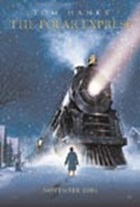
The Polar Express
1 of 4
No ordinary train, the Polar Express is a journey from doubt to beliefThe Conductor (Tom Hanks) invites the boy to get on boardHero Girl (Nona Gaye) is caught up in the wonder of it allTom Hanks doing 'performance capture' in the studio, and the final product














 While we pray for peace, we need moral clarity about this war.
 As my doubts about his teachings grew, so did a secret fascination with Jesus.
 Christian artists work at the intersection of music and climate change.