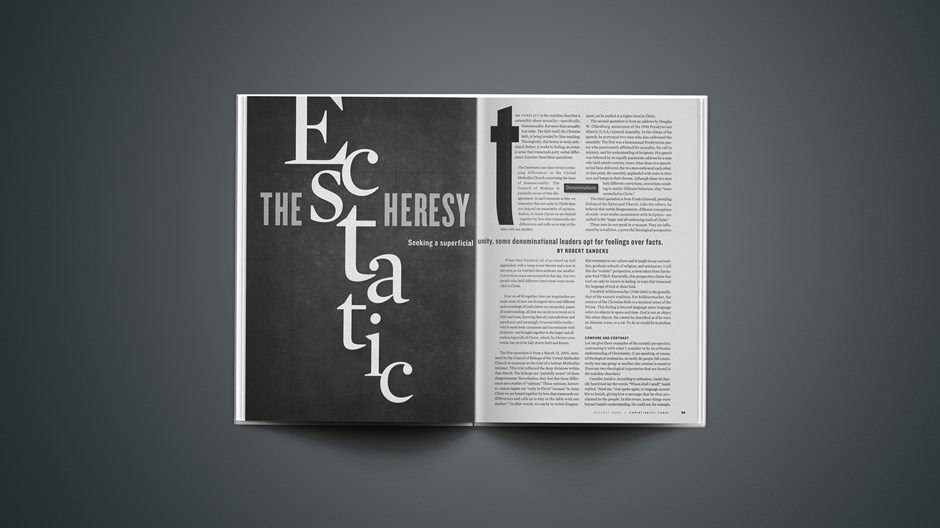
The conflict in the mainline churches is ostensibly about sexuality—specifically, homosexuality. But more than sexuality is at stake. The faith itself, the Christian faith, is being invaded by false teaching. Theologically, this heresy is rarely articulated. Rather, it works by feeling, an ecstatic sense that transcends petty verbal differences. Consider these three quotations:
The Dammann case does reveal continuing differences in the United Methodist Church concerning the issue of homosexuality. The Council of Bishops is painfully aware of this disagreement. In such moments as this, we remember that our unity in Christ does not depend on unanimity of opinion. Rather, in Jesus Christ we are bound together by love that transcends our differences and calls us to stay at the table with one another.
When they finished, all of us stood up and applauded, with a lump in our throats and a tear in our eyes, as we watched them embrace one another. Convictions were not reconciled that day, but two people who held different convictions were reconciled in Christ.
How we all fit together, how our singularities are made sense of, how our divergent views and different understandings of God's intent are reconciled, passes all understanding. All that we can do is to travel on in faith and trust, knowing that all contradictions and paradoxes and seemingly irreconcilable truths—which seem both consistent and inconsistent with Scripture—are brought together in the larger and all- embracing truth of Christ, which, by Christ's own words, has yet to be fully drawn forth and known.
The first quotation is from a March 25, 2004, statement by the Council of Bishops of the United Methodist Church in response to the trial of a lesbian Methodist minister. This trial reflected the deep divisions within that church. The bishops are "painfully aware" of these disagreements. Nevertheless, they feel that these differences are a matter of "opinion." These opinions, however, cannot negate our "unity in Christ" because "in Jesus Christ we are bound together by love that transcends our differences and calls us to stay at the table with one another." In other words, we can be in verbal disagreement, yet be unified at a higher level in Christ.
The second quotation is from an address by Douglas W. Oldenburg, moderator of the 1998 Presbyterian Church (U.S.A.) General Assembly. In the climax of his speech, he portrayed two men who also addressed the assembly. The first was a homosexual Presbyterian pastor who passionately affirmed his sexuality, his call to ministry, and his understanding of Scripture. His speech was followed by an equally passionate address by a man who held utterly contrary views. Once these two speeches had been delivered, the two men embraced each other. At that point, the assembly applauded with tears in their eyes and lumps in their throats. Although these two men held different convictions, convictions resulting in starkly different behaviors, they "were reconciled in Christ."
The third quotation is from Frank Griswold, presiding bishop of the Episcopal Church. Like the others, he believes that verbal disagreements, different conceptions of truth—even truths inconsistent with Scripture—are unified in the "larger and all-embracing truth of Christ."
These men do not speak in a vacuum. They are influenced by a tradition, a powerful theological perspective that resonates in our culture and is taught in our universities, graduate schools of religion, and seminaries. I call this the "ecstatic" perspective, a term taken from theologian Paul Tillich. Essentially, this perspective claims that God can only be known in feeling, in ways that transcend the language of God or about God.
Friedrich Schleiermacher (1768-1834) is the grandfather of the ecstatic tradition. For Schleiermacher, the essence of the Christian faith is a mystical sense of the Divine. This feeling is beyond language since language refers to objects in space and time. God is not an object like other objects. He cannot be described as if he were an electron, a tree, or a cat. To do so would be to profane God.
Compare and Contrast
Let me give three examples of the ecstatic perspective, contrasting it with what I consider to be an orthodox understanding of Christianity. (I am speaking, of course, of theological tendencies, as rarely do people fall consistently into one group or another; the contrast is meant to illustrate two theological trajectories that are found in the mainline churches.)
Consider Isaiah 6. According to orthodoxy, Isaiah literally heard God say the words, "Whom shall I send?" Isaiah replied, "Send me." God spoke again, in language accessible to Isaiah, giving him a message that he then proclaimed to the people. In this event, some things were beyond Isaiah's understanding. He could not, for example, comprehend the intense holiness of God, so holy that the Seraphim hid their eyes and Isaiah cried out, "Woe is me! For I am lost." Yet even though God remained a deep mystery, Isaiah nonetheless heard the transcendent God speak.
Article continues below
According to the ecstatic perspective, the divine utterance "Whom shall I send?" is a poetic metaphor. Rather than literally hearing a particular message from God, Isaiah merely had a profound sense of God the transcendent Holy One. As a result, his imagination created a dialogue between God and himself. The mystical feeling that gave rise to the dialogue came from God, but Isaiah—as formed by his psychological, social, and historical context—created its verbal expression.
Both views, orthodox and ecstatic, understand that God is transcendent. But for the orthodox, the transcendent God speaks actual words. The supreme example of God's speech is the Incarnation of the Word, who reveals God in concrete deeds and words. These two ways of being God, transcendent and holy yet present and speaking, correspond to God the Father and God the Word (or Son), while God the Holy Spirit enables human beings to hear and obey God's spoken words. This view requires the doctrines of Trinity and Incarnation. John 1:18 (RSV) states it this way: "No one has ever seen God; the only Son, who is in the bosom of the Father, he has made him known."
The ecstatic view robs the Incarnation of its objective, concrete character by making the revelation in Jesus ineffable. From there, the Trinity is debased since ultimately there is no God the Word who comes from God to verbally reveal the Father.
Consider a further example, the Resurrection. If Jesus was bodily raised by God, then God acted physically at a specific time and place. This would make God an agent, as if God—like an electron, a tree, or a cat—was literally affecting matter. Ecstatics would not understand God in such a "crude" fashion. As a result, many ecstatics deny the bodily Resurrection. Many also deny biblical miracles, which they consider creations of primitive peoples who took felt experiences of the Holy and clothed them in language normally used for objects. By contrast, an orthodox perspective would trust in the biblical miracles, especially that God raised Jesus bodily from the dead, that the tomb was indeed empty.
Finally, consider ethics. Ecstatics do not believe that specific biblical commands were literally uttered by God. Rather, biblical people had a mystical sense of divine obligation that they expressed in the thought forms of their day. Since these thought forms are constantly changing, the ethical sense takes new forms under new circumstances. As a result, ethics changes as culture changes. From an orthodox perspective, however, God literally spoke biblical commands. Some of them were specific to the time and situation of the original hearers, but many of them, certainly the words of Jesus, are eternally valid.
Article continues below
Ten Differences
These two ways of understanding God—the ecstatic and the orthodox—underlie the theological division in mainline Protestant churches. These differences are not always clearly articulated, and many persons have vaguely adapted portions of each. When the matter is thought through, however, these two views differ in virtually every dimension of the Christian faith.
In addition to the examples given above, let me list ten principal differences.
Ecstatic: God in himself, or in his revelation as Word and words, is never really verbal. He always transcends language. Orthodox: God is transcendent in his essence, but God can speak to human beings who can actually understand him. Above all, God is known in the words and deeds of Jesus Christ, the Word made flesh.
Ecstatic: Theological statements use language, but literal language refers only to objective realities. Language applied to God is always symbolic since God is ineffable. Orthodox: Theological statements can accurately, albeit not exhaustively, describe God and his will. Theology also employs symbolic language since the spoken Word reveals God the Father, who is holy and transcendent.
Ecstatic: Scripture is the history of ecstatic experiences given verbal content according to the social context of the biblical peoples. We live in a different social context. Consequently, one must first hear the "Word within the biblical words" in order to sense the Divine that transcends all historical contexts. Then, once sensed, the Word within the biblical words is expressed in contemporary categories. The concept of "contemporary categories" allows experience to transform Scripture. Orthodox: The biblical Word has verbal content in union with the specific cultural context in which the Word is spoken. There is no "Word within the biblical words," but the biblical words—including their cultural forms—are the Word written. As such, they directly address and redeem all cultural contexts as God's living Word. Experience lies under Scripture.
Ecstatic: The task of theology is to reinterpret the faith as relevant to new cultural contexts. The content of faith evolves since culture evolves. Orthodox: The task of theology is first and foremost to clarify and preserve the faith once delivered to the saints and to transfer it intact to each succeeding generation. Certain aspects of revelation never evolve.
Article continues below
Ecstatic: Since personhood requires objectivity—that is, a person over against us who can speak to us—God is not personal so much as he is an energy to be experienced. Orthodox: God is personal, revealing himself as God the Son who became objectively incarnate in the man Jesus, with whom one can have a relationship.
Ecstatic: Doctrines do not literally refer to God but to feeling, the depth of reality, or the horizon of being. Therefore doctrines can be radically reinterpreted in terms of ecstatic categories, and pastoral experience can carry more weight than doctrine. Orthodox: Doctrines teach truths about God—his moral will and his saving acts. They can be variously understood. They deal with mysteries, but they cannot be reinterpreted in categories that have no literal reference to a God who speaks.
Ecstatic: Sacraments or ordinances express the identity and unity of the ongoing life of the church. Orthodox: In liturgical traditions, sacraments are concrete means of supernatural grace by which God transforms his people. In the free churches, ordinances are the God-ordained means by which believers show their faith in God's saving acts. Both focus on God's action.
Ecstatic: All religions are ultimately one since the faith of each is an expression of the Holy or Ineffable in the concrete forms of a particular culture. Orthodox: The particulars of a religion matter, and therefore, the religions are divided by their specific content.
Ecstatic: The ascent to God is a mystical union beyond the objective boundary of self and God. At this highest level, dialogue, give and take with God, disappears. All is bliss. Humanity has ascended to God. Orthodox: Spirituality is an encounter with God, mediated by Word and sacrament, in which God and the person know each other as distinct selves. God truly speaks to us and listens to us. God condescends to speak to humanity on our terms.
Ecstatic: Those who affirm a particular piety or religious preference constitute the church. Heresy is not as troublesome as schism, to claim ultimacy for one's own verbal beliefs while denying that the differing beliefs of others are equally expressive of the Infinite. Orthodox: Those who have been called by the incarnate Jesus Christ and conformed to that Word by the Spirit constitute the church. Schism is not as much a concern as heresy, the denial of an objectively revealed tradition.
Article continues below
A Church of Both/And
Ecstatics do not deny Scripture, the creeds, or the great documents of their traditions. They consider the Scriptures to be the foundation of faith, their liturgies resonate with the Ineffable, and the various confessions are a cultural treasure. They simply revise these sources along ecstatic lines. That is why it is appropriate to call them "revisionists." They revise Scripture, creeds, and the faith in terms of a non-Trinitarian perspective that has no real sense of the Incarnation.
Since the revisionists "honor" Scripture and tradition, they can worship, study, pray, teach, and promote their agenda shoulder to shoulder with the orthodox while holding utterly different conceptions of the faith. Conflict only arises when the church must deal with concrete issues such as revision of our language for God, sexual norms, evangelism to those of other faiths, or who is welcome to take Communion. At that point, real differences emerge.
As a result, it is not enough for orthodox Christians to simply say that Jesus called God "Father," or that Scripture condemns homosexuality, or that Jesus commands us to evangelize, or that the universal tradition of the church requires baptism prior to Eucharist. Ecstatics know all this. They relativize these claims by viewing them as outmoded expressions of an evolving faith that progressively expresses the Indescribable.
The ecstatic approach is ideal for denominational leaders seeking to maintain institutional harmony in the face of profound theological and moral divisions. It allows them to affirm a transcendent unity while affirming the contradictory beliefs and actions of their constituents. Such leaders may or may not have studied Schleiermacher, but their theology articulates the deepest values of our pluralistic culture—diversity, tolerance, and unity. Once these values assume theological expression and legitimacy, they function perfectly in the North American religious context.
But for the orthodox, it isn't feeling that brings life. It is a God who spoke his living words to them in Jesus Christ. "Heaven and earth will pass away, but my words will never pass away." (Mt. 24:35)
Robert Sanders is associate rector of St. Mark's Episcopal Church in Jacksonville, Florida. He received his Ph.D. in theology from the Graduate Theological Union and the University of California Graduate School in Berkeley, California. More of his writings can be found at http://users.iglide.net/rjsanders.
Canadian Anglicans Face Off | Bishops hold charges against dissenting clergy, but division and suspicion abound. (Dec. 09, 2003)
The Gay Bishop's Global Fallout | How each of the 39 provinces in the Anglican Communion have responded to Sunday's consecration. (Nov. 07, 2003)
Translating the Anglican Primates | Interpretations vary widely on what last week's statement means, how forceful it was, and what's next. (Oct. 21, 2003)
Anglicanism's Communion of Saints | Under the somber portraits of their predecessors, Anglican archbishops will discuss the fractious issues of the church and homosexuality (Oct. 15, 2003)
Florida Bishop Defies Episcopal Church Head | The consecration of a new bishop becomes the latest battleground between Frank Griswold and the American Anglican Council. (Oct. 10, 2003)
Reimagining Anglican Bonds of Affection | Orthodox American leaders begin describing what realignment of the Anglican Communion might look like. (Oct. 09, 2003)
Deputies Slice into the Gordian Knot | The Episcopal Church's House of Deputies approves Gene Robinson as New Hampshire Bishop. The House of Bishops will vote today. (Aug. 4, 2003)
Praise the Lord and Pass the Condoms | Southern Hemisphere primates warned that approving Gene Robinson would place the church outside most of the world's 72 million Anglicans. "You'll get over it," responded about 60 percent of the House of Deputies. (Aug. 4, 2003)
Gene and Me | My history with the openly gay man elected bishop of Rochester. (July 31, 2003)
Coming Attractions | Gay activism is not just found in liberal churches (July 28, 2003)
Anglican Communion Frays | Bishops worldwide chastise Canadian bishop who approved gay unions. (July 09, 2003)
The African Lion Roars in the Western Church | Anglican liberals are fretting, conservatives rejoicing, and all are scrambling to their history books: whence this new evangelical force on the world scene? (June 27, 20 03)
Why I Walked | Sometimes loving a denomination requires you to fight. (Jan. 03, 2003)
A Holy Nuisance | J.I. Packer has strong words for those who don't feel called to agitate for reform. (Jan. 03, 2003)
Mortified in Vancouver | A church's actions can be in conflict with its professed faith only so long before faithful Christians wonder how much hypocrisy they can stand. (July 30, 2002)















 While we pray for peace, we need moral clarity about this war.
 As my doubts about his teachings grew, so did a secret fascination with Jesus.
 The founder of Concerned Women for America was credited by President Ronald Reagan with “changing the face of American politics.”






