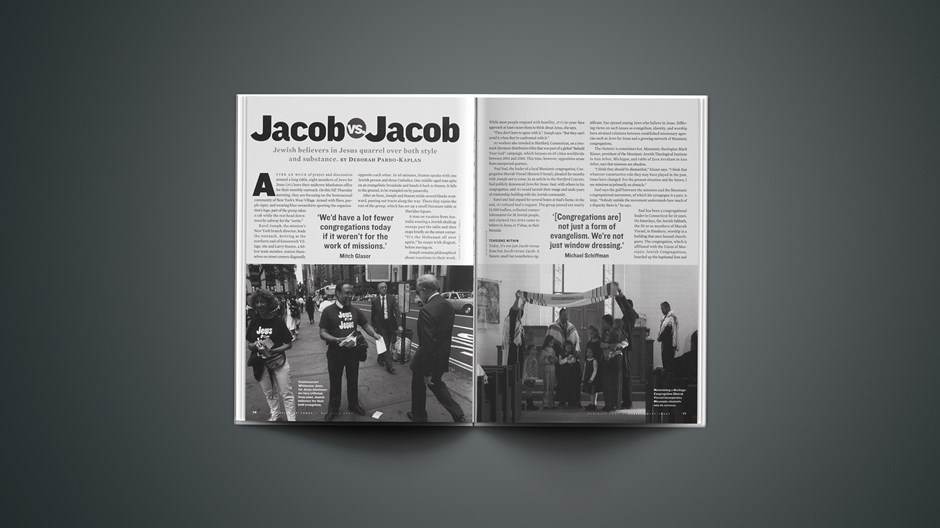
After an hour of prayer and discussion around a long table, eight members of Jews for Jesus (JFJ) leave their midtown Manhattan office for their monthly outreach. On this fall Thursday morning, they are focusing on the homosexual community of New York's West Village. Armed with fliers, purple signs, and wearing blue sweatshirts sporting the organization's logo, part of the group takes a cab while the rest head downtown by subway for the "sortie."
Karol Joseph, the mission's New York branch director, leads the outreach. Arriving at the northern end of Greenwich Village, she and Larry Stamm, a fellow team member, station themselves on street corners diagonally opposite each other. In 45 minutes, Stamm speaks with one Jewish person and three Catholics. One middle-aged man spits on an evangelistic broadside and hands it back to Stamm. It falls to the ground, to be trampled on by passersby.
After an hour, Joseph and Stamm stride several blocks westward, passing out tracts along the way. There they rejoin the rest of the group, which has set up a small literature table at Sheridan Square.
A man on vacation from Australia wearing a Jewish skullcap sweeps past the table and then stops briefly on the street corner. "It's the Holocaust all over again," he snaps with disgust, before moving on.
Joseph remains philosophical about reactions to their work. While most people respond with hostility, JFJ's in-your-face approach at least causes them to think about Jesus, she says.
"They don't have to agree with it," Joseph says. "But they can't avoid it when they're confronted with it."
JFJ workers also traveled to Hartford, Connecticut, on a two-week literature distribution blitz that was part of a global "Behold Your God" campaign, which focuses on 65 cities worldwide between 2001 and 2006. This time, however, opposition arose from unexpected quarters.
Karol and Saal argued for several hours at Saal's home. In the end, JFJ refused Saal's request. The group passed out nearly 12,000 leaflets, collected contact information for 38 Jewish people, and claimed two Jews came to believe in Jesus, or Y'shua, as their Messiah.
Tensions Within
Today, it's not just Jacob versus Esau but Jacob versus Jacob. A fissure, small but nonetheless significant, has opened among Jews who believe in Jesus. Differing views on such issues as evangelism, identity, and worship have strained relations between established missionary agencies such as Jews for Jesus and a growing network of Messianic congregations.
The rhetoric is sometimes hot. Messianic theologian Mark Kinzer, president of the Messianic Jewish Theological Institute in Ann Arbor, Michigan, and rabbi of Zera Avraham in Ann Arbor, says that missions are obsolete.
"I think they should be dismantled," Kinzer says. "I think that whatever constructive role they may have played in the past, times have changed. For the present situation and the future, I see missions as primarily an obstacle."
Saal says the gulf between the missions and the Messianic congregational movement, of which his synagogue is a part, is large. "Nobody outside the movement understands how much of a disparity there is," he says.
Saal has been a congregational leader in Connecticut for 10 years. On Saturdays, the Jewish Sabbath, the 50 or so members of Shuvah Yisrael, in Simsbury, worship in a building that once housed churchgoers. The congregation, which is affiliated with the Union of Messianic Jewish Congregations, boarded up the baptismal font and removed the crosses. The service inconspicuously incorporates Messianic additions, such as from the New Testament Book of Hebrews, to the framework of traditional Jewish liturgy.
Many in the Messianic congregational movement refrain from what they describe as confrontational proselytism to the Jewish community. They not only prefer a more relational experience with the Jewish community, but also view themselves primarily as part of it.
For their part, some in the missions movement, to which Jews for Jesus belongs, charge that some Messianic congregations are trying to gain acceptance in the Jewish community by downplaying Jesus and overemphasizing their Jewishness. David Sedaca, former executive secretary of the International Messianic Jewish Alliance, is a reluctant critic.
"I believe Messianic Jewish congregations have dropped the ball in regards to evangelism," Sedaca says.
Mitch Glaser, the president of Chosen People Ministries, one of the oldest Jewish missions in America, says many congregations owe their very existence to missions. "We'd have a lot fewer congregations today if it weren't for the work of missions over the last 20 years."
Common Roots
Jewish missions, which began in the mid-19th century in both the United States and England, established many Messianic congregations. According to Yaakov Ariel, professor of American religion at the University of North Carolina and author of Evangelizing the Chosen People, New York had more than a dozen missionary organizations in the late 1800s. By the early 1900s, more than 200 full-time paid missionaries in the United States were evangelizing the Jewish community.
Article continues below
For the most part, those involved believed Jews should enter Christian churches and relinquish Jewish affiliations. From the 1920s through the 1960s, missions warmed up to the idea of Hebrew Christian congregations, as they were called at the time. Protestant denominations, such as the Presbyterians, sporadically tried to foster these groups through their own missions in Los Angeles, Baltimore, Philadelphia, and Chicago.
It wasn't until the 1970s that missionary organizations openly supported the notion that Jews who believe in Jesus could maintain their Jewish heritage through congregations separate from established churches. Missionary organizations began to see these places as a new form of evangelism. At this time, the term "Messianic Judaism" became popular, mainly connoting those who wanted to keep some kind of Jewish identity.
Today, the two major Messianic umbrella organizations, the International Alliance of Messianic Congregations and Synagogues and the Union of Messianic Jewish Congregations, count approximately 200 congregations under their auspices. Adding in congregations that link with other groups or that lack affiliation brings the total to between 400 and 500 worldwide. Leaders estimate there are somewhere between 10,000 and 30,000 Messianic Jews in the United States, not counting Jews in typical churches—which would bring the number closer to 200,000, according to scholars such as Ariel.
Jew or Christian?
The dispute centers mainly on identity. Saal, Kinzer, and others within the congregational movement don't believe missions should identify equally with the Christian church and the Jewish community. Saal and Kinzer consider their primary locus of identity to be within the Jewish community, although they say they are one with both communities. Kinzer says the church should consider reorienting itself within Israel, rather than perceiving itself as standing outside it. Other congregational leaders, however, prefer not to choose.
"I don't think in those terms," says Michael Wolf, a member of the executive committee of the Messianic Jewish Alliance of America. "I do not choose one over the other. I think it's unproductive. I'm one with our Jewish people in the sense that I'm a part of our people and one with the body of Messiah."
Some congregations embrace traditions from evangelical Protestant churches while others express varying degrees of Jewish symbolism and tradition. When not speaking in churches, Karol Joseph attends Calvary Baptist Church in Manhattan on Sundays. She also participates in JFJ's monthly Friday night services. JFJ offers Hebrew lessons and helps those who want to observe Jewish rites of passage such as bar mitzvahs.
Article continues below
"We try to be as authentically Jewish in our expression in Jews for Jesus as we can," says David Brickner, executive director of Jews for Jesus. "A lot of folks in Jews for Jesus did come from fairly traditional Jewish backgrounds. So this is not something that needs to be discovered. Many of us grew up with it."
However, many members of the Messianic congregational movement suspect that those in missions use the traditions simply as bait.
"[Congregations are] not just a form of evangelism," says Michael Schiffman, an associate rabbi at Shuvah Yisrael. "We're not just window dressing. When the Jewish missions have planted congregations, often the Jewishness is window dressing because they're operating with the mentality that whatever it takes to bring someone to Jesus is all that they really care about."
Messianic congregations often prefer good works as a way to engage the Jewish community socially. In Florida, congregations gave money to Jewish Family Services for hurricane relief. Additionally, the alliance's Joseph Project has given $32 million for humanitarian work in Israel. Schiffman, from Saal's congregation, helps impoverished Jews from the former Soviet Union through Anshe Rachamim (People of Compassion).
Like Sedaca, those involved in evangelizing Jews—a total of 62 mission organizations in the United States—tend to say that Messianic congregations care too little about evangelism.
Some wonder if the problem goes deeper. Jim Sibley, coordinator of Jewish ministries for the Southern Baptist Convention, says that some are questioning whether Jewish people, because they are God's chosen people, need Jesus to be saved from divine wrath. "Many of those same individuals have also begun to question the gospel itself," Sibley says.
Saal, however, says that while he believes in divine judgment, he does not believe it's his job to determine people's fate. Nor does he think salvation can be reduced to a method. "I don't think it's based upon people giving verbal assent to a few ideological concepts that I can fit on a three-by-five card."
In 2002, the Union of Messianic Jewish Congregations, an umbrella organization of 90 Messianic congregations, defined Messianic Judaism as a movement of Jewish congregations committed to Jesus who also embrace a responsibility to Jewish life and identity. Missions such as Jews for Jesus protest that the definition is too narrow. Brickner says the definition also would exclude the 75 percent of Jewish believers who attend churches.
Article continues below
"We need to continue to have a broad base and big tent for Jewish believers of varying opinions," Brickner says. "To narrowly define the movement is a mistake."
Russ Resnik, executive director of the Union, defends the statement.
"I don't want to define anybody out of being Messianic Jewish," Resnik says. "But the Messianic movement, as a corporate movement or entity, involves congregational life."
Looking to the Future
Both missions to the Jews and the Messianic congregational movement are seeking to lay a theological foundation for the future. The Union of Messianic Jewish Congregations, for example, formally began a Messianic Jewish seminary, the Messianic Jewish Theological Institute, in Ann Arbor, Michigan, in 2002. Administrators hope it will receive state accreditation within five to ten years.
The training institute offers two streams of study: the School of Jewish Studies and the Rabbinical Ordination Institute, with courses and concentrations in Bible, rabbinics, theology, history, and spiritual life. So far, the Union has ordained 25 to 30 rabbis, although local congregations, not the school, bequeath the title. Kinzer says the institute has a training standard similar to a three-year Christian seminary, but is heading toward a five-year program similar to a rabbinic seminary.
Over the last 15 years, the Messianic Jewish Alliance of America has ordained 40 rabbis through an itinerant educational program. Another 15 are in process.
In the missions movement, Chosen People Ministries aims to open a seminary in New York this year offering a three-year Master of Divinity degree. The curriculum will combine traditional theological studies with Jewish studies, emphasizing practical Messianic ministry and spiritual development.
Kinzer, however, does not think the mission's institute and the seminary can be compared. He says mission-sponsored schools will always include missionary training as an objective.
Despite the tensions, Jews for Jesus leaders remain hopeful for unity with their congregational brethren. As part of its "Behold Your God" campaign, JFJ has been working with a Union congregation in San Diego and several Alliance congregations elsewhere. Last September, Brickner wrote an article that affirmed Messianic congregations.
Article continues below
The organization has even decided not to sell a controversial new book, Messianic Judaism Is Not Christianity, from its website, even though JFJ founder Moishe Rosen wrote the foreword. In the book, author Stan Telchin rejects Messianic Judaism, criticizing it for an excessive emphasis on Jewish tradition.
"Just to let the Messianic congregational movement know we are not antagonistic, we've chosen not to promote the book," Brickner says.
Prior to heading Chosen People Ministries, Glaser worked with Jews for Jesus for 20 years. In his office in New York City, Glaser says he hopes for a more irenic, less confrontational approach to the Jewish community. But he admits that this will take time, and realizes that both missions and congregations are needed.
"In the Book of Acts, there are two types of groups doing God's work," Glaser says. "One is a local group. Call them a congregation. The other is a group on the move, crossing boundaries, going like Star Trek, going where people haven't gone before. That's the mission."
Deborah Pardo-Kaplan is a writer living in Boston. She is a Messianic Jew who currently attends Congregation Ruach Israel.
Chosen People Ministries is for Jews and Gentiles. It has articles, information about its ministries, and information to understand Jewish festivals and presenting Messiah to Jewish friends.
CT Classic: Do Jews Really Need Jesus? | What evangelicals believe about evangelization of the Jews—and whether the Holocaust makes a difference in that task. (Aug. 16, 2002)
The Return of the Jewish Church | In 1967, there were no Messianic Jewish congregations in the world. Today there are 350. Who are these believers? (Sept. 7, 1998)
Have something to add about this? See something we missed? Share your feedback here.
Our digital archives are a work in progress. Let us know if corrections need to be made.















 While we pray for peace, we need moral clarity about this war.
 We’ve got little information on Jesus’ appearance and personality. But that’s the way God designed it.españolFrançais
 NIL deals in college athletics present new challenges—and opportunities—for colleges and students.






