Philip Jenkins, in his groundbreaking The Next Christendom, wrote that a "global perspective should make us think carefully before asserting 'what Christians believe' or 'how the church is changing.' All too often [such statements] refer only to what that ever-shrinking remnant of Western Christians and Catholics believe. Such assertions are outrageous today. … The era of Western Christianity has passed within our lifetimes, and the day of Southern Christianity is dawning."
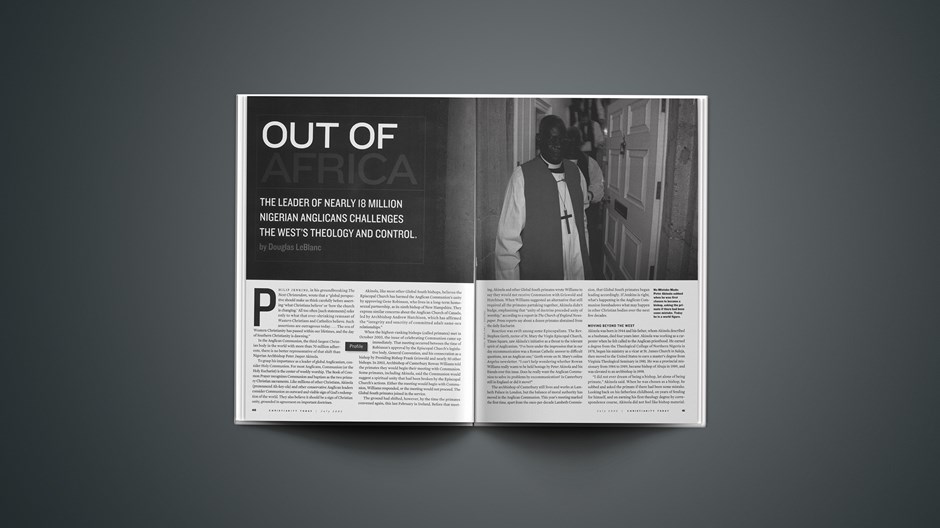
In the Anglican Communion, the third-largest Christian body in the world with more than 70 million adherents, there is no better representative of that shift than Nigerian Archbishop Peter Jasper Akinola.
To grasp his importance as a leader of global Anglicanism, consider Holy Communion. For most Anglicans, Communion (or the Holy Eucharist) is the center of weekly worship. The Book of Common Prayer recognizes Communion and baptism as the two primary Christian sacraments. Like millions of other Christians, Akinola (pronounced Ah-key-ola) and other conservative Anglican leaders consider Communion an outward and visible sign of God's redemption of the world. They also believe it should be a sign of Christian unity, grounded in agreement on important doctrines.
Akinola, like most other Global South bishops, believes the Episcopal Church has harmed the Anglican Communion's unity by approving Gene Robinson, who lives in a long-term homosexual partnership, as its ninth bishop of New Hampshire. They express similar concerns about the Anglican Church of Canada, led by Archbishop Andrew Hutchison, which has affirmed the "integrity and sanctity of committed adult same-sex relationships."
When the highest-ranking bishops (called primates) met in October 2003, the issue of celebrating Communion came up immediately. That meeting occurred between the time of Robinson's approval by the Episcopal Church's legislative body, General Convention, and his consecration as a bishop by Presiding Bishop Frank Griswold and nearly 50 other bishops. In 2003, Archbishop of Canterbury Rowan Williams told the primates they would begin their meeting with Communion. Some primates, including Akinola, said the Communion would suggest a spiritual unity that had been broken by the Episcopal Church's actions. Either the meeting would begin with Communion, Williams responded, or the meeting would not proceed. The Global South primates joined in the service.
The ground had shifted, however, by the time the primates convened again, this last February in Ireland. Before that meeting, Akinola and other Global South primates wrote Williams to say they would not receive Communion with Griswold and Hutchison. When Williams suggested an alternative that still required all the primates partaking together, Akinola didn't budge, emphasizing that "unity of doctrine preceded unity of worship," according to a report in The Church of England Newspaper. Press reports say about a dozen primates abstained from the daily Eucharist.
Reaction was swift among some Episcopalians. The Rev. Stephen Gerth, rector of St. Mary the Virgin Episcopal Church, Times Square, saw Akinola's initiative as a threat to the tolerant spirit of Anglicanism. "I've been under the impression that in our day excommunication was a Roman Catholic answer to difficult questions, not an Anglican one," Gerth wrote on St. Mary's online Angelus newsletter. "I can't help wondering whether Rowan Williams really wants to be held hostage by Peter Akinola and his friends over this issue. Does he really want the Anglican Communion to solve its problems by excommunication? Is Canterbury still in England or did it move?"
The archbishop of Canterbury still lives and works at Lambeth Palace in London, but the balance of moral authority has moved in the Anglican Communion. This year's meeting marked the first time, apart from the once-per-decade Lambeth Commission, that Global South primates began leading accordingly. If Jenkins is right, what's happening in the Anglican Communion foreshadows what may happen in other Christian bodies over the next few decades.
Moving beyond the West
Akinola was born in 1944 and his father, whom Akinola described as a bushman, died four years later. Akinola was working as a carpenter when he felt called to the Anglican priesthood. He earned a degree from the Theological College of Northern Nigeria in 1978, began his ministry as a vicar at St. James Church in Suleja, then moved to the United States to earn a master's degree from Virginia Theological Seminary in 1981. He was a provincial missionary from 1984 to 1989, became bishop of Abuja in 1989, and was elevated to an archbishop in 1998.
"I did not ever dream of being a bishop, let alone of being primate," Akinola said. When he was chosen as a bishop, he sobbed and asked the primate if there had been some mistake. Looking back on his fatherless childhood, on years of fending for himself, and on earning his first theology degree by correspondence course, Akinola did not feel like bishop material: "Nobody knew me, except God."
Article continues below
Akinola felt a similar astonishment when he was chosen in 2000 as the successor to Joseph Adetiloye, who had been primate of Nigeria since 1988 and led the church through a period of vigorous growth during the Anglican Communion's Decade of Evangelism. (There were about 5 million Nigerian Anglicans in the late 1970s. Today there are nearly 18 million. Akinola wants to double Nigeria's Anglican dioceses, to more than 160, within three years. "He's planting dioceses faster than we're planting congregations," said the Rev. Martyn Minns, rector of Truro Church in Virginia, which helped coordinate a recent Akinola visit to Washington.)
"For me to think of being the primate would have been the height of foolishness," Akinola says, brushing his hands together as if he's just disposed of trash. "It was entirely by God's grace and providence."
One of the core affirmations of Anglicanism is the archbishop of Canterbury's centrality to Anglican unity. He is not an Anglican pope, but the first among equals (sharing authority with 37 other primates). Churches may call themselves Anglican, but if they are not "in fellowship with Canterbury"—recognized as Anglicans by the archbishop, and invited to participate in Anglican councils, such as the Lambeth Conference—they move in an ecclesiastical limbo, like the splinter churches that believe they are more Catholic than the pope because they reject Vatican II. Akinola remains in communion with the archbishop of Canterbury, as does Griswold, but one of his most repeated remarks—"We do not have to go through Canterbury to get to Jesus"—indicates his willingness to challenge Western control.
Asked by CT about the importance of being in fellowship with Canterbury, Akinola first responded with a smile and a rhetorical question: Is the Church of England an Anglican church?
"The church did not start in Canterbury, the church did not start in Rome," he said. "Whether Canterbury is Anglican or not is immaterial. We are Anglicans. They are the Church of England." Akinola stresses that he's not trying to replace Williams, who is six years his junior: "Nobody is asking for the position of Rowan. We love him, we respect him. Akinola is not looking for a new job. I have enough to do at home."
Theological Crisis
The shift in the Anglican Communion, as the conflict over the Eucharist suggested, happened relatively quickly. As late as 2002 it might have appeared that Akinola would be as reliable as Archbishop Desmond Tutu in supporting the Episcopal Church, regardless of its differences with African Anglicanism. In that year alone, Akinola welcomed Griswold for a ten-day visit to Nigeria; joined only six other leaders who have been enthroned on an honorary "international cathedra" at the Cathedral of St. John the Divine in New York City; and brought his fraternal greetings to a meeting of the Episcopal Church's House of Bishops.
Article continues below
Akinola praised Griswold vigorously at the end of his brother primate's visit to Nigeria. "There had been a huge dividing wall … of misconceptions about this man," Akinola said about Nigerian clergy's impressions of Griswold. "Their impression of him before has now been removed. They now see him as a brother."
The Rev. Canon Bill Atwood of the Ekklesia Society, who has worked with Akinola throughout his time as a primate, sees those visits as Akinola's attempt to bring a godly influence on the Episcopal Church. "He spent personal equity by the ton to bring Griswold to Nigeria," Atwood said. "He was willing to be criticized to try to get Frank on the same page."
Akinola criticized the Anglican Mission in America, launched by two other Anglican primates—Emmanuel Kolini of Rwanda and Yong Ping Chung of Malaysia—for establishing its own conservative congregations within the Episcopal Church's boundaries. "You don't just jump from your diocese to begin to do whatever you like in another man's diocese," Akinola told the Church of Nigeria News. "That is not done in our Anglican tradition."
Akinola has seen things differently since General Convention met in the summer of 2003 and approved Robinson's election. Akinola, other bishops from the Global South, and American conservatives had issued a statement one week before General Convention and pleaded with that body not to approve Robinson or to move any closer to blessing gay couples. General Convention not only approved Robinson, but also declared that "local faith communities are operating within the bounds of our common life as they explore and experience liturgies celebrating and blessing same-sex unions."
Just 14 months after those votes, Akinola announced plans similar to those of the Anglican Mission in America: As the primate of Nigeria, he intends to establish a Church of Nigeria in America to minister to Nigerian expatriates—and any Episcopalians who wish to join them—who feel alienated by the actions of General Convention. Akinola said this church would have its own bishop, appointed by Nigerian bishops, and he compared it to the overlapping European jurisdictions of the Episcopal Church and the Church of England. "There was much more respect between us and the Episcopal Church," Akinola said at a press conference during a visit to Washington, D.C., and its suburbs in October. "I had prayed and hoped that this would be sustained, but it was not to be."
Article continues below
Listening to Akinola, it would be easy to forget that some Episcopal bishops had been ordaining openly gay priests since the 1970s. Robinson's elevation as a bishop placed the Episcopal Church's sexuality debate on Akinola's radar. "Hitherto my position has been that there was no need [for alternative oversight] … but that was when we were together, sharing the same faith, sharing the same order," Akinola said at a press conference during his U.S. visit. "When the Episcopal Church chose to separate itself from us, we had no choice but to come rescue our people."
Akinola believes the church's sexuality debate is part of a larger theological conflict that includes attacks on creedal faith. He cites John Shelby Spong, the retired bishop of Newark, New Jersey, and author of Why Christianity Must Change or Die and Rescuing the Bible from Fundamentalism. "If a bishop in another part of the world had done what Spong did, he would be defrocked," he said in an interview with Christianity Today during his visit to Washington. "In the United States they smile because they agree with him." (In his retirement years, Spong has withdrawn from regular participation in the House of Bishops, missing even the General Convention debate about Robinson's election. Nevertheless, many bishops express their agreement with Spong, or support programs that promote similar theology.)
When the primates gathered in London in October 2003 to discuss General Convention's approval of Robinson and the Canadian Diocese of New Westminster's approval of an official rite for blessing gay couples, Akinola said he appealed to Griswold to intervene against Robinson's consecration. He described saying to Griswold during a break for tea, "You and I have come a long way in the past three or four years. We have established a new relationship, new friendship, new rapport, new understanding." Akinola said he mentioned how primates from India and Pakistan were in tears because of General Convention's decisions, then added, "Our hearts are bleeding. You can save the communion this costly problem by putting a stop to this agenda. You can stop the consecration of a practicing gay priest." Griswold, Akinola said, described himself as not having the authority to stop Robinson's consecration because it had followed diocesan procedure and had been approved by General Convention.
Article continues below
Through Episcopal Church spokesman Robert Williams, Griswold said he did not recall similar details from his personal conversation with Akinola. And regarding that October 2003 primates' meeting, as Williams put it, Griswold "recalls parting from the meeting with an amicable and subdued spirit."
African Priorities
Among the things Akinola wants to do at home is to move Anglicans toward financial self-sufficiency. "The first and most important step is to change the mindset of bishops who say, Whatever you want, just go to the Episcopal Church and you can get it," he said. Every people group has a vocation in a specific place, he said, citing as disparate examples Bedouin Arabs and Eskimos, and God provides the resources for those vocations. "No African has an excuse, with good soil and the resources at our disposal—natural, spiritual, and human."
Akinola believes African Anglicans can make significant steps toward this self-sufficiency by 2009, when he plans to retire. He recognizes that Africans must continue accepting some financial assistance from the prosperous West, but he wants that financial assistance to be short-term. "Let there be some form of reciprocity," he said.
As the chairman of the Council of the Anglican Provinces of Africa, Akinola also is urging Africans to develop their own system of theological education. When bishops held their first all-Africa gathering at Lagos, Nigeria, in late October, they agreed. "The time has come for the church in Africa to address the pitfalls in our present theological and Western worldview education, which has failed to relate with some of the sociopolitical and economic challenges and Christian faith in Africa," their communiqué said. "We need well-resourced, highly rated and contextually relevant theological institutions that can engage intelligently with our peculiar challenges from an African perspective."
That goal, too, connects with Akinola's concern that African Anglicans not be at the mercy of wealthy Westerners. Akinola believes the Episcopal Church is creating a new religion. God asks in Amos 3:3, "Do two walk together unless they have agreed to do so?" It's a question Akinola has cited repeatedly. Akinola has said he can no longer walk alongside the Episcopal Church. "Whatever is not in line with the authority of the Word of God must be evangelized. Those who do not uphold this," Akinola said while holding a Bible aloft, "I will not go with them."
Article continues below
Just what that means for the future of the Anglican Communion will become clearer as the next Lambeth Conference convenes in 2008. For now, as Philip Jenkins has observed, the day of Global South Christianity is dawning.
Douglas LeBlanc, a CT contributing editor, is a lifelong Anglican.
Christian History Corner The African Lion Roars in the Western Church | Anglican liberals are fretting, conservatives rejoicing, and all are scrambling to their history books: whence this new evangelical force on the world scene? (June 27, 2003)















 While we pray for peace, we need moral clarity about this war.
 As my doubts about his teachings grew, so did a secret fascination with Jesus.
 Beyoncé’s right. Whether listening to Cowboy Carter or reading theology, diversity is a good thing.






