London. Global warming is approaching the critical point of no return, after which widespread drought, crop failure and rising sea-levels would be irreversible, an international climate change task force warned yesterday. — Associated Press, January 25, 2005.
When evening comes, you say, 'It will be fair weather, for the sky is red,' and in the morning, 'Today it will be stormy, for the sky is red and overcast.' You know how to interpret the appearance of the sky, but you cannot interpret the signs of the times. — Jesus Christ, Matthew 16:2-4
Just an unattended bag? Or a bomb? — NJ Homeland Security poster
The day after Christmas turned out to be a living nightmare reminiscent of The Day after Tomorrow. — Arthur C. Clarke, credited with first conceiving the idea of global satellites, describing the tsunami's effect on his homeland of Sri Lanka
Fear will keep the local systems in line. Fear of this battle station. — Grand Moff Tarkin, Star Wars
Terror is the normal state of any oral society, for in it everything affects everything all the time. — Marshall McLuhan, The Gutenberg Galaxy, 1962, p. 44.
Even so we, when we were children, were in bondage under the elements of the world … But now, after that ye have known God, or rather are known of God, how turn ye again to the weak and beggarly elements, whereunto ye desire again to be in bondage? — Galatians 4:3, 9
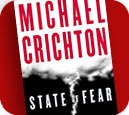
Michael Crichton's latest book, the eighteenth from this prodigious gentleman, will remind you simultaneously of recent disaster movies and recent weather forecasts. The trick is figuring out which one is an advertisement for the other.
State of Fear
STATE OF FEAR Michael Crichton, HarperCollins, 603 pp.; $27.95
Immediately after 9/11, critics agreed that it was eerily reminiscent of the movie The Siege. In more recent news of fearful disaster, the tsunami in southeast Asia looked like something from the movie The Day After Tomorrow, and this according to no less a thinker than Arthur C. Clarke. Remember the irony: that film was roundly ridiculed on its release for junk science of the propagandistic left wing variety, despite containing several elements of right-wing science: sudden climate change (including animals flash-frozen in mid-bite) massive and instantaneous geological movement, and a plot device that allowed for the Gutenberg Bible to be the only item saved from a library destined for destruction. In retrospect, the movie almost reads like a stealth defense of creation science.
What if man-made disasters could be disguised as natural disasters, and sold to the population as a stealth means of political control? That is the essential question that Crichton's novel asks and attempts to answer. How you answer it depends on where you stand in the impolite conversation going on in the culture wars today, the one about whose science will get taught. It is so awkward that most avoid it, and yet it touches on almost every issue.
Crichton's novel fearlessly jumps into this conversation and reveals not only the psychological "state of fear" that has been induced in recent history, but also the political "state" of fear that we live in, and how political interests, via mass media, massage and manipulate us into succumbing to their definitions. It is classic advertising consumer psychology: The way to motivate the consumer is through the carrot or the stick, through the promise of reward or the risk of punishment. Heaven or hell, security or fear, it's all the same if it creates the desired result — which is an outcome of predictability and control.
In State of Fear, a missing chunk of donation money gets used for nefarious purposes, which ultimately are intended to serve as an exclamation point on a conference on global warming: We made it happen, so that now, when we say we told you it would happen, you'll believe us and switch your allegiance to our agenda. The novel is not that simple of course, and events and heroes come in to save the day at the last minute, but that is the gist of it. Underneath the plot, the novel is really about information architecture and the plausibility of denial.
Ecologically, everything is interconnected with everything else. It always was, of course, but under globally hyperlinked convergent media conditions, you can actually see the connections because they happen so rapidly that whether you solve the question of cause and effect begins to pale in comparison to the sheer pleasure of pattern recognition. The global village has a brain (electronic media), and now you can watch its synapses firing. If you haven't been watching the media on a daily hyperlinked basis, you can see it in media about the media. Increasingly in the movies, from Conspiracy Theory (in 1997, when the Internet became a mass medium) to last year's The Butterfly Effect (for which Ashton Kutcher is the reason most people missed this otherwise provocative film), you witness the interconnectedness of everything, and how one small change in one realm can have massive consequences in another realm.
Article continues below
In addition to being a visually-oriented page-turner that would make a great movie (duh), Crichton's book does three other things exceedingly well: 1) It makes the case for fiction writers as the last truth-tellers. 2) It gives ample grist for the conspiracy theory mill. 3) It offers the reader an excellent primer on media ecology.
To the first point, Crichton deftly reminds us that today, only fiction writers can tell the truth. (Mark Twain thought only dead men could). In Neil Gaimain's book, American Gods, the author's note tells us that this is a work of fiction, with the caveat that "only the gods are real." In Crichton's book, the disclaimer of fiction has only this exception: "footnotes are real." God, it would seem, is in the details. And that is where you'll have to look, and look carefully, to consider just what Crichton really is saying. For on the one hand, he is extremely critical, almost mockingly so, of the misuse and abuse of science by propagandists pushing an agenda. For his take on environmentalism as tantamount to a religious faith, see his famous speech to the Commonwealth Club from October of 2004. At moments, his debunking of junk science, complete with charts, footnotes galore, and common sense backing him up, reads like some of the best of Michael Fumento's or Todd Seavey's non-fiction writing on the same subjects. (Full disclosure: these gentlemen also have their critics.)
On the second point, Crichton's book does give an awful lot of tantalizing speculation, bordering on justification, for some of the more provocative conspiracy theories out there. Do a Google search on "tsunami conspiracy", and you'll see what I mean. Crichton's novel itself unravels a series of seemingly disconnected events until the protagonist finally understands what turns out to be the ultimate conspiracy for political control by means of manipulation of nature —calving ice shelves in Antarctica and creating underwater earthquakes to spark 500 mph tsunamis in the South Pacific.
The bad guys use stealth technologies to unnaturally cause seemingly natural events, and simultaneously use media to manipulate public perception of the disasters as nature's response to humanity's overuse of, ahem, technology. The Environmental Liberation Front is made out to look essentially like a group of organized Ted Kaczynskis, disgruntled professors so insistent on proving the validity of their favorite theories that they will resort to violence. Unintended yet implicit in this characterization, however, is Crichton's acknowledgment that such scenarios are not outside the realm of the possible, and so the reader is left to interpret current events by the light of her own wisdom.
Article continues below
The novel is a delight to read, with very thinly disguised references to the science culture wars going on between the political right and left, replete with a George Soros-styled billionaire (George Morton in the novel), and places called the Competitive Enterprise Institute, the Hoover Foundation, and the Marshall Institute, "Groups financed by right-wing radicals and brain-dead fundamentalists. But unfortunately, they have a tremendous amount of money at their disposal."
Crichton skewers both sides equally well for their excess devotion to the cause whenever and wherever it blinds them to the facts, and for this alone the novel is a refresher in common sense. Crichton's feelings for Hollywood actors who jump on the environmental bandwagon is revealed in the novel's most poignant and gruesome scene, when we discover that cannibalism is alive and well and very much practiced on a certain movie star. You can't tell which is stronger: the sense that celebrities are getting their just desserts when eaten alive, or the implicit idea that American moviegoers (and by extension, this novel's readers), are the real cannibals. Our primitive willingness to listen with solemnity to people whose primary training is in pretending to be someone else, is indeed startling. On the other hand, if beautiful and famous people didn't tell us about the horrors in the world, maybe we would simply flip channels?
Clearly, Crichton doesn't want to give one shred of credence to the junk science masquerading as dire environmental warning. On the other hand, he does quite a bit to justify the fears of the technological conspiracy theorists. If America controls the corridors of space, (i.e., satellite technology), and if satellite technology can influence and to some degree control the weather, then events which look to the majority of the world (and to insurance companies) like "acts of God" may in fact simply be the acts of engineers knowing how easy it is to fool people into mistaking natural phenomena for God's hand. Just look at the parallel histories of satellite growth and "crop circles," or the parallel growth of TV channels and cases of Attention Deficit Disorder, or the spread of pornography and the rise of erectile-dysfunction medications. These correlations are so obvious and ubiquitous that as a result they are essentially invisible to public awareness. And if all this is speculation, then it at least brings us to the last and perhaps most valuable lesson Crichton's book offers: all of these events, their reality and their meaning, are themselves mediated to us by those with "an agenda.".
Article continues below
State of Fear gives the reader an excellent primer on media ecology. The phrase (and subsequent school of thought) was coined by Marshall McLuhan, carried into manifestation as a graduate program at NYU under Neil Postman, and has been borrowed, appropriated, referenced or downright exploited by everyone across the spectrum from Adbuster magazine's motto "Journal of the Mental Environment" to M. Rex Miller's church history book, The Millennium Matrix, to professor David Levy's "new term" information environmentalism — which is merely a synonym with a more polysyllabic and clunky signature. Wired magazine claimed McLuhan their patron saint, and latent Catholic Camille Paglia is now a member of the Media Ecology Association, having famously snubbed the MLA as no longer "with it."
Perhaps Crichton's best advice for training the reader in media ecological thinking is the line, "Think structurally, in terms of how information functions. What it holds up, what holds it up." Pondered carefully and applied thoroughly to contemporary media, those two sentences alone are worth a master's degree, and form the essential wake-up call that the author begs of the reader. The pleasure in the novel is that both the media and the ecology aspect of the story are explored in their full original sense. Once we are so technologically removed from nature as to need media to tell us what nature is, how hard is it to believe whatever the weather report says? If you need a sticker label on every piece of fruit you buy, how much more might you fall for a mediated version of falling snow, about which your knowledge is a poor substitute for the fact that you still have no control? There's a reason the ancient Greeks thought Zeus hurled thunderbolts—you need an explanation for that kind of unpredictable terror.
Crichton also reminds the reader that, under current communication conditions, nothing is irrelevant. Nothing is outside the meaning of the story, or outside the possible grounds for consideration when interpreting the signs of the times. This is nicely played out in the clues he drops all along regarding one aspect of the gotcha ending. Later, the novel's obligatory mad professor, who plays both the instrument of our enlightenment and serves as the clear inspiration for the novel's title (and some of its subject matter), is played by what the endnotes reveal to be an amalgamation of Barry Glassner's book, The Culture of Fear: Why Americans Are Afraid of the Wrong Things and Frank Furedi's book, Culture of Fear:Risk-Taking and the Morality of Low Expectation.
Article continues below
Glassner was first brought to mainstream American audience's attention by his appearance in Michael Moore's film Bowling for Columbine, which posited America's history of "fear" as the underlying motivation for our gun-friendly (and gun-endangered) culture. Despite the similar use they make of Glassner's research, something tells me that Moore and Crichton are not in each other's Palm Pilots.
A key lesson that both Crichton and media ecology attempt to promote is that of non-partisanship, which is almost but not quite the same as objectivity. Science is critically important to media ecology, and yet it is not God. For McLuhan, God was "an endless invitation to wonder." For Postman, both science and religion were best understood as stories, and God was best left to the theologians, for whom he had a deep respect. In most universities that study the canon of media ecology thinkers, you willl come across the names and some of the books of Walter Ong, Jacques Ellul, and Marshall McLuhan. I say some because youll very rarely discover through secular academia just how profoundly these thinkers were influenced by the historic theology of Judaism and Christianity. Crichton ends his novel's footnotes with the oddly hubristic claim that science is humanities only hope — an especially odd claim for Crichton to make, since so many of his novels deal with the abuse and human tragedy that results from taking science too far, including the current one. You suspect Crichton knew that theology was once the queen of the sciences, but has perhaps since forgotten.
State of Fear is startling, provocative, and engaging in a way that will stimulate both your intellect and your emotions, and give you pause over just how much there is to fear, and know, in the world. That wisdom dispels fear, and that seeking understanding is still the best method for acquiring that wisdom, is perhaps his novel's ultimate message. Finding understanding by doing a Google search, however, may not be the best approach.
Read Mercer Schuchardtstudied at NYU's media ecology program under Neil Postman from 1995 to 2003. He submitted his dissertation on the medieval Catholic symbol system and contemporary corporate iconography this year.













 While we pray for peace, we need moral clarity about this war.
 We’ve got little information on Jesus’ appearance and personality. But that’s the way God designed it.españolFrançais
 As Haiti is uprooted by violence, church leaders treat gunshot wounds, give up homes for strangers, and rescue dignitaries.Français





