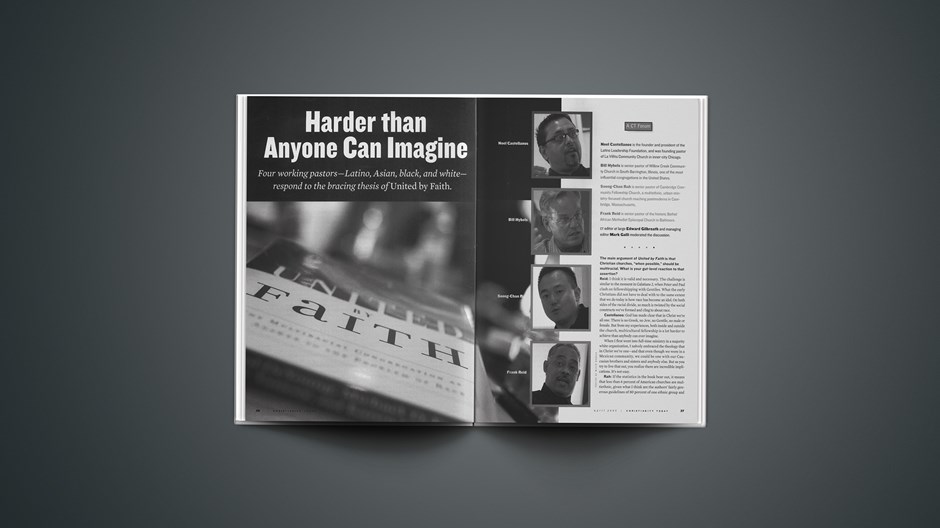
Noel Castellanos is the founder and president of the Latino Leadership Foundation, and was founding pastor of La Villita Community Church in inner-city Chicago.
Bill Hybels is senior pastor of Willow Creek Community Church in South Barrington, Illinois, one of the most influential congregations in the United States.
Soong-Chan Rah is senior pastor of Cambridge Community Fellowship Church, a multiethnic, urban-ministry-focused church reaching postmoderns in Cambridge, Massachusetts.
Frank Reid is senior pastor of the historic Bethel African Methodist Episcopal Church in Baltimore.
CT editor at large Edward Gilbreath and managing editor Mark Galli moderated the discussion.
The main argument of United by Faith is that Christian churches, "when possible," should be multiracial. What is your gut-level reaction to that assertion?
Reid: I think it is valid and necessary. The challenge is similar to the moment in Galatians 2, when Peter and Paul clash on fellowshipping with Gentiles. What the early Christians did not have to deal with to the same extent that we do today is how race has become an idol. On both sides of the racial divide, so much is twisted by the social constructs we've formed and cling to about race.
Castellanos: God has made clear that in Christ we're all one. There is no Greek, no Jew, no Gentile, no male or female. But from my experiences, both inside and outside the church, multicultural fellowship is a lot harder to achieve than anybody can ever imagine.
When I first went into full-time ministry in a majority white organization, I naïvely embraced the theology that in Christ we're one—and that even though we were in a Mexican community, we could be one with our Caucasian brothers and sisters and anybody else. But as you try to live that out, you realize there are incredible implications. It's not easy.
Rah: If the statistics in the book bear out, it means that less than 6 percent of American churches are multiethnic, given what I think are the authors' fairly generous guidelines of 80 percent of one ethnic group and 20 percent of another. Those are pretty wide guidelines, and still less than 6 percent of American churches approach that.
If we were to hear of any other institution in the United States that had those kinds of statistics, we would be outraged. If less than 6 percent of universities or government institutions were integrated, we would say there is something seriously wrong.
Hybels: Willow Creek started in the era when, as the book noted, the church-growth people were saying, "Don't dissipate any of your energies fighting race issues. Focus everything on evangelism." It was the homogeneous unit principle of church growth. And I remember as a young pastor thinking, That's true. I didn't know whether I wanted to chance alienating people who were seekers, whose eternity was on the line, and who might only come to church one time. I wanted to take away as many obstacles as possible, other than the Cross, to help people focus on the gospel.
So now, 30 years later, as I read this book, I recognize that a true biblically functioning community must include being multiethnic. My heart beats so fast for that vision today. I marvel at how naÏve and pragmatic I was 30 years ago.
Who's at the Table?
I don't go into places and wonder who's at the table making the decisions. I rarely think about that. I think whites just assume they run the table. But I'm realizing that it means more to people of ethnicity who are in the minority cultures than to those who are in the larger numbers. To know that someone like them is included in the decision-making process is important. When people say to me, "Okay, when are you going to have minorities on the board of elders?" I think to myself, Well, what's the rush? We just made all these steps. But I'm learning that, for both symbolic and practical reasons, when there is diversity on that elder board, it makes a difference.
—Bill Hybels
What were your "aha" moments on this issue?
Hybels: Alvin Bibbs is an African American who leads our extension ministry and helps us with our inner-city partnerships. A few years back, when I was leaving to go on a family vacation, I said to Alvin as I was walking out the door, "God's stirring in me about the reconciliation issue. If you can give me one book on the issue to take with me, I'll read it while I'm gone." He grabbed the book Divided by Faith, and I took it with me on that week-long vacation. And that book just wrecked me.
I was like the stereotypical person that Divided by Faith talked about. I didn't view myself as being racist in any way. I therefore felt that there was no issue I was responsible for. If it was okay with me and my individual multiracial friendships, then it was all okay. And when I got to the section about the ongoing structural inequities, it devastated me. I thought, How could I have not seen this? And that was the beginning of my journey. I felt so badly about being a pastor for 25 years and having been as oblivious as I was to these kinds of issues. It was embarrassing. But these days I'm trying to make up for lost time.
Article continues below
Reid: One moment came in 1990 when Taylor Branch, a white author of two acclaimed books on Dr. Martin Luther King Jr., spoke to our congregation. We developed a friendship. And he said to me after about the third month of visiting, "Frank, I love the preaching. I love the work of the church. But you're so Afro-centric that, while my wife and I would love to join the church, I'm afraid our children will get nothing of their cultural heritage here." My internal response was, Well, all these years black people in America have had to accept the white Jesus and white angels and a Euro-centric view of Christianity, so that's your problem.
Shortly after that, though, we had a black member who is interracially married, but I didn't know it. So, in one of my sermons I regrettably made a negative reference to interracial marriages, and shortly thereafter she left the church. I saw her in a supermarket sometime later and asked her, as any pastor would, "Where are you now? How are you doing? Why did you leave?"
She said, "Pastor, you offended me because you were insensitive to people like my husband." Those two events led me to meet with Curtiss Paul DeYoung, one of the coauthors of this book, to talk about reconciliation and how to start a movement for multiracial Christianity.
While the authors recognize different types of multicultural churches, they hold up "integration" as the ideal. What does true integration look like to you?
Rah: One image that most of us have discarded by now is the "melting pot," because what it ends up becoming is a soupy mixture that has no flavor at all. A second metaphor is the "salad bowl," where you have all these different vegetables that sort of make up different flavors. But it turned out that the dressing was still creamy ranch, and it smothered everything else.
So we've got to start looking for other models that point to what we hope to become in a multicultural ministry. Are we looking to boil everybody down into one unrecognizable mass? Or are we trying to smother everything with one culture so that everybody is the same flavor? We need to be honest about this.
An African American at our church should get the sense that who he is as an African American believer is to be affirmed rather than subjugated. He shouldn't feel like he needs to become Asian or white to fit in. And that's one reason why this is so challenging, because it means we, as pastors, have to become cultural anthropologists in addition to all the other roles we fill.
Article continues below
Reid: This is where our theology becomes important, both in word and practice. If we're serious about building multicultural congregations, I think the church itself will become our new culture.
Castellanos: United by Faith draws on the thinking of Latino theologian Virgilio Elizondo, who talks about the mestizaje process of cultural mixing that took place in what's now the country of Mexico. The Spaniards blended with the dominant pre-Hispanic indigenous culture, and out of that was birthed the Mexican people. There were two contributing cultures, but it was a third culture that emerged.
The vision for multiethnic churches is not that people should leave behind their unique cultures, but that we should be able to come together to celebrate our diversity and to allow the blending of our differences to give birth to something new. I think there's an incredible amount of blessing in that.
Hybels: In the Willow Creek Association, we train pastors around the world. And probably the most intense experience I've ever had in this area of multiethnic ministry was in 2003 in South Africa, where after 10 years of meeting with the various groups separately, we were finally able to bring together the whites and the coloreds and the blacks for a single conference. We trained a thousand people in the middle of Soweto, and when we sang a couple of songs together in that environment there wasn't a dry eye in the place. We spent the whole day talking about the power of community and what we could become if the church is working right.
So all this is about the challenge of keeping the value of culture, and having the power of Christian community be the galvanizing force that draws different people together.
'Is This Just for Whites?' In 1976, I went with four other Hispanic kids to a Young Life camp. There were five non-white kids at that camp out of dozens. And I remember being absolutely blown away that week by the message of Christ. It changed my life forever. On the ride home my counselor asked what were my impressions of the week. I told him how amazed I was by the message of the gospel. But I also told him that I couldn't believe that at a camp like that there were only four other kids who looked like me. "Is this thing just for white folks?" I asked. I was 16 and had never really thought about any racial issues before, but that struck me.
—Noel Castellanos
Article continues below
How does that look at a big suburban church like Willow Creek?
Hybels: It would be very rare for you to come to Willow now and not see cultural diversity intentionally represented on our stage. You didn't see much for 25 years, but now we're very intentional about it, whether it's in our drama, in our worship team, in our band, or whoever is the host of the services, there's almost always going to be color and ethnicity represented. Again, we're still just in the embryonic stages, but our early attempts have been to celebrate the different cultures and to bet the farm that the power of Christ can bring us into something that's truly transcultural.
In every congregation, someone has to have a vision for what the church should be biblically and then the practicality to ask, How do we move toward that? In my opinion, a church doesn't have much of a chance of moving in the direction this book describes until the senior pastor has a "conversion experience" about this issue.
What in your experience has been the biggest obstacle to making multiracial churches work?
Reid: It's hard to talk about multiracial congregations without addressing the reality of spiritual warfare. Ephesians 6 says our struggle is not with flesh and blood but with the principalities and powers of evil. Satan does not want to see unity in the church. And one way spiritual warfare manifests itself in everyday life is through the issue of power.
If a denomination or local church is going to become a true multiracial entity, that needs to be reflected in the composition of the leadership. But when you start talking about sharing power, that's usually when people get nervous.
Rah: Despite all the strides we've made with civil rights and racial reconciliation, American evangelicalism still looks dominated by white culture and white leadership.
One of the scriptures that we challenge our congregation with is Micah 4, which presents a picture of everybody laying down their swords in order to come to the house of God in humility. I think that image foreshadows people laying down their power to come into God's presence together.
Laying down power will mean different things for different communities, but I think for Asians the laying down of power means our willingness to make friendships across racial lines. We in the Asian community tend to be tight-knit within our own cultural circles, often to the exclusion of others. And I think with whites, laying down power comes down to a willingness to be in places of submission to those outside of their own community. How many whites have had non-white mentors?
Article continues below
Hybels: I think the way a Caucasian hears the power question is a little different. It has been a turnoff to me, because the language doesn't line up with our core values at Willow. Besides redemption itself, our church's highest value is servanthood.
It's never been about power. We've never recruited "powerful" people. We've watched God raise up people who have powerful and anointed ministries because they were humble and willing servants.
And so, that's an issue that pushes my buttons. But that's another reason why it's so helpful for me to be around tables like this one, because it helps me understand that the question is not so much about power-grabbing as it is about justice and inclusion.
But somehow, on all sides of this question, we have to do a better job with language, because in corporate America if someone talks about power, we all know what they mean. In church, however, power can stir up other notions.
A Divided House Cannot Stand If we're serious about building multicultural congregations in America, we have to resist the temptation to constantly play the race card. Reactionary racism has become such a spiritual stronghold in our world that not even the church recognizes it as a tool of the enemy. We've made a sport of pointing out racism, when what we should be doing is focusing our prayers and actions toward creating congregations that proclaim Christ's lordship over his entire church. In many black churches, we've turned race and an obsession over racism into an idol.
—Frank Reid
As pastors, what have you done to encourage your congregations to be more multicultural?
Hybels: First, I had to communicate at a rate that could take people along with me as opposed to blowing the church up. If I'd done a month-long series after I read Divided by Faith, it would not have been constructive. I started by giving brief personal remarks about the issue, and that led eventually to sermons.
I also started working behind the scenes to give more visibility at our services to the various ethnic groups in our church. I wanted it to become a normal part of our church before having to declare some big change that people could fight against.
We also added an African American to our board and have been intentional in seeking out people of ethnicity when filling vacancies in our senior staff. We now offer classes on bridging the racial divide. And we're also doing Casa de Luz, which is a Spanish-speaking service in our chapel. Our feeling is we want to be a laboratory where we can practice this stuff, because I don't know how you learn unless you just dive in the pool and start swimming around.
Article continues below
What about smaller churches located in predominantly white, middle-class communities? How do they begin to bring more diversity to their churches?
Rah: I would imagine that most of ct's readers live in 99.9 percent white communities, and have to travel to meet black folks and Asian folks and Hispanic folks. They would probably say, "It's not realistic for my church." But when you think of this in prophetic terms, as a biblical mandate, it brings more urgency.
The fact is, it's extremely difficult. In the past eight years since launching our church, we've seen numerous conflicts. There are moments when I say to myself, It would be so much easier to go to a Korean church and pastor second-generation Koreans. But it really comes back to the fact that this is God's calling. And I think churches have to be secure in that. If it is not your calling, then you're going to burn out very quickly.
Reid: I'm still trying to discover the principles for making it work. I'm trying to figure out principles that I can take back to Bethel, sit down with our leaders and say, "This is what God is calling us to." And I know it's going to be hell, because the other side of having Asians and Hispanics and whites and African Americans and various ethnic groups worshiping together is sharing power in leadership. As long as you're sitting in the pew, it's fine. But as soon as you begin to grow and seek to use your gifts in positions of leadership and power, that's when the real challenge of the multiracial congregation begins.
Stereotypes without Shame Last summer, LifeWay, which is the publishing arm of the Southern Baptist Convention, distributed a vacation Bible school curriculum called Far-out Far East Rickshaw Rally. Sadly, the content played to every stereotype imaginable about Asian culture. The theme song had lines like, "Wax on wax off, get your rickshaw ready"—stuff straight out of The Karate Kid. It had nothing to do with the reality of Asian culture. It showed images of little white girls in kimonos with chopsticks in their hair. Some activity suggestions were to have kids dress up in inflatable sumo outfits and wrestle each other. The stereotypes and caricatures were without shame. And this was not 1955 or 1971. It was 2004. If you're a socially conscious, young Asian American, why would you ever want to step foot in a church where you would encounter people with that kind of worldview? You'll want to stay with your own.
Article continues below
—Soong-Chan Rah
Is such a vision so hard that we're never going to see anything but mere glimpses of true multiculturalism?
Hybels: I like C. S. Lewis's thinking in Mere Christianity. You have to weigh the progress of our sanctification against how miserable and cantankerous, funky, and depraved people were before they met Christ. I believe what the authors have finally crystallized is something that the average pastor can wrap his or her brain around, and I think it's way too early to declare victory or defeat on this.
Castellanos: We can talk about this and write books about it until we're blue in the face, but ultimately the churches have to accept the challenge. We must create a movement of multiracial churches that is so compelling that people are going to say, "We cannot ignore this." The challenge for the church is this: Do you teach people the principles, or do you teach them to long for the reality of what God wants to see happen? Talking about it all the time can make the process methodical and taxing and burdensome. But when people are able to discover the biblical truth of multiracial churches for themselves, it becomes this contagious and liberating passion.
Rah: My 3-year-old daughter is just at that age where she's starting to recognize different ethnicities, and I'm so excited because she now thinks it's normal to have a Haitian auntie, a Jamaican uncle, a Caucasian big sister, to have half of her friends be biracial. That is the kind of environment that I want for my kids, and this is a part of what the church is all about. That vision keeps me going.















 While we pray for peace, we need moral clarity about this war.
 We’ve got little information on Jesus’ appearance and personality. But that’s the way God designed it.españolFrançais
 C.S. Lewis recommended discernment over diatribes in exactly the moments we’re most eager to indulge in critique.






