Scott Derrickson, co-writer and director of the upcoming film The Exorcism of Emily Rose, says horror movies are an excellent way for a Christian filmmaker to address things of faith.
Can a Christian make horror movies? Scott Derrickson thinks so. As a screenwriter—and a Christian—he has worked on quite a few films in the genre, including Urban Legends: Final Cut, Dracula 2000 and Hellraiser: Inferno, the last of which he also directed. His newest film as co-writer and director, The Exorcism of Emily Rose, coming to theaters on September 9, looks at first glance like more of the same.
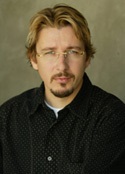
Scott Derrickson
But this movie is a little different. It is based on the true story of a German woman named Anneliese Michel, who died during an exorcism in 1976; the priest who tried to cast the demons out of her was charged with manslaughter. So the film is part horror story, part courtroom drama—and Derrickson says it will get people talking about God.
Derrickson spoke to Christianity Today Movies from his home in Glendale, California.
Why would a Christian get involved in horror films, of all things?
Scott Derrickson: In my opinion, the horror genre is a perfect genre for Christians to be involved with. I think the more compelling question is, Why do so many Christians find it odd that a Christian would be working in this genre? To me, this genre deals more overtly with the supernatural than any other genre, it tackles issues of good and evil more than any other genre, it distinguishes and articulates the essence of good and evil better than any other genre, and my feeling is that a lot of Christians are wary of this genre simply because it's unpleasant. The genre is not about making you feel good, it is about making you face your fears. And in my experience, that's something that a lot of Christians don't want to do.
To me, the horror genre is the genre of non-denial. It's about admitting that there is evil in the world, and recognizing that there is evil within us, and that we're not in control, and that the things that we are afraid of must be confronted in order for us to relinquish that fear. And I think that the horror genre serves a great purpose in bolstering our understanding of what is evil and therefore better defining what is good. And of course I'm talking about, really, the potential of the horror genre, because there are a lot of horror films that don't do these things. It is a genre that's full of exploitation, but the better films in the genre certainly accomplish, I think, very noble things.
How do you avoid what some might consider a fascination with evil?
Derrickson: It's something I've thought a lot about. I think of this kind of material in an almost dietary fashion. It's something that is potent and powerful and it's not healthy for anyone to overindulge in it.
I would be concerned if one of my children were constantly watching nothing but horror films or indulging in gothic literature without the balance of other types of art and entertainment. I do think that's a danger. C. S. Lewis had that very practical wisdom, well stated, in his introduction to The Screwtape Letters, when he talks about how the two great dangers, in regard to our thoughts about the demonic and the devil, are to think too much of them or too little of them. To be too afraid of them, to be too hesitant to engage in discussion or thought or art that deals with this realm, is to give in to fear; but to become fascinated with it and to indulge in the material is also very unhealthy.
So for me personally, I stagger the kinds of material that I do. I've written in other genres, and if I'm working on a project like the one that I just did, during the course of working on it, I don't watch any horror films, I don't read any scary literature, I try to fill myself with things that are a bit brighter, to keep myself personally balanced. But I think that both kinds of material are important for a balanced diet—at least for me.
It's been said that The Passion of the Christ was very popular with horror audiences. Do you have any perspective on that?
Derrickson: I do. It's very gothic, a very dark film. And I think there are people who just have an inclination to want to see material that deals with that aesthetic. And yet I think that film also ought to be regarded by Christians as a horror film. I think the crucifix is gothic iconography, and yet what I love about the horror genre, what I love about gothic iconography, what I love about gothic literature, is the potential that it carries to blend with it beauty and meaning. And when beauty and meaning are combined with the horrific, you get things like the cross, and you get things like medieval art, and you get things like Dante's Inferno.
And it is something that American evangelicalism has abandoned, for the most part—to their own detriment, because I think the result is, we have left gothic imagery and the power of that aesthetic to Catholics and to non-Christians. Not that Catholics are non-Christians—I think most Catholics are Christians—but my point is that there is a great value in that aesthetic and people need that. I think that the history of the Christian church is one that is marked by an understanding of this. When I went to Europe a few years ago, I felt very at home there, and I loved standing in Notre Dame and looking at all the gargoyles on the outside of that building, and realizing that, as scary and frightening as they were, what I was looking at was something that was built to the glory of God.
Article continues below
How did your interest in the horror genre begin?
Derrickson: When I was in film school. I knew that I wanted to integrate my faith with cinema in some way that was relevant to the culture. And I was looking for a way to do that, and I had just re-read The Screwtape Letters, and within the same year, I read Walker Percy's novel Lancelot, and there was a line in Lancelot that said, "'Evil' is surely the clue to this age, the only quest appropriate to the age. For everything and everyone's either wonderful or sick and nothing is evil … God may be absent, but what if someone should find the Devil?"
It really started to resonate with me, that this was the genre where a Christian could connect with mainstream culture, and there was potential there to not preach to the choir—not even preach to the culture, but connect with the culture. And that is certainly what I have been trying to do with a lot of my work. And in the case of The Exorcism of Emily Rose, I was very committed to not making a movie that was intended to give spiritual or religious or metaphysical answers to the audience. I really just wanted to make a film that was going to provoke the mainstream audience to ask themselves what they believe, and cause them to come away from the film provoked to think about and discuss spiritual matters and spiritual issues that I think are profoundly important.
The director with Jennifer Carpenter, who plays the title character
Turning to Emily Rose specifically: I'm aware that there is a possession case and I'm aware that there's a court case. Is the movie kind of divided like Law & Order? How does it balance these two elements?
Derrickson: They're pretty balanced all the way through the movie. With Law & Order, the first half is a cop show and the second half is a legal show, and this one is really a courtroom movie all the way through and it is a horror film all the way through.
Is the possession told in flashbacks?
Derrickson: Yeah, it's very inspired by Rashomon. And that's a term that gets thrown around by filmmakers a lot, inaccurately I think, because typically, any time a film has a fragmented narrative and has any flashbacks, people talk about Rashomon. But Kurosawa is my hero and I've taught courses on his films, and I love what he does, and Rashomon is, I think, his second greatest film after Ikiru. And I think what is so amazing about that film is not just that it's a fragmented narrative and not just that it has flashbacks, but that it really has flashbacks from multiple points of view that are not all compatible. And this movie does have that strategy at work in it. It is a movie that is looking at the past from various retrospectives, trying to extricate from that past what really happened.
Article continues below
This film is about presenting cogent arguments for two very different perspectives on this girl's condition and her story, and I tried to have those articulated very well throughout the film. The goal is, again, not to provide any metaphysical answers for the audience, but to leave them asking themselves what do they believe about this particular girl's case? What do they believe about the larger questions that her case proposes? Do demons exist? Is there a spiritual realm? How does God play into all of that? Is there a devil and therefore is there a God? Questions like that. And I don't think that anyone can watch this movie without asking themselves what they believe.
You've got some really great actors in there—Tom Wilkinson, Campbell Scott, and of course Laura Linney. Was it intimidating to be surrounded by so much talent?
Derrickson: It wasn't intimidating because they were all such generous people. It was a really, really enjoyable experience.
When Laura Linney and I first met, Laura was very hesitant to do a movie with this title, I think. She had read the script and thought the script was really good and really fascinating, but she reeeeally had a lot of questions. We met and talked for maybe three hours, and she really wanted to know very specifically where I was coming from, and what kind of film I wanted to make. And I think, when we were finished, she was sold that this was not going to be an exploitive film but a classy movie, which it really is. There's virtually no gore or blood. It's not a violent film. But Laura just wanted to know that it was going to be intelligent and that it was going to represent various points of view and not just one point of view on the subject matter.
It was a thrill to watch them act, particularly the scenes with Jennifer; some of the possession scenes with Jennifer were just jaw-dropping to observe, to watch an actress do the things she was doing, and go as far as she would go. But then, also, the more intimate scenes between Tom Wilkinson and Laura Linney—that was a real delight for me as a director, and as a writer, to sit there and listen to them say things that I had written, and to watch them act. I had just never been physically in the proximity of that kind of talent, acting-wise. It was quite a thing to behold. I felt really privileged to do it.













 While we pray for peace, we need moral clarity about this war.
 A Christian reconciliation group in Israel and Palestine warned that war would come. Now the war threatens their relevance.العربيةFrançais
 As Haiti is uprooted by violence, church leaders treat gunshot wounds, give up homes for strangers, and rescue dignitaries.