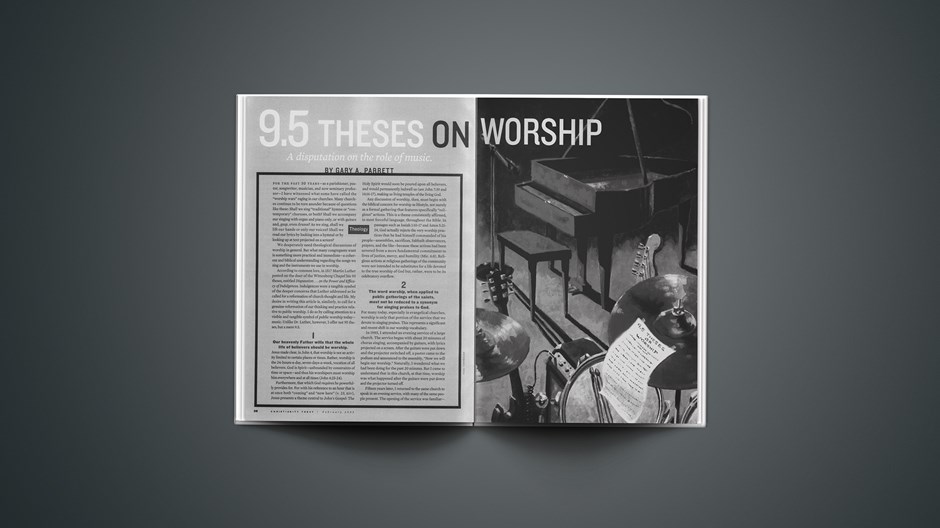
For the past 30 years—as a parishioner, pastor, songwriter, musician, and now seminary professor—I have witnessed what some have called the "worship wars" raging in our churches. Many churches continue to be torn asunder because of questions like these: Shall we sing "traditional" hymns or "contemporary" choruses, or both? Shall we accompany our singing with organ and piano only, or with guitars and, gasp, even drums? As we sing, shall we lift our hands or only our voices? Shall we read our lyrics by looking into a hymnal or by looking up at text projected on a screen?
We desperately need theological discussions of worship in general. But what many congregants want is something more practical and immediate—a coherent and biblical understanding regarding the songs we sing and the instruments we use in worship.
1 Our heavenly Father wills that the whole life of believers should be worship.
Jesus made clear, in John 4, that worship is not an activity limited to certain places or times. Rather, worship is the 24-hours-a-day, seven-days-a-week, vocation of all believers. God is Spirit-unbounded by constraints of time or space—and thus his worshipers must worship him everywhere and at all times (John 4:23-24).
Furthermore, that which God requires he powerfully provides for. For with his reference to an hour that is at once both "coming" and "now here" (v. 23, ESV), Jesus presents a theme central to John's Gospel: The Holy Spirit would soon be poured upon all believers, and would permanently indwell us (see John 7:39 and 14:16-17), making us living temples of the living God.
Any discussion of worship, then, must begin with the biblical concern for worship as lifestyle, not merely as a formal gathering that features specifically "religious" actions. This is a theme consistently affirmed, in most forceful language, throughout the Bible. In passages such as Isaiah 1:10-17 and Amos 5:21-24, God actually rejects the very worship practices that he had himself commanded of his people—assemblies, sacrifices, Sabbath observances, prayers, and the like—because these actions had been severed from a more fundamental commitment to lives of justice, mercy, and humility (Mic. 6:8). Religious actions at religious gatherings of the community were not intended to be substitutes for a life devoted to the true worship of God but, rather, were to be its celebratory overflow.
2 The word worship, when applied to public gatherings of the saints, must not be reduced to a synonym for singing praises to God.
For many today, especially in evangelical churches, worship is only that portion of the service that we devote to singing praises. This represents a significant and recent shift in our worship vocabulary.
In 1985, I attended an evening service of a large church. The service began with about 20 minutes of chorus singing, accompanied by guitars, with lyrics projected on a screen. After the guitars were put down and the projector switched off, a pastor came to the podium and announced to the assembly, "Now we will begin our worship." Naturally, I wondered what we had been doing for the past 20 minutes. But I came to understand that in this church, at that time, worship was what happened after the guitars were put down and the projector turned off.
Fifteen years later, I returned to the same church to speak in an evening service, with many of the same people present. The opening of the service was familiar—singers, guitars, projector, choruses of praise. But this time, when that singing had ended, a pastor stood before us and said, "That was a wonderful time of worship. And now …" The "And now …" was pregnant with meaning. It was clear that the definition of worship had changed.
Almost every time I hear the word worship used by believers today, it is clear that they are referring to singing praises. Many, of course, if pushed on this matter, would confess that worship involves far more. But words matter, and our language betrays our misperceptions. When we call those who lead us in song our "worship leaders," our true convictions are revealed. It is imperative, then, that we work diligently to reform the vocabulary of worship.
3 Worship involves a rhythm of revelation and response: God graciously reveals himself to us, and we faithfully respond— all the elements must help worshipers participate in this rhythm.
God initiates the worship experience by graciously revealing something of himself—his character, his mighty deeds, his will for our lives. Our obligation, having received this revelation, is to respond appropriately. The pattern is evident throughout the Scriptures: God, the Lord, is one; therefore, we must love him with all that we have (Deut. 6:4-5). God has demonstrated profound mercies to us; in view of these mercies, we must offer our bodies as living sacrifices (Rom. 12:1).
One of the most striking examples of this rhythm of revelation and response is recorded in Isaiah 6:1-8. There, the prophet has an amazing encounter with the living God. First, God's character is revealed: God is high, lifted up, and holy, holy, holy. The prophet's response is exactly right: "Woe to me, I am ruined!" But God graciously reveals more. He is loving and merciful. This is revealed by atoning action and explanatory speech. Isaiah's response, again, is the right one: He humbly receives God's grace and believes God's word. Finally, God's work and will are revealed as the Lord himself asks, "Whom shall I send? And who will go for us?" Isaiah faithfully responds: "Here am I. Send me!"
Article continues below
As we read this account, we are reminded of Romans 12:1—"in view of God's mercy, offer your bodies as living sacrifices." Indeed, the Isaiah passage provides a wonderful example of a pattern that could, and perhaps should, mark all of our worship gatherings. First, we are reminded of God's awesome and holy character. In light of this, we are moved to humble confession. Next, we are reminded of how God has intervened on behalf of us sinners, by sending his Son to be an atoning sacrifice for us. This good news we humbly receive and believe. Finally, God charges us to be engaged in his ongoing work in this broken and defiant world. We respond by offering our lives afresh for his service.
Like other elements in our worship gatherings—preaching, sacrament, offerings, Scripture readings, prayers, and more—our songs should aid us either in clarifying what God has revealed to us or in guiding us toward faithful response, or both. Sadly, many of our songs are deficient on both counts. They do not speak clearly of God's character, deeds, or will. Nor do they speak substantively of the response God requires of us. We should encourage those who lead us in song to select songs of substance, and we must pray that a new generation of songwriters will rise up to compose such songs for the saints. The church must retain those songs of old that were most helpful in terms of revelation and response. In some cases, new melodies or arrangements can be employed to help younger generations access these treasures of the church. Thankfully, there have been encouraging developments in these areas of late. Perhaps a new wind of theologically sensitive songs will blow some of the chaff out of our sanctuaries for good.
4 Those who lead the congregation in song must be theologically equipped for this important task.
Many in our churches have their theology formed principally by our hymnody. When we recognize young men and women in our congregations as gifted in the areas of musical composition, performance, or leading, we should encourage them to pursue theological training and support them to do so. This may mean sending them off to seminary, Bible college, or some other venue.
Article continues below
Others, for whom such training seems inaccessible, should be mentored by those in the congregation who are more biblically literate and mature. Pastors must not relinquish "worship leading" to a theologically unequipped person simply because that one is musically gifted. Song selection and composition can be conducted in partnership with those who are, or ought to be, teachers in the flock.
5 Faithful response to God involves more than praise—we need a much broader range of songs available for congregations.
The Psalter—Israel's prayer book and hymnal—provides a good model for us. In the Psalms, we find that the songs of praise take their place alongside songs and prayers of lament, confession, adoration, complaint, spiritual warfare, thanksgiving, and more.
A couple years ago, I felt compelled to compose a hymn based on Psalm 88, which is generally acknowledged as the darkest of all the psalms. It begins in confusion and ends, it seems, in utter frustration. Searching through the Scripture indices of the hymnals in my office, I could not find a single hymn based on this psalm. Yet is it not a God-inspired prayer for people of God who find themselves in a dark season of life? Do we not ask such people to stand alongside us in our congregational worship and join us in singing the triumphant songs of praise? Are we unwilling to join them in crying out to God for mercy? In our churches, sadly, it often does not go both ways—we rejoice with those who rejoice, but seldom do we weep with those who weep.
The other side of this coin, of course, is that what God has revealed about himself is not always what we would like to acknowledge. Do our songs address the full range of his attributes and actions, or only those that we delight in? We sing often of his love and kindness. But what of his wrath, his jealousy, his inscrutability—do we sing honestly of these things? Surely we should.
6 The body of Christ in worship is more than an assembly of individual worshipers— we need more we songs.
Not long ago, the practice in churches I attended was to project songs onto a screen with overhead transparencies. These were stored in some sort of file-folder system in alphabetical order, based on the first line of the song. But we had one problem: We continually needed to add more folders to accommodate songs that began with the letter I.
Article continues below
When I attend services that feature "contemporary" worship today, it seems that 80 percent to 90 percent of all the songs sung by the congregation prominently feature that familiar trinity of I, Me, My. Rarely do we sing songs that remind us of our identity as the body of Christ, the people of God. There are simply too few we songs in our congregational gatherings. It seems that many songwriters have taken songs directly from their personal devotional life into the assembly, without considering the possibility of adapting the songs for congregational use. In cultures that are already dominated by narcissism, this is unwise and dangerous.
From Jesus' teaching about praying to our Father in secret, to Paul's admonition that tongues without interpretation should be kept to oneself, we are reminded that a distinction should be drawn between personal worship of God and worshiping him in the assembly of the faithful. It is not that I songs are unhelpful or unnecessary, it is simply that we are badly out of balance here, and we need a corrective. Our hymnody must play a part in this. In many cases, a song can be easily adapted for such purposes by changing a few pronouns. Better by far, however, is composing songs with a true vision of the church and rediscovering those great songs that already feature such a vision.
7 The body of Christ is far bigger than what we see in the gathered community—and our songs should reflect this.
There is only one church—"one holy, catholic, and apostolic." When my local assembly gathers for worship, we join ourselves with "the communion of saints" (Apostles' Creed), those who have gone before us and those who will come after us, and with the millions upon millions who fill the Earth today. This reality should also be reflected in our corporate worship. This means we must move beyond the chronological snobbery that insists that "newer is better" when it comes to our songs of worship. Likewise, we must move beyond a narrow vision of a church based on nationality or ethnicity. Incorporating songs, confessions, and other liturgical resources from around the globe and from other eras is an enriching commitment. It brings us closer to the beautiful vision of worship in passages like Revelation 7:9-10, where we read of an innumerable throng of worshipers from every nation, tribe, and tongue praising God in one accord.
Article continues below
8 Those who lead the church in song are called to assist the congregation in its singing, not to replace it—technologies such as amplification must be used with theological and pastoral sensitivity.
On many Sundays, nowadays, it seems that it does not matter if I sing during worship, for I cannot hear myself even if I do. Nor can I hear the brothers and sisters sitting near me. In fact, we can only hear those few people standing up front with their microphones. Sometimes, we barely hear even them, because their voices are also drowned out by the amplified instruments that are supposedly accompanying all of us as we sing.
When I mention these things to song leaders today, I am often told that this is a generational matter, that younger people simply like it louder than do older people (like me). But I don't buy it. Israel's praise was no doubt often lively and loud. But throughout the history of Judeo-Christian worship, if the volume was loud, it was the sound of the people themselves, or the glory of our great God, that made it so. But in our day, our volume comes mostly from amplifiers. We simply have not sufficiently wrestled with how to use the host of new technologies. We need, among other things, a theology of electronic amplification!
The Bible commands us to "speak to one another" in songs, hymns, and spiritual songs (Eph. 5:19; Col. 3:16). I find myself longing for such experiences today. I need to hear my sisters and brothers confessing the faith into my ears, and they need to hear me. Surely it is not only the professionals or the gifted who believe the things we are singing. Those who lead us in song must do precisely that—lead us, not replace us or overpower us. Let the amplifiers provide for a volume level loud enough to help us do our job, for it is the congregation, and not the band, that is the true "worship team."
9 The Seeker that we must serve in our worship services is, first and foremost, God himself.
One of the more obvious "worship trends" in the past three decades has been the emergence of "seeker services." In some instances, these have been Sunday services totally redesigned with "seekers" in view. Surely being "seeker friendly" is a better option than being "seeker hostile" or "seeker indifferent," as too many congregations seem to be. But there are problems.
For one thing, while attempting to reach the unchurched, churches may actually be "unchurching the churched" (as Michael Horton argues) or otherwise "dumbing down" for the sake of evangelism (as Marva Dawn puts it). I know of a church, for example, that has printed the Scripture text in the bulletin or projected it on screen each week for the seekers who might be attending without a Bible in hand. An unintended consequence, however, has been that the believers have stopped bringing their Bibles and the sound of pages rustling as the saints move from passage to passage during the sermon is seldom heard.
Article continues below
The more significant issue is that our worship services should not be people-centered at all, but be first and foremost for and about our awesome God. This should affect our music and hymnody as well as every other aspect of the service. Our emphasis should be on content that serves the rhythm of revelation and response, not on pleasing guests with particular musical or stylistic choices. Worship should not be designed to suit unbelievers' tastes; nor should we shape it to suit our own. We are to worship God according to his requirements and for his own sake.
The good news, however, is that when we do so, we find that other wonders follow: The saints are well formed and unbelievers who may be present in the assembly are challenged by the presence of the living God. The fact is, we cannot outdo God in serving seekers, for he is the first and truest Seeker of all. There is no one who seeks God (Rom. 3:11). But from his asking, "Where are you?" in the Garden (Gen. 3:9), to seeking worshipers who will worship him in spirit and truth (John 4:24), to sending his only Son "to seek and save what was lost" (Luke 19:10), our God is the great Seeker of lost sheep. When he is first in the formation and conduct of our public worship, much good will surely follow.
9.5 In its services of public worship, the church must obey such Scriptures as Philippians 2:3-4: "Do nothing out of selfish ambition or vain conceit, but in humility consider others more important than yourselves. Each of you should look not only to his own interests, but also to the interests of others."
When my first church home divided over musical issues and other aspects of our public worship, many hearts were broken. I remember the final act of our final service together. We were asked to form a circle around the sanctuary and join hands. Together, we sang the chorus, "We Are One in the Bond of Love." Then we closed the service with prayer; many hugs and tears followed.
It was very emotional. It was also very hypocritical. We were not, of course, one in the bond of love. We were the victims of self-seeking from all sides. We had not obeyed the admonition of Philippians 2:3-4, nor that of Ephesians 4:3 to "make every effort to keep the unity of the Spirit through the bond of peace," nor Christ's new commandment to "love one another as I have loved you" (John 13:34).
A ready-to-download Bible Study on this article is available at ChristianBibleStudies.com. These unique Bible studies use articles from current issues of Christianity Today and other magazines to prompt thought-provoking discussions in adult Sunday school classes or small groups.
Martin Luther's 95 Theses are available from Project Wittenberg.
The Silenced Word | Why aren't evangelicals reading the Bible in worship anymore? (March 20, 2001)
Whatever Happened to God? | One of evangelicalism's most respected theologians says most worship is clubby and convivial rather than adoring and expectant. (Feb. 1, 2001)
The New/Old CCM | Classical Christian music, especially the sacred works of Johann Sebastian Bach, finds a young, and large, audience. (Dec. 18, 2000)
















 While we pray for peace, we need moral clarity about this war.
 We’ve got little information on Jesus’ appearance and personality. But that’s the way God designed it.españolFrançais
 The Grammy-winning artist was found dead at her home in Nashville at age 47.






