Last March former White House terrorism adviser Richard Clarke told the National Commission on Terrorist Attacks Upon the United States that the U.S. government "failed to prevent the tragedy of 9/11." He proceeded to apologize for that failure.
At the same hour that Clarke testified to the 9/11 Commission, the Supreme Court heard arguments in Elk Grove Unified School District v. Newdow. There Michael Newdow argued that the United States no longer should be acknowledged as "one nation under God." Those two hearings may at first glance seem unrelated. But there is an important link.
Of course the government failed to prevent the attack on the Twin Towers. But beyond that, the government also failed to prevent the Chicago Fire, the San Francisco Earthquake, the Johnstown Flood, the St. Valentine's Day Massacre, the stock-market crash of 1929, the Holocaust, the aids epidemic, the Oklahoma City bombing, the Columbine killings, Hurricane Whatshername, the Enron meltdown, and a long list of other tragedies and disasters, both natural and man-made.
Clarke seemed to presume that "your government" should somehow have been able to anticipate and prevent evil from happening—both the evil that we call natural disasters, and the evil that comes directly from the hearts and hands of evil people. It is a false premise. To presume the government's ability to prevent such a catastrophe is to assume that it possesses qualities and abilities that no person, let alone a government, can ever possess.
Omniscience and omnipotence are qualities that we ascribe only to God. Clarke fails to recognize the inherent limitations of government. The U.S. Constitution certainly envisions no omniscience or omnipotence for the federal government.
In fact, the Constitution sets comparatively modest, human-sized objectives for the government: "to form a more perfect union, establish justice, insure domestic tranquility, provide for the common defense, promote the general welfare, and secure the blessings of liberty to ourselves and our posterity." Those finite tasks are challenging enough. Providing for the "common defense" is a noble task for a government. Protecting every citizen from any kind of harm is quite another matter.
Pledging Allegiance
On the same day that we heard that our government had failed, Newdow argued before the U.S. Supreme Court that "under God" should be removed from the Pledge of Allegiance.
One cannot help being struck by the irony of these hearings taking place only hundreds of feet apart. At issue in both hearings was the same question: Are we "under God"?
Let us be careful here. If there is a Creator, then we are "under God" whether we acknowledge it in a pledge or not. If there is a Creator, then we are creatures. If there is a Creator, then he is the one who is omniscient and omnipotent, and not us.
Many Americans are "practical atheists" who have long since forsaken a Creator and a theistic worldview—and in the process have seemingly transferred onto the government the divine qualities of omniscience and omnipotence. For centuries people have tended to blame God for not preventing everything bad that happens. In fact, Freud (and others) posited that God is merely a human invention created to explain and possibly to blame for those phenomena that cannot otherwise be rationally explained. Many now blame the government because they presume it should possess the divine foreknowledge and requisite power to protect citizens from all harm.
Exactly how this transferal took place is a mystery, but it seems to reflect the erosion of the dominant theistic worldview and the growing acceptance of a naturalistic worldview. Perhaps it was Freud's influence. Perhaps the growing "victim mentality" in our culture (which some call "the Oprahfication of America") played a part.
Yet, all the interpreters and advocates of the secular worldview have only managed to marginalize what they consider the outmoded theistic worldview. They offer no new insights to explain the anomalies of life. In place of God, government—a most imposing institution that also seems bigger than life—has assumed the default position.
Most bad things happen in our world because humanity is inherently sinful. In some cases, that disposition spills over the moral dams and results in great and senseless acts of evil, be it individual (Timothy McVeigh or Columbine High School killers Eric Harris and Dylan Klebold) or collective (the Holocaust).
Of course, this view of human nature flies in the face of the romanticized evolutionary worldview of progressivism that humankind is basically good and getting better, only in need of more, better, and politically correct education. We ought to recall, however, that the U.S. Constitution purposefully delineated the separation of the branches of government, articulating the "balance of powers" based on the worldview that human nature is corrupt.
Happy Evil
The Creator (whom Jefferson cited in the Declaration of Independence) has "endowed us" with the right to pursue happiness. But that endowment to very evil people like Dylan Klebold or Timothy McVeigh can result in the evil pursuit of a perverted happiness. A chilling reminder of this is the videotape of Osama bin Laden celebrating the destruction of the World Trade Center.
Article continues below
Because our world has a significant number of evil people who pursue their happiness in this way, it is impossible to prevent them without being both omniscient and omnipotent. Government cannot anticipate and prevent every evil act hatched in the imaginations of evil people.
When seriously evil people succeed in their pursuit of happiness, many believers angrily ask: Why didn't God stop it? Why didn't God exercise his omniscience and omnipotence and prevent it from happening? In fact many have abandoned faith in God because they cannot find a satisfactory answer to this question.
Yet our omnipotent and omniscient Creator has decided not to directly restrain our evil tendencies. He does not systematically prevent those he endowed with the unalienable rights of life, liberty, and the pursuit of happiness from using those liberties to do evil. Likewise, he does not cause our computers to crash to keep us from filing false tax returns. He does not cause us to go blind to prevent us from viewing child pornography.
Somehow, though, when evil people shoot at students and teachers in Columbine High School, we expect God to turn bullets into marshmallows. We expect him to turn hijacked airliners away from tall buildings. (Curiously, the one plane that did not find its target on September 11 was diverted by a group of people—led by a Christian—who sought to prevent greater evil than that which they faced. Todd Beamer understood the biblical exhortation to "overcome evil with good.")
While God does not directly intervene to restrain our evil tendencies, he has ordained human government to function in that capacity to a limited degree—to punish evildoers. Hence it is not surprising that unbelievers (both philosophical atheists and practical atheists) now ask: Why didn't government stop it?
The irony, of course, is that many of those who want or expect the government to prevent evil strongly resist the government's growing need for knowledge and power to act effectively in protecting the American public.
"My government failed!" Of course my government failed. Americans, keenly focused on "life, liberty, and the pursuit of happiness," have made it clear they are unwilling to remove limits on the ability of government both to know and to interfere in that highly individualized pursuit. The Patriot Act has reminded us that the expectation of government to protect us quickly runs aground on the rocks of surveillance laws, privacy rights, and the overall "pursuit of happiness" Americans enjoy.
Article continues below
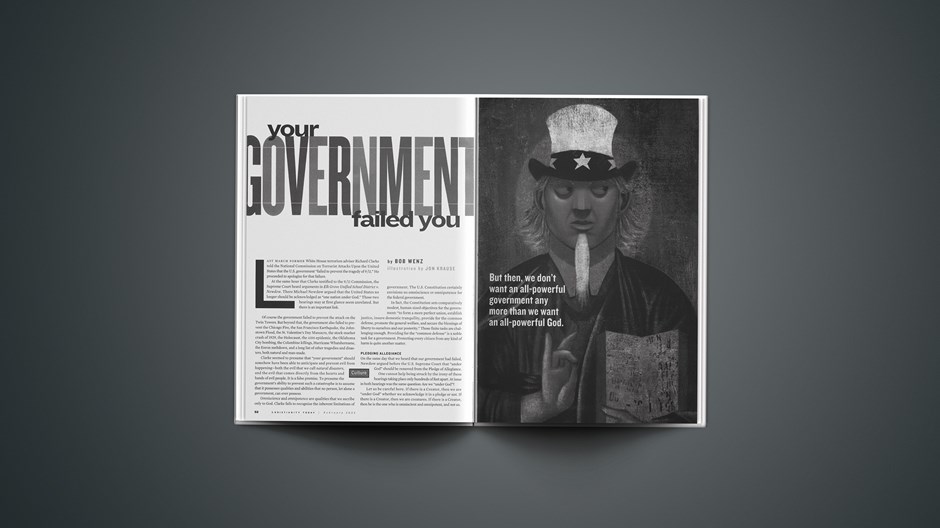
In essence, we don't want an omniscient and omnipotent government for the same reasons we reject the idea of a nation "under God." So we end up holding both at arm's length. We don't want an all-knowing and all-powerful entity in our lives—except, perhaps, when evil strikes us from abroad or disaster befalls us, and we need someone to blame.
Bob Wenz is vice president of national ministries for the National Association of Evangelicals.
More thoughts on government are available from our Politics & Law page, including:
Jim Wallis: 'I See Genuine Soul-Searching Among Democrats' | Evangelical activist says it's time to find common ground on abortion and other issues. (Feb. 11, 2005)
Article continues below
Aliens in Our Midst | America is hardening its heart to refugees and immigrants. (Feb. 10, 2005)
Q&A: John Thune | The Republican from South Dakota, who defeated Senate Minority Leader Tom Daschle last November. Daschle had taken a leading role in blocking some of President Bush's pro-life judicial nominees. (Feb. 10, 2005)
















 While we pray for peace, we need moral clarity about this war.
 A Christian reconciliation group in Israel and Palestine warned that war would come. Now the war threatens their relevance.españolالعربيةFrançaisрусскийУкраїнська
 NIL deals in college athletics present new challenges—and opportunities—for colleges and students.






