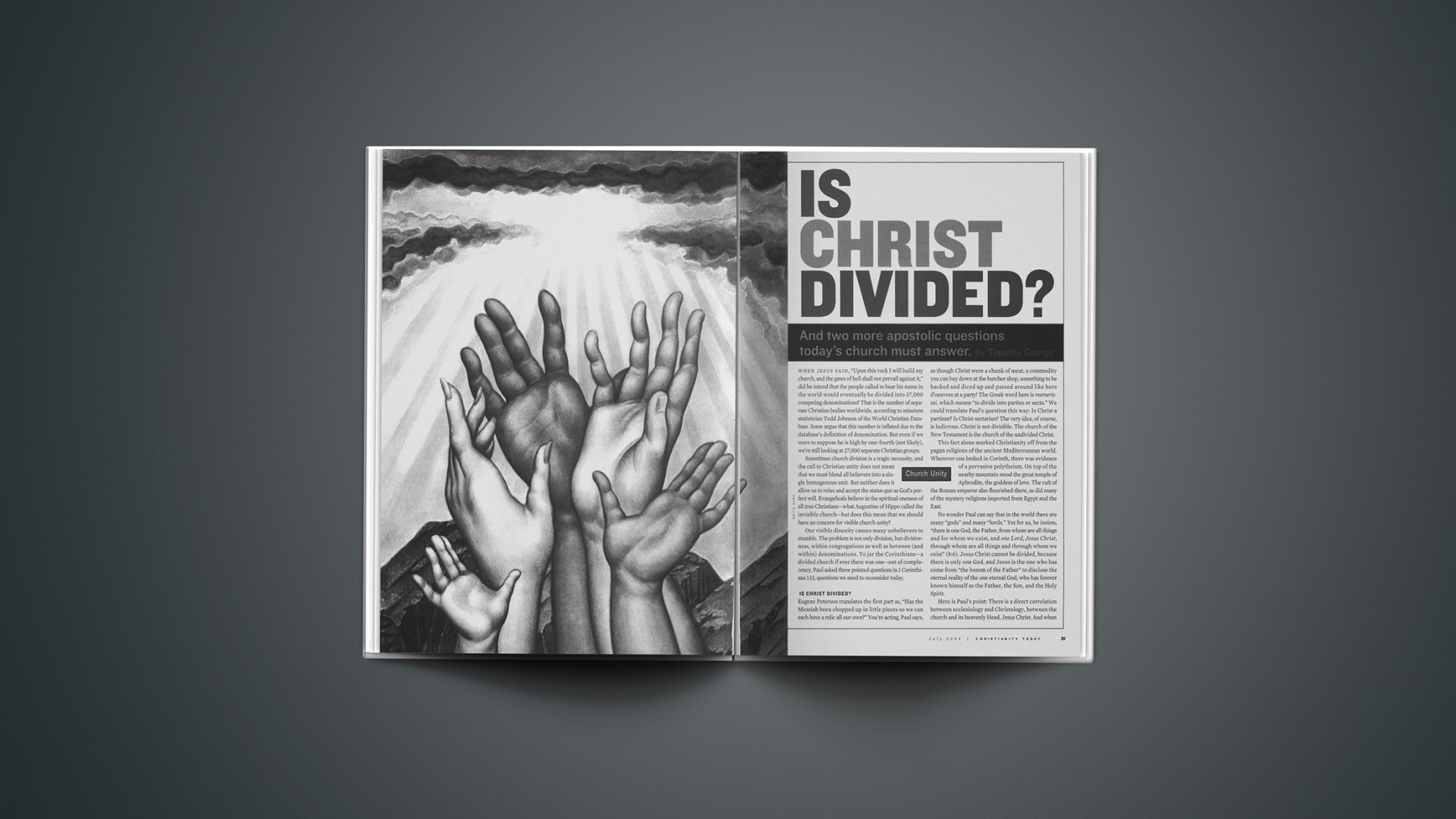
When Jesus said, “Upon this rock I will build my church, and the gates of hell shall not prevail against it,” did he intend that the people called to bear his name in the world would eventually be divided into 37,000 competing denominations? That is the number of separate Christian bodies worldwide, according to missions statistician Todd Johnson of the World Christian Database. Some argue that this number is inflated due to the database’s definition of denomination. But even if we were to suppose he is high by one-fourth (not likely), we’re still looking at 27,000 separate Christian groups.
Sometimes church division is a tragic necessity, and the call to Christian unity does not mean that we must blend all believers into a single homogenous unit. But neither does it allow us to relax and accept the status quo as God’s perfect will. Evangelicals believe in the spiritual oneness of all true Christians-what Augustine of Hippo called the invisible church-but does this mean that we should have no concern for visible church unity?
Our visible disunity causes many unbelievers to stumble. The problem is not only division, but divisiveness, within congregations as well as between (and within) denominations. To jar the Corinthians-a divided church if ever there was one-out of complacency, Paul asked three pointed questions in 1 Corinthians 1:13, questions we need to reconsider today.
Is Christ Divided?
Eugene Peterson translates the first part as, “Has the Messiah been chopped up in little pieces so we can each have a relic all our own?” You’re acting, Paul says, as though Christ were a chunk of meat, a commodity you can buy down at the butcher shop, something to be hacked and diced up and passed around like hors d’oeuvres at a party! The Greek word here is memeristai, which means “to divide into parties or sects.” We could translate Paul’s question this way: Is Christ a partisan? Is Christ sectarian? The very idea, of course, is ludicrous. Christ is not divisible. The church of the New Testament is the church of the undivided Christ.
This fact alone marked Christianity off from the pagan religions of the ancient Mediterranean world. Wherever one looked in Corinth, there was evidence of a pervasive polytheism. On top of the nearby mountain stood the great temple of Aphrodite, the goddess of love. The cult of the Roman emperor also flourished there, as did many of the mystery religions imported from Egypt and the East.
No wonder Paul can say that in the world there are many “gods” and many “lords.” Yet for us, he insists, “there is one God, the Father, from whom are all things and for whom we exist, and one Lord, Jesus Christ, through whom are all things and through whom we exist” (8:6). Jesus Christ cannot be divided, because there is only one God, and Jesus is the one who has come from “the bosom of the Father” to disclose the eternal reality of the one eternal God, who has forever known himself as the Father, the Son, and the Holy Spirit.
Here is Paul’s point: There is a direct correlation between ecclesiology and Christology, between the church and its heavenly Head, Jesus Christ. And when we live in rancor, bitterness, and enmity with one another, we are not only sinning against one another, we are also sinning against Christ. This is a lesson Paul learned on the first day he became a Christian. On his way to persecute believers in Damascus, he was suddenly halted by the risen Christ, who asked him, “Saul, Saul, why are you persecuting me?” Jesus’ question to Saul implies that it is not possible to hurt those who belong to him, those who have been redeemed by his blood, without also hurting him. When you do it unto the least of these, my brother, you do it unto me!
This perspective elevates the question of disunity and conflict among believers to an entirely new level.
Was Paul Crucified for You?
Here Paul reminds the Corinthian believers that their life in Christ is inextricably bound up with what happened one Friday afternoon outside the gates of Jerusalem when Jesus was impaled on a Roman cross. Why does he bring in the Cross at this point? Because the Cross is where all bragging stops. Behind all the side-choosing and sloganeering-I am of “Paul,” I am of “Apollos,” etc.-was the self-assertion and self-glorification of those who had overweening confidence in their own virtues and abilities: the wise, the weighty, and the well-born, as Paul refers to them (1:26).
The common anthropological assumptions of Greek philosophy and Hellenistic culture, not unlike those of the modern cult of self-esteem, greatly valued all forms of human assertiveness as badges of excellence, strength, and virtue (from the Latin virtus, meaning “manliness” or “worth”). Physical prowess, military feats, oratorical abilities, intellectual acumen, political power, monetary success, social status-all these were things to be proud of and to glory in.
But in contrast to all this, Paul holds up something utterly despicable, contemptible, and valueless by any worldly standard-the Cross of Christ. For 2,000 years, the Cross has been so variously and beautifully represented in Christian iconography and symbolism that it is almost impossible for us to appreciate the sense of horror and shock that must have greeted the apostolic proclamation of a crucified redeemer. Actually, the Latin word crux was regarded as an expression so crude, no polite Roman would utter it in public. In order to get around this, the Romans devised a euphemistic circumlocution, “Hang him on the unlucky tree” (arbori infelici suspendito), an expression from Cicero. But what the world regarded as too shameful to whisper in polite company, a detestable object used for the brutal execution of the dregs of society, Paul declared to be the proper basis for exaltation. In the Cross, and the Cross alone, Paul said, he would make his boast in life and death, for all time and eternity.
“When false foundations all are gone,
Each lying refuge blown to air,
The Cross remains our boast alone,
The righteousness of God is there.”
The Corinthian believers did not actually deny that Jesus was put to death on the Cross, but they certainly de-emphasized it. They had not yet realized the ethical implications of Jesus’ death for every believer: to be “in Christ,” to be “crucified with Christ,” implies a radical transformation within the believer, a transformation based on our identification with Jesus’ once-for-all victory on the Cross, but also leading to an ongoing process of mortification and self-denial. To realize that Jesus, not Paul or anyone else, was crucified for us means a willingness to bear the “brand marks” of Jesus-to live under the Cross. This is the only thing that we have any biblical warrant to boast about.
Were You Baptized into the Name of Paul?
It may seem strange that Paul would bring baptism into the argument at this point. Several years ago, Michael Green, a distinguished Anglican church leader, published a book about baptism entitled Baptism: Its Purpose, Practice, and Power. For centuries Christians have been deeply divided about the meaning, significance, and role of baptism in the life of the church. Should we baptize infants, or only adult believers? How much water should we use-do we drip, douse, or dunk? How does baptism relate to church membership? Who is authorized to baptize-ordained ministers only or laypersons as well? Entire denominations have divided over such issues in the past, and such differences are far from resolved today, even among evangelical Christians who appeal to the authority of Scripture.
But something else is at stake in this passage. The question here is: In whose name have you been baptized? In the early church, baptism signified the transfer of loyalty from one realm to another. Baptism was far more than an initiatory rite of passage; rather, it involved a decisive transition from an old way of human life to a new and different way. Baptism was an act of radical obedience in which a specific renunciation was made and a specific promise was given.
The renunciation part-the act of publicly saying “No!”-became prominent in the baptismal liturgy of the early church, as we read in documents from the late second century, such as Tertullian’s On Baptism and Hippolytus’s Apostolic Traditions. From these sources we learn that baptism was often done on Easter eve, following a period of intensive preparation that included fasting, prayer, and Scripture reading. When at last the time for baptism itself arrived, the candidate would be called upon to renounce the Devil and all his pomp. Facing westward, the direction in which the sun went down, he would exclaim, “I renounce thee, O Satan, and all thy works!” Then he would deliberately spit three times in the direction of darkness, signifying a complete break with the powers of evil and all their former claim on his life. Next, turning toward the sunrise, he would say, “And I embrace thee, O Lord Jesus Christ!” This would be followed by immersion three times in the name of the triune God, receiving a new robe, anointing with oil, laying on of hands, and participation in the Lord’s Supper.
Baptism was not a private ritual to be performed in secret. It was a public confession of allegiance to Jesus Christ. Baptized Christians were often singled out for persecution, and were sometimes taken directly from the sacred waters of baptism to the expected bloodbath in the arena. To be baptized in the name of Jesus was risky business. It was a public declaration that “the old has gone, the new has come” (2 Cor. 5:17). During the Reformation, Huldreich Zwingli compared baptism to the white cross sewed onto the red uniform of the Swiss mercenary soldiers, among whom he once served as a chaplain. Wherever the soldiers moved across the battlefield, they would be identified to all who saw them by the white cross. This design can still be seen today on the Swiss national flag. Baptism too, Zwingli thought, was a public badge that identified one with a particular cause. Baptism marked the believer off as a member of the militia Christi, a soldier of the gospel, fighting under the direction of Christ the Captain.
This was true not only of individual Christians, but also of the church as the called-out people of God. Paul declares that something radically new and different has occurred within this baptized community so that “there is neither Jew nor Greek, slave nor free, male nor female” (Gal. 3:28). The three pairs of opposites Paul listed here stand for the fundamental cleavages of human existence: ethnicity, economic capacity, and sexuality.
Race, money, and sex are primal powers in human life. No one of them is inherently evil, yet each of these spheres of human creativity has become degraded and soiled through the perversity of sin. Nationality and ethnicity have been corrupted by pride, material blessings by greed, and sexuality by lust. This has led to the chaotic pattern of exploitation and self-destruction that marks the human story from the Tower of Babel to the streets of Baghdad and Beirut.
Bypaths to Avoid
All this is not to suggest that we should aspire to unity for unity’s sake, nor to argue that there are no legitimate divisions in the church. In fact, we are wise to avoid three common mistakes.
First, the way to true Christian unity cannot be purchased at the expense of moral purity. Throughout history, the Christian church has ever lived in tension between the poles of identity and adaptability. When we focus too strongly on identity, and forget adaptability, we become a “holy huddle” unmindful of the world and our mission to carry the Good News of Christ to the “uttermost” limit of every culture and every people group on Earth. On the other hand, when the church gravitates one-sidedly toward the pole of adaptability, it can easily lose its identity in the trends and fashions of its surrounding environment. This was precisely the problem at Corinth, and Paul, quoting from Isaiah 52, called on those believers to separate themselves from the immoral practices they had indulged in before they met Christ (2 Cor. 6:17).
The Corinthian temptation still faces the church today. In recent years, many denominations have been torn apart by the debate over homosexuality. In the name of love and unity, some church leaders have put aside the clear teaching of Scripture on this issue, and some churches have moved to bless same-sex unions and ordained openly gay clergy. While we should all remember that homosexuals are among those persons for whom Jesus died, and that there is no place for bigotry against any person made in the image of God, we are not at liberty to set aside biblical standards for holy living and sexual purity. The late Stanley Grenz wrote a helpful book on this subject with a title that expresses just the right response to persons engaged in or tempted toward a gay lifestyle: Welcoming but not Affirming.
Second, the way to true Christian unity cannot be purchased at the expense of theological integrity. Some advocates of the mainline ecumenical movement have little patience for theological discussion and frank dialogue over doctrinal differences among the various Christian groups. They reason like this: “In a world beset by pressing social needs, racial conflict, famine, war, and a global ecological crisis, we cannot afford to dredge up the old debates that have divided Christians in the past. Let’s forget about our theological differences, or at least put them on hold, so we can work together toward common goals.”
While this appeal is attractive at a superficial level, it misses entirely an essential commitment of the Christian message: Truth matters. In John 17, Jesus prayed to the heavenly Father both that his disciples would be one, and also that they would be sanctified through the truth (John 17:22, 19). Both common action and honest dialogue among Christians of different denominations or theological commitments must be predicated on the understanding that any unity not based on truth is a unity not worth having. Admittedly, this conviction flies in the face of postmodernist notions of truth and the reigning ideology of theological pluralism that dominates the declining world of mainline Protestant enterprises. But it cannot be dodged if we are to be faithful to the apostolic mandate to speak the truth in love.
Third, true Christian unity cannot be purchased at the expense of genuine diversity. Paul makes this abundantly clear in 1 Corinthians 12, where he describes the unity of the church in terms of the interdependence and mutuality of the members of the body. God has so created the body and “tempered together” its members that there should be no internal disconnect or division within the organism, but that its parts should have equal concern for each other (1 Cor. 12:25). There is one body and one Spirit, just as there is one God and one Redeemer. But there are “many” gifts, many places to serve, many “diversities of operations,” as the KJV puts it (12:6). Unity is not uniformity. To try to impose an artificial oneness on the genuine diversity in the body of Christ is to be blind to the many-faceted, many-colored wisdom of God.
That being said, we today, with our tens of thousands of divisions, should ponder Paul’s penetrating questions. The path from disunity to unity is strewn with land mines and heartache. To be sure, not all efforts at unity are justified. But surely most of the divisions we endure are unnecessary if, in fact, Jesus Christ the crucified, in whom we have all been baptized, is not divided. As we come closer to Jesus Christ, Christ the Center (as Bonhoeffer called him), we will grow closer to one another. How we should proceed toward unity is a matter of healthy debate. That we should continue to move closer to one another is not.
Timothy George is dean of Beeson Divinity School of Samford University and an executive editor of Christianity Today. This article is adapted from The Mark of Jesus: Loving in a Way the World Can See, written by George and John Woodbridge (Moody Publishers, 2005).
Copyright © 2005 Christianity Today. Click for reprint information.
Related Elsewhere:
Other CT articles on church division and ecumenism include:
No-Fault Division? | It may be time for mainline churches to consider an amicable divorce. A Christianity Today editorial (July 01, 2004)
A Distinctive People | A new document from Evangelicals and Catholics Together challenges narcissism, individualism, and spiritual sloth. (March 03, 2005)
Christians Form Broad Alliance | Christian Churches Together in the USA announces it will launch once 25 denominations join. (March 25, 2003)
Whither Christian Unity? | The WCC and the WEA represent very different paths. One of them has real promise. (Aug. 09, 2002)
Slovakia’s Catholics and Lutherans Reach Agreement on Baptism | Signing clears the way for the common celebration of other inter-church accords. (June 21, 2001)
Koreans Plan Historic Easter Prayer for Christian Unity |Taking advantage of calendar anomaly, Protestants, Catholics, and Orthodox will celebrate together. (March 12, 2001)
The New Ecumenists | At the Vine, emerging Christian leaders are reinterpreting the meaning of church unity. (Feb. 5, 2001)
Seeds for a ‘100-Year’ Peace Process | Ecumenical summit leaves religious leaders cautiously hopeful for gradual change. (Sept. 6, 2000)