Eugene Peterson had a publishing life before The Message. And one could argue that it was his previous publications that led, at least in part, to the renewal of Christian spirituality among pastors and laypeople today. In such books as Five Smooth Stones for Pastoral Work, Run with the Horses, A Long Obedience in the Same Direction: Discipleship in an Instant Society, and The Contemplative Pastor: Returning to the Art of Spiritual Direction, Peterson exposed the shallowness of American Christianity and offered a bracing and invigorating alternative.
It is momentous, then, that Peterson has returned to writing about the Christian life with Christ Plays in Ten Thousand Places: A Conversation in Spiritual Theology (Eerdmans, 2005). It is the first of a projected five-volume series in which Peterson will systematically pull together themes he has been talking about for three decades—spiritual formation, Scripture, leadership, the church, pastoring, spiritual direction.
The first volume is a tour de force in spiritual theology, combining incisive cultural analysis and biblical exposition with a sweeping and engaging vision of the Christian life.
All of his writing has emerged out of his work as a pastor, mostly at Christ Our King Presbyterian Church in Bel Air, Maryland, a Baltimore suburb. He was the founding pastor of the church, which grew to some 500 members before he left after 29 years. He went from there to Pittsburgh Theological Seminary and then to Regent College in Vancouver, British Columbia. He is now "retired," living in his home state of Montana, but he remains at heart a pastor who cares deeply about the Christian life as it is lived in the local church.
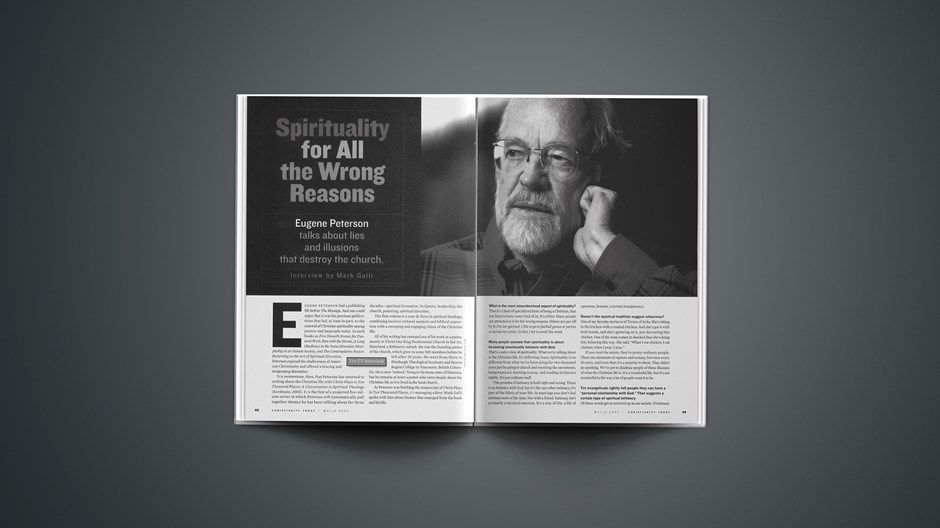
As Peterson was finishing the manuscript of Christ Plays in Ten Thousand Places, CT managing editor Mark Galli spoke with him about themes that emerged from the book and his life.
What is the most misunderstood aspect of spirituality?
That it's a kind of specialized form of being a Christian, that you have to have some kind of in. It's elitist. Many people are attracted to it for the wrong reasons. Others are put off by it: I'm not spiritual. I like to go to football games or parties or pursue my career. In fact, I try to avoid the word.
Many people assume that spirituality is about becoming emotionally intimate with God.
That's a naïve view of spirituality. What we're talking about is the Christian life. It's following Jesus. Spirituality is no different from what we've been doing for two thousand years just by going to church and receiving the sacraments, being baptized, learning to pray, and reading Scriptures rightly. It's just ordinary stuff.
This promise of intimacy is both right and wrong. There is an intimacy with God, but it's like any other intimacy; it's part of the fabric of your life. In marriage you don't feel intimate most of the time. Nor with a friend. Intimacy isn't primarily a mystical emotion. It's a way of life, a life of openness, honesty, a certain transparency.
Doesn't the mystical tradition suggest otherwise?
One of my favorite stories is of Teresa of Avila. She's sitting in the kitchen with a roasted chicken. And she's got it with both hands, and she's gnawing on it, just devouring this chicken. One of the nuns comes in shocked that she's doing this, behaving this way. She said, "When I eat chicken, I eat chicken; when I pray, I pray."
If you read the saints, they're pretty ordinary people. There are moments of rapture and ecstasy, but once every 10 years. And even then it's a surprise to them. They didn't do anything. We've got to disabuse people of these illusions of what the Christian life is. It's a wonderful life, but it's not wonderful in the way a lot of people want it to be.
Yet evangelicals rightly tell people they can have a "personal relationship with God." That suggests a certain type of spiritual intimacy.
All these words get so screwed up in our society. If intimacy means being open and honest and authentic, so I don't have veils, or I don't have to be defensive or in denial of who I am, that's wonderful. But in our culture, intimacy usually has sexual connotations, with some kind of completion. So I want intimacy because I want more out of life. Very seldom does it have the sense of sacrifice or giving or being vulnerable. Those are two different ways of being intimate. And in our American vocabulary intimacy usually has to do with getting something from the other. That just screws the whole thing up.
It's very dangerous to use the language of the culture to interpret the gospel. Our vocabulary has to be chastened and tested by revelation, by the Scriptures. We've got a pretty good vocabulary and syntax, and we'd better start paying attention to it because the way we grab words here and there to appeal to unbelievers is not very good.
Article continues below
This corruption of the word spirituality even in Christian circles—does it have something to do with the New Age movement?
The New Age stuff is old age. It's been around for a long time. It's a cheap shortcut to—I guess we have to use the word—spirituality. It avoids the ordinary, the everyday, the physical, the material. It's a form of Gnosticism, and it has a terrific appeal because it's a spirituality that doesn't have anything to do with doing the dishes or changing diapers or going to work. There's not much integration with work, people, sin, trouble, inconvenience.
I've been a pastor most of my life, for some 45 years. I love doing this. But to tell you the truth, the people who give me the most distress are those who come asking, "Pastor, how can I be spiritual?" Forget about being spiritual. How about loving your husband? Now that's a good place to start. But that's not what they're interested in. How about learning to love your kids, accept them the way they are?
My name shouldn't even be connected with spirituality.
But it very much is.
I know. Then a few years ago I got this embarrassing position of being a professor of "spiritual theology" at Regent. Now what do you do?
You make spirituality sound so mundane.
I don't want to suggest that those of us who are following Jesus don't have any fun, that there's no joy, no exuberance, no ecstasy. They're just not what the consumer thinks they are. When we advertise the gospel in terms of the world's values, we lie to people. We lie to them, because this is a new life. It involves following Jesus. It involves the Cross. It involves death, an acceptable sacrifice. We give up our lives.
The Gospel of Mark is so graphic this way. The first half of the Gospel is Jesus showing people how to live. He's healing everybody. Then right in the middle, he shifts. He starts showing people how to die: "Now that you've got a life, I'm going to show you how to give it up." That's the whole spiritual life. It's learning how to die. And as you learn how to die, you start losing all your illusions, and you start being capable now of true intimacy and love.
It involves a kind of learned passivity, so that our primary mode of relationship is receiving, submitting, instead of giving and getting and doing. We don't do that very well. We're trained to be assertive, to get, to apply, or to consume and to perform.
Article continues below
Repentance, dying to self, submission—these are not very attractive hooks to draw people into the faith.
I think the minute you put the issue that way you're in trouble. Because then we join the consumer world, and everything then becomes product designed to give you something. We don't need something more. We don't need something better. We're after life. We're learning how to live.
I think people are fed up with consumer approaches, even though they're addicted to them. But if we cast the evangel in terms of benefits, we're setting people up for disappointment. We're telling them lies.
This is not the way our Scriptures are written. This is not the way Jesus came among us. It's not the way Paul preached. Where do we get all this stuff? We have a textbook. We have these Scriptures and most of the time they're saying, "You're going the wrong way. Turn around. The culture is poisoning."
Do we realize how almost exactly the Baal culture of Canaan is reproduced in American church culture? Baal religion is about what makes you feel good. Baal worship is a total immersion in what I can get out of it. And of course, it was incredibly successful. The Baal priests could gather crowds that outnumbered followers of Yahweh 20 to 1. There was sex, there was excitement, there was music, there was ecstasy, there was dance. "We got girls over here, friends. We got statues, girls, and festivals." This was great stuff. And what did the Hebrews have to offer in response? The Word. What's the Word? Well, Hebrews had festivals, at least!
Still, the one big hook or benefit to Christian faith is salvation, no? "Believe on the Lord Jesus Christ and you will be saved." Is this not something we can use to legitimately attract listeners?
It's the biggest word we have—salvation, being saved. We are saved from a way of life in which there was no resurrection. And we're being saved from ourselves. One way to define spiritual life is getting so tired and fed up with yourself you go on to something better, which is following Jesus.
But the minute we start advertising the faith in terms of benefits, we're just exacerbating the self problem. "With Christ, you're better, stronger, more likeable, you enjoy some ecstasy." But it's just more self. Instead, we want to get people bored with themselves so they can start looking at Jesus.
We've all met a certain type of spiritual person. She's a wonderful person. She loves the Lord. She prays and reads the Bible all the time. But all she thinks about is herself. She's not a selfish person. But she's always at the center of everything she's doing. "How can I witness better? How can I do this better? How can I take care of this person's problem better?" It's me, me, me disguised in a way that is difficult to see because her spiritual talk disarms us.
Article continues below
So how should we visualize the Christian life?
In church last Sunday, there was a couple in front of us with two bratty kids. Two pews behind us there was another couple with their two bratty kids making a lot of noise. This is mostly an older congregation. So these people are set in their ways. Their kids have been gone a long time. And so it wasn't a very nice service; it was just not very good worship. But afterwards I saw half a dozen of these elderly people come up and put their arms around the mother, touch the kids, sympathize with her. They could have been irritated.
Now why do people go to a church like that when they can go to a church that has a nursery, is air conditioned, and all the rest? Well, because they're Lutherans. They don't mind being miserable! Norwegian Lutherans!
And this same church recently welcomed a young woman with a baby and a three-year-old boy. The children were baptized a few weeks ago. But there was no man with her. She's never married; each of the kids has a different father. She shows up at church and wants her children baptized. She's a Christian and wants to follow in the Christian way. So a couple from the church acted as godparents. Now there are three or four couples in the church who every Sunday try to get together with her.
Now, where is the "joy" in that church? These are dour Norwegians! But there's a lot of joy. There's an abundant life going, but it's not abundant in the way a non-Christian would think. I think there's a lot more going on in churches like this; they're just totally anticultural. They're full of joy and faithfulness and obedience and care. But you sure wouldn't know it by reading the literature of church growth, would you?
But many Christians would look at this church and say it's dead, merely an institutional expression of the faith.
What other church is there besides institutional? There's nobody who doesn't have problems with the church, because there's sin in the church. But there's no other place to be a Christian except the church. There's sin in the local bank. There's sin in the grocery stores. I really don't understand this naïve criticism of the institution. I really don't get it.
Article continues below
Frederick von Hugel said the institution of the church is like the bark on the tree. There's no life in the bark. It's dead wood. But it protects the life of the tree within. And the tree grows and grows and grows and grows. If you take the bark off, it's prone to disease, dehydration, death.
So, yes, the church is dead but it protects something alive. And when you try to have a church without bark, it doesn't last long. It disappears, gets sick, and it's prone to all kinds of disease, heresy, and narcissism.
In my writing, I hope to recover a sense of the reality of congregation—what it is. It's a gift of the Holy Spirit. Why are we always idealizing what the Holy Spirit doesn't idealize? There's no idealization of the church in the Bible—none. We've got two thousand years of history now. Why are we so dumb?
Since the Reformation, though, we've championed the idea that the church can be reformed.
Hasn't happened. I'm for always reforming, but to think that we can get a church that's reformed is just silliness.
I think the besetting sin of pastors, maybe especially evangelical pastors, is impatience. We have a goal. We have a mission. We're going to save the world. We're going to evangelize everybody, and we're going to do all this good stuff and fill our churches. This is wonderful. All the goals are right. But this is slow, slow work, this soul work, this bringing people into a life of obedience and love and joy before God.
And we get impatient and start taking shortcuts and use any means available. We talk about benefits. We manipulate people. We bully them. We use language that is just incredibly impersonal—bullying language, manipulative language.
One doesn't normally think of churches as bullying.
Whenever guilt is used as a tool to get people to do anything—good, bad, indifferent—it's bullying. And then there's manipulative language—to talk people into programs, to get them involved, usually by promising them something.
I have a friend who is an expert at this sort of thing. He's always saying, "You've got to identify people's felt needs. Then you construct a program to meet the felt needs." It's pretty easy to manipulate people. We're so used to being manipulated by the image industry, the publicity industry, and the politicians that we hardly know we're being manipulated.
Article continues below
This impatience to leave the methods of Jesus in order to get the work of Jesus done is what destroys spirituality, because we're using a non-biblical, non-Jesus way to do what Jesus did. That's why spirituality is in such a mess as it is today.
But many pastors see people suffering in bad marriages, with drug addiction, with greed. And so they rightly want to help them now, by whatever method will work.
Yes, except something backfires on you when you're impatient. How do we meet the need? Do we do it in Jesus' way or do we do it the Wal-Mart way?
Spirituality is not about ends or benefits or things; it's about means. It's about how you do this. How do you live in reality?
So, how do you help all these people? The needs are huge. Well, you do it the way Jesus did it. You do it one at a time. You can't do gospel work, kingdom work in an impersonal way.
We live in the Trinity. Everything we do has to be in the context of the Trinity, which means personally, relationally. The minute you start doing things impersonally, functionally, mass oriented, you deny the gospel. Yet that's all we do.
Jesus is the Truth and the Life, but first he's the Way. We can't do Jesus' work in the Devil's way.
I get exercised about this because many pastors are getting castrated by these methodologies, which are impersonal. There's no relationship to them. And so they become performance oriented and successful. It's pretty easy in our culture, at least if you're tall and have a big smile. And they lose their soul. There's nothing to them after 20 years. Or they crash. They try all this stuff and it doesn't work, and they quit, or quit and start doing something else. Probably 90 percent of the affairs that pastors have are not due to lust, but boredom with not having this romantic kind of life they thought they'd get.
What if we were to frame this not in terms of needs but relevance? Many Christians hope to speak to generation X or Y or postmoderns, or some subgroup, like cowboys or bikers—people for whom the typical church seems irrelevant.
When you start tailoring the gospel to the culture, whether it's a youth culture, a generation culture or any other kind of culture, you have taken the guts out of the gospel. The gospel of Jesus Christ is not the kingdom of this world. It's a different kingdom.
Article continues below
My son Eric organized a new church six years ago. The Presbyterians have kind of a boot camp for new church pastors where you learn what you're supposed to do. So Eric went. One of the teachers there said he shouldn't put on a robe and a stole: "You get out there and you meet this generation where they are."
So Eric, being a good student and wanting to please his peers, didn't wear a robe. His church started meeting in a high-school auditorium. He started out by wearing a business suit every Sunday. But when the first Sunday of Advent rolled around, and they were going to have Communion, he told me, "Dad, I just couldn't do it. So I put my robe on."
Their neighbors, Joel and his wife, attended his church. Joel was the stereotype of the person the new church development was designed for—suburban, middle management, never been to church, totally secular. Eric figured he was coming because they were neighbors, or because he liked him. After that Advent service, he asked Joel what he thought of his wearing a robe.
He said, "It made an impression. My wife and I talked about it. I think what we're really looking for is sacred space. We both think we found it."
I think relevance is a crock. I don't think people care a whole lot about what kind of music you have or how you shape the service. They want a place where God is taken seriously, where they're taken seriously, where there is no manipulation of their emotions or their consumer needs.
Why did we get captured by this advertising, publicity mindset? I think it's destroying our church.
But someone else might walk into Eric's church, see him with his robe, and walk out, thinking the whole place was too religious, too churchy.
So why are they going if it's not going to be religious? What do they go to church for?
Of course, there's another aspect to this. If you're going to a church where everybody's playing a religious role, that's going to be off putting. But that performance mentality, role mentality can be seen in the cowboy church or whatever—everybody is performing a role there, too.
But we're involved with something that has a huge mystery to it. Are we going to wipe out all the mystery so we can be in control of it? Isn't reverence at the very heart of the worship of God?
And if we present a rendition of the faith in which all the mystery is removed, and there's no reverence, how are people ever going to know there's something more than just their own emotions, their own needs? There's something a lot bigger than my needs that's going on. How do I ever get to that if the church service and worship program is all centered on my needs?
Article continues below
Some people would argue that it's important to have a worship service in which people feel comfortable so they can hear the gospel.
I think they're wrong. Take the story I told you about this family in front of us on Sunday. Nobody was comfortable. The whole church was miserable.
And yet, they might have experienced more gospel in going up and putting their arms around that poor mother, who was embarrassed to death.
How do we know when they have moved from merely adapting ministry to the culture to sacrificing the gospel?
One test I think is this: Am I working out of the Jesus story, the Jesus methods, the Jesus way? Am I sacrificing relationship, personal attention, personal relationship for a shortcut, a program so I can get stuff done? You can't do Jesus' work in a non-Jesus way and get by with it—although you can be very "successful."
One thing that I think is characteristic of me is I stay local. I'm rooted in a pastoral life, which is an ordinary life. So while all this glitter and image of spirituality is going around, I feel quite indifferent to it, to tell you the truth. And I'm somewhat suspicious of it because it seems to be uprooted, not grounded in local conditions, which are the only conditions in which you can live a Christian life.

















 While we pray for peace, we need moral clarity about this war.
 A Christian reconciliation group in Israel and Palestine warned that war would come. Now the war threatens their relevance.العربيةFrançais
 Eastern Orthodox poet Scott Cairns reflects on his new collection, his journey of faith, and poetry’s capacity to apprehend inexhaustible realities.






