R (for language, including descriptions of atrocities, and for a scene of violence)
Directed By
John Boorman
Run Time
1 hour 45 minutes
Cast
Juliette Binoche, Samuel L. Jackson, Brendan Gleeson
Theatre Release
May 07, 2004 by Sony Pictures Classics
South Africa's Truth and Reconciliation Commission hearings deserve a film like Schindler's List or Hotel Rwanda—something that brings that historical drama to life in a way that helps us shoulder the burden of history and walk away wiser. In My Country tries to be that film, but falls short.
The hearings, which started in 1996 and lasted two years, gave more than 20,000 witnesses a chance to testify—2,000 publicly—against their predominantly white oppressors in a courtroom. Even more astonishing: The hearings were not about retribution. They were carried on to give the world a demonstration of principled forgiveness and "ubuntu" (a South African word for reconciliation). The accused could attempt to explain their behavior, and they could appeal for amnesty if they could prove that they were "just following orders" and were politically motivated in their violence.
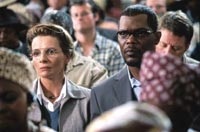
Juliette Binoche and Samuel L. Jackson in the lead roles
Clearly, director John Boorman had the resources at his disposal to make a powerful, affecting drama. He had the gorgeous backdrop of the lush South African landscape. He had three supremely talented actors—Samuel Jackson, Juliette Binoche, and Brendan Gleeson—in the leading roles. And he had a vast reservoir of eyewitness testimonies about racial violence that he could have used to educate a dismayingly ignorant Western audience. Those must have been amazing scenes that played out in those makeshift courtrooms, as the wronged South Africans confronted their oppressors in court with spirit-crushing stories of murder, rape, and mutilation. We hear several devastating stories based on actual transcripts. A woman begs to have the severed hand of her son back, so she has something to bury. Another weeps for her husband, who was stabbed thirty-seven times just so the government could "eliminate" a "thorn in the flesh." One man testifies about how electrocution rendered his body useless. "I want my manhood back," he declares.
But Boorman seems uninspired by these confrontations. Ann Peacock's adaptation of Antjie Krog's autobiographical Country of My Skull makes the audience less interested in the liberation of the South Africans and more interested in whether the two weary journalists at the center of the story will suffer nervous breakdowns or run off into the desert for a torrid love affair.
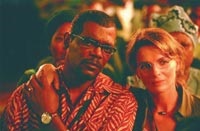
An implausible love affair diminishes what could've been a great movie
Despite its good intentions, the film fails largely because Jackson and Binoche, one of the oddest onscreen pairings in recent years, aren't given convincing characters to play. And the dialogue throughout the film creaks under the weight of oversimplified arguments, information-loaded summaries, and angst-heavy sentiments—like, "When you despise yourself, it's that much easier to despise others." Thus the film feels more like a tour full of speeches than a story.
Langston Whitfield (Jackson) is a cynical Washington Post journalist who thinks he has come to see white supremacists get let off the hook for their wickedness. He scoffs at the idea of "ubuntu," and asks if the hearings show that black people have a greater capacity for forgiveness, or that white people have a greater capacity for murder.
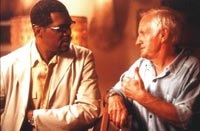
Brendan Gleeson as De Jager, testifying before the commission
Thus, he's put off by the beautiful Afrikaans poet, Anna Malan (Binoche), who is deeply moved by the proceedings as she reports for National Public Radio. Anna's traumatized by what she's hearing, and by the burden of "white guilt" that she carries for her family, who are disgruntled by the shift in political power. When cattle thieves strike their farm at night, Anna's hard-hearted father growls at her, "This is the new South Africa you admire so much?" When someone asks about calling the police, Anna's brother says, "They're not our police anymore. It's not our country anymore. It's open season on whites."
It's strange that, for all of its agonizing over the wounds of black people in South Africa, all of the film's black South African characters remain in the background. We only have Dumi (Menzi Ngubane), who serves primarily to bring Langston and Anna together. Langston asks Dumi why he isn't shedding tears over the hearings. He replies, "We did our crying years ago." That's all fine and good, but it still feels odd that he's little more than comic relief for most of the film, grinning and winking as Langston and Anna work through their differences (far too easily) on their way to a tumble in the sheets.
Jackson and director John Boorman on the set
A tumble, indeed. The unlikely, unconvincing love affair steers us away from the subject of the story and dilutes the film's emotional content. It's implausible that they'd both slip so easily into an affair when they're so proud of the spouses and kids waiting back on their respective ranches. Peacock's script wants us to think about the human capacity for lies and betrayal. And she tries to get us worried about Anna's sanity, so we'll have some sympathy when she falls into Langston's all-too-eager embrace. But this couple has chemistry only as colleagues, not as lovers, and certainly not as detective buddies. Near the end, the story lurches into the territory of sappy television melodrama, with lines like "My skin will never forget you," and last-minute CSI-style revelations that are less than surprising.
Article continues below
The actors perform admirably with what they're given. Binoche is arguably the most gifted screen actress in the world, and she's more than capable of playing a poet. But as she staggers around wringing her hands, Binoche is asked to perform far too many of her famous, close-up, emotional collapses. Her supervisor is more interesting—a woman strangely unfazed by the proceedings, giddily congratulating Anna if her tape recorder picks up any dramatic screams in the courtroom.
It's actually rather fun to watch Jackson in this movie, because we rarely seem him so relaxed, so himself. There's only a flicker of the fire-eyed, commanding Tough Guy he plays so often. He's even coaxed to get up and dance for the fun of it. But the increasing weariness on his face—and this goes for Binoche's angst as well—could very likely stem from frustration with the meandering script.
The great Brendan Gleeson (The General, 28 Days Later, Cold Mountain) stoops to playing the token Evil White Supremacist, a South African police chief who supervised unspeakable tortures. He's made to utter unimaginative, predictably nasty lines, comparing the process of torture to the pleasures of sex. His chair is placed, of course, in front of a fireplace, so flames can dance around his head and shoulders, like they did for Al Pacino's over-the-top Satan in The Devil's Advocate. Clearly, Gleeson was told to "pace like a caged animal" in his lair, which is decorated with the stuffed and mounted heads of an entire zoo in order to accentuate his predatory nature.
In spite of the bloody territory, Boorman admirably minimizes onscreen violence, just as Terry George did in Hotel Rwanda. But the flaws here are even more evident when compared to George's film. While it was similarly lacking in imagination, Rwanda succeeded by rooting us deeply in the experience and perspective of one man. We saw what he saw and suffered when he suffered. It was a story of someone who took action, not someone who stood on the sidelines and took notes. There were no unnecessary tangents.
And Rwanda arrived at a conclusion that effectively acknowledged the possibility of grace in the midst of overwhelming evil. In My Country betrays its theme of reconciliation by building to a cliché in which a bad guy takes a dramatic fall.
On the wall behind the attentive judges, we see a mural depicting Christ's passion—a poignant reminder of the inspiration for such grace. Yet Boorman and Peacock show very little interest in exploring spiritual matters. We need films like this to help us see how small the world is, how much responsibility we bear for the suffering of others, and how much good individuals can do if they allow their hearts to break for their neighbors. In My Country begins with an achingly beautiful African chorus repeating the painful refrain "What have we done?" But we're left thinking about all the things the filmmakers could have done with a subject this rich, actors this strong, and such crucial spiritual issues before them. With a thousand available strands of compelling story available to them, they've chosen to follow a loose and meandering thread.
Article continues below
Talk About It
Discussion starters
Compare the perspectives of Langston and Anna on the hearings at the beginning of the film. What do they disagree about? Are their perspectives at the end different? What changes them?
What do you think of the South African emphasis on "ubuntu"? Were these "fair trials"?
What do you think of Langston and Anna's affair? What draws them together? Did you find this part of the story plausible?
What parts of the South African apartheid/reconciliation story do you wish this film had explored further? Why?
In what ways did you see the Christian concept of grace and forgiveness manifested in this movie? In what ways were those ideals ignored?
The Family Corner
For parents to consider
In My Country is rated R for harsh language, including graphic descriptions of violent crimes and sex crimes, and for a scene of violence.
South Africa's Truth and Reconciliation Commission hearings deserve a film like Schindler's List or Hotel Rwanda—something that brings that historical drama to life in a way that helps us shoulder the burden of history and walk away wiser. In My Country, which stars Samuel L. Jackson and Juliette Binoche, tries to be that film, but falls short.
Clearly, director John Boorman had the resources at his disposal to make a powerful, affecting drama. But Ann Peacock's adaptation of Antjie Krog's autobiographical Country of My Skull makes the audience less interested in the liberation of the South Africans and more interested in whether the two weary journalists at the center of the story will suffer nervous breakdowns or run off into the desert for a torrid love affair.
J. Robert Parks (The Phantom Tollbooth) says, "I guess I can encourage you to see the movie's first half (if you do, flee the theater when the stars get in bed for the second time—you'll know what I mean). And high school teachers might want to screen selected scenes to educate students who weren't even alive when apartheid fell. But for most of us, this attempt to show some history falls prey to our current problem of showing too many celebrities."
The Grammy-winning artist was found dead at her home in Nashville at age 47.
Diana Chandler - Baptist Press
In My Country
1 of 4
Juliette Binoche and Samuel L. Jackson in the lead rolesAn implausible love affair diminishes what could've been a great movieBrendan Gleeson as De Jager, testifying before the commissionJackson and director John Boorman on the set














 While we pray for peace, we need moral clarity about this war.
 As my doubts about his teachings grew, so did a secret fascination with Jesus.
 The Grammy-winning artist was found dead at her home in Nashville at age 47.