"That's Latin," said an ever-helpful commentator during the funeral mass for John Paul II. Like the belief that television is necessary, the idea that Latin is "dead" is as bogus as it is recent. It's true that Ben Franklin's autobiography pits the "living" tongues against that unspoken one, but the Sage's most important point was that French, or another romance language, can serve as a bridge to Latin. My students who know French or Spanish can vouch for this. Another who knows Russian has recognized Latin's influence on that language. And I have learned that even Welsh owes much of its vocabulary to the speech of the Caesars. Anyway, James Madison busted his rump studying Latin and Greek to pass the entrance exam at what would become Princeton University, and it didn't do him any harm.
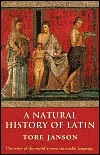
"I won't say anything about the death of Latin," writes retired linguistics professor Tore Janson in A Natural History of Latin, "[for] the language is still very much alive." Save for those who have labored under the direction of cruddy teachers, everyone who has studied Latin knows that Janson is right. As he regularly points out, one obvious thing that keeps Latin in the category of the living is its presence in just about every sentence English-speakers utter. Here, for example, is the Pledge of Allegiance with the Latin taken out:
I … to the flag of the … of America and to the … for which it stands, one … under God … with … and … for all.
Indeed, something like 75 percent of the multisyllabic words in the English lexicon come from Latin, or from Greek via Latin, or from Latin via French. As I put it to my students, if Yiddish were erased from contemporary English we'd have a hard time talking about bagels, pastrami, klutzes, and schmucks. If we dumped Dutch, we'd be without cookies, Yankees, bundles, and booms. If we bid au revoir to Hindi, we'd be at a loss when contemplating bandannas, cheetahs, jungles, and shampoo. If we said aloha to Congolese we'd have a tough time ruminating on funky gorillas, zebra zombies, and mojo boogie. Sans Arabic, we wouldn't know about algebra, algorithms, and almanacs. But if Latin died in our mouths, we'd just stop talking; or, at best, we'd be left mostly with monosyllables bequeathed to us from the Angles and Saxons—requiem aeternum dona eis, Domine.
While not an argument for the study of the classical languages, for which we can turn to Tracy Simmons and Victor Davis Hanson (among others), Janson paints in broad strokes the story of Latin—among other things, its development into dialects and then into separate European languages. For readers with little background in the history of Western civilization and its literature, the strokes may be too broad; on a single page, for example, we find references to Cicero, Lorenzo Valla, Erasmus, Jerome, Augustine, Ambrose, Petrarch and Thomas More. The explanation of Latin grammar comprising the book's third part is useful to the initiated but likely to be difficult for newcomers. And the politically correct asides that punctuate the text—theology is outdated, Roman battle descriptions are offensive—are irksome.
But the vocabulary list and some 500 Latin phrases that take up the last 80 pages of the book cover a multitude of sins. Here we learn that dictum sapienti sat est ("a word is enough to a wise man") and that dimidium facti qui coepit habet ("a job begun is a job half done.") In the hands of a teacher introducing students to Latin, the classics, or to general themes in Western history, this book could be very useful.
Janson's Natural History comes as further evidence of a reviving interest in Latin. Advanced Placement courses in the language are budding; homeschoolers' curricula often emphasize it; the classical schools movement, which is growing across the country, has been spurred partly by a commitment to it; and some publishers think it worthwhile to produce Latin translations of contemporary works. Janson's small book now rests on my office shelf next to Quomodo Indiviosulus Nomine Grinchus Christi Natalem Abrogaverit ("How the Wretched Little One Named Grinch Snuffed Christmas"), Harrius Potter, and the Latin translation of Antoine de Saint-Exupery's Little Prince.
May the Latin is Important movement, assisted by books like Janson's, prosper.
Preston Jones, a contributing editor to Books & Culture, teaches at John Brown University>
At Home in the Dark | The first new book of poems in almost twenty years from Rod Jellema. (May 17, 2005)
Article continues below
"Taken Up in Glory" | The Ascension has been forgotten in many Protestant churches, jettisoning an essential part of the Christian story. (May 10, 2005)
Making Believe | Bedtime stories for grown-ups. (May 03, 2005)
The Words of the Word | Two sharply contrasting perspectives on Bible translation. (April 19, 2005)
Divine Comedies | A report on Baylor's Art & Soul conference, version 2005. (April 12, 2005)
Unbelievable | Religion is really, really bad for you. (April 05, 2005)
This Land Is Whose Land? | An impassioned plea on behalf of the "caribou people" in the Arctic National Wildlife Refuge and the land they have inhabited for nearly 20,000 years. (March 22, 2005)
All in Her Head | How a chronic pain sufferer found a little bit of strength in a lot of weakness. (March 15, 2005)
My Likeness, My Brother | A powerful autobiographical work from a prizewinning creator of comics in France. (March 08, 2005)
Looking for Yogi | The 2005 Spring Training preview. (March 01, 2005)
Gut Check | Blink makes the case for intuitive judgment. (Feb. 22, 2005)













 While we pray for peace, we need moral clarity about this war.
 A Christian reconciliation group in Israel and Palestine warned that war would come. Now the war threatens their relevance.españolالعربيةFrançaisрусскийУкраїнська
 NIL deals in college athletics present new challenges—and opportunities—for colleges and students.





