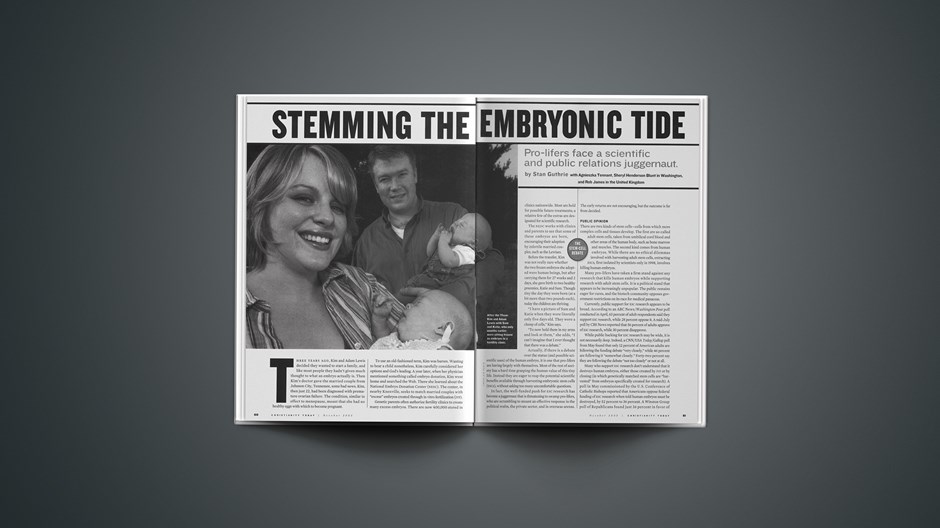
Three years ago, Kim and Adam Lewis decided they wanted to start a family, and like most people they hadn't given much thought to what an embryo actually is. Then Kim's doctor gave the married couple from Johnson City, Tennessee, some bad news. Kim, then just 22, had been diagnosed with premature ovarian failure. The condition, similar in effect to menopause, meant that she had no healthy eggs with which to become pregnant.
To use an old-fashioned term, Kim was barren. Wanting to bear a child nonetheless, Kim carefully considered her options and God's leading. A year later, when her physician mentioned something called embryo donation, Kim went home and searched the Web. There she learned about the National Embryo Donation Center (NEDC). The center, in nearby Knoxville, seeks to match married couples with "excess" embryos created through in vitro fertilization (IVF).
Genetic parents often authorize fertility clinics to create many excess embryos. There are now 400,000 stored in clinics nationwide. Most are held for possible future treatments; a relative few of the extras are designated for scientific research.
The NEDC works with clinics and parents to see that some of these embryos are born, encouraging their adoption by infertile married couples, such as the Lewises.
Before the transfer, Kim was not really sure whether the two frozen embryos she adopted were human beings, but after carrying them for 27 weeks and 2 days, she gave birth to two healthy preemies, Katie and Sam. Though tiny the day they were born (at a bit more than two pounds each), today the children are thriving.
"I have a picture of Sam and Katie when they were literally only five days old. They were a clump of cells," Kim says.
"To now hold them in my arms and look at them," she adds, "I can't imagine that I ever thought that there was a debate."
Actually, if there is a debate over the status (and possible scientific uses) of the human embryo, it is one that pro-lifers are having largely with themselves. Most of the rest of society has a hard time grasping the human value of this tiny life. Instead they are eager to reap the potential scientific benefits available through harvesting embryonic stem cells (ESCs), without asking too many uncomfortable questions.
In fact, the well-funded push for ESC research has become a juggernaut that is threatening to swamp pro-lifers, who are scrambling to mount an effective response in the political realm, the private sector, and in overseas arenas. The early returns are not encouraging, but the outcome is far from decided.
There are two kinds of stem cells—cells from which more complex cells and tissues develop. The first are so-called adult stem cells, taken from umbilical cord blood and other areas of the human body, such as bone marrow and muscles. The second kind comes from human embryos. While there are no ethical dilemmas involved with harvesting adult stem cells, extracting ESCs, first isolated by scientists only in 1998, involves killing human embryos.
Many pro-lifers have taken a firm stand against any research that kills human embryos while supporting research with adult stem cells. It is a political stand that appears to be increasingly unpopular. The public remains eager for cures, and the biotech community opposes government restrictions on its race for medical panaceas.
Currently, public support for ESC research appears to be broad. According to an ABC News/Washington Post poll conducted in April, 63 percent of adult respondents said they support ESC research, while 28 percent oppose it. A mid-July poll by CBS News reported that 56 percent of adults approve of ESC research, while 30 percent disapprove.
While public backing for ESC research may be wide, it is not necessarily deep. Indeed, a CNN/USA Today/Gallup poll from May found that only 12 percent of American adults are following the funding debate "very closely," while 46 percent are following it "somewhat closely." Forty-two percent say they are following the debate "not too closely" or not at all.
Many who support ESC research don't understand that it destroys human embryos, either those created by IVF or by cloning (in which genetically matched stem cells are "harvested" from embryos specifically created for research). A poll in May commissioned by the U.S. Conference of Catholic Bishops reported that Americans oppose federal funding of ESC research when told human embryos must be destroyed, by 52 percent to 36 percent. A Winston Group poll of Republicans found just 36 percent in favor of expanded federal funding.
Federal Initiatives
On August 9, 2001, President Bush announced a compromise. He would allow federal funding of ESC research. But he restricted this government support to the 78 ESC lines that had already been created as of that date, "where the life-and-death decision has already been made." At that time, Sen. Bill Frist, a heart- and lung-transplant physician, announced he would support the policy.
But last May the Republican-controlled House of Representatives passed a bill, H.R. 810. The bill seeks to remove the funding restrictions and allow researchers to extract stem cells from human embryos in cold storage. Bush promised to veto any such bill that reached his desk, and pro-life leaders assumed Frist, the Senate majority leader, would stand with him.
Article continues below
But Frist, a self-proclaimed pro-lifer, faced a growing clamor from the public, members of his own party, and scientists and biotech firms. So in July he proposed some "adjustments" to the President's policy. Claiming that only 22 ESC lines (not 78) are actually suitable for research, the Tennessee Republican said it is time to allow federal funding for research using "excess" embryos created for fertility treatments—in other words, from among those 400,000 frozen embryos that "would otherwise be discarded and destroyed." Frist, however, did draw the line at cloning human embryos for research.
An alternative to H.R. 810, the Stem-Cell Therapeutic and Research Act (H.R. 2520) authorizes $79 million for a cord blood inventory and research system, and $158 million to reauthorize and expand the ongoing federal bone marrow transplant program. The bill also attempts to simplify efforts for patients, doctors, and researchers by establishing a new program for cord blood and bone marrow stem-cell data. This bill would fund adult (including cord blood) stem-cell research. Pro-life groups, including the National Right to Life Committee (NRLC), support this bill, as well as the Human Cloning Prohibition Act (H.R. 1357).
While the House has passed two bills in the last three sessions banning human cloning for medical research, pressure from the biotech lobby and disease advocacy groups has so far blocked Senate passage.
States of the Debate
Whatever happens with federal funding, which has grown from $306 million in 2001 to $566 million in 2005 for all forms of stem-cell research, the ESC juggernaut is moving ahead privately and in the states. David Greenwood is executive vice president of Geron Corporation, a Menlo Park, California-based biotech firm doing pioneering research with ESCs. Greenwood tells CT that federal funding is inconsequential to Geron, saying that the firm gets most of its ESC research money from international partners and investors. Across the private sector in the United States, 70 companies doing stem-cell research expect annual revenues to hit $3.6 billion by 2015.
Several states—including California, Illinois, Connecticut, and New Jersey—are moving ahead with state funding of ESC research. Last fall, 59 percent of California voters approved a 10-year, $3.1 billion stem-cell initiative called Proposition 71.
Article continues below
John Whiffen is an orthopedic surgeon who is president of the board of the California Family Council. Whiffen says he expects that pro-lifers eventually will convince Californians to oppose ESC research funding. A key goal is to place an initiative on the ballot in November 2006 to overturn Proposition 71. Whiffen believes facts and logic will eventually win out.
"We may lose for a while," Whiffen tells CT. "But over a longer period of time, I think we'll win this debate. Our job is to do the best we can to win this debate as quickly as we can."
In Massachusetts, Republican Gov. Mitt Romney vetoed legislation in May to expand stem-cell research. Romney said he opposed it because it allowed the so-called therapeutic cloning of human embryos to harvest their stem cells. However, the state legislature, controlled by Democrats, overrode the veto.
Pro-lifers are struggling to respond. Tom Reilly, the state attorney general, shot down an attempt to place an initiative on the ballot to repeal the law. Kris Mineau of the Massachusetts Family Institute says advocates for ESC research have redefined life, and he hopes continuing public debate will get the truth out.
The Overseas Arena
On top of all this, the research continues both in America and overseas. Although the United Nations passed a nonbinding anti-cloning resolution earlier this year, scientists in Great Britain and South Korea have announced that they have cloned human embryos for research purposes.
Catholic and evangelical groups have opposed the push toward cloning in Britain. Nigel Cameron, chair of the London-based Centre for Bioethics and Public Policy, admits that "the U.K. pro-life groups have been profoundly ineffective" in making their case against the government's "laissez-faire/whatever ethics" regarding human cloning.
Roger Smith, head of public policy at CARE (Christian Action Research and Education), says British Christians are still seeking to be heard. "We are engaging with those making the decisions," Smith says. "We are educating the Christian public, and we are far from sidelined. I don't feel we are simply a voice in the wilderness, even though we are certainly saying things that people do not want to hear."
CARE has requested that the government establish a national bioethics council. Smith hopes one may be formed in the next two or three years.
Article continues below
While no American scientist has made a cloning announcement, cloning currently is legal in the United States. Douglas Johnson of the NRLC is worried.
"What's needed is more public awareness of how late the hour is," Johnson says. "There are labs in the U.S. working 'round the clock to get to where South Korea is."
Metaphysics and Science
Of course, cloning developments overseas prompt more cries in the United States that American researchers not "fall behind" their international peers. Scientists have been reluctant to discuss the nature of the element critical in that work: the embryo. When asked whether Geron considers the embryo to be human, Greenwood instead mentions research protocols vetted by a private ethics advisory board.
"I can't put labels … on these materials," Greenwood says. "The materials are what they are medically and scientifically, and that's what we describe. It's IVF material.
"As a company, obviously, it would be grossly inappropriate for us to make theological pronouncements of any kind."
While shying away from "theological pronouncements," ESC researchers prize stem cells because they are pluripotent, having an almost mystical ability to grow into other kinds of tissue. ESCs also have the ability to reproduce themselves indefinitely.
"Quite simply, [ESC research] may redefine medicine," Greenwood says. "Its potential is that extraordinary."
Seeking to restrict ESC research, pro-life Christians who believe life begins at conception find themselves in the unaccustomed position of using the language of science, while those who support ESC research often resort to the language of faith—faith in the protean potential of an embryo that, at five days old, is smaller than the period at the end of this sentence.
Perfectly stating the science-based pro-life side, ironically, is Frist, who said during his late-July speech:
"I believe human life begins at conception. It is at this moment that the organism is complete—yes, immature—but complete. An embryo is nascent life. It's genetically distinct. And it's biologically human. It's living. This position is consistent with my faith. But to me, it isn't just a matter of faith. It's a fact of science."
Such science-based arguments seemingly carry little weight in the face of untested (and perhaps unattainable) claims of future ESC-based cures for heart-wrenching conditions ranging from juvenile diabetes to Alzheimer's.
Article continues below
So far, however, after 24 years of research using both mouse and human embryonic stem cells, no ESC-based treatments for humans have emerged. Removed from their natural environment in a woman's body, embryonic stem cells are hard to control and sometimes wildly grow into tumors.
However, adult stem cells have provided, so far, treatments for at least 65 conditions in humans, from brain cancer to heart damage, according to www.stemcellresearch.org. Yet ESC research grabs most of the headlines.
Geron focuses much of its work in an almost messianic mission to find cures for spinal cord injuries using ESCs. When asked whether claims of some boosters of ESC research might be over-promising future benefits, Greenwood says flatly, "No."
Others disagree—but expressing such skepticism can be difficult. David A. Prentice is senior fellow for life sciences at the Family Research Council and a former professor of life sciences at Indiana State University. He says the scientific and ethical questions he raised at Indiana State University over ESC research were treated as heresy: "Some of the offhand comments within my department were that what I was talking about really was not science but politics and religion. Certainly if I talked about the ethics of embryonic versus adult stem cells in addition to the science, that was just immediately stereotyped as religion."
Joni Eareckson Tada, left a quadriplegic by a diving injury 38 years ago, is frustrated by what she sees as scientific hype. "The media have played out the human embryo as the holy grail of stem-cell research," Tada, who founded the Joni and Friends ministry in 1979, tells CT. "The biotech industry, linked with venture capitalists, would have us believe that an embryo is not a human being—it's just a mindless clump of cells not worthy of protection or legal rights. And we bought into it."
Viable Alternatives
Opponents are hoping that a sufficient number of Americans have moral qualms about ESC research—or will, given enough education—that scientists and biotech firms will have to look for alternatives.
In his July speech, Frist himself noted that scientists and ethicists are now looking at four methods that may yield pluripotent stem cells that do not involve the destruction of nascent human life. These are extracting stem cells from dead embryos; developing non-harmful ways of extracting them from living embryos; extracting them from artificially created "non-embryos"; and reprogramming adult cells to pluripotency via fusion with embryonic cell lines. (As if on cue, in August researchers from Harvard announced that they had "reprogrammed" skin cells into what appear to be embryonic stem cells.)
Article continues below
These recommendations come from the President's Council on Bioethics, headed by Leon Kass of the University of Chicago. Bush formed the council when he announced his stem-cell policy in 2001.
"I believe that if we really do pour our resources into these alternatives," Kass tells CT, "we might find a morally unproblematic and uncontroversial way to get this research done."
According to John Kilner, professor of bioethics and contemporary culture at Trinity International University in Deerfield, Illinois, new findings indicate that adult stem-cell growth may indeed be more versatile than previously believed. In addition, the cells themselves are more available throughout the human body than previously thought. On top of that, in August a team of researchers at the University of Pittsburgh discovered that cells saved from human placentas during childbirth may possess pluripotency.
"If the research on adult stem cells shows that we can actually use them to do everything that we would want to do with embryonic stem cells, then some strong counter-forces will come into play," Kilner says. "Certain portions of populations everywhere are going to be resistant to the embryonic work. And so they're going to say, 'Hey, if you can do it equally well either way, then we'll support and buy the products that use the adult stem-cell approaches.'"
Yet Tada and other pro-lifers admit that IVF, as currently practiced in the United States, creates too many embryos for reasons of cost and convenience, and that many Christians are complicit in their destruction.
"I think we need severe restrictions on the number of embryos that are produced," Tada says. "They should implant all these embryos that result from fertilization and limit the number that are produced."
Which brings us back to Kim Lewis and embryo adoption. The NEDC, with an annual budget of just $300,000, seems to stand little chance when pitted against the well-funded Gerons and other biotech giants. Jeff Keenan, a reproductive endocrinologist and director of the NEDC, expects the number of "transfers" to accelerate from the current 40 or 50 annually to approximately 1,000 by 2010—still a drop in the bucket when compared with the need. The Snowflakes Embryo Adoption Program represents another small option.
Article continues below
But to Kim Lewis, the numbers are secondary when she considers what life was like without Katie and Sam.
"It's a joy just to have them."
Stan Guthrie is senior associate news editor of Christianity Today. His website may be found at www.stanguthrie.com.
Our weekly bioethics column, Life Matters, discusses stem cells and related life ethics issues. Nigel M. de S. Cameron's latest column was "Leon Kass, a Bioethics Legend, Steps Down."
More CT articles on stem-cell research includes:
The Stem-Cell Conspiracy | The Washington Post muddles a major breakthrough in adult stem-cell research, while the U.K. marches blindly on. (Aug. 29, 2005)
Post-Election Education | Pro-lifers weigh options after Californians fund embryonic stem-cell research. (Dec. 1, 2004)
The Politics of Stem Cells | Why do some scientists and politicians insist on exploiting embryos? (Nov. 17, 2004)
It's Not About Stem Cells | Why we must clarify the debate over harvesting embryos. (A Christianity Today editorial—Sept. 29, 2004)
















 While we pray for peace, we need moral clarity about this war.
 We’ve got little information on Jesus’ appearance and personality. But that’s the way God designed it.españolFrançais
 We must always be people of the Word, but we’ll have to reimagine deep engagement with Scripture.






