While columnists from Paris to Peoria debate the fate of Floyd Landis, awaiting the results of a second sample—the consensus is that indeed his victory in the 2006 Tour de France was aided by drugs—it's not a bad time to step back and survey the history of the event.
by Christopher Thompson
Univ. of California Press
398 pp.; $29.95
In the midst of his seven-year reign as king of the Tour, Lance Armstrong published his autobiography with the cheeky title It's Not About the Bike. Of course, the book was also about his recovery from cancer, but from early success as a teenage racer to the domination of the world's most famous race, Armstrong's story cannot be told without the bike. At the time, I wondered if this book would spawn imitators:
Bill Gates: It's Not About the Computer
Mario Andretti: It's Not About the Car
Yo-Yo Ma: It's Not About the Cello
Jonah: It's Not About the Fish
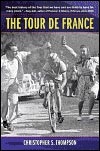
Armstrong did not start a trend, but he should have loaned his title to Christopher Thompson, author of The Tour de France: A Cultural History. Thompson should have called the book It's Not About the Race. Alas, although chock-full of interesting bits about the man who founded and promoted the Tour, this book is almost completely free of information about the race itself. The cover features a splendid black & white photo of the 1947 winner of the Tour climbing a mountain with enthusiastic spectators running alongside pouring water on their hero. A reader could assume the race would appear somewhere in the text. It doesn't, except in the introduction. In the opening paragraph Thompson says he has been a fan of the Tour since he lived in Belgium as a teenager. He may have been a fan, but he was not a racer. In the first paragraph he gets the action of the race very wrong.
He writes of riders "swerving acrobatically" in the final sprint. Hardly. Sprinters hammer the straightest possible line to the finish. Swerving is not intended, but follows either elbow-banging contact at 40+ mph or one last slashing move by one rider from behind another rider. For a rider in a sprint, his vision narrowing as his heart rate reaches maximum, there is nothing but the wheel in front and the finish line. Sprinters are a scrum of fullbacks, all with the ball, trying to be first to the goal line. The final sprint looks more like the bulls at Pamplona than a group of gymnasts.
Then Thompson tells us the riders "inched up" and "rocketed down" the Alps and Pyrenees. Is he kidding? I am an amateur masters racer. I ride 10,000 miles per year training to race with other guys my age. Occasionally my training mates and I have the opportunity to ride with international professional cyclists when big races are held on the East Coast. The difference between them and us is power. That power is most evident on long, steep climbs. The pros can rocket up hills nearly twice as fast as amateurs. Lance Armstrong climbed Alpe d'Huez, the toughest of all the climbs in the Tour, at an average speed over 12 mph—that's the speed a casual tourist rider travels on level ground and is a five-minute mile for a comparison with running. On the less steep climbs, the top professionals go 17 to 20 mph uphill. Inching? Of "rocketed down" I will only say there are climbing bonus and sprint bonuses in every stage of the Tour but not one descent bonus. Nobody gains time descending. In fact in this year's Tour Floyd Landis gained one minute on his rivals in the final descent and the commentators were talking about Landis as one of the best descenders ever—and they were right. The bikes go fast downhill, but they don't accelerate. In some ways, a 55 mph descent is one of the dullest parts of a bike race. Steady speed, no effort, just coasting. The reality is the reverse of Thompson's description. Tour racers rocket up the mountains; they gain mere inches on the descents; and when they swerve it is not at all acrobatic. Thompson's words do express the view of a casual spectator, but a historian should give insight, not repeat popular misperception.
When the apoplexy I suffered reading the introduction subsided, I read about the social program of the race's organizer, Henri Desgrange. This enterprising journalist, publisher, and race promoter founded the Tour and presented it as the solution to France's perceived problems of declining birthrate and softening masculinity. The Tour, he said, would showcase virile men performing great feats. Men properly admired by virtuous and beautiful women. What he got was mechanics and shopkeepers willing to suffer and risk injury for the chance of making a year's salary in three grueling weeks. Thompson carefully chronicles the salaries made by pipe fitters, carpenters, and factory workers to show why these men would be motivated to ride. Surely money motivated many riders, but most men who race, or compete in any sport, will strive to win whether the prize is grand or trivial. We do not hear from racers who simply want to be known as better, faster, stronger than—everyone, someone, anyone. Mastery as motivation certainly says something about a culture.
Article continues below
After reading this book I thought it perfectly appropriate that Americans have come to dominate professional cycling in the new millennium. This race may circle France, but from the first Tour in 1903, it has followed a very American sporting model—the promoter, not tradition, sets the rules and changes them to increase competitiveness and attract more sponsor money. Desgrange went against the racing model of what are now called the Classic races and changed the route of the Tour every year. Why? More potential sponsors, more press coverage. The race circles the country each year but passes through different places, giving thousands of towns, cities, and hamlets the opportunity to be part of the event. In addition to changing the route, Desgrange changed the scoring of the race from time to points and then back again to make it more competitive.
He also spurned technical innovation. Although gear changing was a French invention, the derailleur was not allowed in the Tour until 1937, nearly half a century after it was invented. Riders were limited to two gears, one on each side of the wheel, and they had to remove the wheel to change gears. Desgrange kept new technology out of the Tour to show that his racers were tough and self-reliant.
Desgrange also invented the Caravan Publicitaire, a parade of vehicles that moved with the Tour promoting sponsors' products. He imposed fines on Tour riders for foul language; for fighting with officials, each other, and even spectators; for being shabbily dressed on or off the bike; and even for public urination. In other words, the fines punished coarse behavior as much as or more than competitive infractions.
Thompson shows the reader an innovation in sport. The Tour de France, unlike the tradition-bound sports we associate with Europe, changes rules in the commercially influenced American model. Soccer (football) plays two sponsor-unfriendly, 45-minute halves. In a normal European motor race, the leader at the end of lap one is the winner of the race. But from 1903 onward, the Tour has changed rules, routes, and regulations to keep it the biggest, richest most coveted event in professional cycling. It has also served as a capitalist beacon, lighting the path which the NFL, NBA, NHL, and NASCAR would eventually follow.
Especially NASCAR. The founder of NASCAR, William "Big Bill" France of Daytona, Florida, followed in Desgrange's footsteps. More than any other sport-sanctioning body, NASCAR follows the Desgrange model of professional competition. The race calendar changes nearly every year, adding new tracks and new markets, moving or eliminating races in smaller places in close proximity to other tracks. The scoring has changed several times to increase competition. (Recently NASCAR changed its scoring rules to create a playoff system.) Like Desgrange, Big Bill kept technology away from this race series originally designed to corral the driving talents of moonshiners. NASCAR stockcars are among the very few vehicles left on the planet that run on carburetors, not fuel injection. They use steel-tube frames, engines designed in the early 1950s, which will reach a new height of absurdity next year when Toyota joins the top level of NASCAR: The innovative Japanese auto giant had to design and produce a 1950s-era iron-block engine to be eligible for NASCAR competition—no aluminum blocks or overhead cams allowed.
Article continues below
One odd bit of information left out of this volume is the audience of the Tour in France. I have traveled to France more than a dozen times in the last decade meeting with editors and academics in Paris, Toulouse, and Lyon. I also bring my bike. I have yet to meet a Parisian professional who follows the Tour. The middle class people I work with in France are rabid soccer fans. They politely ask me questions about the most recent Tour when we meet at lunch or dinner, but the sooner we can return to discussing soccer and politics, the better. In contrast, when I ride in the daily training races in Bois de Boulogne in the southeast corner of Paris, I am riding with fans of the Tour: electricians, plumbers, delivery drivers, and mechanics. In another parallel with NASCAR, the blue-collar folks are the race fans and many French of the middle/professional class make it clear they do not follow the race.
In an all-too-prescient conclusion, Thompson surveys the doping debate. He cites surveys in Europe showing that the public believes doping is pervasive. Last year 79 percent of European survey respondents and 97 percent of French respondents associated cycling with doping. Whatever the outcome for Floyd Landis of Farmersville, Pennsylvania, it seems very clear the perception of doping will follow future Tours more closely than riders drafting in a final sprint.
Neil Gussman, an amateur masters racer, rides about 10,000 miles per year.












 While we pray for peace, we need moral clarity about this war.
 As my doubts about his teachings grew, so did a secret fascination with Jesus.
 After lobbying from fellow Southern Baptists and Christians affected by the war, the House speaker moves a package forward.





