I first heard the word in my college classroom a few years ago. I was an assistant professor of English at a state university, and, not incidentally, the mother of five children at the time. We were doing the usual around-the-room introductions in this opening class, which served as my forecast and early warning system for the upcoming semester. Several of the women had listed their occupations, their passions, and then mentioned they were also mothers. Then it was Rosalyn's turn. "Hi, I'm Rosalyn, and I've been a truck driver and a commercial fisherman, and I'm not a breeder." Everyone looked at me, silent, eyes wide. I smiled out of reflex, but suddenly it hit my brain like a smart bomb: A breeder? So that's the term now! Like dogs or horses, purely animal-species survival.
When I told an administrator at the college where I taught that I was pregnant and had decided to resign my position, he snorted and said, "This is your, what, ninth or tenth?" So many children, of course, that they are uncountable. The next summer, a neighbor I hadn't seen for awhile came to visit. "How many kids you got now?" he asked, in his usual direct manner.
"Six," I said, smiling bravely.
"Oh! That's too many! What do you have six kids for?" he asked, grimacing. "You gonna have any more?" was his parting shot. This despite the fact that I am nearly 50.
The messages are constant and clear. They are posted throughout the internet, and they descend upon me in my small hometown through almost weekly public accostings. In exceeding the national norm, which currently stands at 2.034 children per household, according to the Population Reference Bureau, I've stepped down the ladder of achievement and broken not one, but several social contracts. First and foremost: If you are an educated professional woman, you will not want innumerable children. Women who are ambitious and smart have better plans for their lives than hosting Tupperware parties and singing "I'm a Little Teapot"—with hand motions—at play groups. In the words of Katharine Hepburn, "I was ambitious and knew I would not have children. I wanted total freedom."
To the intentionally childless movement, better known as the Childfree movement (and the related One Child Only movement), I am at best the "other," at worst, the enemy. Both movements are on the rise, posting significant gains in the last few years. "Single-child families have doubled over the past 15 years," wrote Andy Steiner in her article "One for the Planet" that appeared in Utne Reader in 1998. Madelyn Cain, author of The Childless Revolution (Perseus, 2002), also claims a "dramatic increase in the number of childless women over the past 30 years." Cain, who is herself a mother, describes its primary impetus: "The emergence of childlessness means that women are seizing the opportunity to be fully realized, self-determined individuals." One of its greatest benefits is "the spiritual growth that takes place thanks to the availability of unfettered time." The smart, ambitious, fully realized 21st-century woman chooses career. The ambition-less woman has children.
The internet flickers with similar lively ideas and proclamations. The most reasonable of these sites, with "Happily Childfree" scripted as its background, asks in bold print, "Are all parents breeders?" It lists the identifying marks of a breeder (as opposed to a responsible parent), 43 in all. Top on the list: "You give your child some trendy soap-opera-based name or a traditional name with absurd spelling." Thankfully, I'm still in the running for a parent, until I hit number 25: "You believe that every child is a 'miracle' despite the fact that any cat in heat can also produce numerous 'miracles.' " I give up on any test that does not distinguish between a newborn baby and a litter of kittens.
When large families make it to the movie and television screen, in shows like Yours, Mine and Ours, Cheaper by the Dozen, and The Brady Bunch, children fare better. But comedy, it seems, is all that can be expected of a pack of kids. Chaos generally rules, with Disneyesque household destruction following in the wake of an errant animal or child, a riotous bedlam that miraculously concludes with everybody fed and dressed and out the door each day looking nearly normal.
When mothers of many children make the newsroom cut, the story is usually of the "man bites dog" variety. A mother of nine who is athletic and fit, not a bulge on her body, makes national news, including Oprah. The woman in Arkansas who gave birth to her 16th child in October and "is ready for the next one" is covered by the Associated Press and MSNBC.
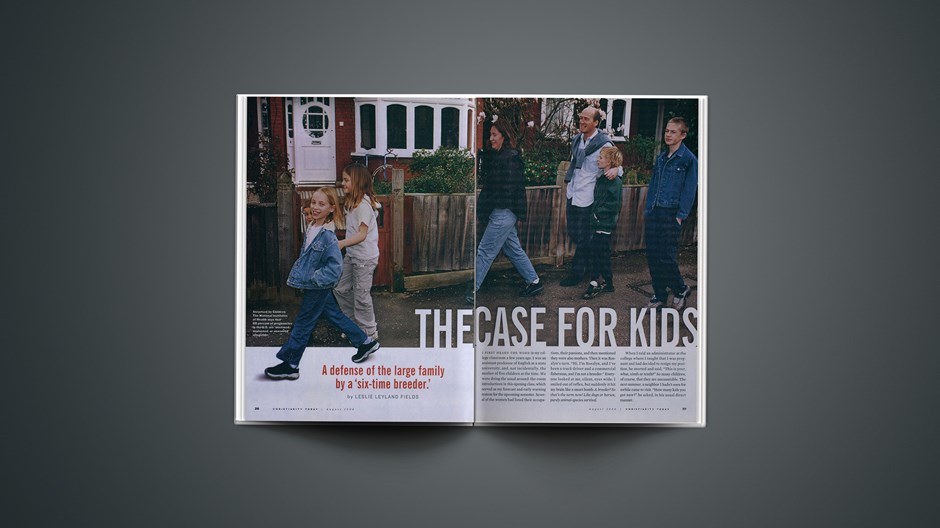
The reporters for these stories do not ask the burning question—the question most people are still too polite to ask, though I wonder how long until this boundary is breached and it's open season on every couple's reproductive life. The only time I recall being asked it was at an academic conference, by a lesbian poet, as we compared our lives over dinner. "Why do you have so many children?" she queried, her face honest and open. The question wasn't, "Why do you have children?" After all, having one or more children is overwhelmingly the norm for the majority of American women. The question was, "Why so many?" She caught me off-guard. My unpremeditated answer was something like, "When we sit around the table and hold hands to give thanks for our food, I like it that the table is big and the circle is wide."
Article continues below
For the Befuddled
Given the rise of the Childfree and One Child Only movements and my nearly weekly public encounters, I feel moved to post a reply—a moral, biblical, and political defense of the larger family, or at least some insights for those who are genuinely befuddled or even fearful. I can do this because I understand the concern and befuddlement. It took ten years of marriage before I ventured nervously into motherhood. Before that, high on education and world travel, I scanned the sidewalks and the public horizon searching for news and interest, visually bleeping over mothers with baby backpacks pushing strollers. Either I did not see mothers with children at all, or, if I did, I would count the children out of curiosity; as the numbers climbed, my estimation of the mothers usually sank. I had an impressive list of prejudices and stereotypes, many of which I now see on the Childfree websites.
In giving this defense of why people have children, or why they have 2 or 6 or 16, I don't want to go overboard. In Reclaiming the Body: Christians and the Faithful Use of Modern Medicine, authors Brian Volck and Joel Shuman confront the question in a chapter entitled, "What Are Children For?" After tracing the effect of an increasingly intrusive medical technology that reduces conception and the building of a family to a consumer choice, they warn, too, against a nearly opposite trend—the temptation to worship children and life as uniquely sacred. "Only God, who gives each of us life, is sacred. Christians must therefore respect life, but not worship it."
Volck and Shuman's warning against both ills—our culture's denigration of children and the Christian near-deification of children—is thoughtfully addressed in a forthcoming book, Conceiving Parenthood: The Protestant Spirit of Biotechnical Reproduction (Eerdmans, 2007). Author Amy Laura Hall, an ethicist and theology professor at Duke Divinity School, identifies a drift in Protestant thought culminating in the 1950s, from Christ as the locus of hope for the world to the properly planned, nuclear family as society's hope. "We mislaid a basic Protestant affirmation," she writes, "that is, the child on whom our hope ultimately depends has [already] been born."
Article continues below
The authors of Children Matter: Celebrating Their Place in the Church, Family, and Community (Eerdmans, 2005) call us back to a balanced, biblical view of children. Jesus pulled a child into the midst of his disciples to highlight God's radical inversion of man's values. A dependent, vulnerable, trusting child is who we must become to enter the kingdom of God. We need children among us today for the same reason, the authors write, "showing us how to trust our gracious God and encouraging us to live kingdom values by welcoming, respecting, and serving the least among us who are greatest in the eyes of God."
Social Capital or Divine Gift?
A recent study in Brazil suggests, by contrast, one reason we have traditionally valued children. There, as in many other countries, fertility rates have plummeted. Since 1975, Brazil's birth rate has dropped by nearly half, to 2.27 children per woman. This comes not as the result of a national family planning campaign—Brazil has never implemented such a program. Rather, the change in attitudes and family size has been correlated with the advent of television, and more specifically with the advent of telenovelas, Brazilian soap operas. Today, the size of a woman's family can be strongly predicted by the number of hours she spends watching telenovelas, writes Philip Longman in his May 31, 2004, article in the New Statesman entitled "Even in Africa, the World's Running out of Children."
These daytime shows, much like our own, portray a life of wealth and ease. "The men are dashing, lustful, power-hungry, and unattached," Longman writes. "The women are lithesome, manipulative, independent, and in control of their own bodies. The few who have young children delegate their care to nannies."
American and European media exports communicate the same message: People with wealth, education, and independence have few, if any, children. The good life is not defined by community or family but by individualism, the pursuit of "unfettered time," and the freedoms of self-fulfillment and self-actualization. All of which requires money. None of which translates into changing diapers, scrubbing food flung by a toddler off the kitchen floor, working an extra job to pay for your son's tuition, driving a used minivan, or sacrificing your own needs to help provide for others.
Article continues below
The correlation between numbers of children and the accumulation of wealth has been noted for decades. Many scholars and demographers assume a "wealth flows" model that explains large families and high fertility rates throughout much of human history as the result of the economic benefit children bring to their parents' lives. By this theory, children are seen as resources who garner wealth and provision for their aging parents. This cost-benefit analysis explains the American family's low fertility rate today, just barely clearing the replacement level and significantly below earlier levels. It no longer makes economic sense to have a large family.
In fact, it no longer makes economic sense to have a child at all. Books, articles, and internet calculators coolly estimate the financial liability of raising a child to adulthood and arrive at staggering figures, ranging from $700,000 to $1.5 million per child. By these calculations, Americans should stop having children altogether.
Yet even though our birth rate is historically low, the U.S. still has the highest birth rate of all industrialized countries. "In short, there is no explanation for why Americans still want children," say the authors of "Why Do Americans Want Children?" (Population Council). The authors of the study conclude that "while the economic value of children to their families has disappeared, their value as a social resource has persisted. Having children is an important way in which people create social capital for themselves." Social capital is described as establishing new relationships between family members.
Few parents are likely to describe their children as "social capital," the term again revealing a sense of investment and expenditure. The ancients did not describe their children so. The Psalmist proclaimed, "Happy is the man whose quiver is full [of children]," and "Children are a gift from the Lord." The early Egyptians valued children and considered them a blessing. They were called "the staff of old age," and families commonly had four to six children, even as many as six to ten. Hispanic culture has traditionally placed utmost value on children. Hispanic writer and poet Rebecca M. Cuevas De Caissie, who is also a mother of five, writes, "Children are not looked upon as a burden that needs thinking and sacrifice to have. They are looked upon as a blessing and as something to be sought after and cherished."
The question—What are children for?—may be best answered personally, as it is lived out in my own family, not anyone else's. I must begin with an essential piece of information: Most families are larger than intended. The National Institutes of Health says that 60 percent of pregnancies in the U.S. are "mistimed, unplanned, or unwanted altogether." It was not my plan to have six children—it was God's. Though the last pregnancies were difficult, life was the only possible choice. What else could I say but, like Mary, Yes, I am your servant.
Article continues below
What happens in larger families? Children are more tolerant. They learn that they are one part of a whole much larger than themselves and that the common good usually takes precedence over their particular desires. They also discover the principle of scarcity; they learn to conserve. Their clothes are on loan and passed on to others when they are done. They have to share their toys. They cannot take more food than they can eat, or someone else will not have enough. They can't take long, hot showers, or someone else gets a cold shower. They learn that their singular behavior affects multiple people. They are not the center of the universe.
Children with multiple siblings are also more accepting. They practice living with a variety of temperaments, quirks, and ages. Older children cannot stay safely within their own peer group. They learn to hold babies, sing lullabies, and change diapers. A teenager cannot retreat, morose, into his bedroom every afternoon to listen to his music—his 3-year-old brother will jump on his back and demand a gallop around the room. A 16-year-old girl will trudge through the door from school, worry on her face, to be greeted by a flying 18-month-old jumping into her arms.
Children from larger families have to work together. Every morning, the grump, the overachiever, the early riser, the dreamer, the snuggler, and the toddler must negotiate their separate concerns toward a single goal: to get out the door and to their respective schools on time. In summer, for a family with a commercial fishing operation like ours, the goal is to pick all of the fish from all of the fishing nets before the next meal. The children have to help each other. They have to work together in storms on the ocean.
Yes, they fight. Sometimes they do it all badly, and 1 Corinthians 13 love—which is patient, kind, and keeps no record of wrongs—is nowhere in sight. But there are other times when they lay down their lives for one another: a sister holding her injured brother's hand as he lies on the ground, waiting for a helicopter ambulance; the oldest brother risking himself to snatch his youngest brother from a fire.
Article continues below
Longing for Sacrifice
For all this, I am not a proselytizer for large families. I do not encourage couples to have more children than they want. I tell younger women the truth: If you aspire to be a mother, you aspire to a job without pay that is harder than any job you'll be paid for. It's a job with no time off, only time away. I tell them they should not have children to derive anything from them—not love or joy or fun or a legacy. It is possible that any or all of these may come, but there will be long stretches when little fulfillment is in sight.
So why do we have children at all? So much is against the whole enterprise. Children cost too much money. They cost too much of ourselves. Children undo us. They show us how much and how little we're made of. They come, it often seems, only to break our hearts. And we let them. We invite it all. We admit perfect strangers through our doors and decide before we even know who they are to love them wildly, without condition, for as long as we live.
How do we account for this behavior? In the end, it is possible that our desire for children is a longing not to benefit ourselves, but to sacrifice ourselves; not to replicate ourselves, but to escape ourselves. For me, this longing hit at 28, while I was tunneling into the heart of the Congo on the back of an expedition truck. Suddenly, I was unutterably weary with my own small life and my endless requirements for fulfillment. I wanted the freedom to give my life away. I wanted an intimate, lifelong, indissoluble relationship with others, the kind of life that simultaneously sucks you dry and sustains you. I guessed that it would take nothing less than an infant to pry open my death-grip on self-determination. I did not know when we started our family a few years later that each birth would deliver into my arms an immeasurable weight of vulnerability and terror, but I guessed that parenting would bring a profligate, extravagant, others-centered life. As it has. But there has been a kind of death involved, make no mistake. "Unless a kernel of wheat falls to the ground and dies, it remains only a single seed," Jesus taught. "But if it dies, it produces many seeds." My ambitious dying life is far from over.
But fewer couples worldwide choose this kind of life. What do we miss without children? What does the world miss with fewer children? Alarm bells are already beginning to ring from demographers, and, in keeping with tradition, their concern is primarily economic. They warn that although declining fertility rates bring a "demographic dividend," that dividend eventually has to be repaid. At first there are fewer children to feed, clothe, and educate, leaving more for adults to enjoy. But soon enough there are fewer productive workers as well, while there are also more and more dependent elderly, each of whom consumes far more resources than a child does. Even after considering the cost of education, a typical child in the U.S. consumes 28 percent less than the typical working-age adult, while elders consumer 27 percent more, mostly in health-related expenses.
Article continues below
How do we order and feed such a top-heavy, resource-consuming society of elders—a demographic of which most who read this article are a part? Who will produce the goods needed to keep the nation's engines and industries running? When our self-reliance wears out, when our self-authenticated minds and our spiritually unfettered and independent souls grow dim with age, who will feed and sustain us? Who will wheel us into surgery, deliver our packages, grow our food, research and formulate the medications that enable us to live longer and better? In an overburdened medical system, who will decide whether or not our lives still have value when our medical costs outweigh our economic worth? In all of this, we will depend on the actions and judgments of other peoples' children.
Perhaps we will need to hope that some of those in charge, some of those upon whom we will be dependent, will have been raised in large families. We will need to hope that these providers, care-givers, and government leaders can resist our culture's obsession with self and remember their family's lessons of tolerance and sympathy extended to all, especially those less able than themselves—knowing that, above all, the universe is not theirs alone.
Leslie Leyland Fields is a writer living with her family on Alaska's Kodiak Island.

















 While we pray for peace, we need moral clarity about this war.
 We’ve got little information on Jesus’ appearance and personality. But that’s the way God designed it.españolFrançais
 We must always be people of the Word, but we’ll have to reimagine deep engagement with Scripture.






