The year 2006 marks the 50th anniversary of Christianity Today. To help us reflect on the role of evangelicalism in the next 50 years, we have undertaken The Christian Vision Project. The project, directed by Andy Crouch, invites leading thinkers to reflect on the shape of Christian faithfulness in the 21st century. The three-year project focuses on culture in year one (underwritten by the Pew Charitable Trusts), mission in year two, and the gospel in year three. For year one, we've asked our writers to answer this question: "How can followers of Christ be a counterculture for the common good?" We've borrowed that piquant phrase from the Rev. Tim Keller of Redeemer Presbyterian Church in Manhattan, whose own response will appear later this year.
We begin with an essay by Michael S. Horton, professor of apologetics and theology at Westminster Seminary California and one of the leading voices in the contemporary revitalization of the Reformed tradition in America. He is editor of Modern Reformation magazine, host of a nationally syndicated radio broadcast, and author of a number of books, including the forthcoming Too Good to Be True (Zondervan) and God of Promise (Baker).
It was confusing to grow up singing both "This World Is Not My Home" and "This Is My Father's World." Those hymns embody two common and seemingly contradictory Christian responses to culture. One sees this world as a wasteland of godlessness, with which the Christian should have as little as possible to do. The other regards cultural transformation as virtually identical to "kingdom activity."
Certainly the answer does not lie in any intrinsic opposition of heaven and earth. After all, Jesus taught us to pray, "Your kingdom come, your will be done on earth as it is in heaven." Rather, the answer is to be sought in understanding the particular moment in redemptive history where God has placed us. We are not yet in the Promised Land, where the kingdom of God may be directly identified with earthly kingdoms and cultural pursuits. Yet we are no longer in Egypt. We are pilgrims in between, on the way.
In Babylon, God commanded the exiles to "build houses and settle down," pursuing the good of their conquering neighbors (Jer. 29). At the same time, he prophesied a new city, an everlasting empire, as the true homeland that would surpass anything Israel had experienced in Canaan.
So both of my childhood hymns tell the truth in their own way: We are pilgrims and strangers in this age, but we "pass through" to the age to come (not some ethereal state of spiritual bliss), which, even now in this present evil age, is dawning.
The challenge is to know what time it is: what the kingdom is, how it comes, and where we should find it right now.
Is Christianity a Culture?
In the Old Covenant, the kingdom of God was identified with the nation of Israel, anticipating the Last Day by executing on a small scale the judgment and blessings that will come one day to the whole world. Yet Jesus introduced a different polity with the New Covenant. Instead of calling on God's people to drive out the Canaanites in holy war, Jesus pointed out that God blesses both believers and unbelievers. He expects his people to love and serve rather than judge and condemn their neighbors, even their enemies (Matt. 5:43-48; see also Matt. 7:1-6). The wheat and the weeds are to be allowed to grow together, separated only at the final harvest (Matt. 13:24-30). The kingdom at present is hidden under suffering and the Cross, conquering through Word and sacrament, yet one day it will be consummated as a kingdom of glory and power. First the Cross, weakness, and suffering; then glory, power, and the announcement that the kingdoms of this world have been made the kingdom of Christ (Rev. 11:15; see also Heb. 2:5-18).
So what is the relationship of Christians to culture in this time between the times? Is Jesus Christ Lord over secular powers and principalities? At least in Reformed theology, the answer is yes, though he is Lord in different ways over the world and the church. God presently rules the world through providence and common grace, while he rules the church through Word, sacrament, and covenantal nurture.
This means that there is no difference between Christians and non-Christians with respect to their vocations. "We urge you, brothers, to [love one another] more and more," Paul writes. "Make it your ambition to lead a quiet life, to mind your own business, and to work with your hands, just as we told you, so that your daily life may win the respect of outsiders and so that you will not be dependent on anybody" (1 Thess. 4:10-12). There are no calls in the New Testament either to withdraw into a private ghetto or to "take back" the realms of cultural and political activity. Rather, we find exhortations, like Paul's, to the inauspicious yet crucial task of loving and serving our neighbors with excellence. Until Christ returns, believers will share with unbelievers in pain and pleasure, poverty and wealth, hurricanes and holidays. A believer, however, will not be anxious about the future and will not "grieve like the rest of men, who have no hope," as Paul adds (1 Thess. 4:13), but will be energized in the most mundane daily pursuits by the knowledge that God will raise the dead and set everything right (1 Thess. 4:14-18). We groan inwardly for that final redemption with the whole of creation, precisely because we already have within us the Spirit as a down payment and guarantee (Rom. 8:18-25).
Article continues below
The earthly citizenship to which Jesus, Paul, and Peter referred is therefore a common sphere for believers and unbelievers. The second-century Epistle to Diognetus offers a self-portrait of the early Christian community:
For Christians are distinguished from the rest of men neither by country nor by language nor by customs. For nowhere do they dwell in cities of their own; they do not use any strange form of speech. … But while they dwell in both Greek and barbarian cities, each as his lot was cast, and follow the customs of the land in dress and food and other matters of living, they show forth the remarkable and admittedly strange order of their own citizenship. They live in fatherlands of their own, but as aliens. They share all things as citizens and suffer all things as strangers. Every foreign land is their fatherland, and every fatherland a foreign land. … They pass their days on earth, but they have their citizenship in heaven.
So Christians are not called to make holy apparel, speak an odd dialect of spiritual jargon, or transform their workplace, neighborhood, or nation into the kingdom of Christ. Rather, they are called to belong to a holy commonwealth that is distinct from the regimes of this age (Phil. 3:20-21) and to contribute as citizens and neighbors in temporal affairs. "For here we do not have an enduring city, but we are looking for the city that is to come" (Heb. 13:14). The church, therefore, as the communion of saints gathered by God for preaching, teaching, sacrament, prayer, and fellowship (Acts 2:46-47), is distinct from the broader cultural activities to which Christians are called in love and service to their neighbors. In our day, this pattern is often reversed, creating a pseudo-Christian subculture that fails to take either calling seriously. Instead of being in the world but not of it, we easily become of the world but not in it.
But the church is not really a culture. The kingdom of God is never something that we bring into being, but something that we are receiving. Cultural advances occur by concentrated and collective effort, while the kingdom of God comes to us through baptism, preaching, teaching, Eucharist, prayer, and fellowship. "Therefore, since we are receiving a kingdom that cannot be shaken, let us be thankful, and so worship God acceptably with reverence and awe, for our 'God is a consuming fire' " (Heb. 12:28-29). There is nothing more important for the church than to receive and proclaim the kingdom in joyful assembly, raising children in the covenant of grace. They are heirs with us of that future place for those "who have tasted the heavenly gift, who have shared in the Holy Spirit, who have tasted the goodness of the Word of God and the powers of the coming age"—a holy land "which drinks in the rain often falling on it" and is "farmed" so that it reaps its Sabbath blessing (Heb. 6:4-8).
Article continues below
A Counterculture?
If the church is not to be identified with culture, is it necessarily a counterculture? If Christians as well as non-Christians participate in the common curse and common grace of this age in secular affairs, then there is no "Christian politics" or "Christian art" or "Christian literature," any more than there is "Christian plumbing." The church has no authority to bind Christian (much less non-Christian) consciences beyond Scripture. When it does, the church as "counterculture" is really just another subculture, an auxiliary of one faction of the current culture wars, distracted from its proper ministry of witnessing to Christ and the new society that he is forming around himself (Gal. 3:26-29). This new society neither ignores nor is consumed by the cultural conflicts of the day.
Recently, an older pastor told me that during the Vietnam era, two of his parishioners, one a war protestor and the other a veteran, were embroiled in a debate in the parking lot, but then joined each other at the Communion rail with their arms around each other. Here was a witness to the Sabbath rest that awaits us, realizing that we still have, for the time being, vineyards to plant and wars to be for or against as citizens.
Too often, of course, the contemporary church simply mirrors the culture. Increasingly, we are less a holy city drawn together around Christ and more a part of the suburban sprawl that celebrates individual autonomy, choice, entertainment, and pragmatic efficiency. These are values that can build highways and commerce, but they cannot sustain significant bonds across cultural divides and between generations. Capitulating to niche demographics and marketing, churches that once nurtured the young, middle-aged, and elderly together, with all of the indispensable gifts that each one brings to the body of Christ, often now contribute to the rending of this intergenerational fabric. If this is a worrisome trend in the social sphere, it is all the more troubling for a body that is constituted by its Lord as a covenantal community.
Article continues below
To be truly countercultural, the church must first receive and then witness to Peter's claim in Acts 2:39: "The promise is for you and your children and for all who are far off—for all whom the Lord our God will call." The promise is not only for us, but also for our children. According to recent studies by sociologists like Christian Smith, evangelical teens are only slightly less likely than their unchurched friends to adopt a working creed of "moralistic, therapeutic deism." As the diet in our churches is increasingly determined by the spirit of the age, and as youth are treated as borderline cases to be cajoled into thinking God is cool, the church risks abandoning that promise. The "pumped-up" teens in our youth groups today are often tomorrow's skeptics and burnouts. They don't need more hip Christian slogans, T-shirts, and other subcultural distractions, but the means of grace for maturing into co-heirs with Christ.
Recently, cnn reporter Anderson Cooper was asked, "Do you think part of your job is to appeal to younger viewers?" "I've never been in a meeting where people said to bring in younger people," he replied. "I think the notion of telling stories differently to appeal to younger people is a mistake. Young people want the same kind of thing older viewers do: interesting, well-told, compelling stories. If you're somehow altering what you're doing because you want to get young viewers, that's a little bit like when your parents go out to buy 'cool' clothes for you." In our culture, relevance is determined—in fact, created—by publicity. But the Word creates its own publicity as it is preached, as the story is told. It creates its own relevance, and as a result, a community that spans the generations.
The promise is not only for us and for our children, Peter says, but "for all who are far off—for all whom the Lord our God will call" (Acts 2:39). And how does he call them? Through the preaching of the gospel. Peter's promise, in fact, is part of such a sermon, proclaiming Christ as the center of Scripture. Refusing to set a covenantal church ("you and your children") against a missional church ("all who are far off"), the apostolic community stuck to its calling and became both an outpost and lightning rod for God's saving activity in the world.
Article continues below
If ours is to truly be a countercultural community, it must begin with the rejection of any notion of self-founding, either in creation or redemption. It is God's choice, not ours; God's "planned community," not ours; God's means of grace, not our ambitious programs, plans, or achievements that extend the kingdom. Being "countercultural" today often amounts to superficial moralism about sex and suvs, or perhaps creating wholesome novels with Christian heroes, removing offensive language from music lyrics, and encouraging positive values. Beyond that, many of the churches with which I am familiar are captivated by the same obsessions as our culture: religion as individual spirituality, therapy, and sentimentalism. It all serves to keep us turned in on ourselves, like a kid at a carnival instead of a pilgrim en route.
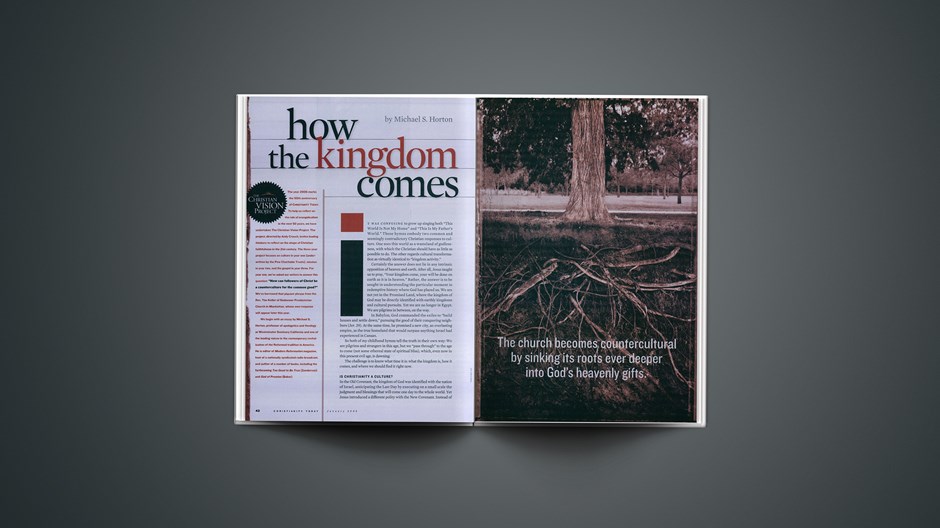
Describing the rapid decline of rural areas that are surrendering to strip malls and homogeneous multinational corporations, Wendell Berry argues, "We must learn to grow like a tree, not like a fire." Berry notes that we are losing our ability to take any place seriously, since this demands patience, love, study, and hard work—in other words, roots. Some use the word "seekers" to describe those we are trying to reach in this culture. But the truth is that they and we are more like tourists than seekers, let alone pilgrims, flying from place to place to consume experiences.
Can churches be a counterculture amidst anonymous neighborhoods and tourist destinations, the apotheoses of individual choice, niche demographics, and marketing? Yes. The church can exist amidst suburban sprawl as easily as in cities or small towns, precisely because its existence is determined by the realities of the age to come—by God's work, rather than by the narrow possibilities of our work in this present age under sin and death. After all, this is our Father's world, even though, for the moment, we are just passing through.
Inside CT Better Than a Cigar | Introducing the Christian Vision Project on CT's 50th birthday.
Christianity Today sister publication Books & Culture's first article in the Christian Vision Project is Lauren F. Winner's "Sleep Therapy."
Article continues below
Turning the Mainline Around | New sociological studies show that evangelicals may well succeed at renewing wayward Protestantism. (July 25, 2003)
Patrons of the Evangelical Mind | Why has evangelical scholarship soared in the last few decades? Native intellectual talent is one reason, to be sure. But an infusion of cash didn't hurt. (July 7, 2002)
We're in the Money! | How did evangelicals get so wealthy, and what has it done to us? (June 9, 2000)
If Grace Is Irresistible, Why Evangelize? | How can I invite "all" sinners to Christ when the Reformed concept of "irresistible grace" implies that for some to be elect some must be nonelect? (September 6, 1999)
Why Calvin Was a Calvinist | Rediscovering the Geneva Reformer in his long-lost catechism. (June 15, 1998)
The Dissatisfaction of Francis Schaeffer | Thirteen years after his death, Schaeffer's vision and frustrations continue to haunt evangelicalism. (March 3, 1997)

















 While we pray for peace, we need moral clarity about this war.
 As my doubts about his teachings grew, so did a secret fascination with Jesus.
 After lobbying from fellow Southern Baptists and Christians affected by the war, the House speaker moves a package forward.






