Joseph Lusi, a Glasgow-trained, Congolese orthopedic surgeon who's built like George Foreman and as articulate as Muhammad Ali, habitually starts his day with prayer. But the morning of October 30, 1996, was different. He was dodging bullets and sheltering from incoming mortar shells.
At dawn, rebels had launched a stealth attack on Goma in eastern Democratic Republic of Congo (DRC) near Rwanda. The fighters had filtered through the border overnight. By daybreak, they were drilling the town with machine gun fire and pounding it with explosives.
Lusi was then director of a Baptist mission hospital, which was located near a military base. The hospital was engulfed in fierce fighting. Staff and able-bodied patients scampered. So did Lusi. A bathroom looked safe. He locked himself in.
The bbc knows no manners. A British journalist called Lusi's satellite phone. The surgeon became a live radio broadcaster, narrating what he saw and heard to a worldwide audience. While on he was on the air, a bomb exploded in the hospital compound.
"I will go and see," Lusi said.
Silence.
In London, Lusi's sister-in-law was tuned in when he went incommunicado. Alarmed by the steady silence, she called Lusi's wife, Gwendolyn, then in Nairobi.
Gwendolyn immediately hit the road. In three days, she found herself stuck at the DRC border. Locals slipped into war-ravaged Goma to scout for her husband.
An indelible image is stamped on her mind: She saw Lusi in a blood-bathed white doctor's gown walking across the border toward her. He had been fixing limbs all weekend—possibly the only surgeon on duty in the city.
How had he survived? When the fighting got ferocious, he and a remnant staff of five hid in the ceiling. The slender ones, who could slide into the roof, had planned to pull Lusi up. But he was too heavy. So the staff jumped down, placed a stool on top of a table, and pushed him through. Gwendolyn chuckles when telling the story.
"Christians should not run from trouble," says Lusi, now director of HEAL Africa, an indigenous ministry that operates a 156-bed hospital, trains medical professionals, and offers HIV-prevention services and holistic AIDS care.
"We should be where God wants us to be."
Grim history
Unless God says otherwise, this former Belgian colony in central Africa, the combined size of Alaska and Texas, is not the place to be.
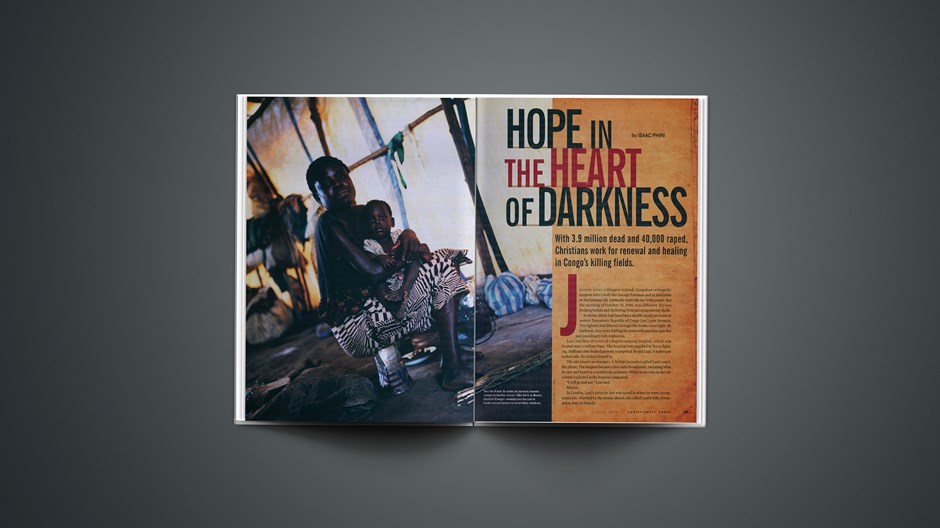
The statistics are depressing. The country's 62 million people live with an infant mortality rate that is ten times higher than that of the U.S. Nearly 50 percent of the population is under age 16, and few will celebrate a 50th birthday. Ten years of war exacerbates the brevity of life. More than 3.9 million have died since 1996, when perpetual fighting first broke out. The conflict has drawn in 16 military and rebel forces from seven nations in central Africa. The largest UN peacekeeping force in the world (19,800 "blue helmets") is stationed in DRC. Fighting persists despite the 2003 peace accords and withdrawal of foreign troops.
"We live in fear," confesses Bayoba Biguge, a church leader in Bukavu, an eastern border city of 1 million. Rebel groups fight each other and the government over territory and the mining of diamonds, gold, and coltan (vital for manufacturing electronics). Illegal trade makes the conflict highly profitable. Coltan has sold for as much as $400 per kilogram.
DRC's missions history is equally grim. The nation is the graveyard for hundreds of Western missionaries. In 1964, American Paul Carlson, a medical missionary with the Evangelical Covenant Church, was shot and killed while trying to escape rebel killings. He stopped to help another missionary climb over a wall when machine gun fire ended his life.
Carlson's sacrifice and that of others is enduring in Congolese minds. "We killed them," laments Lusi, "but they kept on coming." Missionary persistence has been rewarded. Today, 72 percent of the population confesses historic Christian faith: 50 percent Catholic and 22 percent a blend of mainline Protestantism and evangelical Pentecostalism. Another 20 percent mix indigenous beliefs with Christianity.
DRC's political history has been violent for decades. Patrice Lumumba, the country's first post-colonial leader, was killed in 1961. Mobutu Sese Seko seized power in 1965 and ruled with an iron fist until 1997. Laurent Kabila then assumed power, but soon found himself battling former allies in a Rwanda- and Uganda-backed insurrection. Angola, Chad, Namibia, Sudan, and Zimbabwe sent in troops and saved Kabila's government. But in January 2001, a personal guard assassinated Kabila. His son, Joseph, took over, negotiated peace, and has promised national elections this year.
Despite relative international peace, DRC is still a killing field. About 1,200 people die daily from conflict-related causes. Civilians are at greater risk of violent death than soldiers.
"Our soldiers are bandits," says Louis Tshishibanci, a Bukavu churchgoer. Rival militias are as bad or worse. They rape, kill, steal, and destroy.
Article continues below
Paradise Lost
Pierre Machiels is the World Vision (WV) program director in Goma. The American-born Belgian, who is married to an Indian, sports Hawaiian shirts and faded blue jeans. He was recruited from Hawaii and assigned to famine- and drought-stricken Chad and Niger before moving to DRC. He loves the people ("They are very warm"), the rich soil ("There has never been a famine here"), and the luxuriant jungle ("This is paradise").
But he also knows it is a paradise lost. There is hunger ("This country is filthy rich, but people are starving"), disease ("Many are preventable and curable"), and violence ("Women are raped, children abandoned, pygmies annihilated").
For the most part, the world remains unaware of this. Much suffering takes place deep in Congo's interior—"the heart of darkness," as Joseph Conrad called it in his 1902 novella.
"Ordinary people suffer," says Machiels. It's most evident in remote areas. "Go to Nyabiondo." And we go.
Going to Nyabiondo—65 miles from Goma into militia-controlled territories—requires quite a checklist. First check with UN forces. Is there any fighting in the area?
If hostilities are reported, don't go. If it's okay, then check your vehicle's fitness and fill up on gas. "It is dangerous out there," warns a war-worn Congolese general.
The hazards are many. The single rugged lane meanders into forlorn hills and edges around blind spots. The Land Cruiser bumps, jumps, jerks, and grunts. On a muddy stretch, it sways and slides.
The official Congolese army controls the road up to the outskirts. Once outside Goma, warring factions control different stretches. Barriers indicate territories. A man in military fatigues materializes from a hideout, surveys the vehicle with blood-shot, sleep-deprived eyes, and waves it through. Government troops dare not come here. Only UN peacekeepers can.
The trip to Nyabiondo has mournful moments. "About 240 children were killed in that school," says a guide. The pitiful-looking structure is haunting. Everyone stares in silence and anguish.
The Masisi territory is the last major stop before Nyabiondo. First, a courtesy call on the government-appointed chief administrator, Justin Mukanya Kasombo. His office is spacious but scantly furnished. Folders are spread over the table; most cases involve land. Returning refugees find their land occupied, and disputes occur. He resolves some. Others go to Goma.
"Masisi is one area where the war left serious consequences," says Kasombo. Thousands were killed; factories were destroyed and farms looted. There used to be 1 million cattle in the area. Today, there are 120. "People are living in misery." Malnutrition kills children. Crime is rampant. "Someone was raped last night." Dignity is lost. "You will find people with no clothes."
Article continues below
What is the role of the churches? "To rescue this population," he says. Churches must not get weary of "spreading the message of peace." What of personal faith? "I have been a Christian all my life," he says. Affiliation? "Pentecostal." Heads bow. The meeting ends in prayer.
Outside, a teenager with a rusty AK-47 on his shoulder roams the streets. We wonder: How many people has he killed? No one knows. No one dares ask.
Nyabiondo is 15 miles further north. Mayi-Mayi, a government-friendly militia, controls this stretch. Their hideouts are perched in strategic places in the hills. Locals spot them. Visitors have to look hard.
The same is true of downtown Nyabiondo.
"Where is it?"
Response: "This is it."
A brick-and-zinc building doubles as the local leaders' offices and a World Vision warehouse. Uphill, a lonely and aged church building—the sole survivor of the mayhem—maintains a defiant stance. Next to it is a three-room patchwork of wood and zinc. "That is the school."
Even here, the local chief has to be seen first. Benjamin Dunia is his name. He is optimistic. "Things have improved," he says. But having fled his home seven times, his confidence is guarded. "I cannot predict tomorrow."
Ministry in the Backwaters
Word spreads quickly in Nyabiondo. Local pastors hear that Christianity Today is talking to indigenous church leaders. Nineteen show up.
An impromptu group interview takes place in a classroom. The pastors file in with their weather-beaten, threadbare clothing and string-strapped footwear. Churches are tiny, they report. The biggest congregation meets in the only church building left standing and draws 100 people. It used to have 800 members. Other churches used to have an average of 500 people. Now they are content with 50 or less.
Why this drop in numbers? Many people are dead, they say. Others hide out in the vast surrounding rain forests. Some have lost faith.
"It hurts," says pastor Epafra Muhindu. "They tell us their problems. There is nothing we can do. We are suffering just like they are."
Lack of facilities is another concern. Except for the one building near the school, all other churches have been bombed or burned to the ground. Church services are held in haphazardly built grass-roofed huts. When it rains, people are drenched. So many choose not to go to church.
Article continues below
Music is another lack that is sorely felt. "Congolese love music," explains pastor Levi Nyamanda. "But all our music instruments were looted."
The most basic supplies are lacking. Not one of the 19 pastors in attendance has a complete Bible. Ten have tattered portions. They borrow Scriptures from each other or from church members.
And financial support? The question triggers a chuckle. Due to deep poverty, local giving peaks at US$10 per month. So how do they survive? More laughter.
"Faith," asserts one pastor. Others nod.
Faith is also what keeps these ministers here. On September 8, 1998, pastor Kitsa Lukoo was walking home at 7 p.m. with a few dozen companions. Suddenly, they were surrounded by armed militia, and gunfire erupted. A dead body fell on Lukoo, forcing him to the ground. Blood from the corpse splashed on him. He feigned death until the killers were gone. The next morning, 68 bodies were found. "I was the only survivor," Lukoo says.
Listening to this story, a World Vision staffer bursts into tears, crying out, "Jesus—this is too hard for me." A long silence follows. "Come, let us pray," pastor Nyamanda finally says.
Nyamanda reminds his fellow pastors of God's goodness even in the darkest hour. Remember December 19, 2004. Nyabiondo was surrounded. "They wanted to kill everybody." Then God intervened. A strong fog covered the whole area, allowing residents to escape safely into the hills.
That was not all. People did not starve. "We ate roots, fruits, even caterpillars, and became healthy." There was no outbreak of disease, no snakebites, and no attacks from wild animals. "God took care of his people."
Nguba Muhubya, 74, possibly the oldest minister in Nyabiondo, testifies to God's divine protection. "In my lifetime, I have experienced many wars," he says. "My cattle have been taken away. My house has been ransacked. My family members have been killed. But God has spared my life." Eyes are moist and an amen is whispered.
"Prayer is the only weapon we have," says pastor Innocent Malemu.
Some leaders believe that DRC's woes result from a rejection of the Christian faith and practice that early missionaries brought. Under Mobutu, DRC political leaders descended to the diabolical. "Our leaders went into occultism, witchcraft, and immoral degradation," explains Bernard Kambale, pastor of a thousand-member church in Goma. This, he believes, unleashed evil over their nation.
Article continues below
Dick Robinson of Elmbrook Church in Milwaukee, Wisconsin, who travels frequently to eastern DRC, observes, "Anyone who attempts to minister in Congo must be prepared to engage in the battle against the principalities and powers. Evil has been unleashed in this beautiful and bountiful region of Africa."
Isaac Mwanaume Mufambali, a respected pastor in Goma, has for years been calling upon Congolese to return to their knees in prayer. He leads Ministèere d'Intercession Pour le Réveil National (MIRENA), which organizes prayer rallies across eastern Congo.
"We mobilize the people to pray for the country," says Desire Kajabika, a Goma pastor involved in MIRENA. The need for prayer is acknowledged from pulpits and in the pews. "We are on our knees praying to God for the remedy," says Tshishibanci, the worshiper in Bukavu.
Prayer is often combined with peacemaking. In March, a Goma church geared up to host 250 pastors from around the country. The April conference was to promote church unity, encourage prayer for the nation, and equip pastors to promote peaceful elections. The Catholic churches are also canvassing for peace. The top Catholic priest in Masisi told CT they were striving to instill civic education among the 30,000 parishioners in the area.
Showing Jesus
Bringing people back to God is one side of the story. There is also a need to bring God to the people—to be bearers of the Good News to a population drowning in violence.
As one Nyabiondo pastor puts it, "People are tired of listening to empty words."
"We have to show Jesus," says Lusi. By we, the native of Goma means the Congolese people. Gone are the days of waiting for missionaries to come and "save" his people. "We are in a post-missionary era," he says. "The kingdom of God should no longer be 'sent' from America or Europe. We are all part of the kingdom."
Making the kingdom manifest is Lusi's life commitment. Aside from study leaves in Scotland and Belgium, he has been serving in this region all his life, following the footsteps of his father, who was also a surgeon. He served in long stints with mission hospitals in DRC and international medical organizations in surrounding countries. On the fateful morning of October 30, 1996, Lusi was director of the Baptist hospital in Goma. After sanity returned to Goma, Lusi and Gwendolyn (locals call her Mama Lusi) launched an indigenous medical ministry to address the outer and inner wounds of war.
HEAL Africa—an acronym for Health, Education, Community Action, and Leadership Development—was started in 1999 as part of Doctors on Call to Service (DOCS). It began in a building that was a former interrogation and torture base for Mobutu's secret police. "We went from cell to cell dedicating the facility to God," says Gwendolyn.
Article continues below
Despite a 2002 volcano that wrecked the property, the organization continues today. In a country where nothing works, HEAL Africa stands out. A residency program takes young doctors, recommended by churches, and gives them clinical experience. There are currently 13 doctors in the program. It also works with the University of Goma, which, in partnership with universities in South Africa and Belgium, offers graduate degrees in family medicine.
HEAL Africa also has an extensive outreach program to victims of rape. Specialists go to rural clinics to train local doctors in how to care for rape victims. A nurse delivers medicines and post-rape kits. Serious cases come back to Goma.
HIV prevention and counseling is another part of their work. In 2004, 80,000 people attended prevention and education classes. In 2005, HEAL Africa began encouraging youth clubs "to make a decision of abstinence." It also supports initiatives to care for foster families, prevent mother-to-child transmissions, and offer antiretroviral therapy. World Food Program helps HEAL Africa provide monthly food rations to 2,000 people infected or affected by HIV.
But Lusi has a surprise for people coming to the hospital. "We do not heal anybody here." What does he mean? "Jesus is the healer. We are just instruments." Each patient receives prayer every Monday morning.
HEAL Africa is an example of what Henri Haber, director of mission advancement for Medical Ambassadors International, calls holistic ministry. "You have to reach out to the whole person—physically, mentally, spiritually, and socially—to make lasting change." (See "Gospel Work in Time of War," p. 28.)
HEAL is but one ministry working heroically to bring God's love and peace to Congo. David Kasali and wife, Kaswera—both with Ph.D.s from Trinity University, Deerfield, Illinois—have launched the Congo Initiative.
Kasali headed the tranquil Nairobi Evangelical Graduate School of Theology for eight years while civil conflict ravaged his country. "It was like the church worldwide forgot about Congo," he says. For the Kasalis, the crisis hit home when two siblings died in the conflict.
"Why should other people die for us?" they asked themselves. It was time go home to Congo and help find a solution. "We belong there, and there is no reason why we should not be there," explains Kasali. "Why should we have a better life than our people?"
Article continues below
The Congo Initiative, centered in Beni, north of Goma, aims to "empower indigenous Christian leaders to transform their communities and their nation." The Kasalis envision several areas of ministry. They want to train church leaders. "They are overwhelmed and are crying for help," says David. They also want to start a Christian university to produce people "who will serve God in society." In addition, they want to encourage creative works in the form of music, theater, print, and electronic communications. "We want to worship as Congolese," he says.
Money and Relationships
How can American evangelicals support ministries such as the Congo Initiative or HEAL Africa?
"It is not about money," says Kasali, who spoke with CT from Milwaukee. Finances are needed, to be sure. HEAL Africa has international financial partners, and the Congo Initiative is nurturing even more partnerships. But, says Kasali, "We need relationships that are not limited to material things."
A growing number of American Christian leaders understand that the solution must come through Congolese hands. "The best we can do is come alongside the indigenous churches," says Robinson. "They need to figure out how to believe in themselves, take charge of their destiny, and not let the rest of the world take advantage of them."
Robinson's Elmbrook church supports the Congo Initiative, but Robinson knows it's an uphill battle. Responding to an invitation from Congolese churches, Robinson facilitated a week of training for pastors, stressing self-reliance and the need to be weaned from missionary dependence. At the end, an older pastor said, "We appreciate what you have said, but we are still waiting for the missionaries to return."
This is not what Robinson wanted to hear. "It negated all we tried to communicate."
He does not blame the pastor. "It is not entirely their fault. Missions can be very paternalistic," he says. "We taught them that we have the answers." This teaching breeds the "worst kind of poverty of the spirit, which waits for somebody else to come and provide the answers."
Haber agrees. People must address the roots of their problems and come up with solutions. "It is not about bringing material goods from the United States," he says. "It is teaching people to do it themselves."
Article continues below
Dan Fountain of the Global Health Training Program at King College, Bristol, Tennessee, says this empowerment must be grounded in God's Word. "As people begin to study God's Word, honesty increases, hard work increases." God takes priority. Desperate, homeless refugees in North Kivu demanded a church be built first. We need a house for God before we get houses for ourselves, they said.
The morning CT visited Lusi, he was neither dodging bullets nor escaping mortar shells. He was walking ward-to-ward, patient-to-patient, with unbelievable vigor. "We can only do this with the help of the Holy Spirit," he says.
Isaac Phiri is a journalist based in Zambia. Additional reporting by Grace Mugabe in Bukavu, DRC, and by CT senior news writer Deann Alford. For more information, visit www.congoinitiative.org; www.healafrica.org; www.monuc.org; and www.worldvision.org.















 While we pray for peace, we need moral clarity about this war.
 As my doubts about his teachings grew, so did a secret fascination with Jesus.
 After lobbying from fellow Southern Baptists and Christians affected by the war, the House speaker moves a package forward.






